
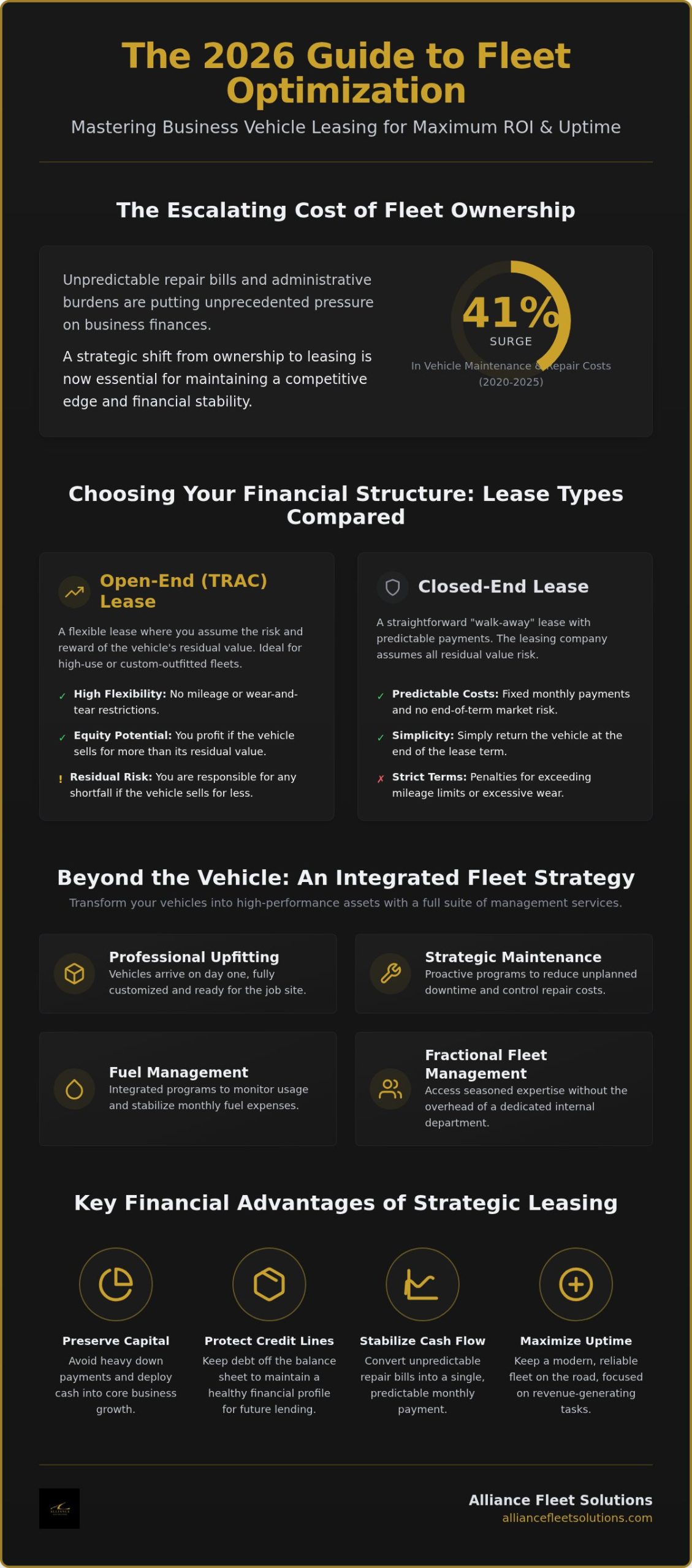
With vehicle maintenance and repair costs having surged by 41% between 2020 and 2025, your bottom line is likely feeling the pressure of an increasingly volatile market. You aren’t alone if unpredictable repair bills and the administrative weight of managing vehicle lifecycles are distracting you from your core business goals. Finding the right business vehicle leasing solutions isn’t just about securing a monthly payment; it’s about building a dependable financial foundation that keeps your drivers on the road. You need a fleet that’s work-ready from day one without the typical operational headaches that drain your time and resources.
This 2026 fleet optimization guide will help you master the financial and operational complexities of commercial leasing to reduce your total cost of ownership and maximize uptime. We’ll explore how strategic structures like open-end TRAC leases and professional upfitting can transform your vehicles into high-performance assets. By focusing on a collaborative partnership model, you’ll learn how to stabilize cash flow, maximize resale value at end-of-life, and ensure every truck is custom-configured for your specific industry tasks. It’s time to move beyond transactional leasing and embrace a strategy that prioritizes long-term reliability, safety, and financial performance.
Key Takeaways
- Compare Open-End and Closed-End leasing to select the financial structure that aligns with your risk tolerance and operational needs.
- Explore how professional upfitting transforms standard vehicles into specialized assets that are ready for the job site immediately upon delivery.
- Master the use of business vehicle leasing solutions to preserve your company’s credit lines while maintaining a modern, reliable fleet.
- Reduce operational friction by integrating maintenance and fuel management programs that stabilize monthly expenses and prevent unplanned downtime.
- Evaluate the fractional fleet management model to provide your growing business with seasoned expertise without the overhead of a dedicated internal department.
Navigating Business Vehicle Leasing Solutions in 2026
The landscape for commercial transportation has shifted away from the traditional ownership model. Historically, business owners viewed vehicle titles as essential assets on the balance sheet. Today, smart managers prioritize strategic access over asset title. This evolution allows companies to deploy capital into core growth rather than sinking it into depreciating iron. Modern business vehicle leasing solutions focus on providing specialized, data-driven assets that arrive ready for the job site. You aren’t just getting a truck; you’re securing a tool that is integrated with your operational goals. This shift reflects a broader trend toward maximizing utility while minimizing the risks associated with rapid technological obsolescence and fluctuating market values.
The transition from “standard” stock vehicles to specialized fleet assets is a hallmark of the 2026 market. Fleet managers no longer settle for base models that require months of aftermarket work. Instead, they demand vehicles pre-configured with the specific telematics and hardware needed for their industry. The goal is to achieve a perfect balance between financial predictability and operational agility. You need a fleet that’s flexible enough to adapt to new contracts but stable enough to keep your monthly expenses flat. By treating your vehicles as strategic tools rather than simple transportation, you position your business to outpace competitors who are still bogged down by the inefficiencies of aging, owned equipment.
The Strategic Shift to Fleet-as-a-Service
Businesses are tired of the maintenance headache. Managing oil changes, DOT inspections, and unexpected breakdowns across dozens of vehicles is a full-time job that distracts from your primary mission. Outsourcing the technical burden of upkeep and compliance is now a necessity for efficient fleet operations. This model moves the needle from simple monthly payments to Lifecycle Value (LCV). You aren’t just paying for a van; you’re paying for guaranteed uptime and professional management. By treating your fleet as a service, you gain the agility to scale your operations rapidly as market demands shift. It’s about ensuring that every mile driven contributes to your ROI rather than subtracting from it through administrative drain.
Preserving Capital for Core Business Growth
The 2026 economic environment demands liquidity. Locking up cash in a heavy down payment is a risk most businesses can’t afford. High interest rates make preserving your bank credit lines more critical than ever. Commercial leasing often keeps debt off the balance sheet, which helps maintain a healthy debt-to-equity ratio for future lending. A Commercial Line of Credit (CLOC) serves as a secret weapon for rapid scaling. It allows you to acquire vehicles in the business name without relying on personal guarantees that put your own assets at risk. Understanding the nuances of Open-End vs. Closed-End Leasing helps you decide which structure protects your cash flow best. By leveraging these financial tools, you keep your capital focused on innovation and expansion while your fleet remains modern and reliable.
Open-End vs. Closed-End Leasing: Choosing the Right Financial Structure
Selecting the right financial framework for your fleet is a high-stakes decision that dictates your long-term capital health. In 2026, business vehicle leasing solutions offer two primary paths: open-end and closed-end structures. Each carries distinct implications for your balance sheet, tax strategy, and operational flexibility. Understanding who holds the equity and who assumes the risk at the end of the term is the first step toward optimizing your fleet’s total cost of ownership. Equity stays with you in one model; risk shifts to the lessor in the other. Your choice should align with your specific industry demands and cash flow requirements.
The Open-End lease, often called a TRAC lease, is built around a Terminal Rental Adjustment Clause. This clause shifts the residual risk from the lessor to your business. If the vehicle’s market value at the end of the term exceeds the projected residual value, your company captures that equity as a credit. Conversely, if the value is lower, you are responsible for the difference. This structure acts as a performance-based agreement that rewards companies for proactive equipment care. Under 2026 accounting standards, these leases provide significant flexibility in how depreciation is handled, allowing for tax strategies that mirror your revenue cycles. If you’re looking for a partner to help navigate these choices, exploring tailored leasing options can provide the financial clarity your business needs.
When to Choose an Open-End (TRAC) Lease
This model is ideal for high-mileage or heavy-wear industries like HVAC, plumbing, or construction where vehicles undergo permanent professional upfitting. Since the equipment is specialized, you likely intend to keep it in service until it’s no longer cost-effective. The flexible term length allows you to trigger replacement cycles at the “right time” rather than being forced into a schedule by a contract. When remarketing values for used commercial vehicles are high, the open-end structure allows your business to profit from the sale of the asset at the end of its life.
The Case for Closed-End Leasing
Closed-end leases function as “walk-away” agreements that prioritize predictability. You pay for the portion of the vehicle’s life you use, typically defined by a fixed term and mileage limit. This model is perfect for businesses with stable, low-mileage routes or executive fleets where customization is minimal. It eliminates the “end-of-lease” surprise by shifting all residual risk to the lessor. Large-scale operations often utilize these frameworks to ensure strategic maintenance and fuel management are handled with maximum financial certainty. You simply return the keys and move into a new unit without worrying about market fluctuations.
Beyond the Lease: Integrating Professional Upfitting and Acquisition
A lease agreement solves the problem of capital, but it doesn’t solve the problem of utility. For specialized trades, a stock vehicle is often a liability because it sits idle while you coordinate aftermarket installs. You lose billable hours every day that a van spends at a local shop getting shelving or refrigeration installed. Comprehensive business vehicle leasing solutions bridge this gap by integrating procurement with vocational customization from the start. This approach ensures your equipment is work-ready the moment it hits your lot. By rolling the costs of professional upfitting directly into your monthly lease payment, you preserve your cash flow while deploying an asset that’s fully optimized for your specific tasks.
Streamlining this process requires more than just a financial partner; it requires a national acquisition network. Local dealerships often struggle with inventory shortages or lack the technical expertise to handle complex builds. Leveraging national buying power allows you to bypass these bottlenecks. You gain access to a wider pool of inventory and specialized upfitters who understand the nuances of your industry. This proactive sourcing strategy ensures that your fleet remains modern and efficient without the typical delays associated with traditional procurement. It’s about moving from a reactive buying habit to a proactive acquisition strategy that prioritizes your operational timeline.
Vocational Customization and Fleet Efficiency
Customized shelving, climate control, and telematics hardware do more than just organize tools; they boost technician productivity. When a driver doesn’t have to hunt for parts, they complete more calls per day. Certified upfitting standards also ensure safety compliance by meeting rigorous industry requirements, reducing your liability and protecting your workforce. This “work-ready” promise significantly reduces the friction between vehicle delivery and the first billable hour. It transforms a standard vehicle into a high-performance business asset designed for your exact operational needs, ensuring that every truck in your fleet is an active contributor to your bottom line.
Strategic Vehicle Sourcing and Remarketing
Effective fleet management starts with planning for the end. The choices you make during the acquisition and upfitting stage significantly impact your future resale value. Strategic sourcing involves selecting configurations that hold high demand in the secondary market. When it’s time to cycle the vehicle out, a robust remarketing program helps you recoup maximum capital. This lifecycle approach ensures that your business vehicle leasing solutions deliver value from the initial acquisition through the final sale. By planning your exit strategy at the beginning, you protect your investment and ensure a steady stream of capital for your next fleet cycle.
Maximizing ROI Through Strategic Maintenance and Fuel Management
Many managers make the mistake of focusing solely on the monthly lease rate. While a low payment looks good on paper, it doesn’t account for the daily friction of operating a fleet. Real ROI comes from analyzing the Total Cost of Ownership (TCO). This includes everything from depreciation and interest to the “death by a thousand cuts” caused by unplanned repairs. Integrating comprehensive business vehicle leasing solutions with proactive management programs ensures that your daily operating cost remains predictable and lean. By looking past the initial acquisition price, you can identify the hidden drains on your cash flow and plug them before they impact your quarterly performance.
Efficient maintenance management is your primary defense against operational downtime. In 2026, the cost of parts and labor continues to climb, making reactive repairs a luxury your budget can’t afford. By shifting to a managed program, you gain access to national vendor networks that provide consistent pricing and quality across the country. This eliminates the stress of vetting local shops and ensures that every service authorization is handled by experts who understand your fleet’s technical needs. Consistent upkeep also protects the vehicle’s future resale value, which is a critical component of recouping capital at the end of the lease lifecycle.
Fuel remains the second largest expense for any commercial operation, yet it’s often the least controlled. Implementing fuel management programs allows you to set hard limits on spending and eliminate fraud before it hits your statement. These programs provide granular data that reveals exactly where your money is going, from the pump to the job site. When you have total visibility into consumption, you can make informed decisions about route efficiency and driver habits. To see how these programs can stabilize your budget, explore our fleet management options today.
Predictive Maintenance vs. Reactive Repair
Telematics data has evolved into a mandatory tool for fleet survival. Instead of waiting for a check engine light, you use real-time diagnostics to schedule service before a breakdown occurs. Managed service billing reduces administrative drain by consolidating invoices and ensuring all work meets your safety standards. This proactive approach keeps your drivers on the road and your delivery schedules intact. National vendor networks ensure that no matter where your vehicles are, they receive the same high standard of care at a pre-negotiated rate.
Fuel Programs and Telematics Integration
Restricted fleet cards are your best tool for eliminating unauthorized spending and fuel theft. When you integrate GPS data, you can optimize routes and identify excessive idling that wastes thousands of dollars annually. This level of monitoring encourages safer and more efficient driver behavior, which directly lowers your insurance risks. Managed fuel programs consolidate all transaction data into a single report that aligns with your lease reporting to simplify tax compliance and audit preparation.
Implementing a Fractional Fleet Management Model for Growth
Many businesses reach a critical point where their fleet becomes too large for the owner to manage but remains too small to justify a full-time executive hire. This “Manager Gap” often leads to missed maintenance intervals, expired registrations, and uncontrolled spending that erodes your profit margins. Fractional fleet management provides the professional solution by offering expert oversight on a part-time, scalable basis. By integrating this model with your business vehicle leasing solutions, you gain the technical authority of a seasoned professional without the burden of an enterprise-level salary. It’s about moving from a reactive DIY approach to a proactive, managed strategy that prioritizes long-term reliability and safety.
An outsourced partner acts as a stabilizer for your operations, handling the high-stakes tasks that often fall through the cracks. They manage vendor negotiations, ensure safety compliance, and monitor driver behavior to lower your insurance risks. This model allows you to maintain expert control over your logistics without adding to your internal headcount. By shifting these technical tasks to a dedicated specialist, you free up your internal team to focus on your core business mission while ensuring your vehicles remain a strategic asset rather than an administrative liability.
Expertise Without the Overhead
Gaining access to enterprise-level fleet software and data analytics is a game-changer for mid-sized firms. Most companies without a dedicated manager lack the tools to track real-time total cost of ownership or driver safety effectively. A fractional partner handles the administrative weight of titles, registrations, and renewals, ensuring your fleet stays compliant and on the road. This is the most cost-effective way to professionalize your operations. You get the benefits of sophisticated data tracking and managed service authorizations without the overhead of a dedicated internal department. It’s a scalable solution that grows alongside your business requirements.
Scaling Your Fleet with a Strategic Partner
A strategic partner doesn’t just manage the present; they forecast your future. By analyzing business growth projections, they help you determine exactly when to acquire new assets and when to cycle out aging ones to avoid spikes in repair costs. This consistent policy enforcement ensures that your fleet remains healthy and your monthly expenses stay flat. The Alliance Fleet Solutions approach acts as a natural extension of your internal team, closing the loop from initial acquisition and upfitting to daily management and final remarketing. This partnership ensures that every decision made regarding your business vehicle leasing solutions is backed by data and driven by your specific operational goals.
Taking Command of Your Fleet Lifecycle
Optimizing your fleet in 2026 requires more than just selecting a vehicle; it demands a lifecycle strategy that integrates procurement, customization, and active management. You now understand how choosing the right lease structure protects your cash flow and how professional upfitting ensures your trucks are ready for work from the first hour. By stabilizing your daily operating costs through managed maintenance and fuel programs, you transform your fleet from a variable expense into a predictable, high performance asset. Implementing these business vehicle leasing solutions allows you to focus on your core growth while we handle the technical and administrative complexities.
Alliance Fleet Solutions provides the expert oversight you need to bridge the manager gap and professionalize your operations. Our national acquisition and remarketing network, combined with specialized vocational upfitting expertise, ensures your fleet remains modern and efficient. We’re ready to help you integrate comprehensive maintenance and fuel management into a single, streamlined strategy. Request a custom fleet leasing and upfitting consultation with Alliance Fleet Solutions today to secure your operational uptime. Your business deserves a partner that understands the mechanics of your industry; let’s build a more reliable future together.
Frequently Asked Questions
What is the difference between an open-end and a closed-end business lease?
An open-end lease places the risk of the vehicle’s terminal value on your business, while a closed-end lease shifts that risk to the lessor. In an open-end structure, you can capture equity if the vehicle sells for more than the residual value at the end of the term. Closed-end leases are better for predictable, low-mileage operations where you prefer to simply return the keys without financial exposure to market fluctuations.
Can I include custom upfitting and equipment in my vehicle lease?
You can absolutely include professional upfitting and specialized equipment in your commercial lease agreement. This allows you to roll the costs of shelving, refrigeration, or safety hardware into a single monthly payment, preserving your initial cash flow. By integrating these costs into your business vehicle leasing solutions, you ensure that your vehicles arrive at your lot work-ready and fully optimized for your specific industry tasks from day one.
How does a commercial line of credit (CLOC) help my business grow its fleet?
A commercial line of credit (CLOC) provides a dedicated, pre-approved financial limit specifically for vehicle acquisition. This allows you to scale your fleet rapidly as new contracts arise without needing to apply for individual loans for every truck. Because the CLOC is established in the business name, it helps preserve your personal credit and existing bank lines for other core operational needs or emergency capital requirements.
What are the tax benefits of leasing a vehicle for business in 2026?
Leasing offers significant tax advantages by typically allowing you to deduct the full monthly payment as an operating expense rather than depreciating a purchased asset over several years. Depending on your accounting structure, this can lower your taxable income more effectively. It’s always advisable to consult with a tax professional to see how current 2026 IRS regulations apply to your specific lease type and business structure.
What happens at the end of a TRAC lease if the vehicle is worth less than the residual?
If a vehicle’s market value is lower than the projected residual at the end of a TRAC lease, your business is responsible for paying the difference. This is the primary risk of an open-end structure. However, proactive maintenance and smart remarketing strategies can mitigate this risk. By keeping equipment in top condition, you increase the likelihood of meeting or exceeding the residual value when it’s time to cycle the asset out.
How does fractional fleet management differ from traditional outsourcing?
Fractional fleet management provides an expert who acts as a part-time extension of your internal team rather than just a third-party service provider. While traditional outsourcing might handle specific tasks like maintenance, a fractional manager oversees the entire lifecycle, including policy enforcement and strategic forecasting. This model offers enterprise-level expertise and sophisticated data analytics tailored for mid-sized firms that don’t require a full-time, salaried fleet executive.
Are maintenance and fuel costs included in a standard business lease?
While basic lease agreements focus on the financial acquisition of the asset, you can choose to integrate managed maintenance and fuel programs into your business vehicle leasing solutions. These add-on services provide a consolidated billing structure and national vendor access, which helps stabilize your monthly expenses. Integrated programs allow you to move from a variable cost model to a predictable operating budget, reducing the administrative burden on your staff.
Can I lease vehicles for my business without a personal guarantee?
It’s possible to lease vehicles without a personal guarantee if your business has established a strong, independent credit profile and sufficient operating history. Many commercial lessors look for a solid track record of revenue and debt management before waiving the requirement for an owner’s guarantee. Building a dedicated commercial line of credit is often the first step toward securing the fleet assets you need based solely on the company’s financial strength.