
What if the monthly payment is actually the least important number on your balance sheet? For most logistics leaders, the real cost of a truck isn’t the sticker price, but the hidden drag of maintenance and vehicle downtime. While a standard commercial vehicle lease vs buy calculator might give you a quick estimate, it often ignores the strategic variables that define your bottom line in 2026. You’re likely feeling the pressure of rising operational costs, which hit a record high of $2.336 per mile earlier this year. It’s frustrating to watch capital get tied up in assets that lose value the moment they leave the lot, especially when you need that liquidity to scale your operations.
We understand that your fleet is the backbone of your business, not just a line item. This guide promises to move you past simple math and into a professional-grade framework for fleet acquisition. You’ll learn how to master the financial and operational variables that drive long-term ROI. We’ll preview the impact of the $2,560,000 Section 179 limit, compare the flexibility of open-end leases against traditional ownership, and show you how to build a fleet that’s custom-fitted for your specific operational needs without the burden of massive upfront debt.
Key Takeaways
- Learn why standard consumer tools fall short and how to bridge the “TCO Gap” to account for the full financial impact of fleet operations.
- Compare the flexibility of Open-End TRAC leases with the predictability of Closed-End structures to find the right fit for your specific mileage patterns.
- Discover how a professional commercial vehicle lease vs buy calculator must incorporate upfitting costs and tax benefits like Section 179 to reflect real-world ROI.
- Master a lifecycle management framework that prioritizes vehicle remarketing to maximize equity and improve long-term cash flow.
- Understand how proactive maintenance management and telematics integration serve as critical tools for reducing the total cost of ownership.
Why Standard Auto Calculators Fail Commercial Fleet Managers
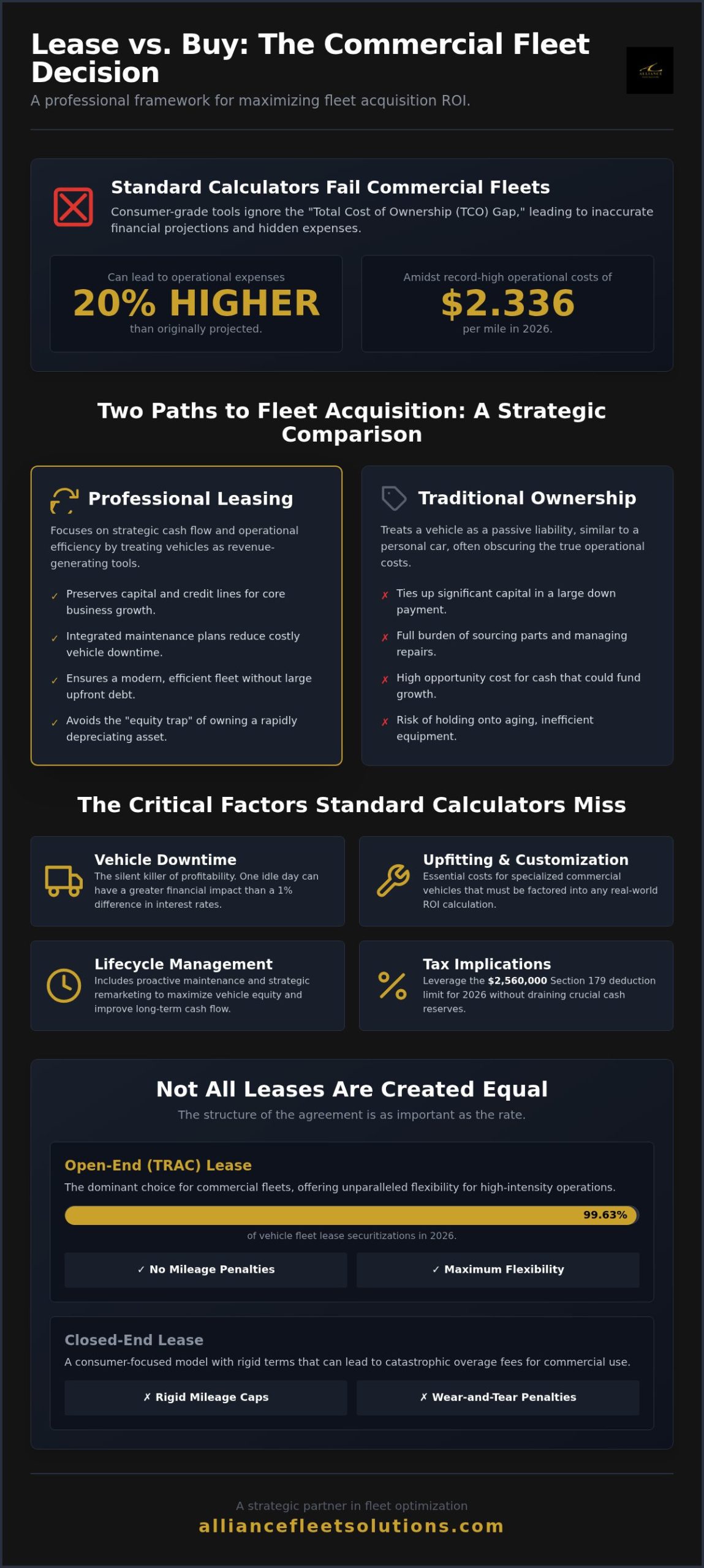
Standard online calculators designed for consumers are fundamentally flawed for logistics operations. They treat a vehicle as a passive liability, similar to a personal car used for errands. For a business, a truck is a revenue-generating tool. If that tool isn’t on the road, it isn’t earning. Most basic tools focus entirely on interest rates and monthly payments while ignoring the “TCO Gap.” This gap represents the hidden costs of upfitting and maintenance management. When these variables are left out of the equation, fleet owners often face operational expenses that are 20% higher than their original projections. A professional-grade commercial vehicle lease vs buy calculator must account for these complexities to provide a realistic financial roadmap.
In the high-inflation economy of 2026, the decision to lease or buy is no longer just about ownership. It’s about strategic cash flow. With operational costs reaching a record high of $2.336 per mile in early 2026, every dollar of liquidity counts. Understanding vehicle leasing fundamentals helps managers see that debt isn’t the only way to grow. A multi-variable commercial vehicle lease vs buy calculator allows you to weigh the benefits of preserving your credit lines against the potential long-term equity of owning a depreciating asset. It shifts the conversation from “what can we afford per month” to “how does this acquisition maximize our fleet’s earning potential.”
The True Cost of Vehicle Downtime
Downtime is the silent killer of fleet profitability. One day of a vehicle sitting idle in a repair shop can impact your bottom line more than a 1% difference in interest rates. When you purchase a vehicle outright without a dedicated maintenance management plan, you assume the full burden of sourcing parts and scheduling repairs. This often leads to longer wait times and unpredictable costs. Professional leasing structures often integrate maintenance schedules directly into the lifecycle of the vehicle. This proactive approach ensures your equipment stays in peak condition, reducing the risk of catastrophic failure and keeping your drivers on the move.
Capital Allocation: Growth vs. Equity
Tying up significant capital in a large down payment for vehicle acquisition creates a high opportunity cost. That cash could instead fund new hires, technology upgrades, or market expansion. Many business owners fall into the “equity trap,” believing that owning a title is always superior to leasing. However, heavy-duty vehicles are depreciating assets. In a fast-paced logistics environment, holding onto aging equipment can actually hinder your company’s valuation. Leasing preserves your credit capacity for core business needs while ensuring your fleet remains modern and efficient. This strategy allows you to leverage the $2,560,000 Section 179 deduction limit for 2026 without draining your primary cash reserves.
The Financial Mechanics: Open-End vs. Closed-End Leasing
A standard commercial vehicle lease vs buy calculator typically treats all leases as equal; however, for a business, the structure of the agreement is as important as the interest rate. Most consumer tools focus on closed-end leases, which offer predictability but come with rigid mileage limits and wear-and-tear penalties. In contrast, the Terminal Rental Adjustment Clause (TRAC) lease, or open-end lease, has become the industry standard for commercial fleets. Recent data shows that open-end structures accounted for 99.63% of vehicle fleet lease securitizations in 2026. This dominance isn’t accidental. It reflects a shift toward structures that treat vehicles as strategic assets rather than simple monthly expenses.
When you plug your numbers into a commercial vehicle lease vs buy calculator, the choice between open-end and closed-end structures will radically alter your projected cash flow and long-term liability. Open-end leases shift the residual value risk to the lessee, but in exchange, they provide the flexibility required for high-intensity logistics. If your trucks are running 50,000 miles a year, a closed-end lease with a 15,000-mile cap will lead to catastrophic overage fees. Understanding full-service fleet leasing options helps managers identify where these hidden costs hide. A well-structured lease should align with your specific vehicle lifecycle, from acquisition to remarketing.
Open-End Leases and Market Risk
Open-end leases allow for unlimited mileage without the fear of end-of-term penalties. This is critical for fleets that operate in unpredictable markets where route demands can change overnight. While you are responsible for the vehicle’s value at the end of the term, a well-maintained fleet can actually result in a credit if the sale price exceeds the projected residual value. This creates a financial incentive for rigorous maintenance management. For a deeper look at how these structures support business growth, see our Comprehensive Fleet Management Services: The 2026 Strategic Guide. Choosing the right path requires balancing market risk with operational freedom.
Tax Advantages of Commercial Acquisition
The tax landscape for 2026 provides significant incentives for fleet expansion. Under Section 179, businesses can deduct up to $2,560,000 for qualifying new and used equipment, with a phase-out beginning only after $4,090,000 in total purchases. Additionally, 100% bonus depreciation remains in effect for 2026, allowing for an immediate write-off of the entire cost of qualifying assets. For the 2026 tax year, heavy vehicles with a GVWR over 14,000 lbs qualify for the full $2,560,000 deduction, while SUVs between 6,000 and 14,000 lbs are limited to $32,000. Leasing payments are often treated as fully deductible operating expenses, which can simplify your balance sheet and improve year-one cash flow. If you’re looking to optimize your acquisition strategy, exploring fleet management solutions can help you navigate these complex tax regulations while maintaining operational efficiency.
The Hidden Variables: Upfitting and Fleet Operations
A standard commercial vehicle lease vs buy calculator often fails because it assumes you’re acquiring a “stock” vehicle. In the logistics and industrial sectors, a vehicle is rarely operational the moment it leaves the dealership. Professional upfitting is a critical variable that can add between $5,000 and $50,000 to the initial cost of a single unit. If you don’t amortize these modifications into your lease or loan, you’re forced to absorb a massive upfront capital hit. This oversight distorts your ROI projections and drains liquidity that should be fueling your core business growth. It’s vital to treat these modifications as part of the asset’s total value rather than a separate, out-of-pocket expense.
Effective fleet management extends far beyond the initial acquisition. You must account for the “repair spike” that typically occurs in years three and four of a vehicle’s life. For instance, the average maintenance cost for a semi-truck in 2026 ranges from 15 to 20 cents per mile. Without a dedicated maintenance management program, these costs can spiral; older trucks over seven years often exceed 22 cents per mile. Integrating these operational realities into your financial framework is essential for maintaining a predictable P&L. Consulting an FTC guide to vehicle financing options provides a helpful baseline for understanding depreciation, but commercial fleets require a more specialized approach to lifecycle costs.
Upfitting as a Strategic Investment
Custom-configured fleets do more than just carry cargo. They improve technician efficiency and driver safety. When tools and equipment are organized through professional upfitting, you reduce the time spent on every job site. This efficiency directly translates to higher revenue per vehicle. Smart upfitting choices can also enhance vehicle remarketing value. By choosing modular systems that are popular in the secondary market, you ensure your asset remains attractive when it’s time to rotate your fleet. For more on maximizing your fleet’s potential, explore our Efficient Fleet Operations: The 2026 Strategic Guide.
Telematics and Data-Driven Calculations
Telematics and GPS solutions are no longer optional “add-ons.” They’re the primary source of truth for your commercial vehicle lease vs buy calculator. By tracking “cost per mile” in real-time, you can identify which units are underperforming before they become a financial drain. Data-driven monitoring also allows you to manage the rising costs of fuel. With diesel prices projected to average $4.76 per gallon in 2026, fuel management programs are essential for protecting your margins. Integrated data allows you to:
- Lower insurance premiums by documenting safe driver behavior.
- Reduce fuel waste through idle-time tracking and route optimization.
- Schedule proactive repairs to avoid the high cost of emergency roadside service.
This level of granular detail allows you to move from guessing to knowing exactly how much each vehicle contributes to your bottom line. It transforms your fleet from a collection of trucks into a synchronized business asset.
Step-by-Step: How to Calculate Your Fleet ROI
Moving from a basic estimate to a professional-grade ROI projection requires a disciplined, multi-step approach. A standard commercial vehicle lease vs buy calculator might give you a monthly payment; however, a strategic framework accounts for the entire lifecycle of the asset. To build an accurate model, follow these five steps:
- Step 1: Define the Vehicle Lifecycle. Map out the timeline from procurement to remarketing. Most commercial fleets find their “sweet spot” for rotation between 36 and 60 months, before maintenance costs escalate.
- Step 2: Account for Soft Costs. Include taxes, registration tags, upfitting, and delivery fees. These “hidden” expenses can represent 10-15% of the total acquisition cost.
- Step 3: Compare Net Present Value (NPV). Analyze the NPV of lease payments versus loan payments. This accounts for the time value of money, showing you the true cost of capital in today’s dollars.
- Step 4: Factor in Residual Value. Estimate the vehicle’s worth at the end of the term. This is the “equity” you either keep (if buying) or use to offset the lease (if open-end leasing).
- Step 5: Apply the 2026 Tax Shield. Calculate your savings based on your specific tax bracket. Use the $2,560,000 Section 179 limit and 100% bonus depreciation to determine your year-one cash flow benefit.
If you’re ready to move beyond basic math, our team can help you design a customized vehicle acquisition strategy that aligns with your 2026 growth targets.
Estimating Residual Value
The remarketing phase is often the most neglected part of the acquisition debate. While many managers focus on the entry price, the exit price determines the true cost of ownership. Professional fleet management services maximize resale value by maintaining meticulous, digital maintenance records. These records prove to secondary buyers that the vehicle was cared for, often pushing the market value well above the standard “book value” at the 60-month mark. Understanding the difference between what a vehicle is worth on paper and what it will actually fetch at auction is key to a successful commercial vehicle lease vs buy calculator output.
The Fractional Fleet Management Advantage
For mid-sized businesses, the cost of a full-time fleet manager can be a significant drain on resources. Fractional fleet management allows you to outsource oversight to seasoned experts, providing “big fleet” buying power without the massive overhead. This model ensures your maintenance management is proactive rather than reactive, preventing the equipment failures that drive up operational costs. You gain access to discounted parts, preferred service scheduling, and expert remarketing advice. To learn how to integrate these savings into your long-term plan, read The Strategic Guide to Maintenance Management for Business Fleets. Scaling your operation shouldn’t mean scaling your administrative burden.
Alliance Fleet Solutions: Your Partner in Fleet Optimization
Spreadsheet data provides a necessary foundation, but the transition from calculation to execution is where most businesses face their greatest hurdles. A commercial vehicle lease vs buy calculator offers a snapshot of potential savings; however, realizing those gains requires a partner who understands the high stakes of the logistics industry. We don’t just provide equipment. We offer a comprehensive business solution that integrates vehicle acquisition with long-term operational efficiency. Whether your strategy calls for the flexibility of an open-end lease or the predictability of a closed-end structure, we tailor our financial products to match your specific cash flow requirements.
The Alliance advantage lies in our ability to manage the entire vehicle lifecycle under one roof. Our in-house professional upfitting services ensure your trucks are road-ready the moment they’re delivered, eliminating the coordination headaches of third-party vendors. By integrating telematics and GPS solutions alongside robust fuel management programs, we provide the data-driven oversight needed to keep your TCO as low as possible. We act as a supportive, reliable partner, allowing you to focus on your core business while we handle the complexities of equipment upkeep and remarketing. This proactive approach transforms your fleet from a simple expense into a high-performance asset.
National Reach, Personalized Strategy
Our national scope provides a distinct advantage in the tight vehicle markets of 2026. We leverage our extensive network to source the exact units your business requires, even when local inventories are depleted. Despite our national reach, we remain grounded in family-owned values that prioritize long-term B2B partnerships over simple transactions. From initial procurement to final vehicle remarketing, our team manages every detail of the lifecycle to maximize your equity and minimize downtime. We understand the mechanics of the industry, and we speak the language of business efficiency to ensure your fleet remains the essential backbone of a functional operation.
Ready to Optimize Your Fleet?
As we’ve explored throughout this framework, the Total Cost of Ownership is the only metric that truly defines your success. It’s time to move past surface-level monthly payments and build a fleet acquisition strategy that supports sustainable growth. Our experts are ready to perform a deep-dive analysis of your current operations and provide a clear, actionable comparison of your leasing and buying options. We’ll help you use a professional-grade commercial vehicle lease vs buy calculator to find the perfect balance between capital preservation and asset performance. Don’t leave your capital allocation to chance when you can have a seasoned expert in your corner. Request a Custom Fleet Lease vs. Buy Analysis today to secure the financial performance of your fleet for 2026 and beyond.
Mastering Your Fleet’s Financial Future
Mastering the 2026 fleet landscape requires looking far beyond the sticker price to the total lifecycle of the asset. We’ve explored how specialized leasing structures and professional upfitting protect your cash flow while data-driven telematics significantly reduce the long-term cost of ownership. While a basic commercial vehicle lease vs buy calculator provides a necessary starting point, a truly strategic framework incorporates the latest tax shields and remarketing potential to maximize every dollar. You need a partner who understands that vehicle acquisition is about more than just a monthly payment; it’s about maintaining a proactive, reliable operation.
As specialists in both open-end and closed-end leasing, we offer the national reach and integrated upfitting solutions necessary to scale your business with confidence. Our team handles the complexities of remarketing and maintenance management so you can focus on your core logistics goals. We’re committed to providing the technical authority and dependable partnership your high-stakes industry demands. Optimize your fleet strategy with Alliance Fleet Solutions today. Your fleet is the essential backbone of your success; let’s build it for peak reliability and long-term performance.
Frequently Asked Questions
Is it better for a business to lease or buy a commercial truck in 2026?
The decision depends on your cash flow needs and operational intensity. In 2026, leasing is often superior for high-mileage fleets because it preserves capital and credit lines while operational costs are at record highs. Using a commercial vehicle lease vs buy calculator helps you see the impact of these variables on your specific P&L. If your priority is long-term equity and you have low mileage, buying might make sense; however, most growth-oriented companies favor the flexibility of leasing.
What are the tax benefits of leasing a commercial vehicle under Section 179?
For the 2026 tax year, the IRS allows a maximum Section 179 deduction of $2,560,000. While you can use this for purchased vehicles, leasing allows you to treat payments as fully deductible operating expenses. This can provide a significant year-one cash flow advantage compared to standard depreciation schedules. Heavy vehicles with a GVWR over 14,000 lbs qualify for the full deduction, making leasing a powerful tool for immediate tax relief and fleet expansion.
What is the difference between an open-end and a closed-end commercial lease?
The primary difference is who assumes the risk of the vehicle’s residual value at the end of the term. In an open-end lease, the lessee is responsible for the value, which allows for unlimited mileage and no wear-and-tear penalties. A closed-end lease places that risk on the lessor but imposes strict usage limits and condition requirements. Most commercial operators prefer open-end structures because they provide the flexibility needed for unpredictable logistics demands and high-use cycles.
How does professional upfitting affect the lease vs buy decision?
Professional upfitting is a massive variable that can add $5,000 to $50,000 to a vehicle’s initial price depending on complexity. Leasing allows you to amortize these costs over the term of the agreement, avoiding a large upfront capital drain. If you buy, you must pay for these modifications out-of-pocket, which can hinder your liquidity. Amortizing these costs ensures your vehicle is custom-fitted for your operational needs without compromising your ability to scale.
Can I include maintenance and fuel programs in my commercial lease?
Yes, many commercial leases allow you to bundle maintenance management and fuel programs into a single monthly payment. This creates predictable operational costs and prevents the “repair spikes” common in older vehicles. With 2026 diesel prices projected to average $4.76 per gallon, fuel management programs are essential for protecting your margins. Integrating these services ensures your fleet remains in peak condition while simplifying your administrative oversight.
What is vehicle remarketing and why does it matter for my fleet ROI?
Vehicle remarketing is the strategic process of selling an asset at the end of its lifecycle to maximize resale value. It matters because the exit price of an asset determines the true total cost of ownership. Professional remarketing services utilize meticulous maintenance records to fetch higher prices at auction or through private sales. By maximizing your equity during the disposal phase, you improve your overall ROI and create a smoother transition into your next acquisition.
How does telematics impact the total cost of ownership for a commercial fleet?
Telematics solutions lower the total cost of ownership by providing real-time data on driver behavior, fuel consumption, and engine health. This visibility allows you to schedule proactive maintenance before minor issues become catastrophic failures. Additionally, documenting safe driving can lead to lower insurance premiums. By integrating these data points into your commercial vehicle lease vs buy calculator, you get a more accurate picture of how operational efficiency drives financial performance.
Is fractional fleet management cost-effective for small to mid-sized businesses?
Fractional fleet management is highly cost-effective for mid-sized businesses that don’t need a full-time fleet director. You gain access to “big fleet” buying power and expert lifecycle management at a fraction of the cost of a dedicated hire. This model ensures your fleet remains compliant and efficient while you focus on core business growth. It bridges the gap between basic vehicle ownership and a fully optimized, professional-grade logistics operation.