
The lowest monthly payment on a 2026 Mercedes-Benz Sprinter might actually be your most expensive mistake if the interior isn’t engineered for demanding operational environments. When you’re weighing commercial fleet leasing vs buying assets, it’s easy to get lost in the spreadsheets of 6.75% APR loans or the applicable sales tax. You likely feel the pressure of rising operational costs and the constant threat of downtime when a van isn’t organized for the job. We understand that your fleet is the backbone of your business, and every minute a driver spends hunting for a tool on the job site is profit down the drain.
This guide will help you navigate the 2026 financial landscape, addressing important shifts in commercial vehicle incentives and regulations. We promise to show you how to maximize your ROI by treating upfitting as a strategic investment rather than an afterthought. You’ll learn how the right weight distribution reduces maintenance costs and how custom cargo solutions can actually increase your vehicle’s resale value. We’ll break down the specific ownership tax rates for 2026 and provide a roadmap to help you choose the acquisition model that keeps your drivers safe and your cargo capacity at its peak.
Key Takeaways
- Discover why Colorado’s unique environmental factors require a shift from standard to specialized fleet configurations to prevent downtime.
- Navigate the financial choice of commercial fleet leasing vs buying colorado by calculating the long-term impact of upfitting on vehicle resale value.
- Learn about modular cargo systems and safety partitions that optimize space and protect your drivers on demanding mountain routes.
- Establish a clear operational mission to bridge the gap between financial acquisition and technical vehicle performance.
- Find out how integrating maintenance management with professional upfitting creates a more durable, reliable, and cost-effective fleet.
Why Colorado Fleets Require Strategic Commercial Van Upfitting
Operating a fleet in the Centennial State presents challenges that go far beyond standard logistics. Between the thin air of the Front Range and the punishing 10,000-foot passes of the High Country, a base-model van is rarely equipped for the job. When business owners evaluate commercial fleet leasing vs buying colorado options, they often focus solely on the monthly payment or interest rates. However, the true cost of ownership is determined by how that vehicle performs in the field. A standard van is a blank canvas; professional upfitting turns it into a specialized business tool that can withstand Colorado’s extreme environment.
Generic, off-the-shelf shelving units often fail in high-intensity commercial settings because they aren’t designed for the mechanical stress of alpine driving. Constant vibration on mountain roads can loosen poorly secured racks, leading to rattles, equipment damage, and increased driver fatigue. By integrating professional upfitting into your acquisition strategy, you ensure the vehicle is mission-ready from day one. This proactive approach reduces operational downtime by keeping tools organized and preventing the “search time” that eats into your daily profit margins.
Engineering for Alpine and Variable Terrain
Safe navigation of steep mountain grades requires precise weight distribution. If your upfit is poorly balanced, it can negatively impact the vehicle’s center of gravity, making it harder to handle on icy curves or during sudden summer downpours. We prioritize strategic layouts that place the heaviest equipment low and centered. This protects your suspension and improves braking performance when descending from the Continental Divide.
Temperature swings in the Rockies are legendary, sometimes shifting 40 degrees in a single afternoon. Standard interior plastics can become brittle and crack in sub-zero winters, while metal surfaces may collect moisture from melting snow. Professional upfitting utilizes durable, climate-resilient materials and protective liners to prevent rust and interior degradation. Before finalizing your acquisition, understanding vehicle leasing structures can help you decide if these custom improvements should be capitalized into a lease or handled as a separate capital expenditure.
Maximizing Efficiency in Regional Logistics
Efficiency in Colorado logistics means more than just a fast engine. It’s about how quickly a driver can access their inventory in a crowded Denver alleyway or at a remote job site in Durango. Ergonomic tool organization reduces the physical strain on your team, which is a critical factor in driver retention.
- Lightweight Materials: Utilizing advanced composites or aluminum instead of heavy steel helps maintain fuel economy, especially when climbing high-altitude passes.
- Integrated Lighting: High-output LED systems are essential for early winter sunsets and poorly lit rural loading zones.
- Modular Systems: As your business grows, your van should adapt. Modular shelving allows for quick reconfigurations without needing a completely new vehicle.
When you consider the commercial fleet leasing vs buying colorado debate, remember that an upfitted van is more than a transport asset. It’s a mobile workspace that must be as rugged and reliable as the professionals who operate it.
Top Commercial Van Upfitting Ideas for Peak Performance
Selecting the right hardware for your interior is just as critical as deciding between commercial fleet leasing vs buying colorado vehicles. A standard cargo van is often a cavernous, unorganized space that leads to damaged equipment and lost billable hours. High-performance fleets treat the vehicle interior as a precision instrument. By moving beyond basic plywood shelving toward modular, adjustable systems, you create a workspace that evolves with your business requirements. These investments aren’t just operational upgrades; they’re tax-deductible business expenses that can significantly lower your net costs when you follow IRS rules for business vehicle deductions.
Effective upfitting also addresses the physical well-being of your team. In the Colorado market, where labor competition is fierce, providing a van that is easy to work out of is a powerful retention tool. We focus on ergonomic designs that minimize repetitive strain and keep high-value assets secure during transit across rough terrain. If you’re looking for a partner to help design these high-efficiency layouts, Alliance Fleet Solutions offers professional upfitting tailored to your specific trade.
Advanced Cargo and Tool Organization
High-roof vans offer incredible volume, but reaching equipment on the roof can lead to shoulder injuries and falls. Drop-down ladder racks are essential for these taller models. They bring the ladder down to a comfortable height with a single motion, protecting your drivers from the strain of overhead lifting. For interior storage, heavy-duty drawer units provide a secure home for expensive diagnostic tools or specialized components. Unlike open bins, these locking drawers keep inventory from becoming projectiles during sudden stops on I-70. Customizable bin systems allow you to reconfigure your layout as your inventory changes, ensuring you never outgrow your initial investment.
Safety, Visibility, and Tech Integration
Colorado winters mean your crews are often working in the dark by 4:30 PM. Standard dome lights are rarely sufficient for finding small parts or reading schematics. Integrated LED interior lighting packages flood the cargo area with clean, bright light, reducing eye strain and improving safety during loading and unloading. We also recommend heavy-duty bulkhead partitions. These serve a dual purpose: they protect the driver from shifting cargo during a collision and improve cab climate control by reducing the volume of air the HVAC system needs to heat or cool.
Modern upfitting now includes the seamless integration of telematics and mobile workstations. By building GPS and asset-tracking hardware directly into the van’s infrastructure, you gain real-time visibility into how your tools are being used. This data is invaluable when analyzing commercial fleet leasing vs buying colorado strategies, as it provides a clear picture of your actual vehicle utilization and maintenance needs. Integrated power inverters and laptop mounts turn the cab into a functional office, allowing for immediate invoicing and communication from the field.
Commercial Fleet Leasing vs. Buying in Colorado: The Financial Impact
Many business owners view vehicle acquisition as a simple choice between a loan or a lease. However, in the 2026 market, the financial decision of commercial fleet leasing vs buying colorado assets is deeply intertwined with how those vehicles are equipped. A base-model van loses value quickly, but a professionally upfitted vehicle becomes a high-value asset on the secondary market. When it comes time for vehicle remarketing, a van featuring high-quality, modular shelving and durable interior protection consistently commands a higher price because the next owner doesn’t have to start from scratch. This residual value protection is a core component of maximizing your fleet’s return on investment.
The engineering of your upfit also directly impacts your long-term service expenses. Poorly distributed weight causes uneven tire wear and puts unnecessary strain on braking systems, especially when navigating Colorado’s steep grades. Integrating your upfit strategy with proactive maintenance management ensures that your vehicles remain on the road rather than in the shop. By balancing the load and protecting the interior from the corrosive effects of road salt and mountain moisture, you extend the functional life of the chassis and reduce the frequency of mechanical failures.
Upfitting as a Strategic Asset Investment
Strategic upfitting serves as a shield for your capital investment. Interior liners and bulkhead partitions prevent shifting cargo from denting exterior panels, which helps you avoid costly “excessive wear and tear” charges at the end of a lease term. In the harsh Rockies climate, these protective layers are essential for preventing the rust and degradation that can prematurely retire a vehicle. Specialized upfits reduce total cost of ownership by 15% over five years. This reduction comes from a combination of lower repair costs, improved fuel efficiency through lightweight materials, and significant labor-hour savings achieved through better tool organization.
Leasing vs. Buying: Upfitting Considerations
Choosing the right acquisition model allows you to leverage upfitting as a financial tool rather than a separate cash drain. Including the cost of equipment in a commercial vehicle leasing agreement allows you to amortize the upfit over the life of the lease, preserving your working capital for other business needs. For many Colorado fleets, an open-end lease offers the most flexibility for highly specialized configurations. Because you retain the equity in the vehicle at the end of an open-end lease, you reap the full financial reward of the upfit’s impact on the resale value.
Managing the timeline between acquisition and deployment is critical for maintaining cash flow. In the 2026 landscape, where House Bill 26-1289 has shifted tax incentives, businesses must be more precise with their “upfit-to-deployment” schedules. Every day a van sits in a lot waiting for shelving is a day it isn’t generating revenue. When you evaluate commercial fleet leasing vs buying colorado, prioritize a partner who can integrate the acquisition and upfitting processes into a single, streamlined workflow. This ensures your vehicles hit the road faster and start paying for themselves from the first mile.
The Roadmap to a Professional Van Upfit
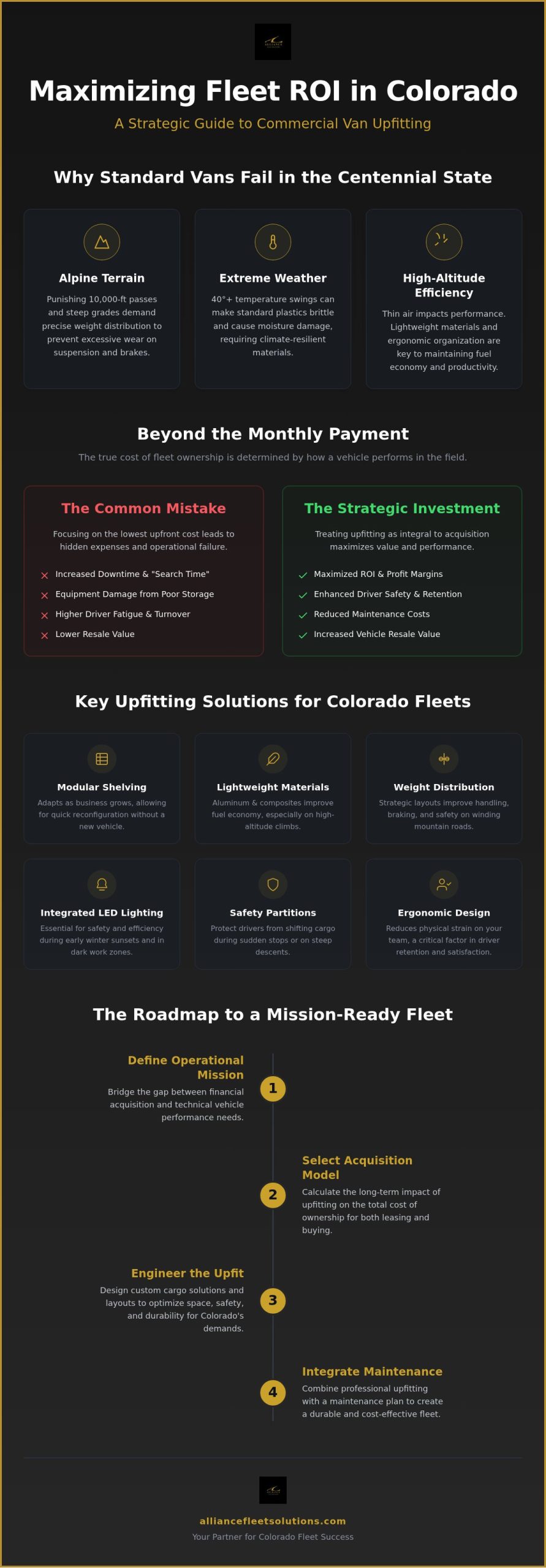
Building a high-performance fleet requires more than just selecting a vehicle from a dealership lot. It demands a structured process that bridges the gap between financial acquisition and daily operational reality. When analyzing commercial fleet leasing vs buying colorado, the technical specifications of your upfit must align with your financial structure. A disorganized van is a liability that costs you in wasted labor hours and driver frustration. To avoid these pitfalls, we follow a rigorous roadmap that ensures every cubic inch of your cargo space is optimized for the specific demands of your trade.
Success starts with defining the operational mission. We look at the granular details of your daily tasks: how many times a driver opens the rear doors, the weight of the heaviest equipment, and the specific inventory needed for a typical day in the field. By using 3D layout software, we can visualize the workflow before a single bolt is tightened. This level of precision ensures that your upfit isn’t just a collection of shelves, but a mobile workstation engineered for speed and safety. To get started on your own fleet transformation, schedule your custom upfit consultation with our expert team today.
Phase 1: Needs Assessment and Specification
Every industry has unique requirements that a generic van cannot meet. A plumbing contractor needs specialized rack systems for pipe transport, while an HVAC technician requires secure refrigerant tank storage. During this phase, we evaluate Gross Vehicle Weight Rating (GVWR) constraints to ensure your build remains safe and legal on Colorado’s steep mountain grades. Overloading a chassis leads to premature brake wear and suspension failure, which can void warranties and increase your total cost of ownership. Selecting the right chassis for your intended upfit is a critical step that impacts both mountain performance and long-term reliability.
Phase 2: Seamless Execution and Delivery
In the 2026 logistics market, speed to market is everything. We manage the entire supply chain to prevent delays that keep your revenue-generating assets sitting in a parking lot. Our installation process adheres to strict national safety and compliance standards, ensuring that partitions and shelving stay secure even in the event of a collision. By integrating efficient fleet operations protocols into the final build, we provide your drivers with a tool that is intuitive to use. This phased approach ensures that your decision regarding commercial fleet leasing vs buying colorado doesn’t just look good on paper but performs flawlessly in the field.
Partnering with Alliance Fleet Solutions for Colorado Success
Choosing between commercial fleet leasing vs buying colorado vehicles is only the first step in a much larger operational journey. At Alliance Fleet Solutions, we believe that the true value of your fleet is realized through the seamless integration of vehicle acquisition, flexible leasing, and professional upfitting. We don’t just provide a van; we deliver a comprehensive business solution that addresses the specific logistics of the Rockies. By acting as your strategic partner, we ensure that every modification contributes to your bottom line and improves your fleet’s eventual resale value.
Our approach bridges the gap between high-level financial planning and the daily realities of mountain logistics. We provide strategic consulting that aligns your upfitting needs with your specific acquisition model. If you’re utilizing an open-end lease, we help you design configurations that maximize equity. If you’re buying outright, we focus on durability that extends the vehicle’s lifecycle. This partnership extends beyond the initial build through fractional fleet management and specialized fuel management programs designed to keep your costs predictable in a volatile 2026 market.
Total Lifecycle Management
Most providers treat upfitting as a transactional hardware purchase. We view it as a critical phase in total lifecycle management. Our team handles everything from the initial procurement of the chassis to the final vehicle remarketing years later. This creates a single point of contact for all your fleet operations, reducing the administrative burden on your staff. Because we understand how specialized upfits impact residual value, we can provide more accurate financial forecasting than a traditional dealership. We manage the corrosive effects of Colorado winters and the mechanical strain of high-altitude driving, ensuring your assets remain reliable until the day they’re decommissioned. Our customized solutions grow with you, allowing for easy reconfigurations as your service area or inventory requirements evolve.
Next Steps for Your Colorado Fleet
The decision of commercial fleet leasing vs buying colorado doesn’t have to be a source of operational stress. By leveraging our national reach and localized expertise, you gain access to a network that prioritizes fast, reliable vehicle configuration. We understand the urgency of the logistics sector and work to minimize the time between acquisition and deployment. Whether you’re managing a small local crew or a regional delivery fleet, the right upfit is the backbone of your success. It’s time to move beyond standard cargo vans and invest in a specialized tool that works as hard as you do. Schedule a Strategic Upfitting Consultation with Alliance Fleet Solutions to start engineering your high-performance fleet today.
Engineering Your Fleet for the Colorado Road Ahead
Your vehicle acquisition strategy should do more than just put keys in your drivers’ hands. It must provide them with a workspace that is safe, efficient, and resilient enough for the Rockies. We’ve seen that the choice between commercial fleet leasing vs buying colorado assets is most effective when paired with professional upfitting. By focusing on weight distribution, modular organization, and durable materials, you turn a standard van into a specialized business tool that reduces operational downtime and protects your long-term ROI. These strategic choices ensure your fleet remains productive despite altitude, extreme weather, and high-mileage mountain routes.
Alliance Fleet Solutions provides the expert integration of leasing and professional upfitting your business needs to stay competitive. We back our builds with proactive maintenance and telematics support to keep your assets visible and operational. As a family-owned and operated company since 2018, we prioritize the partnerships that keep Colorado’s economy moving. It’s time to stop settling for off-the-shelf solutions and start building a fleet that’s truly mission-ready.
Schedule a Strategic Upfitting Consultation with Alliance Fleet Solutions today. We look forward to helping you optimize your operations for 2026 and beyond.
Frequently Asked Questions
What are the most popular van upfitting ideas for service fleets in Colorado?
Drop-down ladder racks and high-visibility LED lighting are top choices for Colorado service fleets. These tools address the physical strain of high-roof vans and the early sunsets of winter. Modular shelving systems and heavy-duty bulkhead partitions are also essential. These partitions improve cab heating efficiency during sub-zero mountain mornings and protect drivers from shifting cargo on steep grades.
How does professional upfitting affect my commercial van lease terms?
Professional upfitting can be integrated directly into your lease agreement, allowing you to amortize the cost over the vehicle’s term. When comparing commercial fleet leasing vs buying colorado options, keep in mind that open-end leases provide the most flexibility for custom builds. Because the upfit protects the interior and improves utility, it often helps maintain a higher residual value, which benefits you during the vehicle remarketing phase.
Can I upfit a van that is already in my fleet or only new acquisitions?
You can upfit both new acquisitions and existing vehicles within your fleet. Retrofitting older vans with modern cargo management systems is a strategic way to improve driver efficiency without the capital expense of a new vehicle. This process allows you to standardize your fleet’s operational layout, making it easier for drivers to switch between vehicles while maintaining high productivity and safety standards across your entire operation.
What is the typical timeline for a professional van upfitting project?
A typical professional upfitting project usually takes between one and three weeks once the vehicle and materials are on-site. The exact timeline depends on the complexity of the configuration and current 2026 supply chain lead times for specialized components. We manage the entire workflow to minimize downtime, ensuring your van moves from acquisition to deployment as quickly as possible so it can start generating revenue.
Does upfitting a commercial van increase its resale value at the end of the lease?
High-quality, professional upfitting significantly increases a van’s resale value by protecting the original interior and providing turnkey utility for the next buyer. Durable floor liners and partitions prevent the dents and scratches that lead to excessive wear charges. When it’s time for vehicle remarketing, a van equipped with recognized, modular shelving brands is much more attractive to secondary buyers than a stripped, base-model cargo van.
How do I ensure my van upfit doesn’t exceed the Gross Vehicle Weight Rating (GVWR)?
We utilize professional engineering software and lightweight materials to ensure every upfit stays within the manufacturer’s Gross Vehicle Weight Rating. Using aluminum or composite shelving instead of traditional steel can save hundreds of pounds, allowing for more cargo capacity. Our team calculates the weight of all components and anticipated inventory to ensure your vehicle remains safe, legal, and performs optimally on steep Colorado mountain passes.
Are there specific upfitting materials better suited for Colorado’s winter climate?
Composite interior liners and powder-coated aluminum components are ideal for Colorado’s winter climate because they resist moisture and corrosion. Standard wood floors can rot or warp when exposed to melting snow and road salt; meanwhile, cheap plastics often become brittle and crack in extreme cold. Selecting weather-resilient materials ensures your upfit remains durable and professional-looking despite the constant exposure to ice, slush, and fluctuating temperatures found in the Rockies.