
Is your aging fleet quietly draining your quarterly profits through a thousand small cuts? It’s a common frustration for managers who see maintenance spikes and rising fuel costs but lack the hard data to justify a fresh acquisition. Mastering fleet lifecycle cost analysis is the only way to move beyond guesswork and regain control over your operational budget. By identifying the precise intersection where depreciation slows and repair costs climb, you can stop reacting to breakdowns and start engineering your fleet for maximum ROI.
We understand that justifying new vehicle acquisitions to stakeholders is a high-stakes challenge when you lack visibility into your true cost-per-mile. This guide provides a clear strategy for 2026 to help you calculate the total cost of ownership and identify the exact moment to rotate your assets. You’ll learn how to lower the average age of your fleet without blowing your budget. We’ll also walk through the formulas needed to secure higher resale values and ensure your equipment remains a strategic business asset rather than a financial burden.
Key Takeaways
- Learn why the initial sticker price represents less than a third of your total spend and how to account for the hidden costs that follow.
- Master fleet lifecycle cost analysis by identifying the “U-Curve” where depreciation and maintenance costs intersect for the perfect replacement timing.
- Compare open-end and closed-end leasing to determine which structure offers the best risk management and flexibility for your specific operation.
- Gain visibility into your true cost-per-mile by accurately categorizing fixed expenses like depreciation against variable costs like unscheduled repairs.
- Discover how fractional fleet management provides professional oversight and data-driven insights without the overhead of a full-time analyst.
What is Fleet Lifecycle Cost Analysis and Why Does it Matter in 2026?
At its core, fleet lifecycle cost analysis is the practice of tracking every dollar associated with a vehicle from the moment it’s ordered until the day it’s sold. It moves beyond simple budgeting to provide a comprehensive view of an asset’s true financial impact. In a year defined by fluctuating interest rates and persistent vehicle scarcity, this analysis is no longer optional for businesses that want to remain competitive. It’s the difference between guessing your margins and engineering them.
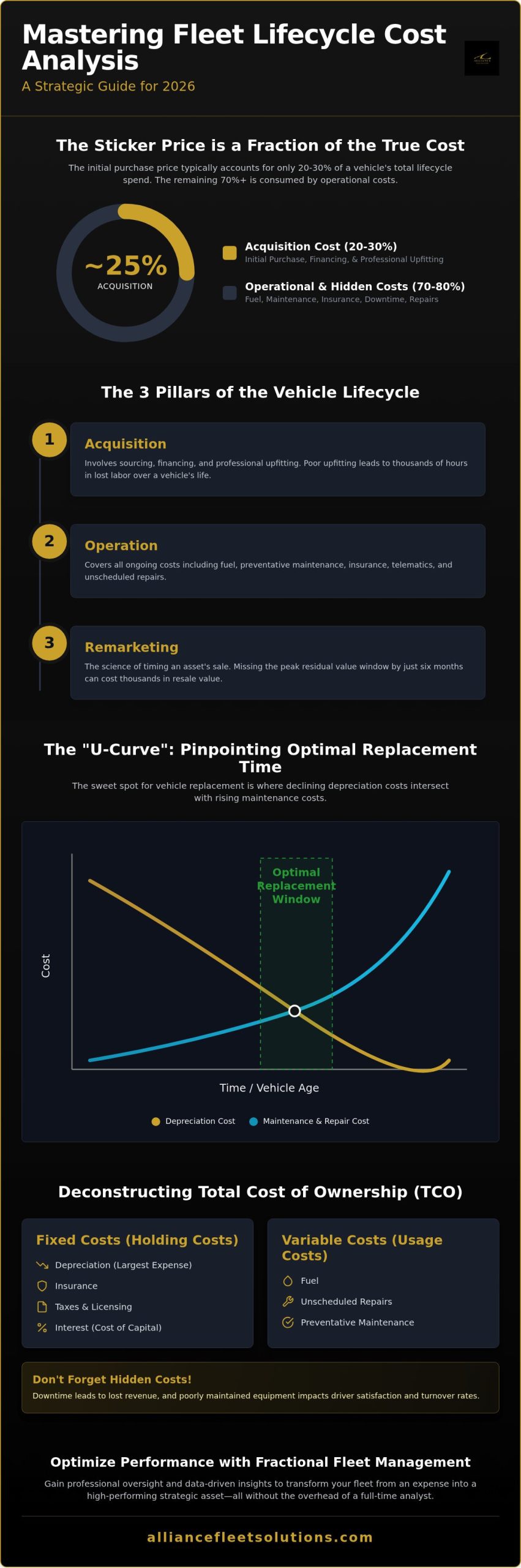
Many managers fall into the “Sticker Price Trap.” They focus almost exclusively on the initial acquisition cost, yet the purchase price typically accounts for only 20% to 30% of a vehicle’s total lifecycle spend. The remaining 70% or more is consumed by fuel, insurance, and maintenance. If you aren’t looking at the full picture, you’re making high-stakes decisions based on a tiny fraction of the data. The ultimate goal is to achieve the lowest Total Cost of Ownership (TCO) per unit, ensuring that each asset contributes to the bottom line rather than eroding it.
The Three Pillars of the Vehicle Lifecycle
A successful analysis breaks the vehicle’s life into three distinct phases. First is acquisition, which involves sourcing, financing, and professional upfitting. We often see businesses cut corners on upfitting to save money upfront, but poor organization in a service body leads to thousands of hours in lost labor over five years. Second is the operational phase, covering fuel, preventative maintenance, and telematics. Finally, there is remarketing. Timing the sale of an asset is a science; missing the peak residual value window by just six months can cost you thousands in resale value.
Why ‘Good Enough’ Data is Costing You Thousands
In the logistics sector, small inefficiencies compound quickly. For a 50-vehicle fleet, even a 1% increase in operational costs can lead to significant profit leaks. Relying on “good enough” data or manual spreadsheets often hides these patterns until it’s too late. Professional fleet management services act as a strategic investment here. They provide the technical authority needed to identify these leaks and fix them before they become systemic. When you treat fleet lifecycle cost analysis as a business solution rather than a clerical task, you transform your fleet from a necessary expense into a high-performing strategic asset.
The Components of Total Cost of Ownership (TCO): Fixed vs. Variable Expenses
Understanding your spending starts with categorizing expenses correctly. Total Cost of Ownership (TCO) serves as the primary metric for any successful fleet lifecycle cost analysis. It isn’t just a number on a ledger; it’s a diagnostic tool that reveals exactly how much value a vehicle returns over its service life. TCO is the sum of all fixed and variable costs divided by the asset’s total mileage.
Fixed costs are your “holding costs.” These expenses remain relatively constant regardless of how many miles the vehicle travels. They include:
- Depreciation: This is almost always the largest single expense in the lifecycle. It represents the loss in value as the vehicle ages and accumulates mileage.
- Insurance: Premiums based on fleet size, vehicle type, and risk profile.
- Taxes and Licensing: Annual registration fees and property taxes.
- Interest: The cost of capital, whether you’re financing a purchase or paying lease interest.
Variable costs fluctuate based on usage and operational efficiency. These are the levers you can pull to improve your margins. They include fuel, unscheduled repairs, and preventative maintenance. Beyond these line items, you must also account for “hidden” costs. Downtime doesn’t just result in a repair bill; it leads to lost revenue and missed delivery windows. Furthermore, poorly maintained equipment causes driver dissatisfaction, which often leads to higher turnover rates and increased training expenses.
The Role of Professional Upfitting in TCO
Professional upfitting is a critical cost factor that many managers overlook during the acquisition phase. A vehicle that’s “job-ready” from day one saves hundreds of hours in technician labor by ensuring tools and equipment are organized for maximum efficiency. While custom configurations require an initial investment, you can often amortize these costs over the life of the lease. Quality upfitting also protects the vehicle’s interior and structural integrity, which helps maintain a higher residual value when it’s time for remarketing.
Fuel and Maintenance: The Volatile Variables
Managing the moving parts of a budget requires a proactive stance rather than a reactive one. Implementing fuel management programs helps stabilize one of your most unpredictable spends by identifying waste and unauthorized usage. Similarly, shifting away from “break-fix” cycles toward structured maintenance management ensures you aren’t overspending on aging assets. If you’re struggling to balance these volatile variables, a fractional fleet management partner can provide the expert oversight needed to keep your operational costs in check.
Identifying the Optimal Vehicle Replacement Window
Finding the “sweet spot” for vehicle replacement is the most impactful part of a fleet lifecycle cost analysis. This decision rests on the “U-Curve” theory, a financial model where the decreasing cost of depreciation eventually intersects with the increasing cost of maintenance and repairs. If you replace too early, you lose money on high depreciation. If you wait too long, escalating repair bills and unplanned downtime erase your profits. The goal is to exit the asset at the bottom of that curve, capturing the lowest possible total cost per mile before expenses spike.
While mileage thresholds and age are traditional triggers, they don’t tell the whole story. You must also account for the opportunity cost of keeping older units. An aging truck isn’t just more expensive to fix; it’s often less fuel-efficient and lacks the latest safety technology. This increases your risk profile and operational friction. Telematics data provides the “ground truth” here, allowing you to move away from rigid, one-size-fits-all replacement cycles. Instead, you can identify specific underperforming units that need to be cycled out immediately based on real-world performance data.
Maximizing Vehicle Remarketing Value
The final six months of a vehicle’s life are critical for your overall ROI. At Alliance, we don’t just “dump” assets at auction. We take a proactive approach to vehicle remarketing by performing professional cleaning and minor repairs that significantly boost buyer interest. By maintaining efficient fleet operations throughout the asset’s life, you ensure the vehicle remains in a condition that commands top dollar in the secondary market. Choosing the right sales channel for each specific vehicle type is the final step in squeezing every cent of value out of your investment.
The 2026 Market Reality: When to Hold vs. When to Fold
Market conditions in 2026 require a more nuanced strategy than in previous decades. Vehicle scarcity remains a factor, meaning you can’t always count on immediate replacements. You have to balance the high resale value of your current units against the lead times for new acquisitions. If the secondary market is strong, it might be worth accelerating your replacement schedule to capture that cash, provided you’ve secured your next round of inventory. We help our partners navigate these timing complexities, ensuring they don’t get stuck with an aging fleet because they missed a procurement window. This proactive stance protects your capital and keeps your drivers in reliable, modern equipment.
How Leasing Structures Influence Your Long-Term Lifecycle Costs
Choosing between open-end and closed-end leasing is one of the most significant levers in your fleet lifecycle cost analysis. This decision fundamentally changes who holds the residual risk and how you manage the vehicle at the end of its service life. While both options preserve capital for business growth initiatives rather than tying it up in depreciating assets, they serve very different operational strategies. Your choice dictates how much flexibility you have with upfitting and how you’ll eventually exit the asset.
Open-End Leasing: The Commercial Standard
Open-end leasing is the backbone of the heavy-duty commercial sector, specifically designed for high-mileage and specialized fleets. This structure utilizes a Terminal Rental Adjustment Clause (TRAC). Under a TRAC lease, the client assumes the residual risk. If the vehicle sells for more than the projected book value at the end of the term, the client receives the credit. This model aligns your interests with our remarketing skills; the better we sell the vehicle, the more money stays in your pocket.
This model is particularly effective for fleets requiring professional upfitting. Because you’re responsible for the final sale price, you aren’t penalized for custom interior modifications or high mileage. You have the freedom to configure the vehicle exactly as the job requires. It’s a hardworking, no-nonsense approach that rewards proactive maintenance and smart timing.
Closed-End Leasing: Budget Certainty
Closed-end leasing provides a “walk-away” solution that prioritizes predictable monthly expenses. This is often the preferred choice for businesses that want a fixed cost and no exposure to the secondary market’s volatility. You pay for the portion of the vehicle you use during the term. When the lease ends, you simply return the keys and rotate into a new unit. This creates a steady, logical rhythm for your budget and simplifies the replacement process.
However, this certainty requires disciplined management. You must stay within mileage thresholds and adhere to strict “wear and tear” clauses to avoid surprise fees at the end of the lease. For fleets with highly predictable routes and standard configurations, the convenience of a closed-end structure provides excellent peace of mind. We help you evaluate your historical data to see if the equity potential of an open-end lease outweighs the fixed-cost benefits of a closed-end one.
If you’re unsure which lease structure fits your long-term financial goals, contact our team for a tailored leasing consultation to find the right path for your fleet.
Optimizing Lifecycle Performance with Fractional Fleet Management
Small to mid-sized businesses often face a significant hurdle: they have the raw data but lack the dedicated analyst required to interpret it. This is where fleet lifecycle cost analysis often stalls. Without a full-time fleet manager, companies rely on “gut feelings” about when to replace a truck or how to handle a major repair. Fractional Fleet Management solves this by providing expert oversight and technical authority without the overhead of a full-time headcount.
Alliance Fleet Solutions acts as a seamless extension of your finance department. We handle the heavy lifting of data analysis, allowing your team to focus on core business operations. The “Alliance Advantage” lies in our ability to manage the entire lifecycle loop. By integrating procurement, professional upfitting, and remarketing into a single strategy, we ensure that every decision made at acquisition supports the eventual resale value. This partnership approach transforms your fleet from a series of disconnected expenses into a unified, high-performing strategic asset.
Data-Driven Decision Making
We consolidate fuel, maintenance, and telematics data into one clear lifecycle report. This visibility allows you to move with cost-per-mile accuracy, identifying exactly which units are underperforming before they become a liability. We help you shift from reactive repairs to strategic asset rotation. By analyzing these trends over time, we identify the precise moment to exit an asset, ensuring your capital isn’t wasted on vehicles that have passed their economic prime.
Getting Started: The Fleet Audit
The first step in a professional fleet lifecycle cost analysis is a comprehensive fleet health check. This audit provides a baseline for your current operations and identifies “low-hanging fruit” where you can reduce costs immediately. Whether it’s identifying vehicles with excessive idle time or spotting maintenance patterns that suggest a need for earlier rotation, an audit provides the roadmap for long-term efficiency. We work alongside you to build a sustainable schedule that balances budget constraints with the need for a modern, reliable fleet.
Contact Alliance Fleet Solutions for a comprehensive fleet lifecycle audit and start engineering your fleet for maximum ROI today.
Take Control of Your Fleet’s Financial Future
Managing a fleet in 2026 requires more than just keeping vehicles on the road. It demands a rigorous approach to fleet lifecycle cost analysis that accounts for every variable from the initial build to the final sale. By mastering the intersection of depreciation and maintenance, you can transform your fleet into a predictable, high-performing asset. Success in today’s market depends on having the right data to time your replacements perfectly.
Alliance Fleet Solutions provides the technical authority you need to navigate these complexities. Our professional in-house upfitting ensures your vehicles are job-ready from day one. We offer specialized open-end and closed-end leasing structures to fit your specific risk profile, supported by a national vehicle remarketing network that captures peak residual value. We act as your essential partner, handling the heavy lifting of data so you can focus on business growth. Optimize your fleet’s ROI with a professional lifecycle analysis from Alliance Fleet Solutions. Your fleet is a strategic investment; let’s make sure it’s working as hard as you are.
Frequently Asked Questions
What is a typical cost-per-mile for a commercial fleet in 2026?
Recent industry data suggests that the average cost-per-mile for commercial fleets continues to fluctuate based on vehicle class and fuel prices. For heavy-duty trucks, many industry professionals report figures ranging between $2.30 and $2.55 per mile. Light-duty commercial vehicles typically see lower averages, though rising insurance premiums and specialized upfitting costs in 2026 are keeping these figures higher than in previous years.
How do I calculate the Total Cost of Ownership (TCO) for a single vehicle?
To calculate TCO, add the total fixed costs, such as depreciation, interest, and insurance, to the total variable costs, including fuel and maintenance, over the vehicle’s service life. Subtract the eventual remarketing proceeds from this sum to find the net cost. A thorough fleet lifecycle cost analysis then divides this total by the asset’s cumulative mileage to establish a precise cost-per-mile metric.
Is it better to lease or buy fleet vehicles for a small business?
Leasing is generally the more strategic choice for small businesses that prioritize cash flow and fleet modernization. It allows you to preserve capital for growth initiatives rather than sinking it into depreciating assets. While buying may offer some tax benefits, leasing simplifies the replacement process and provides a predictable budget. This approach ensures your team always operates reliable, late-model equipment with the latest safety features.
What is the difference between open-end and closed-end leasing in fleet management?
Open-end leasing places the residual value risk on your business, making it ideal for specialized or high-mileage fleets where you can benefit from a strong resale market. Closed-end leasing offers a “walk-away” model with fixed monthly payments and no resale risk, provided you adhere to mileage and condition limits. Each structure fundamentally alters your fleet lifecycle cost analysis by changing how you exit the asset.
When is the most cost-effective time to replace a fleet vehicle?
The optimal replacement window occurs at the bottom of the “U-Curve,” the point where declining depreciation costs meet rising maintenance expenses. For most light-duty commercial trucks, this typically happens between 36 and 48 months or around 85,000 miles. Replacing vehicles within this window captures the highest possible remarketing value before major unscheduled repairs and downtime begin to erode your total return on investment.
How does vehicle upfitting affect my fleet’s lifecycle cost?
Professional upfitting is a critical investment that reduces long-term operational friction. While it increases the initial acquisition price, it significantly improves daily driver efficiency and organization. High-quality upfits also protect the vehicle’s interior and structural integrity. This protection often translates into higher resale values at the end of the term, as buyers in the secondary market prioritize well-maintained, job-ready equipment over standard configurations.
What are the biggest hidden costs in fleet management?
Unplanned downtime and driver turnover are the most damaging hidden costs. A vehicle sitting in a shop isn’t just a repair bill; it’s a loss of revenue and potential damage to your client relationships. Additionally, aging or poorly equipped vehicles often lead to driver frustration and higher turnover rates. These soft costs don’t always appear as line items, but they significantly impact your bottom-line performance over time.
How can telematics help in fleet lifecycle cost analysis?
Telematics provide the “ground truth” data required for accurate replacement forecasting. By monitoring real-world fuel economy, engine hours, and diagnostic codes, you can identify specific underperforming units that need to be rotated out early. This data-driven approach moves you away from rigid, mileage-only schedules. It ensures you replace vehicles based on their actual economic performance, preventing you from keeping “lemons” too long or replacing healthy assets too early.