
What if your drivers viewed your latest fleet policy as a professional toolkit rather than a surveillance device? For most managers, getting team buy-in for a new fleet policy feels like an uphill battle against “Big Brother” accusations and administrative friction. You’re likely balancing the need for lower total cost of ownership with the reality that 54.4% of your peers cite rising costs as their primary headache in 2026. It’s a high-stakes environment where misalignment between Finance, HR, and the shop floor can stall even the most logical updates.
We understand that a policy is only as effective as the people who follow it. This guide provides a strategic framework to help you bridge the gap between technical requirements and driver acceptance. You’ll discover how to transform compliance into a collaborative asset that enhances safety and fosters a culture of mutual accountability. We’ll explore how to navigate new FMCSA digital standards and utilize incentives like the 100% bonus depreciation for heavy EVs to create a policy that leadership supports and drivers actually embrace.
Key Takeaways
- Bridge the “Resistance Gap” by getting team buy-in for a new fleet policy through active psychological acceptance rather than forced compliance.
- Align all four key stakeholder groups by identifying the specific value propositions that drive cooperation from the boardroom to the driver’s seat.
- Reframe telematics and monitoring as “exoneration technology” to protect your drivers from unfair blame during road incidents.
- Show how policy-driven maintenance management reduces operational friction by minimizing roadside downtime and improving vehicle reliability.
- Discover how fractional fleet management provides the professional authority needed to implement complex policy changes without increasing internal overhead.
The Psychology of Fleet Policy Change: Why Buy-In is Your Foundation
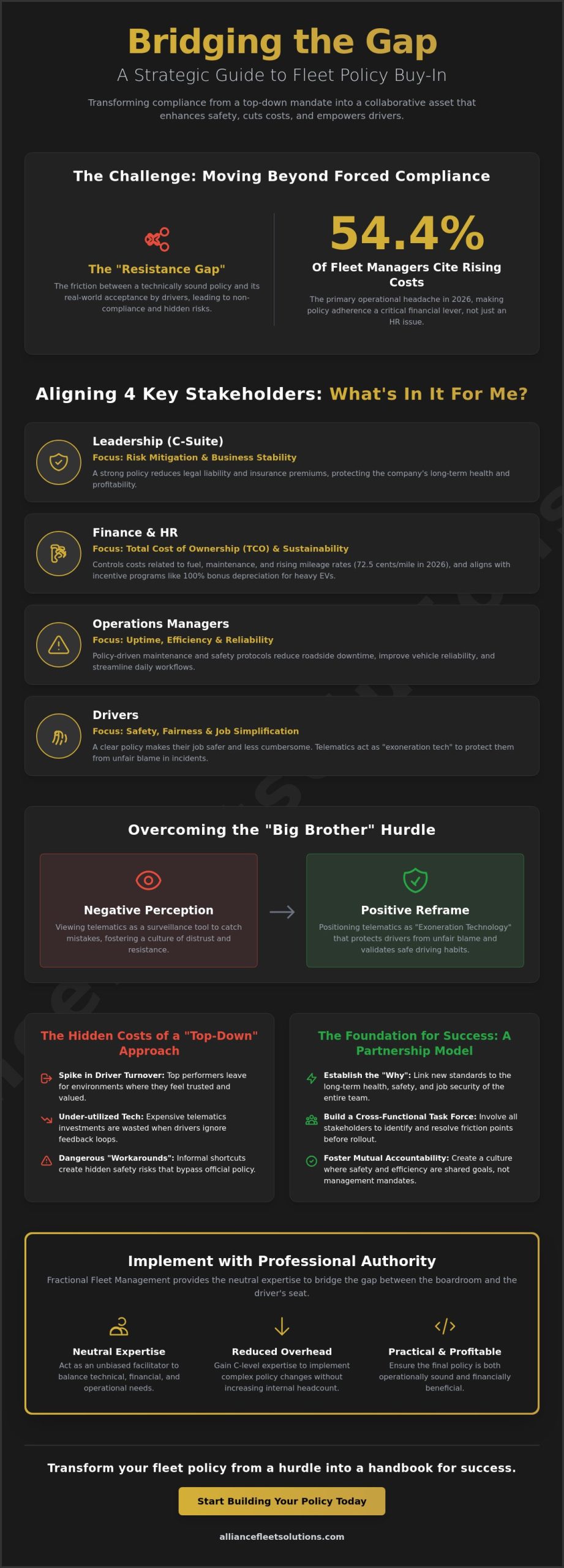
Fleet policy buy-in is more than just a signature on a handbook. It represents the active psychological acceptance of new operational standards by every person in your organization, from the shop floor to the executive suite. When you focus on getting team buy-in for a new fleet policy, you are addressing the “Resistance Gap.” This is the friction that occurs when a policy is technically sound on paper but fails to translate into real-world compliance. This gap often stems from a lack of transparency regarding how data is used or how new rules impact a driver’s daily workflow. In 2026, the stakes for closing this gap are higher than ever. Rising insurance premiums and increased legal liability mean that inconsistent adherence to safety protocols isn’t just an internal friction; it’s a significant financial risk.
Professional fleet leaders understand that successful implementation relies on the principles of change management. Instead of viewing a policy as a set of restrictions, it should be framed as a core pillar of comprehensive fleet management services. This approach ensures that the policy supports business growth rather than acting as a roadblock to daily operations.
The Hidden Costs of a “Top-Down” Only Approach
Dictating rules from an ivory tower often triggers defensive reactions from drivers. When teams feel their autonomy is threatened, driver turnover rates often spike as top performers look for environments where they feel trusted. Beyond staffing issues, a top-down approach leads to the under-utilization of expensive telematics and GPS investments. When drivers perceive monitoring as a lack of trust, they may intentionally ignore feedback loops from these systems, rendering the data useless for predictive maintenance or route optimization. Perhaps most dangerously, restrictive rules without buy-in encourage “workarounds.” These are informal shortcuts drivers use to bypass rules, creating hidden safety risks that management might not detect until an incident occurs.
Establishing the “Why” Before the “How”
Effective communication starts with the reason for the change. You must link new standards to the long-term health and safety of the entire team. Use operational data to show how inefficiency or poor safety records threaten the stability of the business. By showing how a well-maintained fleet protects jobs and lives, you change the narrative from “compliance” to “protection.” Getting team buy-in for a new fleet policy is a strategic partnership between management and operators that aligns individual performance with the collective success and safety of the organization.
Aligning Stakeholders: From the C-Suite to the Driver’s Seat
Successful policy implementation requires a unified front across four primary stakeholder groups: Leadership, Operations, Finance, and Drivers. Each group approaches a new policy with a different set of priorities, making the “What’s In It For Me” (WIIFM) factor the most critical element of your communication strategy. For Leadership, the focus is often on risk mitigation and long-term business stability. Operations managers prioritize uptime and efficiency. Finance seeks to control the total cost of ownership, especially with the 2026 IRS standard mileage rate rising to 72.5 cents per mile. Drivers, meanwhile, want a policy that makes their jobs safer and less cumbersome. To get employees on board with these changes, you must articulate how the policy solves their specific pain points.
Establishing a cross-functional task force is a proven method for getting team buy-in for a new fleet policy. This group should review policy drafts to identify operational friction points before they reach the field. Many organizations find that using fractional fleet management experts provides a necessary neutral perspective. These specialists act as facilitators who can balance the technical needs of the shop with the financial requirements of the boardroom, ensuring the final document is both practical and profitable.
The Role of Finance and HR in Policy Design
Finance and HR are the architects of policy sustainability. Finance ensures that the budget aligns with new requirements, such as investing in EV charging infrastructure before the 30C tax credit expires in June 2026. Simultaneously, HR must ensure that fleet rules are integrated into employment contracts and that disciplinary actions are fair. Transparency is key here. If a driver understands that a policy update is tied to a new fuel management program designed to offset the 25% to 35% of expenses lost to fuel costs, they are far more likely to comply with idling restrictions.
Empowering Driver Representatives
Drivers are your eyes and ears on the road. Selecting “influencer” drivers to join your task force allows you to address regional operational differences that a broad national policy might miss. These representatives can highlight where a rule might be impossible to follow due to local infrastructure or specific equipment limitations. This creates a feedback loop where drivers suggest “safety wins” rather than just receiving orders. By including them in the process, you transform the policy from a top-down mandate into a collaborative tool for professional success.
Overcoming the “Big Brother” Hurdle: Telematics and Monitoring
Drivers often view GPS as a digital leash. This perception is the single largest roadblock when getting team buy-in for a new fleet policy. To move past this, management must pivot the conversation from surveillance to support. By framing these systems as “Exoneration Technology,” you highlight their value as a shield. When a third party causes a collision, the data proves your driver’s innocence, potentially saving their CDL and your company’s reputation. Objective data removes the “he-said, she-said” dynamic from road incidents, which provides your team with a level of professional security they didn’t have before.
Commitment to transparency is your strongest tool for building trust. Clearly state what data is collected, who has access to it, and how it impacts performance reviews. Instead of using telematics solely to identify mistakes, implement gamification to reward high-performing operators. Monthly safety bonuses or public recognition for the most efficient routes turn a compliance burden into a competitive advantage. When drivers see tangible rewards for their data, their resistance to monitoring typically fades.
Telematics as a Professional Development Tool
Modern fleet systems should empower the driver, not just the manager. Providing drivers with their own performance dashboards allows them to self-correct habits like excessive idling or harsh braking before the data ever reaches a supervisor’s desk. This autonomy respects their professional skill set. Telematics and GPS solutions protect drivers from false accident claims by providing objective, third-party verification of speed, location, and braking force during an event. Furthermore, this data justifies vehicle upgrades. If the sensors consistently show a specific truck is struggling with fuel efficiency despite perfect driving, it provides the evidence needed to fast-track maintenance or replacement.
Privacy Boundaries in the 2026 Fleet Landscape
The 2026 regulatory environment is increasingly focused on data privacy, with federal pushes like the DRIVER Act aiming to give vehicle owners more control. Your policy must reflect these standards by strictly differentiating between business-hours tracking and personal-use privacy. If drivers take vehicles home, ensure the GPS “goes dark” during off-hours. Implement robust data security protocols to guarantee that driver information is used strictly for operational optimization. Finally, set clear, written guidelines on in-cab camera usage. If you use inward-facing cameras, explain exactly what triggers a recording and confirm that audio recording is disabled to respect the driver’s workspace. Getting team buy-in for a new fleet policy becomes significantly easier when the team knows their privacy is a priority.
Designing a Policy That Delivers Value to Drivers
A fleet policy should not be viewed as a static document of restrictions. Instead, it serves as a roadmap for providing drivers with the best tools available. When getting team buy-in for a new fleet policy, you must demonstrate how these rules directly improve the driver’s daily experience. One of the most effective ways to do this is by highlighting how strict maintenance management protocols virtually eliminate the frustration of roadside breakdowns. When drivers see that compliance leads to better-maintained, newer, and safer vehicles, the policy stops being a burden and starts being a benefit.
Asset management is a two-way street. By maintaining a disciplined replacement cycle, you ensure that the team is always operating equipment that features the latest safety technology. You can also incentivize participation in fuel management programs. Since fuel accounts for 25% to 35% of total fleet expenses, even small efficiency gains can be redistributed into driver bonuses or profit-sharing schemes. This creates a direct financial link between policy adherence and personal gain.
Upfitting: Making the Vehicle a Better Office
The “Uptime” Guarantee for Field Staff
Nothing kills morale faster than broken equipment that prevents a driver from completing their route. Your policy should streamline the reporting process for vehicle defects, moving away from illegible paper reports to digital systems. This ensures that repairs are handled before they become critical failures. Establishing reliable “loaner” vehicle protocols is another essential pillar of getting team buy-in for a new fleet policy. If a driver knows they won’t lose income or time while their primary vehicle is in the shop, they are far more likely to report issues early. This proactive approach keeps the wheels turning and the team focused on their goals.
Ready to optimize your fleet’s performance and driver satisfaction? Explore our professional upfitting solutions to turn your vehicles into high-efficiency mobile offices.
Implementing Your New Fleet Policy with a Professional Partner
Designing a robust framework is a significant milestone, but the true test of any strategy lies in its execution. Alliance Fleet Solutions bridges the gap between policy design and field-level adherence by providing the technical expertise and administrative support necessary to sustain long-term change. When you partner with experts, getting team buy-in for a new fleet policy becomes a streamlined process rather than a source of internal friction. We help you translate complex regulatory requirements, such as the 2026 FMCSA mandate requiring motor carriers to verify medical certifications exclusively through Motor Vehicle Records, into clear, actionable steps for your drivers and staff.
A professional partner also manages the lifecycle of your assets through vehicle remarketing. By ensuring a steady rotation of modern, reliable equipment, you demonstrate to your drivers that their safety and comfort are top priorities. This commitment to high-quality equipment is a powerful motivator for compliance. It’s much easier to enforce a clean-cab policy or a strict maintenance schedule when the driver is operating a new vehicle equipped with the latest ergonomic upfitting and safety technology.
The Fractional Management Advantage
Fractional fleet management provides your organization with seasoned authority without the overhead of a full-time executive position. These external experts often handle the “difficult” conversations regarding compliance, acting as a neutral buffer between company leadership and the field. This relationship helps maintain a positive workplace culture while ensuring that safety standards aren’t compromised. Because these specialists stay current with shifting 2026 tech trends and national regulations, your policy remains a living document that evolves alongside your business. They help you leverage 100% bonus depreciation for heavy EVs or navigate the expiration of the 30C charging infrastructure credit, ensuring your fleet remains financially optimized.
Next Steps: From Draft to Deployment
Moving too quickly can alienate your team, so a 30-60-90 day rollout plan is essential for success. Phase one should focus on transparency and stakeholder workshops to address the “why” behind every change. By the 60-day mark, you should have your digital reporting systems, such as electronic DVIRs, fully operational to avoid the “missing document” fines that became more prevalent after the February 2026 FMCSA clarifications. Finally, by day 90, you can begin using real-world performance data to refine the policy and reward your top performers. To begin this transition, contact Alliance Fleet Solutions to audit your current policy and identify the best path forward for getting team buy-in for a new fleet policy that actually sticks.
Driving Success Through Collaborative Fleet Standards
Mastering the complexities of 2026 fleet regulations requires more than just updated handbooks; it demands a fundamental shift in organizational culture. By reframing monitoring as a protective shield and ensuring your vehicles serve as high-efficiency mobile offices, you move from simple enforcement to genuine partnership. We’ve explored how getting team buy-in for a new fleet policy relies on aligning every stakeholder’s goals with the long-term health and safety of the business.
Since 2018, our family-owned and operated team has helped industry leaders bridge the gap between policy design and real-world execution. We provide specialized fractional fleet management expertise and professional upfitting solutions that turn your equipment into strategic business assets. Don’t let operational friction or driver resistance stall your progress. Partner with Alliance Fleet Solutions to build a high-performance fleet culture. Our lifecycle management strategies ensure your team remains safe, compliant, and motivated. Your fleet is the backbone of your operation; let’s make it your strongest asset.
Frequently Asked Questions
What is the most common reason fleet policies fail?
Fleet policies typically fail due to a lack of consistent enforcement and poor communication regarding the purpose of the rules. If drivers perceive that management ignores violations or if they don’t understand how the policy protects their safety, they will view it as an arbitrary burden. A policy that exists only on paper creates a culture of apathy. This leads to operational drift that eventually makes the document irrelevant to daily logistics activities.
How can I introduce telematics without making drivers feel micromanaged?
Focus on how the technology serves as a tool for professional exoneration rather than a digital leash. Show drivers that the data protects their CDL from false claims during road incidents by providing objective proof of their actions. By giving them access to their own performance dashboards first, you empower them to self-correct. This approach is essential for getting team buy-in for a new fleet policy because it shifts the focus from surveillance to support.
Should I involve drivers in the actual writing of the fleet policy?
You should include driver representatives during the review phase to ensure the rules are practically applicable in the field. While leadership sets the safety and financial goals, drivers provide the perspective that prevents operational friction. Their input on realistic route times or vehicle upfitting needs makes the policy a collaborative asset. This involvement reduces the “Big Brother” stigma and fosters a sense of ownership across the entire team.
How often should a commercial fleet policy be updated?
You should review and update your fleet policy at least once a year to keep pace with shifting regulatory and technological standards. For example, the 2026 FMCSA rules regarding digital DVIRs and medical certification verification through MVRs require immediate policy adjustments. Annual reviews ensure your standards reflect current tax incentives, such as 100% bonus depreciation for heavy EVs, and help you refine fuel management targets based on real-world data.
What are the legal risks of having a policy that isn’t enforced?
An unenforced policy often creates more legal liability than having no policy at all. In a court of law, a written rule that management knowingly allowed drivers to break can be used as evidence of “negligent entrustment.” This significantly increases the risk of high-dollar verdicts and rising insurance premiums. Consistent enforcement proves that your organization prioritizes safety and maintains expert control over its mobile assets and professional reputation.
Can a third-party fleet manager help improve driver buy-in?
A third-party manager acts as a neutral facilitator who can bridge the gap between corporate goals and field reality. They provide the technical authority to explain policy changes without the baggage of internal company politics. By handling difficult compliance conversations, a fractional fleet manager allows your internal supervisors to maintain positive relationships with their drivers. This objective partnership is a proven method for getting team buy-in for a new fleet policy.
How do I handle a high-performing driver who refuses to follow new rules?
Address the behavior immediately by emphasizing that high performance includes safety and compliance, not just speed or delivery volume. Even your most productive driver becomes a liability if they bypass telematics or skip maintenance checks. Explain how their influence affects the safety culture of the rest of the team. If they continue to resist, you must apply the disciplinary actions outlined in your policy to maintain consistency and fairness.
What incentives work best for encouraging fleet policy compliance?
Financial rewards tied to fuel efficiency and safety scores are the most effective motivators for professional drivers. Since fuel costs can account for up to 35% of total fleet expenses, sharing a portion of those savings with compliant drivers creates a win-win scenario. Other incentives include priority for new vehicle acquisition or custom upfitting rewards. These tangible benefits show drivers that following the policy leads to a better workspace and a more profitable career.