
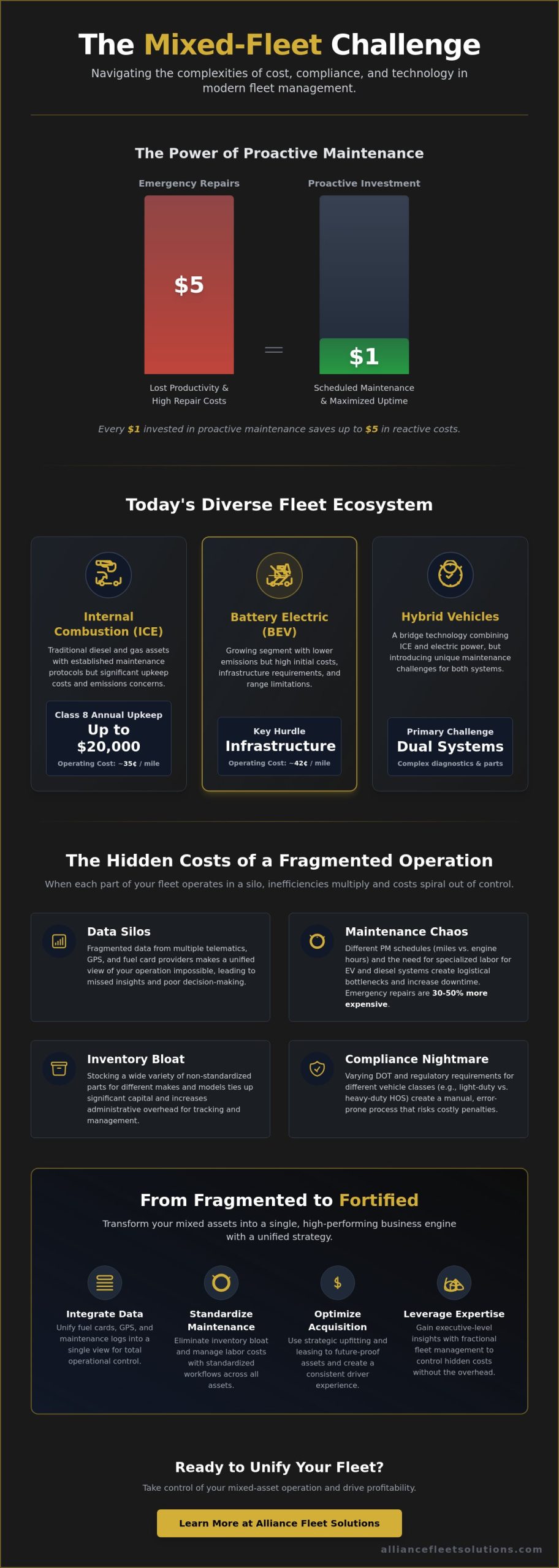
Did you know that every $1 you invest in proactive maintenance can save your operation up to $5 in emergency repair costs and lost productivity? In 2026, the challenges of managing a mixed fleet have reached a tipping point as managers juggle traditional diesel engines alongside a growing number of electric and hybrid assets. You’re likely dealing with fragmented data from multiple telematics providers and the stress of rising insurance premiums. It’s difficult to maintain a steady rhythm when your Class 8 trucks require up to $20,000 in annual upkeep while your new EVs demand entirely different infrastructure and tracking.
We understand that your goal isn’t just to keep wheels turning, but to protect your bottom line through total operational control. This guide will show you how to unify those fragmented operations and significantly reduce costs across your diverse vehicle classes. We’ll examine how to build a reliable roadmap for EV integration, solve the headache of inconsistent uptime, and master TCO forecasting despite the latest EPA regulatory shifts. By the end of this article, you’ll have a clear strategy to transform your mixed assets into a single, high-performing business engine.
Key Takeaways
- Learn how to navigate the 2026 regulatory environment by turning vehicle diversity into a strategic advantage rather than an operational burden.
- Discover strategies to eliminate inventory bloat and manage specialized labor costs by standardizing maintenance workflows across different vehicle makes.
- Master the challenges of managing a mixed fleet by integrating fuel cards, GPS, and maintenance logs into a single, unified view of your entire operation.
- Use professional upfitting and strategic leasing to create a consistent driver experience and future-proof your assets against rapid technology shifts.
- Explore how fractional fleet management provides the executive-level expertise needed to identify and control hidden costs without the overhead of a full-time hire.
What Defines the Challenges of Managing a Mixed Fleet in 2026?
In 2026, a mixed fleet is no longer defined simply by having different vehicle brands. It’s a sophisticated ecosystem of internal combustion engines (ICE), hybrids, and battery-electric vehicles (BEVs) spread across diverse weight classes and specialized vocational equipment. Managing this diversity isn’t a choice; it’s a requirement for staying competitive. Even with the EPA’s major deregulatory moves earlier this year, state-level mandates and corporate sustainability goals mean you’re likely operating assets that don’t share a single part or maintenance protocol.
This diversity often leads to the “Complexity Trap.” When your fleet includes everything from Class 8 tractors to light-duty electric vans, your vendor list explodes. You’re managing different fuel cards, separate telematics platforms, and specialized technicians for each asset type. One of the core challenges of managing a mixed fleet is the fragmentation of these relationships. To stay profitable, managers must shift their focus from simple vehicle tracking to holistic Fleet management that oversees the entire asset lifecycle from acquisition to remarketing. This ensures that every piece of equipment is an optimized business asset rather than a logistical burden.
The ICE, Hybrid, and EV Integration Hurdle
Integrating electric vehicles alongside traditional diesel assets introduces a steep infrastructure hurdle. While a diesel vehicle costs roughly 35 cents per mile to operate on regional routes, a BEV can cost up to 42 cents per mile when you factor in charging infrastructure. Managers face a constant trade-off between the “uptime” of diesel and the “range anxiety” of early-stage EV routes. On May 14, 2026, the EPA proposed a delay for “Tier 4” emission standards until MY 2029. This gives some breathing room for replacement cycles, but it also creates uncertainty for long-term procurement and charging site development.
Varying Regulatory and DOT Compliance Standards
Compliance isn’t a one-size-fits-all task. A light-duty passenger fleet has vastly different DOT requirements than a heavy-duty trucking operation. Maintaining an audit-ready status across these diverse classes is a manual nightmare without automation. You need to track hours-of-service for heavy-duty drivers while managing simple registration and safety inspections for light-duty assets. Failing to centralize these standards leads to costly penalties. This regulatory divergence is one of the most persistent challenges of managing a mixed fleet in 2026. Automated compliance tracking is the only way to ensure every asset meets its specific legal obligations without slowing down your operation.
The Fragmentation of Maintenance and Parts Inventory
One of the most expensive challenges of managing a mixed fleet is the lack of standardization in the garage. When your fleet contains multiple brands, fuel types, and weight classes, you’re essentially running several different maintenance programs simultaneously. This fragmentation drives up specialized labor costs. You need technicians who understand high-voltage EV systems for your light-duty vans and others who are experts in heavy-duty diesel emissions for your Class 8 trucks. Relying on multiple specialized shops instead of a unified service partner creates a logistical bottleneck that slows down your entire operation.
This diversity also leads to “inventory bloat.” Stocking oil filters for five different engine types or brake pads for four different chassis models ties up significant capital in parts that may sit on a shelf for months. Beyond the cost of the parts themselves, the administrative burden of tracking this non-standardized inventory is immense. Inconsistent preventive maintenance (PM) schedules further complicate the issue. A light-duty passenger vehicle might require service every 7,500 miles, while a heavy-duty truck is tracked by engine hours. When these windows are missed, you face emergency repairs, which are 30% to 50% more expensive than scheduled maintenance.
Centralized Maintenance Management is the solution to this fragmentation. By unifying service intervals into a single, logical schedule, you can ensure every asset receives the care it needs without the administrative headache. This proactive approach allows you to leverage your data to predict needs rather than reacting to failures, keeping your fleet on the road and your budget under control.
Overcoming OEM-Specific Service Requirements
Managing warranties across multiple manufacturers is a complex puzzle. Each OEM has specific requirements for what constitutes “certified service,” and failing to document these properly can void expensive coverage. Having a single point of contact for all mechanical repairs simplifies this process. It ensures that whether you’re servicing a Ford Transit or a Freightliner, the work is documented, compliant, and warranty-safe. For a deeper dive into optimizing these workflows, check out our strategic guide to maintenance management.
Standardizing Uptime Across Diverse Asset Classes
Uptime is the primary KPI for mixed fleet health. It doesn’t matter if a vehicle is electric, hybrid, or diesel if it’s sitting in the shop instead of generating revenue. You can Improve Fleet Productivity With Telematics by using predictive diagnostics to bridge the gap between older mechanical assets and newer digital ones. Predictive maintenance is the use of data and sensor inputs to prevent vehicle failure before it occurs. This technology allows you to treat a diverse fleet as a single, high-performing unit with a standardized uptime rating across all asset classes.
Solving the Data Silo Problem with Unified Telematics
One of the most persistent challenges of managing a mixed fleet is the fragmentation of critical information. When your fuel consumption data lives in one portal, your GPS locations in another, and your maintenance logs in a third, you’re operating with dangerous blind spots. In 2026, the volume of data generated by a single asset has surged, yet many managers still struggle to see the full picture. Without a “single pane of glass” view, you’ll spend more time reconciling conflicting spreadsheets than making strategic decisions. This fragmentation often leads to “data fatigue,” where the sheer number of disconnected dashboards causes managers to ignore alerts or miss critical trends in vehicle health.
Solving this requires robust API integration to connect disparate software systems. Modern fleet management demands that your telematics provider speaks the same language as your fuel cards and maintenance software. By pulling these data streams into a central hub, you can see fuel transactions alongside real-time engine diagnostics. This level of visibility is essential for controlling the rising costs of insurance and maintenance. It transforms raw data into actionable insights, allowing you to identify inefficiencies before they impact your bottom line. When your systems are unified, you’re no longer just tracking vehicles; you’re managing a high-performance business asset.
Aggregating KPIs for ICE and Electric Assets
Comparing the performance of a diesel truck to an electric van requires a fundamental shift in your metrics. You can’t compare Miles Per Gallon (MPG) to kilowatt-hours (kWh) per mile without a normalization strategy. A unified platform takes these disparate values and converts them into a standardized cost-per-mile or energy-equivalent value. Utilizing professional telematics and gps solutions allows you to see that while a diesel vehicle costs roughly 35 cents per mile, a BEV on a similar regional route might cost 42 cents when infrastructure is factored in. Having these numbers side-by-side is the only way to make informed decisions about vehicle acquisition.
Real-Time Visibility and Driver Safety Tracking
Driver behavior accounts for 30% to 50% of a fleet’s maintenance costs, making safety tracking a financial necessity. However, monitoring behavior in a high-torque EV differs from monitoring a heavy-duty diesel truck. Unified safety scorecards allow you to set consistent standards for harsh braking and rapid acceleration across all vehicle types. Real-time visibility also acts as a powerful deterrent for unauthorized vehicle use, which can significantly inflate your liability. By centralizing these insights, you ensure that every operator is held to the same high standard, regardless of the asset they drive. This consistency is the backbone of a safe, predictable operation.
Strategic Acquisition: Standardization Through Upfitting and Leasing
Strategic acquisition is your first line of defense against the challenges of managing a mixed fleet. If you buy assets haphazardly based on immediate availability or price alone, you’re essentially choosing to inherit years of operational friction. In 2026, future-proofing your fleet means selecting vehicles that fit into a unified lifecycle strategy. This involves more than just picking a make and model; it requires a proactive approach to how those vehicles are financed, equipped, and eventually retired. By standardizing your acquisition process, you can mitigate the complexity of managing diverse asset classes before the keys even hit the driver’s hand.
The Role of Professional Upfitting in Mixed Fleets
Professional upfitting is the bridge between a diverse fleet and a standardized operator experience. When your technicians move between a Ford, a Chevrolet, or an electric Rivian van, they shouldn’t have to relearn where their tools and safety equipment are located. Custom storage solutions and standardized cockpit layouts ensure that your team remains efficient regardless of the badge on the grille. This consistency reduces training time and minimizes the risk of accidents caused by unfamiliar equipment configurations. To maximize ROI, you should plan your upfitting during the acquisition phase. Treating it as an afterthought often leads to compatibility issues and extended downtime during the initial rollout. We can help you optimize your vehicle acquisition strategy to ensure your upfitting meets these rigorous standards from day one.
Leasing Structures for Varying Asset Lifecycles
Financial flexibility is critical when your fleet includes high-mileage diesel workhorses and newer, tech-heavy electric vehicles. Open-end leasing is often the preferred choice for heavy-duty assets with unpredictable usage patterns, as it offers the flexibility to adjust the lease term based on the vehicle’s actual utility. Conversely, closed-end leasing is highly effective for passenger cars or early-stage EVs. This structure protects your business from the rapid depreciation and technological obsolescence common in current EV models. Efficient fleet operations depend on matching the right lease term to each specific asset’s lifecycle, ensuring you aren’t stuck with an aging asset that no longer serves your needs.
Your strategy must also account for the end of the road. Vehicle remarketing is the final step in overcoming the challenges of managing a mixed fleet. Diverse assets require diverse resale channels. A specialized Class 8 truck won’t find its best value in the same market as a light-duty electric van. A dedicated remarketing strategy ensures you recover the maximum residual value from every asset, providing the capital needed for your next round of strategic acquisitions. This closed-loop approach transforms your fleet from a collection of disparate vehicles into a revolving door of high-performing business assets.
The Fractional Solution: Expert Management for Mixed Fleets
Managing the challenges of managing a mixed fleet requires more than just mechanical knowledge; it demands executive-level strategy. Many mid-sized businesses reach a point where their fleet is too complex for a part-time manager but not large enough to justify the high salary and benefits of a full-time Fleet Director. Fractional fleet management bridges this gap. It provides you with C-suite expertise and sophisticated management tools at a fraction of the cost of a full-time hire. By partnering with a dedicated expert, you gain a strategic backbone that oversees everything from vehicle acquisition to the final remarketing sale.
This model addresses the “hidden” costs that often bleed a mixed fleet dry. These include unrecovered warranty claims, inefficient fuel spend, and the administrative burden of managing diverse vendor relationships. Instead of your team spending hours reconciling telematics data from three different providers, a fractional manager delivers a unified report with clear action items. This proactive oversight ensures that your diverse assets operate as a single, cohesive unit rather than a collection of expensive problems. Alliance Fleet Solutions acts as your seasoned partner, identifying these inefficiencies before they impact your financial performance.
Why a Partnership Model Outperforms DIY Management
The DIY approach to fleet management often forces business owners to choose between administrative tasks and strategic growth. Every hour spent auditing a maintenance invoice is an hour lost on scaling your business. A management partner changes this dynamic by providing a single point of accountability for your entire operation. Because we manage assets at a national scale, we leverage that volume to secure better pricing on parts and services than a single business could negotiate alone. This isn’t just about saving money on an oil change. It’s about having an expert advocate who ensures you aren’t overcharged for specialized EV repairs or heavy-duty engine work, giving you total peace of mind.
Optimizing Your Total Cost of Ownership (TCO)
True profitability in a mixed fleet is found in the details of the vehicle’s entire lifecycle. Implementing data-driven fuel management programs allows you to track energy consumption across diesel and electric assets, identifying specific drivers or routes that are driving up costs. When it’s time to retire an asset, professional vehicle remarketing ensures you recover the maximum capital possible. This is essential given the challenges of managing a mixed fleet with varying depreciation rates. We ensure your capital is recovered and reinvested efficiently, keeping your operation lean and competitive.
Learn how Alliance Fleet Solutions can streamline your mixed fleet today.
Take Command of Your Fleet Lifecycle Today
Success in 2026 depends on your ability to transform a fragmented collection of assets into a single, high-performing business unit. We’ve explored how unified telematics can dissolve data silos and how strategic upfitting ensures your drivers remain efficient across different vehicle makes. By moving away from reactive maintenance and embracing a holistic lifecycle strategy, you can protect your bottom line from the rising costs of insurance and specialized repairs. The challenges of managing a mixed fleet are significant, but they aren’t insurmountable with the right technical partner at your side.
Alliance Fleet Solutions provides the tools and expertise you need to regain control. From specialized professional upfitting that standardizes your equipment to flexible open-end leasing options that match your specific asset utility, we handle the complexity so you can focus on growth. Our expert fractional fleet management gives you access to C-suite insights without the overhead of a full-time executive. Don’t let operational fragmentation slow your momentum. Request a Comprehensive Mixed Fleet Analysis from Alliance Fleet Solutions and start building a more resilient, cost-effective operation today. We’re ready to help you drive your business forward.
Frequently Asked Questions
What is the biggest challenge when managing a mixed fleet?
The primary hurdle is data fragmentation across multiple telematics platforms and vendor portals. One of the core challenges of managing a mixed fleet is the “Complexity Trap,” where diverse assets lead to disconnected dashboards and administrative fatigue. You must integrate these silos into a single hub to maintain a clear view of your total cost of ownership and operational health.
How do I track fuel efficiency across both gas and electric vehicles?
You track efficiency by normalizing disparate metrics into a standardized cost-per-mile or energy-equivalent value. While traditional vehicles use MPG, electric assets track kWh per mile. A unified management system converts these values so you can accurately compare the 35 cents per mile for diesel against the 42 cents per mile for regional battery-electric routes.
Is it better to lease or buy vehicles for a diverse fleet?
Leasing is generally superior for diverse fleets because it provides the flexibility to match the financing term to the asset’s specific utility. Open-end leasing works best for high-mileage trucks with varying lifecycles. Closed-end leasing protects your business from the rapid depreciation and technological shifts common in the current electric vehicle market.
How can telematics help with mixed fleet compliance?
Telematics automate the collection of specific data required for diverse regulatory standards. You can track Hours of Service (HOS) for heavy-duty trucks while simultaneously managing safety inspections and registration for light-duty vans. This real-time visibility ensures your entire fleet remains audit-ready and helps you avoid the costly penalties associated with non-compliance across different vehicle classes.
What is fractional fleet management and how does it help?
Fractional fleet management allows you to access executive-level expertise on a part-time basis. This model helps mid-sized businesses overcome the challenges of managing a mixed fleet by providing a dedicated expert to oversee vendor relations, fuel programs, and maintenance oversight. It delivers C-suite results and strategic lifecycle planning without the overhead of a full-time Fleet Director.
Should I standardize my fleet to one manufacturer to reduce complexity?
Standardizing to one manufacturer is often impossible due to specialized vocational needs or supply chain constraints. Instead of forcing a single brand, focus on standardizing the operator’s experience through professional upfitting. This creates a uniform work environment across different makes, ensuring your team remains productive and safe regardless of the vehicle they drive.
How does professional upfitting improve fleet-wide efficiency?
Professional upfitting improves efficiency by creating consistent storage and equipment configurations across your entire fleet. When your technicians have the same cockpit layout and tool placement in every vehicle, they spend less time searching for equipment and more time on the job. This standardization reduces training time and significantly boosts daily productivity across diverse asset classes.
What are the common mistakes in mixed fleet maintenance?
The most common mistakes include using inconsistent preventive maintenance (PM) schedules and allowing inventory bloat. Failing to align service intervals for different assets leads to unexpected downtime and emergency repairs, which are 30% to 50% more expensive than scheduled care. Additionally, stocking specialized parts for every unique vehicle type ties up capital that could be better used for fleet growth.