
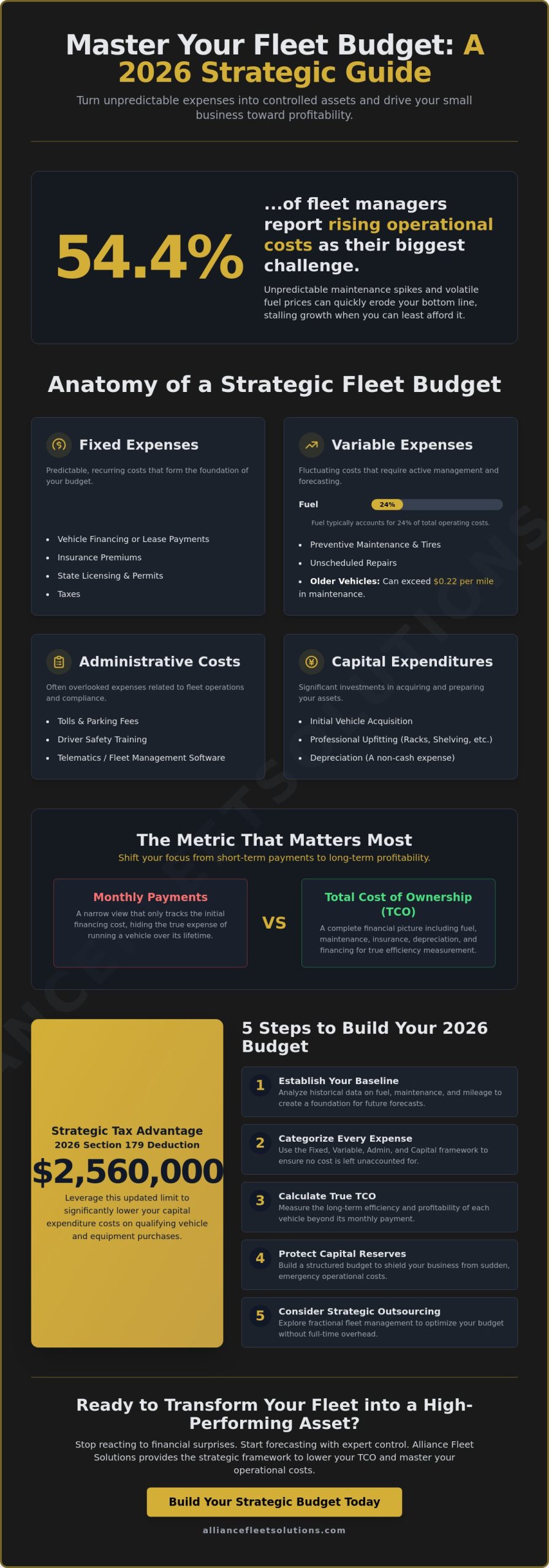
Did you know that 54.4% of fleet managers report rising operational costs as their biggest headache in 2026? It’s a staggering figure that highlights how quickly unpredictable maintenance spikes and shifting fuel prices can erode your bottom line. When you’re trying to scale, using a professional fleet budget template for small business operations is the only way to turn these moving targets into controlled assets. You’ve likely felt the sting of a surprise repair bill or watched your fuel expenses climb to nearly 24% of your total operating costs, making it difficult to project your true monthly burn rate.
We’re here to help you master these expenses and eliminate the financial surprises that stall your growth. Our 2026 strategic planning guide provides a comprehensive framework to lower your total cost of ownership and present a polished financial plan to your stakeholders or lenders. This article previews the essential categories for your budget, from leveraging the updated $2,560,000 Section 179 deduction limit to calculating the specific ROI of your older vehicles. You’ll gain the expert control needed to transform your fleet from a source of stress into a high-performing business asset.
Key Takeaways
- Learn how a structured budget acts as a strategic roadmap to protect your capital reserves from sudden, emergency operational costs.
- Identify critical fixed and variable expenses to include in your fleet budget template for small business to ensure every dollar is accounted for.
- Shift your focus from simple monthly payments to Total Cost of Ownership (TCO) to measure the true efficiency and long-term profitability of your vehicles.
- Follow a five-step process to establish an operational baseline using historical data, allowing for more accurate 2026 financial forecasting.
- Discover the strategic advantages of fractional fleet management to optimize your budget without the overhead of a full-time internal department.
Why Small Businesses Need a Strategic Fleet Budget
A strategic fleet budget is far more than a simple ledger of monthly payments. It serves as your operational roadmap, ensuring that capital is available exactly when it’s needed to maintain vehicle uptime. For many small business owners, the difference between a profitable quarter and a financial crisis often comes down to how they handle the unexpected. Without a structured plan, you’re constantly reacting to mechanical failures or market shifts. This leads to emergency spending that can quickly drain your cash reserves and stall your growth.
By utilizing a professional fleet budget template for small business, you shift from passive expense tracking to active financial forecasting. Tracking tells you what you spent last month; forecasting tells you what you’ll need to spend six months from now to avoid a fleet wide slowdown. This foresight is critical for managing vehicle replacement cycles. If you don’t budget for depreciation and future acquisitions today, you’ll find yourself stuck with an aging fleet that costs more to repair than it’s worth. Proactive planning ensures you have the liquidity to expand your fleet when the market demands it, rather than just replacing vehicles when they finally break down.
Moving Beyond the Basic Spreadsheet
Many operators rely on manual spreadsheets that fail to account for hidden costs. Depreciation, for instance, isn’t a bill you pay every month, but it’s a real loss of value that impacts your balance sheet. In 2026, proactive financial management is the industry standard. A professional budget does more than just keep the lights on. It provides the documentation necessary to secure better lending terms from banks or investors. When you can show a lender a clear plan for your Total Cost of Ownership, you demonstrate a level of professional control that increases your overall business valuation.
Identifying Your Primary Fleet Cost Drivers
Effective budgeting requires a clear distinction between fixed and variable costs. Fixed expenses like insurance, permits, and licensing are predictable, but variable costs like fuel and repairs require constant monitoring. Research indicates that fuel typically accounts for about 24% of a fleet’s operating costs, while maintenance for vehicles over seven years old can exceed $0.22 per mile. As your vehicles age, budget volatility increases. Using historical data to set industry specific benchmarks allows you to anticipate these spikes. A fleet budget template for small business helps you categorize these drivers, so you aren’t surprised when a high mileage truck requires an unscheduled engine overhaul. This structured approach helps you maintain a predictable monthly burn rate even when the road gets bumpy.
Key Categories for Your Fleet Budget Template
Organizing your expenses into logical buckets is the first step toward financial clarity. A robust fleet budget template for small business must account for every dollar that leaves your accounts. To achieve a predictable burn rate, you need to categorize your expenses into four distinct areas: fixed, variable, administrative, and capital expenditures. This structure ensures you aren’t blindsided by a sudden spike in one area that could jeopardize your overall cash flow.
Fixed expenses are your steady anchors. These include vehicle financing or lease payments, insurance premiums, state licensing fees, and taxes. While these numbers rarely change month to month, they form the foundation of your operational costs. Variable expenses, however, require more active management. Research shows that fuel typically accounts for 24% of your total operating costs. You must also budget for preventive maintenance, tires, and those inevitable unscheduled repairs. For older vehicles, maintenance costs can exceed $0.22 per mile, making it essential to track these fluctuations closely.
Administrative costs are frequently overlooked but can add up quickly. This category includes tolls, parking fees, driver safety training, and the subscription costs for telematics or fleet management software. Finally, capital expenditures cover the big-ticket items. This includes initial vehicle acquisition and the specific investments required to make those vehicles work for your business, such as professional upfitting.
Accounting for Professional Upfitting
Professional upfitting is often treated as a one-time expense, but it’s actually a long-term investment in your operational efficiency. Custom configurations, such as specialized shelving, refrigeration units, or heavy-duty racks, ensure your team has the right tools for the job. High-quality upfitting reduces operational downtime by preventing equipment failure and improving driver productivity. When building your budget, it’s often strategic to amortize these costs over the life of the vehicle lease. This approach aligns the expense with the revenue the vehicle generates. If you need help tailoring these configurations to your specific industry, our team at Alliance Fleet Solutions can guide you through the professional upfitting process.
The ‘Hidden’ Cost of Depreciation
Ignoring depreciation is a common mistake that leads to financial surprises when it’s time to refresh your fleet. Depreciation isn’t a cash expense you see every day, but it represents the declining value of your assets. To get an accurate financial picture, your fleet budget template for small business should include the projected residual value of each vehicle. Effective vehicle remarketing strategies can help you recover significant capital at the end of a vehicle’s lifecycle. By planning for this recovery early, you can offset the costs of your next acquisition cycle and maintain a healthier balance sheet.
TCO: The Metric That Matters More Than Monthly Payments
While a low monthly payment looks attractive on a balance sheet, it’s often a deceptive metric. To truly understand your fleet’s efficiency, you must focus on the Total Cost of Ownership (TCO). This metric encompasses every cent a vehicle consumes from acquisition to remarketing. When you use a fleet budget template for small business, shifting your focus to TCO allows you to see the real impact of your financial decisions. For example, owning a vehicle outright might eliminate a monthly lease payment, but it often leads to higher maintenance costs as the vehicle ages. Efficiency isn’t accidental; it’s the result of looking beyond the initial price tag.
Addressing the common objection that leasing is more expensive requires looking at the long term. Commercial leasing models often include maintenance packages that stabilize your monthly burn rate. This prevents the ’emergency spending’ spikes that drain cash reserves. For small teams, Fractional Fleet Management further reduces TCO by providing expert oversight without the cost of a full-time salary. You get the benefit of a seasoned pro who knows how to spot inefficiencies before they become expensive failures. It’s a partnership that prioritizes your bottom line and operational stability.
Open-End vs. Closed-End Leasing in Your Budget
Your choice of lease significantly impacts your cash flow. Open-end leasing provides the flexibility needed for high-mileage or specialized commercial fleets, as there are no mileage restrictions. It places the residual value risk on your business, which can be a strategic advantage if you maintain your equipment well. Conversely, closed-end leasing offers maximum predictability for businesses with fixed operational routes. You simply return the vehicle at the end of the term. Integrating these specific lease payments into your template ensures consistent, month-over-month cash flow.
The ROI of Preventive Maintenance
A higher maintenance budget doesn’t always mean higher costs. In fact, proactive spending often leads to a lower overall TCO. Every ‘day off the road’ represents lost revenue and disrupted client schedules. Downtime is a silent profit killer. With unscheduled repairs accounting for 40.1% of fleet work in 2026, the cost of equipment failure is too high to ignore. By utilizing professional maintenance management, you can stabilize these variable repair costs. This strategic approach ensures that your fleet budget template for small business reflects a proactive stance, keeping your vehicles on the road and your capital working for you.
5 Steps to Building Your 2026 Fleet Budget
Building a resilient financial plan requires moving past guesswork. To create a high-performing fleet budget template for small business, you must start with a rigorous audit of your historical data. We recommend gathering 12 months of records to identify seasonal trends and established spend patterns. This baseline allows you to separate anomalies from consistent operational needs. Once your history is clear, follow these five steps to solidify your 2026 strategy.
- Establish your baseline: Use your 12 month audit to set a realistic starting point for all categories.
- Calculate fixed costs: Review current lease agreements and insurance premiums. These are your non-negotiable anchors.
- Project variable costs: Use data from professional fuel management programs to forecast consumption based on current mileage trends.
- Allocate a 10% contingency: Set aside a dedicated fund for emergency repairs and inflationary pressures. This buffer prevents a single transmission failure from derailing your entire quarter.
- Review quarterly: A budget isn’t a static document. Adjust your figures every 90 days to reflect real-world performance.
Precision is the hallmark of a professional operation. Modern telematics and GPS solutions provide the granular data needed for precise fuel forecasting. By monitoring driver behavior, you can predict future maintenance needs and tire wear before they become urgent expenses. This proactive approach turns raw data into actionable budget adjustments that support efficient fleet operations. Instead of waiting for a breakdown, you’ll see the warning signs in your reports, allowing you to schedule service during planned downtime.
Leveraging Telematics for Budget Accuracy
Telematics data removes the ambiguity from your financial forecasting. When you know exactly how many miles each vehicle travels and how much fuel it consumes, your budget becomes a precision tool. This data also helps you identify which drivers are hardest on your equipment, allowing for targeted training that reduces long-term maintenance costs. It’s about turning operational behavior into predictable financial outcomes.
Setting Realistic Fuel Benchmarks
Fuel is often the most volatile line item in any fleet budget template for small business. To master this expense, you must account for seasonal fluctuations in both price and vehicle efficiency. Fuel cards play a vital role here by simplifying expense tracking and preventing unauthorized purchases. You can also estimate significant fuel savings by focusing on optimized routing and reduced idling time. If you want to refine these projections with expert oversight, consider how our fleet management services can help you lock in more predictable operational costs.
Strategic Fleet Management with Alliance Fleet Solutions
While a fleet budget template for small business provides the necessary structure for financial planning, a spreadsheet cannot actively manage a vehicle on the road. Moving from manual tracking to a proactive partnership is how you truly optimize your operational costs. Alliance Fleet Solutions acts as an extension of your team, providing the technical authority and logistical support needed to turn your budget from a static document into a high performance business asset. We don’t just help you track expenses; we help you eliminate the inefficiencies that cause them.
Outsourcing to a fractional fleet manager allows you to access specialized expertise without the overhead of a full time executive salary. This model is particularly effective for small businesses that need to scale quickly but lack the internal resources to monitor every maintenance alert or fuel transaction. By transitioning to a fleet management service, you gain a dedicated partner who understands the high stakes of your industry and is committed to your long term reliability and safety.
Tailored Leasing and Acquisition Models
We design flexible leasing structures that prioritize your working capital. Whether your operation benefits from the flexibility of open-end leasing or the fixed predictability of closed-end models, we customize our approach to match your specific financial goals. Our vehicle acquisition process includes professional upfitting from day one. We ensure your trucks are work ready the moment they join your fleet, which reduces the initial downtime that often plagues new acquisitions. When a vehicle reaches the end of its lifecycle, our expert remarketing strategies help you recover maximum capital to fund your next upgrade cycle.
Maximizing Efficiency Through Partnership
The administrative burden of managing a fleet can distract your team from their core business tasks. We alleviate this stress by managing the complex technical processes, from ELD compliance to driver safety training. As a small business partner, you gain access to enterprise level maintenance and fuel programs that were previously reserved for massive corporations. This allows you to leverage our industry relationships to lower your total cost of ownership across every vehicle in your fleet. Alliance Fleet Solutions bridges the gap between your annual budgeting goals and daily operational excellence by providing the seasoned expertise and data driven solutions your business deserves.
Master Your Fleet’s Financial Future
Implementing a robust fleet budget template for small business operations is the definitive first step toward long-term stability. You’ve learned that focusing on the Total Cost of Ownership (TCO) and leveraging 12 months of historical data creates a more resilient financial roadmap. By categorizing fixed and variable expenses accurately, you eliminate the surprise costs that often stall growth in the logistics sector. This shift from reactive bookkeeping to proactive forecasting ensures your capital remains protected and your vehicles stay on the road.
Strategic planning doesn’t have to be a solo endeavor. Alliance Fleet Solutions provides the expert oversight needed to bridge the gap between a basic spreadsheet and operational excellence. We offer specialized professional upfitting and flexible open-end or closed-end leasing structures tailored to your specific goals. Our comprehensive maintenance and fuel management programs provide the enterprise-level tools necessary to compete in a fast-paced market. Get a Professional Fleet Budget Consultation with Alliance Fleet Solutions today to secure your operational uptime. Your business deserves a partner that’s as hardworking and committed to reliability as you are.
Frequently Asked Questions
What are the most common hidden costs in a fleet budget?
Hidden costs often include excessive fuel consumption from vehicle idling and the administrative time spent on manual data entry. While many operators focus on major repairs, the soft costs of managing registration renewals and driver training can quietly erode your margins. Using a professional fleet budget template for small business helps you account for these overlooked line items before they impact your cash flow.
How much should a small business set aside for emergency vehicle repairs?
We recommend establishing a contingency fund equal to 10% of your total annual fleet budget. This buffer protects your operating reserves from the high costs of unscheduled repairs, which account for 40.1% of fleet work in 2026. For older vehicles over seven years, you might increase this reserve as maintenance costs often exceed $0.22 per mile.
Is it better to lease or buy vehicles for a small business fleet in 2026?
The choice depends on your capital needs and tax strategy. For 2026, the Section 179 deduction limit is $2,560,000, which makes purchasing attractive for some. However, commercial leasing often provides lower monthly payments and includes maintenance programs that stabilize your budget. Leasing is generally preferred by businesses that want to avoid the risks of vehicle depreciation and remarketing.
How often should I update my fleet budget template?
You should review and adjust your fleet budget template for small business at least once every quarter. Market volatility, particularly in fuel prices and interest rates, can make annual projections inaccurate within a few months. Quarterly updates allow you to integrate real world telematics data and adjust your variable cost benchmarks to reflect actual performance.
What is the difference between fixed and variable fleet costs?
Fixed costs are consistent expenses that don’t change regardless of how much your vehicles are driven, such as insurance, lease payments, and permits. Variable costs fluctuate based on usage and include fuel, tires, and unscheduled repairs. Balancing these two categories is essential for maintaining a predictable monthly burn rate and protecting your bottom line.
Can telematics data really help me save money on my fleet budget?
Telematics provides the granular data needed to reduce fuel waste and predict mechanical failures. Since fuel typically accounts for 24% of operating costs, even small improvements in routing or idling behavior lead to significant savings. This data turns your budget from a guess into a precision tool by identifying exactly where your money is being spent on the road.
What is a reasonable percentage of revenue to spend on fleet operations?
While this varies by industry, many service based businesses aim to keep fleet costs between 10% and 15% of total revenue. Logistics heavy operations may see higher percentages due to increased mileage and fuel consumption. It’s important to benchmark your spending against similar companies in your specific sector to ensure your operational efficiency remains competitive.
How does professional upfitting affect my vehicle’s resale value?
Professional upfitting can increase a vehicle’s residual value by making it a turnkey solution for the next buyer in your industry. High quality shelving, racks, or specialized equipment are viewed as valuable assets during vehicle remarketing. When done correctly, upfitting isn’t just an expense; it’s an investment that enhances both daily productivity and the eventual return on your asset.