
Did you know that in a recent $1.00 billion securitization of vehicle fleet leases, open-end structures accounted for a staggering 99.63% of the total? This overwhelming preference among major operators highlights a strategic shift toward financial structures that prioritize long-term flexibility over rigid restrictions. If you’ve ever felt trapped by a contract that limits your operational capacity, understanding exactly when to choose an open-end lease is the first step toward reclaiming your bottom line and gaining technical control over your assets.
We know how frustrating it is to face unpredictable mileage penalties or excessive wear-and-tear charges at the end of a term. It feels like you’re paying a premium for the simple reality of doing business in a high-demand logistics environment. This guide will show you how to leverage an open-end lease to gain the freedom of ownership without the heavy capital constraints of a direct purchase. We’ll explore how current 2026 market conditions, from the 72.5 cents per mile IRS rate to the 20% bonus depreciation, create a unique window for fleet managers to lower their total cost of ownership and simplify vehicle disposal transitions.
Key Takeaways
- Eliminate the risk of costly mileage penalties and wear-and-tear charges by shifting to a lease structure that mirrors the flexibility of vehicle ownership.
- Identify the specific operational scenarios, such as rough vehicle usage or high-intensity routes, where an open-end lease offers the highest financial ROI.
- Learn exactly when to choose an open-end lease to maintain full control over vehicle disposal and capitalize on market-driven resale values.
- Understand the mechanics of TRAC provisions and how they allow you to adjust final rental payments based on the actual sale price of your assets.
- Discover how integrating maintenance management into your leasing strategy preserves vehicle equity and ensures a seamless, profitable end-of-term transition.
What is an Open-End Lease and How Does it Function?
An open-end lease is a commercial financing agreement where you, the lessee, take on the responsibility for the vehicle’s residual value at the end of the term. Unlike consumer-grade leases, this structure is built for the high-intensity demands of the logistics and service sectors. It’s often described as providing the “freedom of ownership” because it removes the artificial barriers that usually restrict fleet activity. You won’t find mileage caps or rigid wear-and-tear penalties in these contracts. This flexibility is exactly why it’s the dominant standard for commercial truck leasing across North America.
Most of these agreements start with a 12-month minimum term. After that initial year, the lease typically transitions to a month-to-month basis. This allows fleet managers to retire or replace vehicles based on actual operational needs rather than a rigid calendar date. This agility is a key consideration for managers determining when to choose an open-end lease for a growing or fluctuating fleet.
The Core Difference: Open-End vs. Closed-End
The primary distinction between these two structures lies in who carries the financial risk. In a closed-end lease, you return the keys and walk away at the end of the term, provided you’ve stayed within strict mileage and condition limits. However, Open-ended motor vehicle leases operate as equity-building tools. If you maintain your vehicles well, you reap the rewards at the end of the term through a higher resale value. Because you’re assuming the residual risk, monthly payments are usually lower than closed-end alternatives. This lower monthly overhead helps preserve cash flow for other critical business investments.
Understanding the TRAC Clause
A Terminal Rental Adjustment Clause (TRAC) is the mechanism that drives an open-end agreement. It’s a provision that allows for a final settlement at the end of the lease term. If the vehicle sells for more than its remaining book value, your company receives the surplus. If it sells for less, you’re responsible for the difference. Beyond the potential for equity, TRAC leases are specifically recognized by the IRS as “true leases” for tax purposes. This allows businesses to treat the entire payment as a deductible operating expense rather than a capital purchase. Understanding these mechanics is vital for identifying when to choose an open-end lease to maximize both operational freedom and fiscal performance.
The Financial Mechanics: TRAC and Residual Value
The financial efficiency of an open-end lease depends on the relationship between the vehicle’s book value and its actual market value. Every month, a portion of your payment goes toward interest, while the rest reduces the “book value” of the asset. This book value is essentially the unamortized balance of the vehicle’s original cost. Unlike closed-end options that set a hard limit on your usage, the financial mechanics here reward proactive management. When you maintain your fleet to high standards, you’re directly protecting the equity you’re building in the equipment.
The Terminal Rental Adjustment Clause (TRAC) is the engine behind this structure. At the end of the term, the vehicle is sold, and a final settlement occurs. If the sale price exceeds the remaining book value, your company receives a positive rental adjustment, often in the form of a check. If the market value is lower than the book value, you’re responsible for a negative adjustment to cover the difference. This structure is a primary reason why many managers decide when to choose an open-end lease, as it allows them to capture the upside of a strong resale market.
From an accounting perspective, 2026 standards under ASC 842 require both operating and finance leases to appear on the balance sheet. However, the specific terms of a TRAC lease often allow it to be classified in a way that optimizes your financial ratios and tax positions. Because the IRS views TRAC leases as “true leases,” you can generally deduct the full monthly payment as an operating expense, which simplifies your tax strategy compared to traditional ownership.
Setting the Right Depreciation Rate
Choosing an aggressive depreciation rate is a strategic move that protects your business from end-of-lease “sticker shock.” While a lower rate might reduce your immediate monthly payments, it leaves a higher book value at the end of the term. If the market shifts, you could be left with a significant deficiency. We help our partners calibrate these rates based on specific duty cycles and industry benchmarks. This ensures your monthly cash flow stays manageable while your long-term equity remains secure.
The Role of Market Value in Your Final Cost
The final cost of your lease isn’t just about the monthly check; it’s about the remarketing result. Factors like rigorous maintenance history and current demand for specific upfitting significantly influence the resale price. The “Three-Payment Rule” serves as a benchmark for reasonableness in residual value settings, protecting lessees from entering agreements with unrealistic end-of-term expectations. Market volatility directly dictates whether the final TRAC settlement results in a cash-back credit or a final invoice for the deficiency. Identifying when to choose an open-end lease requires a clear-eyed look at these market variables to ensure your fleet remains a financial asset rather than a liability.
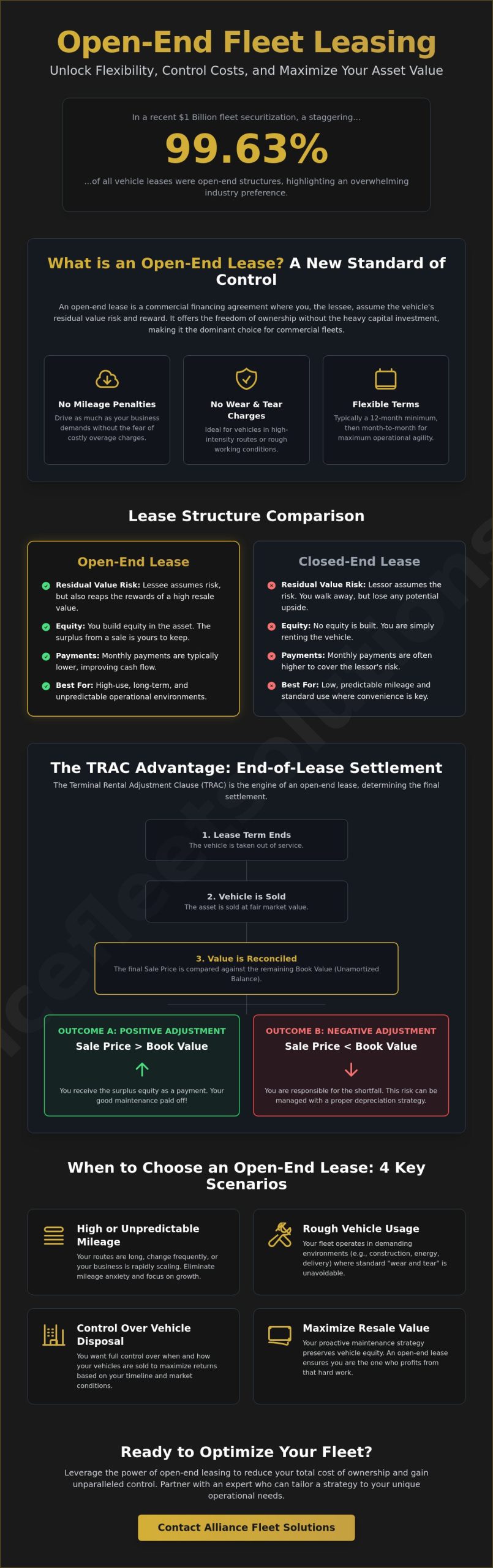
When to Choose an Open-End Lease: 4 Critical Scenarios
Deciding when to choose an open-end lease often comes down to your fleet’s specific operational profile. While closed-end leases might work for predictable, low-impact office commutes, they often fail under the pressure of industrial use. We’ve identified four key scenarios where the open-end structure provides a clear competitive advantage by aligning your financing with your actual work requirements.
High Mileage and Rough Usage Advantage
If your vehicles consistently cover more than 25,000 miles per year, a closed-end lease becomes a financial liability. Standard contracts typically charge between 15 and 25 cents per mile over the limit. For a high-utilization fleet, these penalties can easily exceed the vehicle’s actual depreciation. Last-mile delivery services and field service fleets are prime examples of operations that thrive under open-end terms. You don’t have to worry about “nickel and diming” from wear-and-tear inspectors when you return the vehicle. Instead of paying arbitrary damage fees, you simply account for the vehicle’s actual condition at the time of sale. This allows your team to focus on service delivery rather than avoiding minor scratches.
The Upfitting Factor in Leasing
Custom equipment often makes a traditional “walk-away” lease impossible. When you install specialized cranes, heavy-duty shelving, or complex branding, you’re creating a unique asset that doesn’t fit the standard return profile of a closed-end lessor. Open-end leasing allows you to amortize the cost of professional upfitting over the life of the lease. This ensures that your specialized equipment pays for itself through operational efficiency. In the secondary market, a properly upfitted vehicle often holds significant value for buyers in similar industries. By choosing an open-end structure, you capture that resale premium at the end of the term rather than handing it over to a leasing company.
Long-term asset strategy also dictates when to choose an open-end lease. If your business model relies on keeping vehicles for five to seven years to maximize their utility, the month-to-month flexibility after the first year is invaluable. You aren’t forced into a replacement cycle that doesn’t match your budget. You retain the power to retire vehicles when maintenance costs begin to spike. This ensures your fleet stays safe and clean without being tethered to a rigid expiration date. It’s a proactive approach that treats your fleet as a strategic business asset rather than a fixed overhead expense.
Managing the Risk: Remarketing and Maintenance
Managing the residual risk of an open-end lease isn’t just about financial forecasting. It’s about day-to-day operational discipline. Since your company bears the responsibility for the vehicle’s final sale price, your approach to maintenance management becomes your primary investment protection tool. A well-maintained truck isn’t just a reliable tool for your drivers; it’s a high-value asset waiting to be liquidated. Determining when to choose an open-end lease requires a commitment to asset preservation that extends far beyond simple oil changes.
Professional remarketing services act as your advocate in the secondary market. Instead of simply sending assets to a local auction, we utilize diversified disposal channels to find the highest bidder. This might include private sales, specialized online platforms, or even driver-purchase programs. By widening the pool of potential buyers, you mitigate the risk of local market downturns. Data plays a critical role here. We use telematics to predict the exact moment a vehicle’s maintenance costs will begin to outweigh its resale value, allowing you to cycle assets out at the peak of their ROI.
Maximizing Resale Value
Simply cleaning a vehicle before a sale isn’t enough to secure a premium price. Savvy buyers in the secondary market look for detailed, verifiable service records. These logs prove that the asset was cared for according to manufacturer standards, which reduces their perceived risk and increases your equity. Timing the market is equally vital. We monitor industry demand to identify when specific vehicle types are in short supply. Alliance Fleet Solutions handles this entire process, from the initial inspection to the final title transfer. If you want to ensure your fleet remains a financial asset, consult with our vehicle remarketing experts to build a custom disposal strategy.
Fuel and Telematics: Operational Efficiency
Operational costs directly impact your final bottom line. Integrating fuel management programs helps reduce the total cost of ownership by identifying inefficient driving habits that also increase mechanical wear. Telematics data provides a transparent look at how each asset is performing in real-time. This information informs the “keep vs. sell” decision by highlighting vehicles that have become outliers in repair frequency. Proactive maintenance prevents negative TRAC adjustments by ensuring the asset’s physical condition meets or exceeds the projected book value at the time of sale. When you combine technical data with professional oversight, you transform the uncertainty of an open-end lease into a controlled, predictable financial advantage.
Why Alliance Fleet Solutions is Your Strategic Leasing Partner
Choosing the right financing structure is only half the battle. To truly maximize your return, you need a partner who understands the mechanical and operational realities of your industry. We don’t just provide capital; we provide comprehensive fleet management that aligns with your specific business goals. Our team specializes in designing customized lease structures that support efficient fleet operations by ensuring every vehicle is financed, equipped, and maintained for peak performance. We combine a national reach with the personalized, family-owned approach that business owners value in a long-term partnership.
Our end-to-end management covers every stage of the vehicle lifecycle. From initial acquisition and professional upfitting to the final remarketing process, we handle the technical details so you can focus on your core business. We provide transparent financial reporting and expert residual value calibration to eliminate the guesswork. This data-driven approach helps you identify exactly when to choose an open-end lease for new additions to your fleet, ensuring your capital is always deployed where it can do the most good.
A Partnership Beyond the Paperwork
We focus on your business outcomes, not just the details of a lease contract. For growing companies that may not require a full-time in-house fleet director, our fractional fleet management services provide the high-level expertise you need without the executive overhead. We act as an extension of your team, utilizing our industry knowledge to reduce operational downtime and streamline your maintenance schedules. This collaborative relationship ensures that your leasing strategy evolves alongside your business needs, keeping you agile in a fast-paced logistics environment.
Get a Custom Lease Analysis
Transitioning to a more efficient leasing model starts with a clear understanding of your current total cost of ownership (TCO). To provide a comprehensive comparison, our team analyzes your historical mileage data, maintenance expenses, and current asset lifecycle. We’ll help you run the numbers to see how an open-end structure could improve your cash flow and operational freedom. Stop letting rigid contracts dictate how you run your business. Contact Alliance Fleet Solutions for a customized leasing consultation today and discover how we can help you build a more resilient and profitable fleet.
Take Control of Your Fleet’s Financial Future
Operational flexibility isn’t just a convenience; it’s a competitive necessity in the 2026 logistics market. By prioritizing structures that eliminate mileage caps and wear-and-tear penalties, you empower your team to focus on service delivery rather than contract constraints. We’ve explored how proactive maintenance and strategic remarketing transform vehicles into equity-building assets rather than depreciating liabilities. Knowing exactly when to choose an open-end lease allows you to align your financing with the high-intensity demands of your specific industry. It’s about maintaining the technical control you need while protecting your company’s cash flow.
Alliance Fleet Solutions provides the expert vehicle remarketing and professional upfitting required to maximize your equipment’s value at every stage. Our national service coverage and partner-first mindset ensure your operation stays moving without the stress of administrative bottlenecks. It’s time to move beyond rigid agreements and embrace a solution that grows with you. Scale your fleet with a strategic open-end lease from Alliance Fleet Solutions and secure a more predictable, profitable future for your business. We’re ready to help you optimize your assets today.
Frequently Asked Questions
What happens if the vehicle’s market value is lower than the book value at lease end?
The lessee is responsible for paying the difference as a final rental adjustment, often called a negative TRAC adjustment. This scenario typically occurs if the vehicle was poorly maintained or if market demand for that specific model dropped significantly. Setting an appropriate depreciation rate at the start of the agreement helps mitigate this risk and ensures your final settlement remains manageable.
Can I terminate an open-end lease early without massive penalties?
Yes, you can typically terminate after the initial 12-month period without the heavy “early termination fees” associated with closed-end contracts. You simply sell the vehicle and settle the difference between the sale price and the remaining book value. This flexibility is a primary factor for managers deciding when to choose an open-end lease to maintain operational agility.
Is an open-end lease considered an operating lease or a capital lease for accounting?
Under current 2026 ASC 842 standards, almost all leases are recorded on the balance sheet as right-of-use assets. However, TRAC leases are specifically designed to meet IRS “true lease” criteria for tax purposes. This allows your business to deduct the full monthly payment as an operating expense rather than depreciating the asset over a fixed schedule.
Who is responsible for maintenance and repairs in an open-end lease agreement?
The lessee carries full responsibility for all maintenance and mechanical repairs throughout the term. Because the final sale price directly impacts your bottom line, keeping a rigorous service schedule is vital for preserving equity. We offer integrated maintenance management to help you track these tasks and ensure your vehicles meet peak market value at disposal.
Does an open-end lease require a large down payment?
No, these leases are typically structured with little to no down payment to maximize your operational cash flow. The goal is to preserve your capital for core business growth while using the vehicle’s monthly payments to gradually reduce its book value. This structure makes it easier to acquire the high-quality assets your team needs without a large upfront investment.
What is the ‘Three-Payment Rule’ in open-end leasing?
The Three-Payment Rule is a benchmark often used to ensure residual values remain realistic and fair. It suggests that a lessee’s liability at the end of the term shouldn’t exceed three times the average monthly payment under normal usage conditions. This serves as a safety check against predatory residual setting and helps maintain the “true lease” status required for tax benefits.
Can I customize or upfit a vehicle under an open-end lease?
Absolutely, and this is one of the most significant benefits of this financing structure. You can include the cost of professional upfitting in the lease and amortize it over the entire term. Since you control the vehicle’s disposal, you don’t have to worry about removing specialized equipment or branding before returning the asset to a lessor.
How do I know if my fleet usage qualifies as ‘heavy-duty’?
Usage is considered heavy-duty if your vehicles regularly tow heavy loads, operate in off-road environments, or accumulate more than 25,000 miles annually. If your trucks face these high-impact conditions, the lack of rigid wear-and-tear penalties makes an open-end lease the most cost-effective choice. Identifying when to choose an open-end lease depends on recognizing these high-utilization patterns early.