
What if the most volatile line item in your 2026 fleet budget isn’t fuel or labor, but the unpredictable resale value of your trucks? You’re likely tired of the stress that comes with fluctuating market prices when it’s time to cycle out your equipment. It’s a common frustration for fleet managers who need stability to protect their bottom line. By choosing a closed-end lease for commercial vehicles, you can finally walk away from the gamble of residual value risk and focus on your core operations.
This guide provides the strategic framework you need to master your 2026 fleet budget through fixed monthly operating costs and simplified turnover. We’ll examine how these agreements provide technical depth for your financial planning while eliminating the burden of vehicle remarketing. You’ll learn how to align your acquisition strategy with the latest IRS depreciation limits, such as those outlined in Revenue Procedure 2026-15, to keep your operation lean and modern. We’re going to break down how to transform your fleet from a source of budget volatility into a reliable, high-performance business solution.
Key Takeaways
- Understand how the “walk-away” model transfers the risk of declining vehicle resale values from your business to the lessor.
- Learn how a closed-end lease for commercial vehicles stabilizes your 2026 budget by replacing variable terminal adjustments with fixed monthly payments.
- Evaluate your fleet’s mileage predictability and usage intensity to determine if a closed-end agreement offers the best path to operational efficiency.
- Define clear standards for reasonable wear and tear to streamline your turnover process and avoid unexpected end-of-term costs.
- Explore how to leverage professional upfitting and national procurement power to customize your vehicles while maintaining a predictable budget.
What is a Closed-End Lease for Commercial Vehicles?
A closed-end lease for commercial vehicles is a contractual agreement where the leasing company takes on the risk of the asset’s future value. Unlike other structures that might leave your business on the hook for market fluctuations, this model provides a fixed exit strategy. You pay a set monthly fee for a predetermined period, and once that term ends, you simply return the keys. This “walk-away” feature is the defining characteristic of the model, allowing you to cycle your fleet without worrying about the secondary market’s appetite for used trucks.
For those asking What is a Closed-End Lease, the answer lies in the transfer of depreciation risk. In the 2026 market, this protection is more valuable than ever. With the industry currently balancing a complex transition toward electrification and shifting supply chain dynamics, predicting what a vehicle will be worth in four years has become a significant challenge. CFOs who prioritize budget certainty find that this structure offers a shield against the volatility that often plagues heavy-duty equipment remarketing.
The Mechanics of Residual Value Risk
Leasing companies calculate residual values by analyzing vast sets of national market data, historical performance, and projected economic shifts. They establish a “book value” at the start of the lease, which serves as the financial anchor for your monthly payments. This differs from the “market value,” which is the actual price the vehicle fetches at auction or resale after your term ends. By setting a fixed residual value at the start, the leasing company guarantees that any shortfall between the vehicle’s actual sale price and its projected worth is their financial burden alone. This mechanism ensures your business isn’t penalized if a sudden market shift devalues your fleet assets prematurely.
Contractual Obligations and Clear Boundaries
Most commercial agreements offer terms ranging from 12 to 60 months, providing the flexibility to align vehicle life cycles with specific contracts or tax strategies. Because you don’t own the asset, the end-of-lease inspection process is a critical milestone. For commercial trucks, this involves a professional assessment of mechanical health and body condition. Establishing transparent wear-and-tear guidelines from the outset is essential for national fleets to avoid disputes. You’ll work within set mileage bands, which prevents excessive depreciation and keeps your monthly costs optimized for your specific operational footprint. This structure turns fleet turnover into a predictable, scheduled event rather than a stressful financial gamble.
Financial Advantages: Budget Certainty and Risk Mitigation
Financial stability is the backbone of any successful logistics operation. One of the most significant risks in fleet management is the “Terminal Rental Adjustment” surprise. This often occurs with open-end leases when the vehicle’s actual resale value falls below the depreciated book value. By utilizing a closed-end lease for commercial vehicles, you eliminate this variable entirely. The lessor assumes the risk of market downturns, ensuring you never receive a massive bill at the end of the term. You simply return the asset and move on to your next acquisition.
This structure often allows for off-balance sheet treatment, which can preserve your company’s borrowing capacity for other critical investments. Understanding the tax implications of vehicle leasing is vital for 2026 tax planning. The IRS Revenue Procedure 2026-15 has already updated the lease inclusion amounts for vehicles first leased this year, making it easier to calculate your exact deductions. By locking in your rates now, you protect your business from the sudden drops in secondary vehicle markets that can happen when consumer demand shifts or new technology renders older models less desirable.
Predictable Cash Flow for National Operations
Budgeting for a national fleet requires precision. When you have hundreds of assets on the road, even a small fluctuation in resale value can create a significant hole in your annual report. Fixed monthly payments support accurate forecasting across your logistics and service sectors. This predictability is central to maintaining Efficient Fleet Operations. It allows you to allocate capital toward active growth rather than keeping it tied up in defensive cash reserves to cover potential remarketing losses.
The Total Cost of Ownership (TCO) Perspective
Evaluating TCO requires looking beyond the monthly payment. While open-end leases might offer the chance of a small profit if the used vehicle market is strong, they expose you to unlimited downside. A closed-end structure locks in your costs from day one. When you integrate other optimizations like fuel management programs, your total spend becomes a known quantity. By shifting the burden of residual value to the lessor, your business avoids the high cost of market volatility and potential remarketing losses. If you’re ready to secure your 2026 budget, Alliance Fleet Solutions provides the technical expertise to structure these agreements for maximum financial impact.
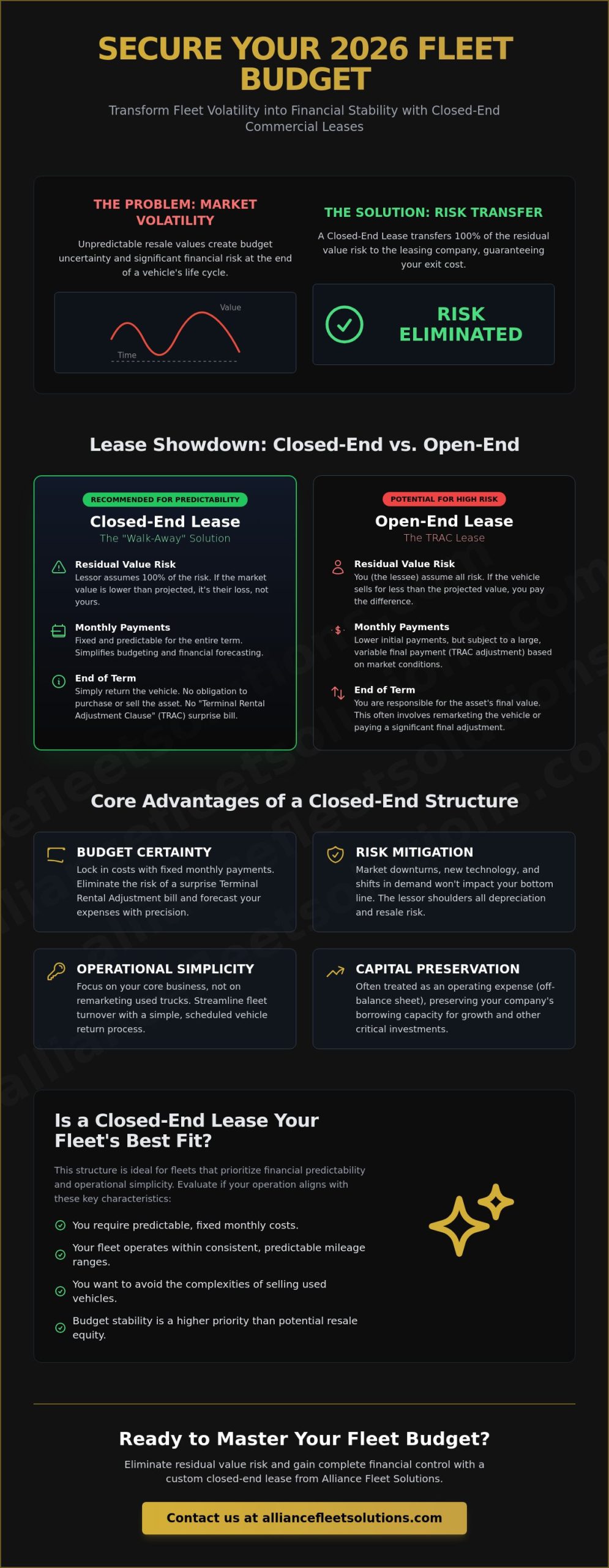
Closed-End vs. Open-End Leases: Which Fits Your Fleet?
Choosing a closed-end lease for commercial vehicles often comes down to how much risk your company is willing to carry on its balance sheet. The fundamental difference lies in who takes responsibility for the asset at the end of the term. In an open-end lease, the lessee is responsible for the difference between the depreciated book value and the actual market sale price. In a closed-end structure, that responsibility shifts entirely to the leasing company. This distinction transforms your fleet from a fluctuating capital asset into a fixed operating expense.
Predictability is the primary driver here. If your vehicles operate in environments where mileage is consistent and the physical wear is manageable, the closed-end model is almost always the superior choice. However, you must evaluate the usage intensity of your assets. Vehicles used in heavy construction or off-road environments might face higher reconditioning costs at the end of a closed-end term. Conversely, for standard highway or urban use, the walk-away guarantee provides a level of financial security that open-end agreements simply cannot match. You trade the flexibility of early termination for the absolute certainty of your final costs.
Choosing the Right Model for Your Industry
Delivery and courier services typically favor the closed-end model because their routes are often fixed and mileage is easy to project. This allows them to set realistic mileage bands and cycle their trucks every three to five years without the administrative burden of remarketing used assets. For these businesses, the goal is high uptime and a modern brand image, not playing the used vehicle market. On the other hand, specialized heavy equipment with highly variable lifecycles might lean toward an open-end structure. Your decision should be based on a clear framework of vehicle replacement cycles; if you plan to replace your trucks every 48 months regardless of market conditions, the closed-end guarantee is your best defensive tool.
Assessing Your Risk Tolerance
Managing the sale of a used commercial truck is a specialized task that requires significant infrastructure. Does your company have the staff to handle title transfers, inspections, and buyer negotiations for a national fleet? Most logistics managers prefer to focus on their core business rather than remarketing. Market fluctuations can create massive swings in your annual financial reporting if you are tied to open-end residuals. A robust strategy for maintenance management is essential here. By keeping your vehicles in peak condition, you ensure they meet the return standards of your closed-end agreement, protecting you from excess wear-and-tear charges while the lessor handles the ultimate sale of the asset.
Evaluating Your Fleet for a Closed-End Structure
Success with a closed-end lease for commercial vehicles depends on your ability to define and manage operational boundaries. While the lessor takes the residual risk, your responsibility lies in returning the asset in a condition that meets contractual standards. For commercial pickups and vans, “reasonable wear and tear” typically excludes structural damage or heavy interior upholstery tears but allows for minor cosmetic scuffs consistent with professional use. In 2026, as fleets integrate more diverse vehicle types, including new electric models, these standards are becoming more technical and specific to the asset type.
Maintenance is the bedrock of lease compliance. You must ensure every asset remains in “good” condition as defined by your agreement. This isn’t just about avoiding penalties; it’s about protecting your operational uptime. With the 2026 supply chain stabilizing, parts availability has improved, making it easier to stick to rigorous schedules. If you fail to document service history, you risk end-of-term charges that can erode the financial benefits of the lease. Consistent upkeep ensures that your vehicles meet the 6,000-pound GVWR threshold requirements for specific tax deductions while remaining safe for your drivers.
Defining Commercial Standards for National Consistency
Standardizing inspection criteria is vital for national fleets. When your vehicles operate across multiple states, a dent in Texas should be evaluated the same way as one in New York. Proactive upkeep prevents the “death by a thousand cuts” scenario where minor issues accumulate into major penalties. Leveraging fleet management services allows you to automate this compliance, ensuring every truck meets its benchmarks before the term ends. This proactive approach turns lease-end inspections from a source of anxiety into a routine administrative task.
Managing Mileage and Asset Rotation
Setting realistic mileage bands is your best defense against overage charges. If you under-estimate, you pay per-mile fees; if you over-estimate, you pay for capacity you didn’t use. Rotating vehicles between high-use urban routes and low-mileage local service helps balance the odometer across the entire fleet. Modern telematics and GPS data provide real-time forecasting, allowing you to see where your mileage will be months before the lease expires. Performing a mid-term lease audit is essential to catch discrepancies early and adjust your rotation strategy. To optimize your asset usage and avoid end-of-term surprises, you should consult with the experts at Alliance Fleet Solutions to build a data-driven rotation plan.
Strategic Acquisition with Alliance Fleet Solutions
Choosing a closed-end lease for commercial vehicles is a strategic decision that requires a partner who understands the full lifecycle of a heavy-duty asset. Alliance Fleet Solutions acts as the essential backbone for your operation, providing the technical expertise to turn vehicle acquisition into a competitive advantage. We utilize national procurement power to source vehicles that align with your specific 2026 business goals; this ensures you get the right equipment without the typical lead-time frustrations. Our fractional fleet management model offers you expert oversight and high-level strategy without the overhead of a full-time department.
The transition at the end of the term is where our partnership truly shines. Because we handle vehicle remarketing internally, the “walk-away” promise of your lease is fully realized without administrative friction. We manage the logistics of returning the asset, allowing your team to stay focused on deliveries and service calls. This end-to-end support ensures that your fleet turnover every three to five years is a steady, logical progression rather than a disruptive event.
Custom Upfitting Within a Lease Framework
One common concern for managers is how custom equipment affects their return rights. Alliance specializes in professional upfitting, integrating custom bins, racks, and specialized technology directly into your lease agreement. We ensure these modifications are performed to industrial standards, which maintains the high residual value required for a closed-end structure. This allows you to combine the cost of the vehicle and the upfit into a single monthly payment, simplifying your accounting and protecting your capital. By coordinating the upfit during the acquisition phase, we deliver work-ready trucks that are compliant with your contract from day one.
National Support and Lifecycle Management
Managing a fleet that spans multiple regions requires a partner with a national footprint. We coordinate deliveries and returns across the country, ensuring consistency in vehicle specs and maintenance standards. Alliance serves as a strategic partner, not just a lessor; we provide the data and technical depth needed to optimize your lifecycle management. This includes real-time monitoring of lease compliance and proactive maintenance scheduling to keep your trucks in “good” condition. If you’re ready to stabilize your budget and eliminate residual risk, Contact Alliance Fleet Solutions to build your custom leasing strategy today.
Secure Your 2026 Fleet Performance
Navigating the 2026 logistics landscape requires a shift from asset ownership to strategic risk management. A closed-end lease for commercial vehicles effectively transfers the burden of depreciation to the lessor, protecting your capital from market swings. By locking in fixed monthly costs and establishing clear operational boundaries, you ensure that your fleet remains a productive asset rather than a financial liability. It’s about turning unpredictable resale values into a manageable, fixed line item that won’t disrupt your bottom line.
Success depends on more than just a contract; it requires a partner with national procurement and upfitting expertise. Alliance Fleet Solutions integrates comprehensive maintenance and fuel management into your strategy, ensuring your vehicles stay on the road and within compliance. We handle the expert vehicle remarketing at the end of every term, allowing you to cycle your equipment with zero friction. Optimize your fleet with a custom closed-end lease from Alliance Fleet Solutions and take control of your long-term operational costs. Your business deserves the stability of a well-structured fleet. Let’s build a more resilient operation together.
Frequently Asked Questions
What is the primary difference between a closed-end and open-end lease?
The primary difference is who carries the residual value risk at the end of the term. In a closed-end agreement, the lessor assumes the risk that the vehicle will be worth less than predicted when the lease expires. In an open-end lease, your business is responsible for paying the difference if the actual resale price falls below the depreciated book value. This makes the closed-end model a safer choice for companies that prioritize budget certainty.
Can I upfit a vehicle that is under a closed-end lease?
Yes, you can upfit a vehicle under a closed-end lease as long as the modifications are approved and integrated into the initial contract. Professional upfitting ensures that bins, racks, and specialized technology are installed to industrial standards, which protects the vehicle’s residual value. This process allows you to include the cost of the equipment in your fixed monthly payment, keeping your acquisition costs predictable and manageable.
What happens if my fleet exceeds the mileage limit on a closed-end lease?
Exceeding the mileage limit results in per-mile overage charges that are clearly specified in your lease agreement. To avoid these unexpected costs, most managers use telematics to monitor usage in real-time and rotate vehicles between high-use and low-use routes. Setting realistic mileage bands at the start of the agreement is the most effective way to protect your budget from end-of-term penalties.
Are maintenance costs included in a commercial closed-end lease?
Maintenance is not automatically included, but it’s frequently bundled into a closed-end lease for commercial vehicles through a comprehensive management program. This ensures the asset remains in the good condition required for return while stabilizing your monthly operating expenses. Bundling these services provides a single, predictable line item for your fleet budget, which reduces administrative overhead and prevents maintenance-related budget spikes.
How does a closed-end lease affect my company’s balance sheet in 2026?
In 2026, a closed-end lease typically qualifies as an operating lease, which may allow for off-balance sheet treatment and preserve your company’s borrowing capacity. You should consult IRS Revenue Procedure 2026-15 for the latest lease inclusion tables and depreciation limits applicable to this year. This structure helps maintain a cleaner balance sheet compared to traditional financing or open-end structures that might require asset capitalization.
Is a closed-end lease better for heavy-duty trucks or light-duty vans?
A closed-end lease is often ideal for light-duty vans and delivery trucks because their routes are usually predictable and mileage is easy to forecast. However, heavy-duty trucks also benefit from this structure if their usage intensity is consistent and the physical environment is manageable. The decision depends less on vehicle size and more on your ability to accurately project mileage and wear over the 12 to 60-month term.
What defines ‘excessive wear and tear’ for a commercial vehicle?
Excessive wear and tear refers to damage that goes beyond minor cosmetic scuffs or expected professional use. This includes structural frame damage, heavy interior upholstery tears, missing equipment, or mechanical failure caused by neglected maintenance. Clear contractual guidelines ensure that national fleets have a consistent standard for end-of-term inspections, preventing disputes when it’s time to cycle out your assets.
Can I terminate a closed-end commercial lease before the term ends?
You can terminate a closed-end lease early, but it usually involves an early termination fee. These agreements are structured for a fixed term to provide the maximum level of residual value protection for your business. If your operation requires high levels of flexibility for frequent asset turnover, it’s essential to discuss specific exit strategies with your fleet partner before signing the agreement.