
In 2026, fleet negotiation isn’t about haggling over a few dollars at a dealership; it’s about data-backed volume commitments and lifecycle synchronization. Most managers find themselves buried under opaque pricing structures like CAP, VIP, or CPA while trying to lower upfront acquisition costs without losing vehicle quality. If you feel like you’re losing the battle against rising dealership service rates and inflation, you aren’t alone. Mastering the art of negotiating with vehicle manufacturers for fleet pricing is the only way to protect your bottom line in this high-stakes environment.
We understand the pressure of balancing brand diversification with the need for single-source discounts. This guide provides a clear roadmap to help you leverage manufacturer programs to secure the lowest total cost of ownership for your commercial fleet. You’ll learn how to capitalize on 2026 incentives, such as the $7,000 Ram ProMaster allowance, and how to utilize the $2,560,000 Section 179 deduction limit. We’ll show you how to turn complex procurement into a strategic business asset that ensures long-term reliability and safety for your entire operation.
Key Takeaways
- Learn why the factory invoice isn’t the true baseline for fleet procurement and how to identify the hidden margins that impact your bottom line.
- Master the technical nuances of CAP, CPA, and VIP programs when negotiating with vehicle manufacturers for fleet pricing to secure long-term cost stability.
- Evaluate the financial advantages of single-source volume commitments against the risk-mitigation benefits of a diversified, multi-manufacturer fleet.
- Follow a structured negotiation checklist to align your 36-month volume projections with specific requirements for professional upfitting and operational readiness.
- Discover how partnering with a fleet management company provides access to tier-one pricing and eliminates the administrative burden of incentive compliance.
Decoding the Fleet Pricing Structure: Beyond the Factory Invoice
The Monroney label serves its purpose on a showroom floor, but it has no place in a professional procurement strategy. For an industry manager, the “sticker price” is a distraction from the financial levers that drive total cost of ownership. When negotiating with vehicle manufacturers for fleet pricing, the goal is to peel back layers of dealer margin and manufacturer padding to reach the true net cost. Relying on retail price points will leave your budget exposed to unnecessary inflation.
A “Factory Invoice” is often presented as the floor, yet it contains hidden credits like dealer holdbacks. These holdbacks are usually a percentage of the MSRP or invoice price that the OEM pays back to the dealer after a sale. In a high-volume fleet transaction, these funds are frequently used as leverage to reduce the unit cost even further. Understanding how these incentives are applied at the point of lease inception is critical. They directly lower the capitalized cost, which in turn reduces your monthly obligation and improves your operational cash flow.
The Anatomy of a Fleet Incentive
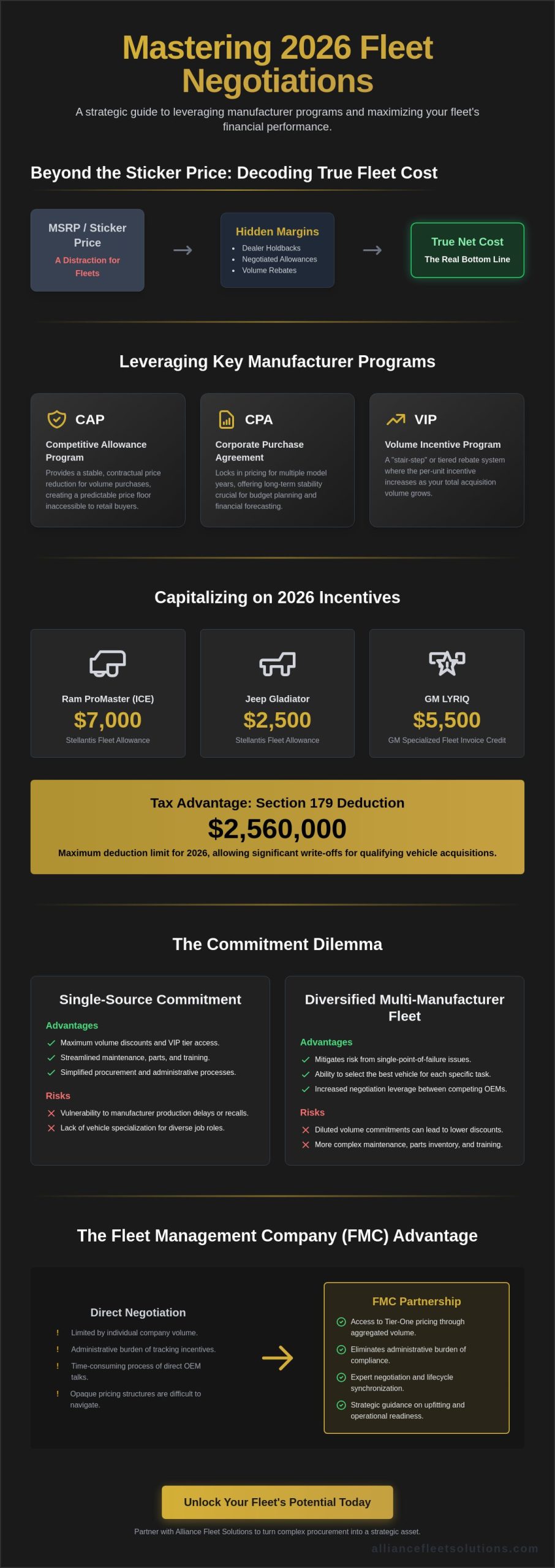
Incentive structures vary, but most rely on a combination of standard fleet rebates and negotiated competitive allowances. A Competitive Allowance Program is a contractual price reduction for volume. Unlike retail rebates that change monthly, these allowances provide a stable price floor for the duration of a model year. Some manufacturers utilize “stair-step” incentives, where the discount per unit increases as your total volume hits specific tiers. For example, the 2026 Stellantis Fleet Empowerment Program offers specific incentives like $7,000 for a Ram ProMaster (ICE) or $2,500 for a Jeep Gladiator, provided the vehicles meet the 12-month or 12,000-mile service requirement.
Why Retail Tactics Fail in B2B Procurement
Treating a fleet acquisition like a retail car purchase is a costly mistake. Retail tactics focus on winning a single transaction, while effective fleet management focuses on long-term scalability and lifecycle synchronization. Individual unit negotiation is inefficient and prevents you from securing the multi-year stability offered by a Corporate Purchase Agreement. Timing also plays a role; manufacturers operate on strict production cycles. Missing an ordering window for 2026 models, such as the GM National Fleet Purchase Program delivery deadline of January 4, 2027, can force you into more expensive “out-of-stock” purchases that bypass negotiated incentives entirely. Proactive planning ensures you don’t pay a premium for lack of foresight.
Leveraging Manufacturer Programs: CAP, CPA, and VIP Explained
Modern fleet procurement requires a deep understanding of the acronyms that manufacturers use to categorize their incentives. Competitive Allowance Programs (CAP) represent the baseline for any serious procurement effort. They provide a predictable price floor that retail buyers simply cannot access. When negotiating with vehicle manufacturers for fleet pricing, you aren’t just asking for a discount; you’re establishing a multi-year financial framework. This is where Commercial Pricing Agreements (CPA) become invaluable. A CPA locks in pricing for several model years, offering the stability needed to plan budgets even as the Federal Reserve is anticipated to continue cutting interest rates through 2026.
Volume Incentive Programs (VIP) function like a rebate ladder. As your acquisition numbers climb, the per-unit incentive increases, rewarding your commitment to a specific brand. While private commercial deals offer more flexibility in vehicle specifications, many managers look to the GSA fleet purchasing program as a benchmark for how massive volume leverage drives down unit costs. Understanding these distinctions allows you to choose the program that aligns with your specific growth trajectory and cash flow requirements.
Navigating Manufacturer-Specific Programs
The “Big Three” domestic manufacturers have launched aggressive programs for the 2026 model year. Stellantis is offering significant incentives, such as $7,000 for the Ram ProMaster and up to $2,500 for the Jeep Gladiator. Meanwhile, GM is focusing on the electric transition, providing invoice credits of $5,500 for the LYRIQ through specialized fleet programs. Import manufacturers are also expanding their commercial footprints, often bundling infrastructure credits with their newer EV models to compete for US market share. Choosing between these options requires analyzing more than just the upfront credit; you must account for the 10-14% budgetary buffer recommended for 2026 operating costs.
The Role of Data in Modern Negotiations
Data is the most powerful tool in a fleet manager’s arsenal. By utilizing telematics and GPS solutions, you can prove usage patterns to manufacturers that justify better warranty extensions or specialized maintenance packages. If your data shows your vehicles are operating in low-stress environments, you have the leverage to negotiate for higher residual value projections in your CAP pricing. This data-driven approach transforms you from a buyer into a strategic partner. If navigating these complex programs feels overwhelming, our experts can help you optimize your vehicle acquisition strategy to ensure you never leave money on the table.
The Commitment Dilemma: Single-Sourcing vs. Diversified Fleets
Choosing between a single-manufacturer commitment and a diversified fleet is one of the most consequential decisions in procurement. A “100% Commitment” CAP deal provides the ultimate leverage. When negotiating with vehicle manufacturers for fleet pricing, offering exclusivity guarantees the OEM a specific market share, which often unlocks the deepest possible discounts and “tier-one” status. This financial power is hard to ignore, especially when you need to offset the 10-14% budgetary buffer required for 2026 operating costs. However, putting all your eggs in one basket creates a single point of failure that can disrupt your entire logistics chain.
Supply chain disruptions still linger for specialized commercial units in 2026. If your chosen manufacturer faces a production delay or a major safety recall, a single-source strategy could ground your entire operation. Diversification serves as a strategic hedge. By maintaining relationships with multiple OEMs, you ensure that a localized failure doesn’t become a systemic catastrophe. This approach also influences your long-term financial performance. A diversified portfolio helps protect your vehicle remarketing outcomes, as you avoid flooding the secondary market with a single make and model when it’s time to cycle units out of service.
Maximizing the Benefits of Single-Sourcing
The primary advantage of a homogenous fleet is operational simplicity. You achieve significant cost savings through maintenance management consistency, as your technicians only need to master one set of diagnostic tools and engine architectures. Parts inventory becomes leaner and more efficient. Beyond the shop, single-sourcing streamlines driver training and safety compliance. When every vehicle has identical controls and telematics interfaces, you reduce the risk of operator error and simplify your internal safety protocols. Manufacturers also reward this loyalty with priority production slots, ensuring your orders are filled first during periods of high demand.
When Diversification Outperforms Commitment
Diversification is often the superior choice for fleets with varied duty cycles. No single manufacturer excels at every vehicle class; one brand might offer the best light-duty electric vans, while another dominates the heavy-duty towing sector. Matching specific vehicle strengths to your operational roles ensures you aren’t overpaying for capability you don’t need or under-equipping your drivers. Additionally, a “split-fleet” strategy keeps manufacturers aggressive. When OEMs know they’re competing for a larger share of your business, they’re more likely to offer “rifle-shot” pricing and enhanced support packages to win you over. This competition is a powerful tool for negotiating with vehicle manufacturers for fleet pricing throughout the model year.
The Fleet Manager’s Negotiation Checklist for 2026
Mid-market fleet operators often assume tier-one pricing is reserved for the Fortune 500. This is a misconception. You can access significant savings by approaching the table with a structured, data-heavy plan. Success in negotiating with vehicle manufacturers for fleet pricing depends on your ability to present a clear, long-term commitment that reduces the OEM’s risk. Use the following checklist to ensure you’re capturing every available incentive before signing a single order.
- Aggregate Volume Projections: Don’t just look at next month. Combine your 12-month and 36-month volume needs to show manufacturers the total potential of your partnership.
- Define Technical Specs: Establish your “must-have” requirements for professional upfitting early. This prevents mid-cycle changes that can void negotiated discounts.
- Solicit Triple Proposals: Always request competing CAP proposals from at least three different manufacturers to maintain a competitive environment.
- Model Total Cost: Factor in fuel economy and fuel management programs. A vehicle with a higher acquisition price might be cheaper over five years if its fuel efficiency is superior.
- Align Lease Structures: Choose between Open-End and Closed-End leasing based on your remarketing strategy. Your lease structure should directly support the acquisition price you’ve negotiated.
Integrating Upfitting into the Negotiation
Upfitting shouldn’t be an afterthought. During your negotiation, request access to “bailment pools,” which are inventories of chassis held specifically for upfitters to ensure faster delivery. You should also ask for manufacturer “ship-thru” credits; these allow the vehicle to be sent to an upfitter and then returned to the manufacturer’s transportation system at a reduced cost. By amortizing upfitting costs within the negotiated lease CAP cost, you can spread the financial impact across the vehicle’s service life and preserve your upfront capital.
Timing the Market for Maximum Leverage
Timing is just as important as volume. You must track “order bank” opening and closing dates for 2026 models to avoid being forced into expensive dealer stock. For example, GM requires delivery by January 4, 2027, for many 2026 fleet programs. Negotiate for “price protection” to ensure that if the manufacturer raises prices after you’ve placed your order, your original quote remains valid. If you have immediate needs, leverage year-end sales targets to secure discounts on “in-stock” inventory that manufacturers are eager to move before the new model year. If you’re ready to modernize your procurement process, our team can streamline your vehicle acquisition to ensure you get the best possible terms.
Bridging the Gap: Why FMC Partnerships Outperform Direct Negotiation
Directly negotiating with vehicle manufacturers for fleet pricing can be an exhausting process for businesses without massive scale. While an individual company might struggle to move the needle, a Fleet Management Company (FMC) leverages the power of aggregated volume. By pooling the purchasing needs of multiple clients, Alliance Fleet Solutions provides access to pricing tiers that manufacturers typically reserve for the largest national accounts. This partnership transforms your procurement from a transactional struggle into a strategic advantage, ensuring you capture every possible dollar in manufacturer incentives without needing a Fortune 500 budget.
Beyond the initial price, the administrative burden of program compliance is significant. Manufacturers require meticulous reporting to verify that vehicles remain in service for mandated durations, such as the 12-month retention requirement for many 2026 programs. We eliminate this stress by handling the entire compliance lifecycle, from initial enrollment to final reporting. Our role as your strategic procurement arm extends into Vehicle Remarketing, where we ensure the savings achieved during acquisition are protected through professional disposal strategies that maximize residual returns at the end of the lifecycle.
Fractional Fleet Management and Procurement
Many organizations lack the budget or the need for a full-time fleet department. This is where Fractional Fleet Management delivers the highest value. You gain access to seasoned negotiators who understand the specific nuances of the 2026 model year without the overhead of a dedicated executive. We provide brand-agnostic advice, helping you choose between ICE, hybrid, or EV powertrains based on objective data rather than manufacturer marketing. We also provide continuous monitoring of program changes, ensuring your Vehicle Acquisition strategy adapts quickly as order banks open and close throughout the year.
Securing Your 2026 Fleet Strategy
Moving from reactive buying to proactive lifecycle management is the most effective way to lower your total cost of ownership. A professionally negotiated fleet lease is a long-term financial tool that supports your operational goals and stabilizes your cash flow. By integrating technical authority with a partnership-first approach, we help you navigate the complexities of 2026 procurement with expert control. Contact Alliance Fleet Solutions today for a comprehensive procurement audit to identify hidden savings and secure a more resilient, cost-effective fleet operation for the years ahead.
Securing Your Competitive Edge in 2026 Procurement
Successful fleet management in 2026 requires moving beyond basic unit pricing to embrace comprehensive lifecycle strategies. By mastering the nuances of CAP and CPA programs, you transform vehicle acquisition from a simple purchase into a high-performance business asset. Negotiating with vehicle manufacturers for fleet pricing is no longer just about the initial discount; it’s about securing long-term stability in an evolving market. You’ve seen how data-driven decisions and strategic volume commitments can protect your bottom line against inflation and rising service costs.
Partnering with a professional team ensures your volume commitments translate into Fortune 500-level incentives. We provide the technical expertise needed for multi-manufacturer CAP negotiations and deliver comprehensive TCO modeling that accounts for every variable, from fuel management to professional upfitting. With our national reach and commitment to personalized partnership, we handle the administrative burden so you can focus on your core operations. Expert control is the backbone of any functional logistics operation.
Don’t leave your procurement outcomes to chance. Optimize your fleet procurement with Alliance Fleet Solutions and gain the strategic assets your business deserves. We’re ready to help you build a safer, more efficient, and more profitable fleet today.
Frequently Asked Questions
What is a Competitive Allowance Program (CAP) in fleet management?
A Competitive Allowance Program (CAP) is a formal agreement where a manufacturer provides a specific, front-end price reduction on new vehicle purchases for qualified fleet customers. These programs establish a consistent discount level for the entire model year, ensuring your costs remain stable regardless of retail market fluctuations. It acts as a contractual price floor that is significantly lower than the standard factory invoice.
Can a small business with only 10 vehicles get fleet pricing?
Yes, businesses with as few as 10 vehicles can often access fleet pricing by partnering with a fleet management company or utilizing specific small-fleet incentive programs. Small operators benefit from “aggregated volume” when working with an FMC, which allows them to tap into the same tier-one incentives usually reserved for national corporations. This approach ensures smaller fleets don’t pay a retail premium for their equipment.
Is it better to negotiate with a local dealer or the manufacturer directly?
It’s best to negotiate the core pricing program with the manufacturer directly while using the dealer for order placement and physical delivery. Direct negotiation ensures you secure the best CAP or CPA incentives and national fleet status. The dealer then manages the logistical “courtesy delivery” and provides local maintenance support, creating a balanced relationship between manufacturer pricing and local service.
How do manufacturer incentives affect the monthly lease payment?
Manufacturer incentives directly reduce the capitalized cost of the vehicle, which is the primary factor in determining your monthly lease payment. When successfully negotiating with vehicle manufacturers for fleet pricing, you lower the total amount being financed. This results in significant interest savings and improved monthly cash flow, allowing you to allocate capital to other areas of your business operation.
What is the difference between a CAP and a CPA?
A CAP provides a specific dollar-amount discount per unit, whereas a CPA (Commercial Pricing Agreement) is a broader contract that locks in pricing and terms for a multi-year period. While a CAP focuses on immediate price reduction for the current model year, a CPA offers long-term budgetary certainty. This protection is vital for businesses looking to hedge against annual price hikes and inflation.
How does vehicle upfitting impact the final negotiated price?
Upfitting adds to the initial unit cost, but these expenses can be amortized into your lease to spread the financial impact over the vehicle’s service life. You can also negotiate for “ship-thru” credits and bailment pool access during the procurement phase. These credits reduce transportation fees and ensure your specialized units are delivered ready-to-work, minimizing the downtime typically associated with secondary equipment installation.
Can I negotiate fleet pricing on electric vehicles (EVs) in 2026?
Negotiating with vehicle manufacturers for fleet pricing on electric vehicles is highly effective in 2026 as OEMs aggressively compete for commercial market share. For example, GM offers invoice credits of $5,500 for the 2026 LYRIQ through specialized programs. These incentives are often paired with infrastructure support and tax benefits, such as the Section 179 deduction, to significantly lower the total cost of ownership.
What happens to my negotiated price if I don’t meet my volume commitment?
Failing to meet your volume commitment can lead to a “chargeback,” where the manufacturer bills you for the difference between the fleet discount and the standard price. Manufacturers track these commitments closely to ensure program integrity. To avoid this financial penalty, it’s critical to provide realistic 36-month projections and work with a partner who can help adjust your procurement strategy if your operational needs change.