
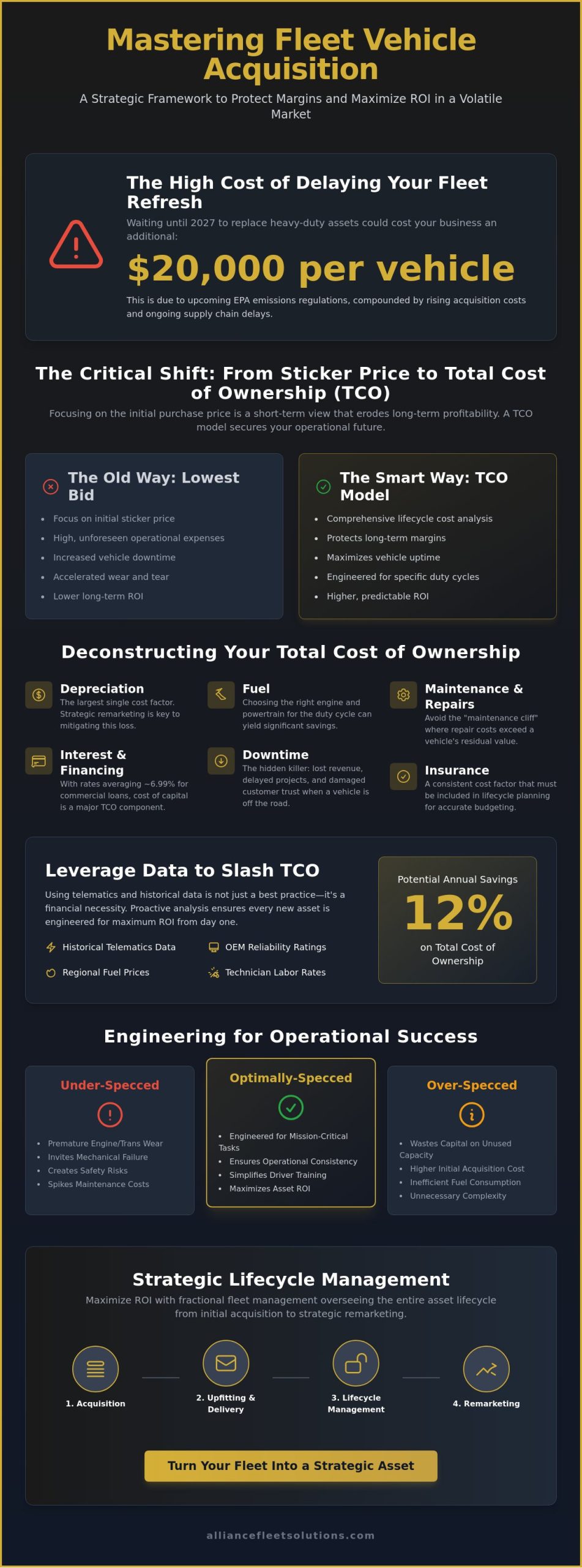
Waiting until 2027 to refresh your heavy-duty assets could cost your business an additional $20,000 per vehicle due to upcoming EPA emissions regulations. Many fleet managers are already feeling the squeeze of rising acquisition costs and supply chain delays that push vehicle ages well beyond their prime. You likely recognize that the traditional buy and hold method isn’t enough to protect your margins anymore. Mastering fleet vehicle acquisition best practices is no longer just about getting a good deal at the dealership; it’s about securing your operational future in a volatile market.
This guide will show you how to master the complexities of commercial procurement by balancing technical specifications with smart financial structures. You’ll learn which leasing models actually fit your tax strategy and how to use telematics data to slash your total cost of ownership by up to 12% annually. We’ll walk through a streamlined process for professional upfitting and delivery so your new equipment hits the road ready to work, not stuck in a shop. By the end, you’ll have a clear framework to turn your fleet into a high-performing strategic asset.
Key Takeaways
- Shift your focus from the initial sticker price to a comprehensive Total Cost of Ownership (TCO) model to protect long-term margins.
- Align technical specifications with actual field requirements to ensure every vehicle is engineered for its specific mission-critical tasks.
- Implement fleet vehicle acquisition best practices by selecting the leasing structure that best matches your organization’s tax and cash flow needs.
- Integrate professional upfitting into the early stages of procurement to prevent delivery delays and ensure vehicles are road-ready upon arrival.
- Maximize asset ROI by leveraging fractional fleet management to oversee the entire lifecycle from initial acquisition to strategic remarketing.
Rethinking Fleet Vehicle Acquisition: From Unit Price to Total Cost of Ownership (TCO)
Procuring a commercial vehicle is the beginning of a multi-year financial commitment, not just a one-time transaction. Many organizations fall into the trap of selecting the lowest bid, only to find that those initial savings are swallowed by high operational expenses. Mastering fleet vehicle acquisition best practices requires a shift in perspective. You must evaluate every asset through the lens of Total Cost of Ownership (TCO) to protect your bottom line. A cheap truck that spends 20% of its time in the shop is significantly more expensive than a premium model with high uptime.
TCO is a comprehensive metric that includes depreciation, fuel, insurance, interest, and maintenance. In 2026, these variables are more volatile than ever. With interest rates for commercial financing averaging around 6.99% for well-qualified buyers, the cost of capital must be a central part of your calculation. Effective fleet management relies on predicting these costs over a five to seven-year lifecycle. Proactive fleet planning cycles allow you to replace assets before they reach the “maintenance cliff,” where repair costs exceed the vehicle’s residual value.
The Hidden Costs of Improper Acquisition
Selecting the wrong vehicle for a specific job creates a ripple effect of expenses. If a van is under-specced for its daily payload, the engine and transmission will wear prematurely, causing maintenance management costs to spike. Beyond repair bills, the impact of downtime is devastating. When a vehicle is off the road, you lose revenue and risk damaging customer trust. Buying “off-the-lot” vehicles often seems convenient, but these units rarely match specific commercial duty cycles, leading to inefficient fuel consumption and accelerated wear.
Data-Driven Procurement Framework
Modern procurement thrives on hard data. You should utilize historical telematics information to identify which engine and transmission configurations perform best in your specific environment. Labor rates for specialized technicians have risen by 12% since 2024; therefore, choosing OEMs with high reliability ratings is a strategic necessity. Your framework should also factor in regional energy trends and fuel prices. By analyzing these data points during the acquisition phase, you can ensure that every new asset is engineered for maximum ROI from day one.
Technical Specification Development: Engineering Your Fleet for Operational Success
Successful procurement starts long before you look at a window sticker. It begins with engineering. Designing a vehicle that perfectly matches its intended use is one of the most impactful fleet vehicle acquisition best practices you can implement. If you over-spec a vehicle, you waste capital on unused capacity; if you under-spec, you invite mechanical failure and safety risks. To find the right balance, you must bridge the gap between the boardroom and the field. Collaborating with field operators helps identify mission-critical features, such as specific shelving layouts or power takeoff (PTO) requirements, that standard models often lack.
Standardizing these specifications across your organization creates a foundation for operational consistency. A uniform fleet simplifies driver training and allows for a leaner parts inventory, which directly supports your long-term maintenance goals. While standardizing is the goal, you should remain flexible enough to adapt to regional environmental conditions or specific job site demands. This approach aligns with the Federal Fleet Management Framework, which emphasizes strategic data collection and lifecycle planning as the core of a functional fleet.
Determining the Optimal Duty Cycle
A duty cycle is the blueprint for vehicle longevity. It encompasses everything from daily mileage and idle time to the specific environmental conditions of the route. For example, a truck performing stop-and-go urban deliveries requires a different powertrain than one hauling equipment on open highways. In 2026, selecting the right powertrain is a high-stakes decision. With engine technology costs expected to rise by 18% for 2027 models, many managers are using 2026 to pre-buy gas or diesel assets. However, for urban routes with high idle times, telematics data often shows that downsizing or transitioning to alternative powertrains can slash annual ownership costs by up to 12%.
Standardization vs. Customization
While a uniform fleet is easier to manage, specialized applications often require professional upfitting to be truly effective. The key is to ensure that any customization doesn’t compromise safety or regulatory adherence. Every modification should align with your corporate fleet safety compliance standards. By integrating safety technology and telematics at the point of acquisition, you future-proof your assets against evolving 2026 industry requirements. If you’re unsure how to balance these technical needs, partnering with an expert for vehicle acquisition ensures your specs are engineered for performance from day one.
Financial Acquisition Strategies: Evaluating Open-End vs. Closed-End Leasing
Selecting the right financial structure is just as critical as choosing the right vehicle specifications. In a market where commercial financing APRs hover around 6.99% for 84-month terms, the way you capitalize your assets directly impacts your cash flow and balance sheet health. You must decide whether your organization is better suited to bear the residual value risk or if you prefer the predictability of a fixed monthly expense. Mastering fleet vehicle acquisition best practices requires a deep understanding of how these different leasing models interact with your specific operational duty cycles and tax strategies.
Your choice of lease affects more than just your monthly payment. It dictates your flexibility to replace vehicles when maintenance costs spike or when market conditions shift. By aligning your financial strategy with the actual usage of your trucks and vans, you protect your business from the volatility of the used vehicle market. This strategic approach ensures that your acquisition process remains a business solution rather than a mounting liability.
Open-End Leasing: The Commercial Standard
Open-End Leasing is the preferred choice for many high-mileage commercial operations because of its inherent flexibility. Unlike consumer leases, this model typically utilizes a Terminal Rental Adjustment Clause (TRAC). This means the lessee, your business, assumes the residual value risk but also retains any equity at the end of the term. If you maintain your vehicles well and remarket them effectively, you can recoup significant capital. There are no mileage restrictions or wear-and-tear penalties, making it ideal for unpredictable vocational applications where trucks might cover 30,000 miles one year and 50,000 the next. It allows you to shorten or extend the lease term based on the vehicle’s actual condition rather than a rigid contract date.
Closed-End Leasing: Fixed-Cost Predictability
Closed-End Leasing offers a “walk-away” solution that appeals to budget-conscious organizations with highly predictable routes. In this model, the lessor assumes the risk of the vehicle’s residual value. You pay a fixed monthly amount and return the vehicle at the end of the term without worrying about market fluctuations. However, this predictability comes with strict mileage limits and specific requirements for vehicle condition upon return. This structure is often best for sales fleets or light-duty applications where mileage is consistent and the operational environment is relatively controlled. It provides a clear, transparent cost structure that simplifies long-term budgeting for organizations that prioritize low risk over equity potential.
The Critical Mid-Phase: Professional Upfitting and Vehicle Acceptance Best Practices
Acquisition is a multi-step journey that doesn’t end when the financing papers are signed. The transition from the factory floor to the job site is often the most mismanaged phase of the lifecycle. Integrating upfitting into your initial procurement timeline is one of the most effective fleet vehicle acquisition best practices to prevent costly delivery delays. When upfitting is treated as an afterthought, you risk vehicles sitting idle in secondary shops for weeks, burning capital without generating revenue while your field teams wait for essential equipment.
Choosing a single-source partner who combines acquisition with high-quality installation provides a massive logistical advantage. This approach ensures that technical specifications for cranes, refrigeration units, or specialized shelving are baked into the chassis order from the start. It eliminates the friction of coordinating between multiple vendors and ensures that quality control protocols are applied consistently across the entire build. For instance, testing a refrigeration unit’s pull-down time or a crane’s hydraulic pressure before the vehicle leaves the facility prevents expensive field failures later. This integrated strategy keeps your project on schedule and your technical standards high.
Designing for Productivity
Productivity is won or lost in the design phase. Ergonomic upfitting reduces driver fatigue and minimizes the risk of workplace injuries, which are major hidden costs in the logistics sector. You must also conduct a rigorous weight distribution analysis to ensure that heavy equipment doesn’t exceed the Gross Vehicle Weight Rating (GVWR). Overloading a chassis leads to premature tire wear and brake failure, directly contradicting the goal of long-term reliability. Custom upfitting designed for the specific needs of your technicians is a cornerstone of efficient fleet operations.
The Delivery and Acceptance Protocol
A vehicle isn’t truly “acquired” until it passes a formal intake inspection. You need a rigorous checklist to verify that the delivered unit matches the original OEM specs and your custom upfit requirements perfectly. This is also the time to verify telematics installation and GPS calibration. If your tracking systems aren’t functioning on day one, you lose critical data from the vehicle’s most vulnerable early miles. Finally, conduct a brief driver orientation to ensure your team understands how to use the new technology safely. Following these fleet vehicle acquisition best practices during the mid-phase ensures your assets are truly work-ready the moment they leave the yard. To streamline your next rollout, consider partnering with an expert in Professional Upfitting to handle the technical heavy lifting.
Strategic Lifecycle Management: Maximizing ROI Through Alliance Fleet Solutions
Acquisition is only the first step in a high-performance fleet strategy. To truly master fleet vehicle acquisition best practices, you must view the purchase through the lens of the entire lifecycle. The most successful operators don’t just buy a vehicle; they manage the “Acquire-Operate-Dispose” cycle with precision. Planning your exit strategy at the same time you sign the acquisition papers ensures you aren’t left with an aging, high-maintenance liability when market conditions shift. This forward-thinking approach protects your capital and keeps your operational uptime at its peak.
Many businesses struggle to balance these complex procurement tasks with their daily operations. Leveraging fractional fleet management allows you to supplement your internal resources with expert oversight without the overhead of a full-time department. This partnership model provides the technical authority needed to navigate 2026’s volatile supply chains and shifting emissions regulations. By treating acquisition as a strategic business solution rather than a simple mechanical fix, you position your organization for long-term financial performance and reliability.
The Science of Remarketing
Maximizing resale value is a technical discipline. Capturing the highest residual value requires timing the market perfectly and utilizing multi-channel disposal strategies, including auctions, retail, and wholesale options. A vehicle’s appeal on the secondary market is directly tied to its operational history. For instance, implementing robust fuel management programs does more than lower your daily expenses. It provides a documented record of efficiency and care that increases the vehicle’s desirability when it’s time for vehicle remarketing. Professional remarketing ensures that your assets exit the fleet with the highest possible return on investment.
The Alliance Advantage
Alliance Fleet Solutions provides a national, turn-key acquisition solution that feels like a local partnership. We design custom-configured fleets specifically engineered for your industry KPIs, ensuring that every truck and van is work-ready from day one. Our team understands the mechanics of the heavy-duty sector and the financial language of business efficiency. We act as the essential backbone of your operation, handling everything from technical specs to delivery logistics with expert control. Don’t let procurement stress slow your momentum. Optimize your 2026 acquisition strategy with Alliance Fleet Solutions and secure a more reliable, cost-effective future for your fleet.
Secure Your Fleet’s Future in 2026 and Beyond
The landscape of commercial procurement is shifting rapidly. Success in 2026 requires moving beyond the initial purchase price to embrace a comprehensive TCO model that accounts for rising financing rates and upcoming emissions standards. By engineering your specs for specific duty cycles and integrating professional upfitting from the start, you ensure your assets are productive from their first mile. Implementing these fleet vehicle acquisition best practices isn’t just about saving money today; it’s about building a resilient, high-performing operation that can withstand market volatility and technical shifts.
Alliance Fleet Solutions is ready to act as your strategic partner in this journey. As fractional fleet management specialists and professional upfitting experts, we provide the technical authority and national service coverage your business needs to thrive. We handle the complexities of procurement and lifecycle management so you can focus on your core growth. Our team is committed to ensuring your fleet remains a powerful business asset rather than an operational burden.
Get a Strategic Fleet Acquisition Consultation
Your fleet is the backbone of your business. With a data-driven strategy and the right partnership, you’ll turn every vehicle into a competitive advantage.
Frequently Asked Questions
What is the best time of year to acquire new fleet vehicles?
The best time to acquire vehicles in 2026 is during the second and third quarters to stay ahead of the anticipated “pre-buy” surge. Many fleet managers are placing orders early to secure 2026 models before the stricter 2027 EPA emissions standards take effect. This strategy helps you avoid the projected price increases of up to $20,000 expected for the 2027 model year while ensuring better availability from manufacturers.
How does vehicle upfitting affect the overall lease price?
Professional upfitting costs are typically rolled into the total capitalized cost of the lease, which increases your monthly payment but preserves your working capital. By residualizing these costs, you pay for the equipment over the term of the lease rather than as a large upfront expense. This approach ensures that mission-critical tools like shelving or refrigeration are financed at the same rate as the vehicle chassis, simplifying your accounting and equipment acquisition.
Should I choose an open-end or closed-end lease for my service fleet?
Service fleets generally benefit most from open-end leasing due to the high-mileage and vocational nature of the work. This model offers the flexibility of unlimited mileage and no wear-and-tear penalties, which is essential for trucks and vans in heavy-duty sectors. It allows you to replace assets based on their actual mechanical condition and market equity rather than being restricted by the rigid term limits of a closed-end contract.
How can I reduce the total cost of ownership (TCO) during the acquisition phase?
Reducing TCO starts with selecting the right engine and transmission configurations for your specific duty cycle. Utilizing fleet vehicle acquisition best practices, such as right-sizing your vehicles based on actual payload needs, can slash annual ownership costs by as much as 12%. Focusing on fuel efficiency and choosing OEMs with high reliability ratings prevents the “maintenance cliff” that often plagues under-specced or poorly planned fleets.
What are the most important safety features for commercial vehicles in 2026?
The most critical safety features in 2026 include Advanced Driver Assistance Systems (ADAS) like collision avoidance, lane-keeping assist, and 360-degree camera systems. These technologies are essential for reducing insurance premiums and protecting your technicians in the field. Integrating these features during the procurement phase ensures your fleet meets modern safety compliance standards and reduces the risk of expensive operational downtime caused by preventable accidents.
How does telematics data improve the vehicle procurement process?
Telematics data provides a factual foundation for your next procurement cycle by revealing how your current assets are actually used. By analyzing idle time, fuel consumption, and average daily mileage, you can identify if a vehicle is over-specced or underutilized. This data allows you to refine your technical specifications for the next acquisition, ensuring you only pay for the capacity and performance your specific operations require.
What is fractional fleet management and how does it help with acquisition?
Fractional fleet management is a service that provides you with expert-level management resources on a part-time or project basis. This helps with acquisition by giving you access to seasoned procurement specialists who understand market timing and technical engineering without the cost of a full-time hire. It’s a scalable solution that ensures your fleet vehicle acquisition best practices are handled with professional precision, from specification development to final delivery.
How do I ensure my new fleet vehicles are compliant with national regulations?
Ensuring compliance requires a proactive review of upcoming federal standards, particularly the EPA Clean Trucks Plan effective January 1, 2027. You should work closely with your acquisition partner to verify that every chassis meets current NOx emissions limits and DOT safety requirements. Staying informed about these regulatory deadlines during the procurement phase prevents your business from being forced into expensive, last-minute equipment upgrades or facing non-compliance penalties.