
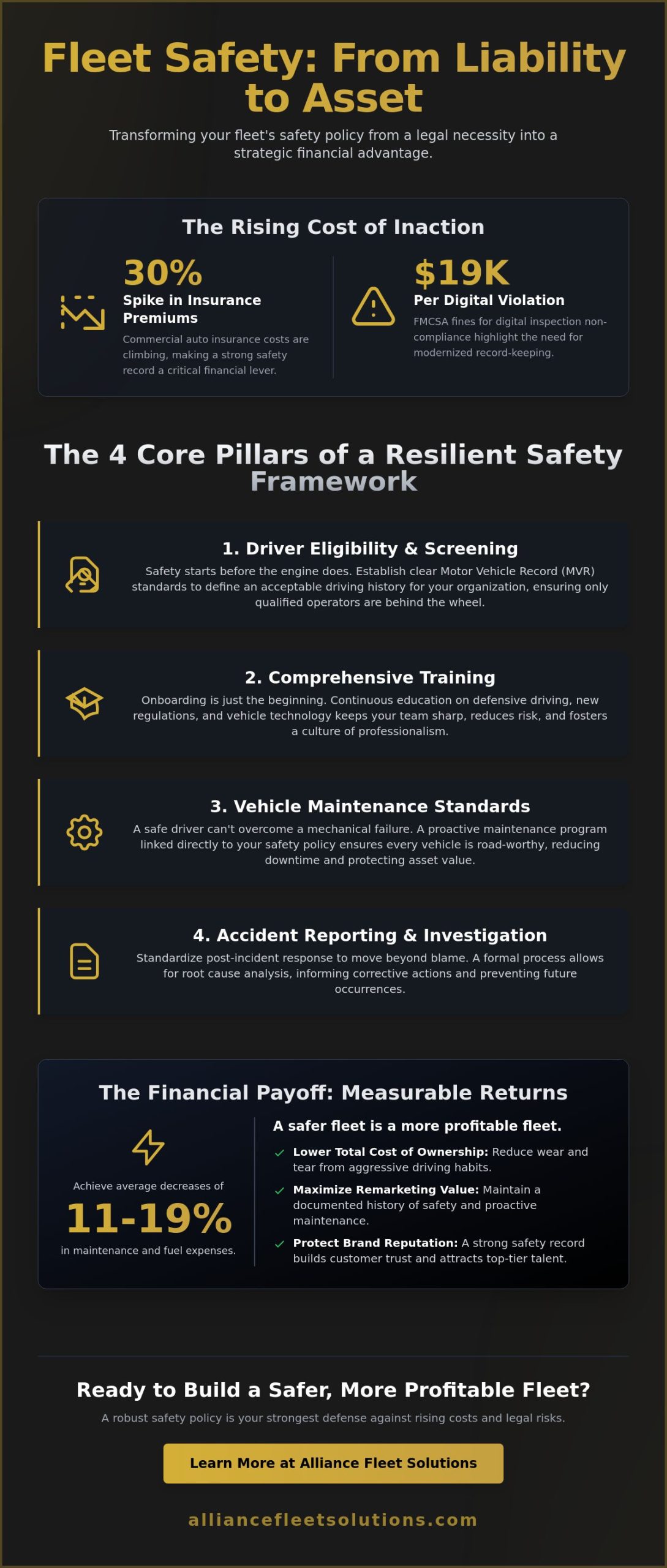
With commercial auto insurance premiums climbing by as much as 30% across the U.S. in 2026, your fleet’s safety record is no longer just a human resources concern; it’s a critical financial metric. When you consider that the FMCSA now imposes fines up to $19,000 for digital inspection violations, the stakes for developing a fleet safety policy have never been higher. You’ve likely felt the sting of rising repair costs and the administrative headache of tracking inconsistent driver behavior across your operations. It’s a stressful position to be in when you’re trying to maintain a reliable, high-performing fleet.
We understand that managing these high-stakes risks while maintaining a fast-paced logistics schedule is a constant balancing act. This guide provides a strategic framework to help you transform safety from a liability shield into a robust business advantage. You’ll learn how to build a policy that protects your drivers, reduces liability, and improves your bottom line through smarter maintenance management and telematics integration. We will explore the essential 2026 regulatory updates, digital compliance strategies, and the technical tools needed to foster a culture of safety that attracts top-tier talent.
Key Takeaways
- Shift your perspective on safety from a legal necessity to a strategic financial asset that stabilizes operating costs and insurance premiums.
- Identify the 8 core pillars of a modern safety framework, ranging from rigorous driver screening standards to ongoing education programs.
- Utilize telematics and GPS data to transition from simple monitoring to a proactive coaching model that corrects high-risk behaviors in real-time.
- Streamline the process of developing a fleet safety policy by securing executive buy-in and building a collaborative culture with your operators.
- Maximize vehicle remarketing value by maintaining a documented history of safety and proactive maintenance throughout the asset lifecycle.
The Financial Imperative: Why a Fleet Safety Policy is a Business Asset
A fleet safety policy is a formal set of rules that dictate driver behavior and vehicle standards across your entire operation. It is the core document that defines how your company manages risk on the road. In the current economic climate, developing a fleet safety policy is a high-stakes financial move. With commercial auto insurance premiums rising by up to 30% across the U.S. in 2026, underwriters are looking for concrete proof of control before they offer competitive rates. If you can’t demonstrate a rigorous, data-driven safety record, your business absorbs the cost through skyrocketing premiums.
Effective fleet management requires a shift in perspective. Safety isn’t just about avoiding a collision; it’s about protecting the company’s bottom line. Beyond the obvious insurance costs, accidents carry a heavy trail of hidden expenses that don’t appear on a repair bill. Vehicle downtime stops your revenue in its tracks. Lost productivity while a driver is sidelined can ripple through your entire supply chain. Perhaps most damaging is the long-term impact on your brand reputation. A single high-profile incident can erode years of customer trust in an afternoon.
Beyond Liability: Safety and Total Cost of Ownership
Safety protocols protect the lifecycle value of your vehicles. Aggressive driving habits like hard braking and rapid acceleration don’t just lead to accidents; they destroy mechanical components. This behavior leads to shorter maintenance cycles and a higher total cost of ownership. By implementing fuel management programs that reward smooth, efficient driving, you see an immediate drop in operational expenses. Industry data shows that fleet managers using safety technology achieve average decreases of 11% to 19% in maintenance and fuel expenses. A safer fleet is quite literally a more efficient fleet.
Regulatory Compliance and Duty of Care
Business owners have a legal “Duty of Care” to ensure their operations don’t pose a threat to the public. If an incident occurs and your organization lacks a documented safety plan, you face “negligent entrustment” claims. These legal battles often result in “nuclear verdicts” that can exceed tens of millions of dollars. With the FMCSA’s February 2026 rule changes, the digital compliance trail is now the law. Illegible paper records are now treated as missing documents, and fines for falsifying inspections have reached $19,000 per violation. Developing a fleet safety policy that incorporates these digital standards is your strongest defense against both regulatory fines and legal liability.
The 8 Pillars of a Comprehensive Fleet Safety Framework
Building a resilient safety program requires more than a simple list of rules. It demands a structured framework that integrates with every part of your operation, from the moment you hire a driver to the day you remarket a vehicle. When you are developing a fleet safety policy, you must view it as the operational manual for your company’s risk tolerance. A robust framework rests on four primary pillars of personnel and vehicle oversight, ensuring that no aspect of your road risk remains unmanaged.
- Driver Eligibility and Screening: Safety begins before the keys are handed over. Establish clear Motor Vehicle Record (MVR) standards that define exactly what constitutes an acceptable driving history for your organization.
- Comprehensive Training: Onboarding is just the start. Continuous education ensures that drivers stay sharp on defensive driving techniques and new regulatory requirements as they emerge.
- Vehicle Maintenance Standards: A safe driver cannot compensate for a mechanical failure. Linking your safety policy to proactive maintenance management ensures that every asset on the road is fundamentally sound.
- Accident Reporting and Investigation: Standardizing the post-incident response is vital. It allows you to identify root causes and implement corrective actions rather than just assigning blame.
By treating these pillars as interconnected systems, you create a safety net that catches small errors before they become catastrophic losses. When you are developing a fleet safety management policy, consistency is your most valuable asset. If you’re looking to strengthen these foundations, our fleet management solutions can help you integrate these standards into your daily workflow.
Driver Behavior and Accountability Standards
Your policy must clearly define “acceptable use” for company vehicles. This includes strict boundaries for personal use and a zero-tolerance stance on distracted driving or substance use. To make these rules stick, implement a transparent points system. This creates a fair environment where violations have clear consequences, but more importantly, where consistently safe behavior is recognized and rewarded. Accountability shouldn’t feel like a burden; it should feel like a shared commitment to everyone’s safety across the team.
Vehicle Standards and Professional Upfitting
One often overlooked aspect of developing a fleet safety policy is the physical configuration of the vehicle itself. Standard factory models aren’t always equipped for the specific rigors of industrial work. Professional upfitting bridges this gap by ensuring that tools and cargo are secured properly. This prevents shifting loads, which are a primary cause of rollovers and cargo-related accidents. Custom-configured interiors reduce ergonomic injuries by placing equipment within easy reach, lowering the risk of repetitive strain for your operators. During the vehicle acquisition phase, prioritizing safety equipment like advanced sensors and 360-degree cameras is a proactive step that pays dividends in reduced collision rates.
Leveraging Telematics and GPS for Proactive Risk Management
Integrating technology is the most effective way to move your safety plan from a static document to a living operational standard. When developing a fleet safety policy, you must decide how to utilize the flood of data generated by modern vehicles. As of early 2026, 80% of fleet professionals use GPS tracking technology, yet many still struggle to use this data for proactive risk management. Telematics provides a real-time window into high-risk behaviors like hard braking, rapid acceleration, and speeding. These aren’t just data points. They are leading indicators of a future collision.
The true power of these systems lies in the transition from simple monitoring to active coaching. Instead of reviewing a report at the end of the month, managers can provide immediate feedback. Video telematics, now adopted by 46% of fleets, allows for context-driven coaching where 74% of users report improved safety outcomes. AI-powered dash cams have proven particularly effective, with some users reporting collision reductions of up to 80% in their first year of deployment. In-cab alerts serve as a first line of defense, providing drivers with instant audible or visual cues when they exceed safety thresholds. This immediate correction prevents a minor error from escalating into a major incident.
GPS integration further enhances safety by optimizing routes to reduce driver fatigue. By analyzing traffic patterns and delivery windows, you ensure drivers aren’t pressured to speed or skip breaks to meet unrealistic deadlines. This strategic planning is a fundamental part of managing risk before the vehicle even leaves the yard. It allows your team to maintain a steady, safe pace without sacrificing productivity.
Data-Driven Driver Scorecards
Objective data removes the friction from safety discussions. By building scorecards based on telematics metrics, you create a transparent ranking system. This allows you to foster healthy competition through safety-based incentives, rewarding your top performers. More importantly, it identifies the “bottom 10%” of drivers who require targeted remedial training. This data-driven approach ensures your training resources are spent where they will have the most significant impact on your risk profile.
Predictive Maintenance as a Safety Tool
A mechanical failure at highway speeds is a nightmare scenario for any manager. Telematics-driven engine diagnostics allow you to identify potential issues like brake wear or engine faults before they lead to a breakdown. This is a core component of efficient fleet operations, as it links vehicle health directly to driver safety. Automated maintenance alerts ensure that inspection schedules are strictly followed, significantly reducing the likelihood of roadside emergencies and protecting your assets’ long-term value.
Implementation Strategies: From Paper Policy to Safety Culture
Execution is the point where many risk management plans falter. A document that sits in a binder does nothing to prevent a collision or lower your insurance premiums. Transforming your guidelines into a living safety culture requires a methodical rollout that prioritizes clear communication and operational buy-in. When you are developing a fleet safety policy, the goal is to integrate these standards so deeply into your daily routine that they become second nature to your team.
The implementation process follows five critical steps:
- Step 1: Secure Executive Buy-In. Present safety as a financial strategy rather than an administrative burden. Use the projected 10% to 30% increase in 2026 insurance premiums to show leadership how a robust policy protects the company’s capital.
- Step 2: Collaborate with Drivers. Involve your operators in the drafting phase. Drivers provide essential feedback on whether a policy is practical in the field, which reduces future friction and non-compliance.
- Step 3: Formalize and Acknowledge. Once the document is finalized, require signed acknowledgments from every employee. This creates a clear record of accountability that is vital for your “Duty of Care” legal defense.
- Step 4: Launch a Training Loop. Move beyond a one-time orientation. Use the 2026 FMCSA digital compliance standards as a baseline for continuous education on electronic inspections and road safety.
- Step 5: Review and Update Annually. Use your telematics data to identify where the policy is working and where it needs adjustment. A policy that doesn’t evolve with your fleet performance quickly becomes obsolete.
Standardizing these steps ensures that your safety initiatives are repeatable and measurable across the entire organization. If you need help aligning your operational data with your safety goals, our fractional fleet management services provide the expert oversight needed to bridge the gap between policy and practice.
Communicating Change to Your Team
Resistance to new policies often stems from a fear of “Big Brother” surveillance. You must frame the policy as a tool for driver protection. Emphasize that having a digital record of safe behavior and vehicle health protects the driver from unfair blame after an incident. Conduct regular “Toolbox Talks” to keep safety top-of-mind and provide clear, non-punitive channels for drivers to report vehicle defects. This partnership approach builds trust and ensures that safety concerns are addressed long before they result in equipment failure.
Incentivizing Safe Behavior
Positive reinforcement is often more effective than the threat of punishment. While clear consequences for violations are necessary, rewarding excellence creates a more sustainable safety culture. Consider low-cost, high-impact rewards like public recognition or gift cards for drivers who maintain top-tier safety scores. Linking safety performance to annual reviews and career progression signals that your company values professional, risk-aware operators. This approach doesn’t just reduce accidents; it helps you retain the high-quality drivers who are essential to your long-term success.
Optimizing the Fleet Lifecycle: How Managed Safety Protects Value
A safety program does more than prevent accidents; it preserves the capital invested in your vehicles. When you’re developing a fleet safety policy, you’re essentially creating a preservation strategy for your most expensive hardware. A well-enforced policy ensures that vehicles return at the end of a lease or lifecycle in peak condition, avoiding the steep reconditioning fees that eat into your margins. This direct link between driver behavior and asset health is a cornerstone of professional fleet management services. By standardizing how vehicles are treated, you minimize the wear and tear caused by aggressive driving and neglect.
Effective policy enforcement provides the infrastructure needed to maintain these standards across hundreds of units. It creates a culture where drivers treat their vehicles as professional tools rather than just a means of transport. This shift in mindset pays dividends throughout the asset’s life, reducing the frequency of unscheduled repairs and keeping your fleet on the road. When safety is managed as a core business function, it transforms from a liability shield into a driver of long-term operational value.
Safety and Vehicle Remarketing
Resale value is a major component of your total cost of ownership. Vehicles with a “clean” history, supported by documented safety logs, command significantly higher prices during vehicle remarketing. Think of your safety data as a pedigree for the asset. Buyers in the secondary market pay a premium for units that have been operated under a strict safety framework. Proactive behavior, like avoiding harsh idling and aggressive maneuvers, keeps the drivetrain and brakes in superior condition compared to unmonitored units. Protecting the physical condition of the fleet through a robust policy is the most effective way to maximize your ROI at the point of disposal. A vehicle that has never been in a collision and shows minimal wear is an asset that sells itself.
The Alliance Partnership: Safety as a Managed Service
Enforcing high standards doesn’t require a massive internal team. Many organizations utilize fractional fleet management to provide the expert oversight needed to keep safety scores high. Alliance Fleet Solutions acts as your strategic partner, ensuring that every vehicle acquisition includes the latest safety technology. We also provide the professional upfitting necessary to secure cargo and protect drivers from ergonomic strain. By outsourcing the monitoring of your policy to seasoned experts, you ensure that safety remains a constant priority without diverting your internal resources from core business growth. We help you source the right equipment and implement the tracking tools needed to make your safety policy a reality in the field.
Secure Your Fleet’s Future with a Strategic Safety Framework
Your safety record is a direct reflection of your company’s operational discipline and financial health. By treating safety as a strategic asset rather than a regulatory checkbox, you protect your drivers and your bottom line simultaneously. We’ve explored how a data-driven approach, powered by telematics and professional maintenance, ensures your vehicles remain profitable throughout their entire lifecycle. Developing a fleet safety policy is the first step toward stabilizing insurance costs and maximizing the resale value of your assets.
Alliance Fleet Solutions has been a family-owned and operated partner since 2018, providing the technical expertise needed to navigate the complexities of 2026’s regulatory landscape. Whether you require comprehensive fractional fleet management, expert vehicle upfitting, or strategic remarketing services, we act as a reliable partner for your business. We handle the heavy lifting of safety management so you can focus on your core operations. Partner with Alliance Fleet Solutions to build a safer, more profitable fleet.
Take the next step in securing your operations today. With the right framework in place, you can turn safety into your most reliable competitive advantage and ensure your team returns home safely every day.
Frequently Asked Questions
What is the most important element of a fleet safety policy?
The most important element is a clear, written commitment from leadership that prioritizes safety over speed or productivity. Without executive buy-in, the policy remains a suggestion rather than a standard. This commitment must be backed by a culture of accountability where every driver understands their role in protecting the company’s assets. A well-defined set of rules only works when the organization consistently enforces them and provides the resources necessary for compliance.
How often should we update our fleet safety program?
You should review and update your fleet safety program at least once every twelve months. This annual cycle allows you to adjust for changes in federal regulations, such as the 2026 FMCSA digital compliance updates. Additionally, you should trigger an immediate review if your telematics data shows a spike in specific incidents or if you acquire new vehicle types. Regular updates ensure your framework evolves alongside your operational needs and technological advancements.
Can telematics data be used as evidence in a legal dispute?
Telematics data is frequently used as admissible evidence in legal disputes to provide an objective record of vehicle speed, braking patterns, and location at the time of an incident. While this data can exonerate a driver by proving they followed safety protocols, it can also highlight negligence if policies were ignored. Maintaining a digital trail is essential for your “Duty of Care” defense. It replaces subjective eyewitness accounts with verifiable, technical facts that hold up in court.
How do we handle drivers who use personal vehicles for business?
Drivers using personal vehicles for business purposes, often called the “grey fleet,” must be held to the same safety standards as your company-owned fleet. Your policy should require these drivers to provide proof of adequate insurance, valid registration, and regular maintenance records. Developing a fleet safety policy that explicitly covers personal vehicle use protects your organization from “vicarious liability” claims. You must ensure these vehicles are fit for their intended business tasks and operated safely.
What are the consequences of not having a formal fleet safety policy?
The consequences include exposure to “nuclear verdicts,” higher insurance premiums, and severe regulatory penalties. Without a formal policy, your company lacks a legal defense against negligent entrustment claims, which can result in settlements exceeding tens of millions of dollars. Additionally, you face the high cost of vehicle downtime and repairs. In the 2026 regulatory environment, failing to provide a digital compliance trail can also lead to FMCSA fines of up to $19,000 per violation.
How do we balance driver privacy with safety monitoring?
Balancing privacy with monitoring requires complete transparency about what data you collect and how you use it. Clearly communicate that telematics and dash cams are tools for driver protection and accident exoneration, not personal surveillance. Focus your monitoring strictly on safety-related behaviors like speeding or distracted driving during business hours. When drivers understand that the data protects their professional reputation and physical safety, they are more likely to accept the technology as a standard operational tool.
What should be included in a post-accident investigation report?
A comprehensive report must include the date, time, and location of the incident, along with weather conditions and witness statements. You should also integrate telematics data to show vehicle speed and braking behavior leading up to the crash. The goal is to conduct a root cause analysis that identifies whether the incident resulted from driver error, mechanical failure, or environmental factors. This documentation is vital for insurance claims and for updating your safety training to prevent future occurrences.
How does a safety policy impact our commercial insurance rates?
A robust safety policy directly influences your insurance premiums by demonstrating a lower risk profile to underwriters. In 2026, insurers increasingly rely on telematics data and documented safety scores to determine rates. By showing a consistent history of low accident rates and proactive maintenance, you can mitigate the 10% to 30% premium increases currently seen across the industry. Developing a fleet safety policy proves to your carrier that you are actively managing the variables that lead to expensive claims.