
What if the DIY approach to your vehicles is actually the most expensive line item on your balance sheet? You likely track fuel prices, which hit an average of $5.60 per gallon this May, and you certainly notice when insurance premiums climb another 8.3%. It’s natural to believe that keeping operations in-house provides more control and lower overhead. However, the hidden costs of self-managing a fleet often live in the gaps between your spreadsheet cells, from the administrative friction of DOT compliance to the cascading expenses of unpredictable maintenance spikes.
We understand the pressure of maintaining a high-stakes logistics operation while equipment lead times for upfitted vehicles stretch past twelve months. You deserve a strategy that transforms these volatile variables into predictable monthly expenses. This article will uncover the invisible leaks draining your bottom line and show you how to reclaim control through strategic management. We’ll explore how professional oversight reduces your administrative burden, improves vehicle resale values, and ensures your drivers stay behind the wheel instead of waiting on repairs.
Key Takeaways
- Learn why traditional spreadsheets often fail to capture the true Total Cost of Ownership by ignoring the “invisible” operational friction beneath the surface.
- Identify how the hidden costs of self-managing a fleet manifest as a human capital drain when your office staff spends critical hours navigating complex DOT and safety regulations.
- Discover the “Daily Revenue Loss” formula to quantify how vehicle downtime creates a cascade effect that disrupts your entire service schedule.
- Understand why “driving it into the ground” is a costly disposal strategy and how meticulous maintenance records significantly increase your vehicle’s resale value.
- Explore how fractional fleet management provides expert oversight to turn volatile, unpredictable expenses into a steady and manageable monthly budget.
The Fleet Cost Iceberg: Why Your Spreadsheet is Lying to You
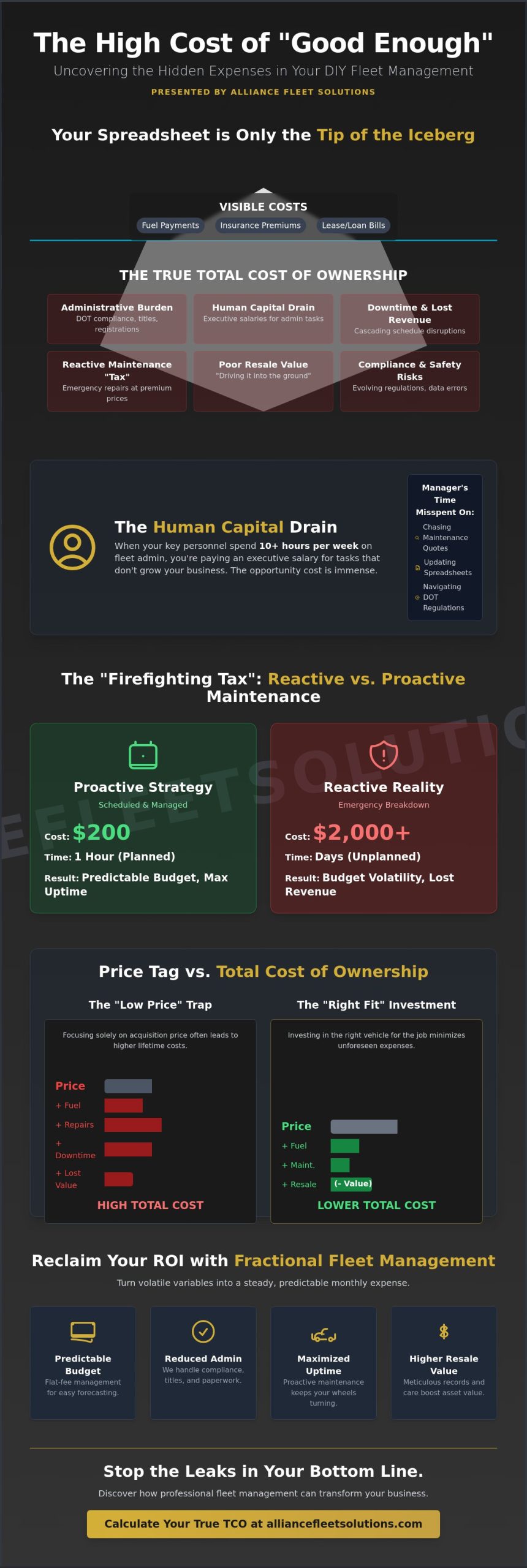
Most business owners look at their monthly ledger and see fuel, insurance, and lease payments. These represent the visible tip of the iceberg. Beneath the surface lies a massive volume of invisible operational friction that erodes your margins. Traditional accounting methods often fail to capture the true Total Cost of Ownership (TCO) because they don’t account for the administrative hours spent on compliance or the revenue lost during unexpected downtime. When you factor in these variables, the hidden costs of self-managing a fleet frequently exceed the flat fees of professional management.
We categorize these leaks into three primary areas. Administrative costs involve the labor required to manage titles, registrations, and complex DOT requirements. Operational costs cover the efficiency gaps in fuel use and maintenance. Finally, lifecycle costs address the value lost through poor vehicle selection or ineffective remarketing strategies. Identifying these categories is the first step toward reclaiming your bottom line.
The Difference Between Price and Total Cost of Ownership
A common trap is focusing on the acquisition price rather than the lifecycle expense. Selecting a vehicle based solely on a low initial monthly payment often backfires. If that vehicle lacks the proper engine for your specific load or requires frequent specialized parts, your maintenance and fuel budgets will suffer. Effective Fleet management requires analyzing every expense from the moment of procurement until the final sale. This includes professional upfitting to ensure the vehicle is fit for purpose on day one. Poor vehicle selection also impacts your team. Drivers who constantly battle equipment issues are more likely to seek employment elsewhere. This adds recruitment and training costs to your ledger, further proving that the hidden costs of self-managing a fleet are as much about people as they are about machines.
The “Firefighting” Tax: The Cost of Reactive Management
We call the premium paid for reactive management the “Firefighting Tax.” When you self-manage without a dedicated maintenance program, you’re often forced to address issues only after a breakdown occurs. A scheduled oil change and inspection might cost $200 and take an hour of planned time. In contrast, a roadside failure can easily result in a $2,000 bill for towing, emergency labor, and expedited parts. This reactive cycle makes financial forecasting nearly impossible. Instead of a predictable, flat maintenance budget, you’re left at the mercy of mechanical chance. This volatility prevents you from reinvesting capital with confidence. It also creates a cascade effect where one broken truck disrupts three other scheduled jobs, multiplying the financial damage far beyond the initial repair invoice.
The Human Capital Drain: The Cost of “Part-Time” Fleet Management
Many business owners assume that assigning fleet tasks to an existing office manager or handling them personally saves money. This is a primary source of the hidden costs of self-managing a fleet. When a high-level manager spends 10 hours per week chasing maintenance quotes or updating spreadsheets, you’re paying an executive salary for administrative labor. This inefficiency scales quickly. If your manager calls five different shops to find the best price for a single brake job, they’ve likely spent more in billable hours than the potential savings on the repair bill.
Manual tracking also introduces the high risk of data entry errors. A single mistyped odometer reading can skew your entire maintenance schedule, leading to missed services or inaccurate fuel tax reporting. Training in-house staff on ever-evolving DOT and safety regulations adds another layer of expense. Regulations change frequently. For instance, the new National Registry II requirements for medical certifications effective June 23, 2026, require examiners to upload results by the next day. Keeping your team updated on these specifics requires constant, expensive education that a professional partner already possesses.
Opportunity Cost: What Are You Not Doing?
Every hour spent on vehicle logistics is an hour stolen from business growth. This creates what we call an Expertise Gap: the financial loss incurred by non-specialist management. A part-time manager often lacks the time to hunt for fuel rebates or optimize tax recovery opportunities that a dedicated professional would catch immediately. Your leadership team should focus on strategy and client acquisition, not tire pressures. Utilizing fractional fleet management allows you to reclaim this bandwidth while ensuring your assets are managed by specialists who understand the mechanics of the industry.
The High Price of Compliance Errors
The financial stakes of fleet management extend far beyond the workshop. Missed DOT inspections or expired driver qualification files can lead to heavy fines and operational shutdowns. Even worse, if an accident occurs, a lack of documented maintenance or safety compliance can result in “nuclear verdicts” that threaten the very existence of your company. Legal liabilities are often the most significant hidden cost in any in-house operation. Using professional fleet management services mitigates these risks through automated tracking. These systems ensure every inspection is logged and every driver file is current, providing a layer of legal protection that manual systems simply cannot match.
Beyond the Repair Bill: The Operational Price of Reactive Maintenance
A truck sitting in a repair bay earns zero revenue. While the invoice for parts and labor is easy to track, the true financial damage of downtime remains invisible to most spreadsheets. To find your actual loss, you must use the Daily Revenue Loss formula: (Total Daily Revenue / Number of Active Vehicles) + Fixed Daily Costs. If a vehicle typically generates $1,200 in daily revenue, a three-day unplanned repair doesn’t just cost you the $800 mechanic bill. It costs you $4,400. These hidden costs of self-managing a fleet compound when you’re forced to secure short-term rentals at premium rates just to keep your promises to clients.
Unplanned failures also trigger the “Cascade Effect.” When one vehicle goes down, its scheduled route must be absorbed by other drivers, leading to overtime pay and increased wear on the rest of your equipment. It’s a cycle that eventually shortens the overall lifespan of your assets. Vehicles subjected to reactive maintenance schedules often require replacement 18 to 24 months earlier than those managed under a rigorous preventive program. This premature capital expenditure is a massive leak in your bottom line that many businesses mistake for a standard cost of doing business.
Vendor Overpayment and Part Markups
Self-managed fleets rarely have the leverage to negotiate national account pricing. This means you’re likely paying retail rates for tires, oil, and specialized parts. Even worse, without an expert auditing your invoices, you’re vulnerable to “service creep” where shops suggest unnecessary repairs. We’ve seen invoices where labor hours were doubled or parts were marked up by 40% because the client lacked the technical authority to challenge the bill. Centralized maintenance management solves this by using ASE-certified experts to review every line item, ensuring you only pay for what’s necessary at a fair fleet rate.
The Fuel Inefficiency Premium
Fuel remains one of your largest expenses, with diesel prices hovering around $5.60 per gallon this May. Poorly maintained vehicles are significantly less fuel-efficient. Low tire pressure, clogged air filters, and dragging brakes can reduce your miles-per-gallon by as much as 10%. Without telematics or strict oversight, you also face the risk of unauthorized “side trips” or fuel card misuse. Professional fuel management programs use data analytics to identify these anomalies, often recovering 5-15% of annual fuel spend. This oversight transforms fuel from a volatile, unmanaged expense into a controlled variable, further reducing the hidden costs of self-managing a fleet.
Asset Depreciation and Remarketing: The Hidden Losses at Lifecycle End
Many business owners believe the most cost-effective way to manage a truck is to drive it until the wheels fall off. This strategy is a major contributor to the hidden costs of self-managing a fleet. As a vehicle ages, its depreciation slows, but its maintenance costs skyrocket. Eventually, you reach a point where the cost of a single major repair exceeds the remaining equity in the asset. When you combine this with the 31% rise in new vehicle prices since 2019, with the average unit now costing approximately $50,000, losing thousands of dollars in resale value due to poor timing becomes a massive financial failure.
Lazy disposal is another profit killer. Selling to a local dealer or taking a vehicle to a general auction often results in receiving wholesale prices. Professional vehicle remarketing uses data-driven channels to find buyers who value your specific equipment, often recovering significantly more per unit. Your maintenance records play a pivotal role here. A buyer will pay a premium for a vehicle with a documented, professional service history because it represents a lower risk. Without these records, you’re forced to accept the lowest common denominator price.
The Timing Trap: When to Replace Your Vehicles
Identifying the “sweet spot” where depreciation and maintenance costs intersect is critical for your bottom line. Holding onto an asset past its reliable life increases your Repair-to-Value ratio to dangerous levels. With current lead times for factory-ordered vehicles sitting at four to six months, and upfitted units taking eight to twelve months, you can’t afford to wait for a total engine failure to begin the replacement process. Reactive replacement forces you to buy whatever is on the lot, often at a premium, rather than following a strategic acquisition plan. Data-driven remarketing avoids this trap by identifying the optimal exit point for every asset in your operation.
Upfitting Errors: Paying Twice for the Same Tool
Upfitting choices also dictate your final return. Generic shelving or poorly installed equipment can actually damage the vehicle’s interior, reducing its value at the end of its life. Professional upfitting ensures that the equipment is not only durable but also configured to a standard that appeals to the secondary market. If your upfitting fails before the vehicle’s life ends, you end up paying twice for the same tool. This redundancy is an avoidable expense that professional management eliminates by matching the right equipment to the right chassis from day one. You can protect your long-term investment and ensure your team has the tools they need by choosing professional vehicle remarketing and upfitting solutions.
Transitioning to Fractional Fleet Management: Reclaiming Your ROI
Fractional Fleet Management offers a strategic middle ground for businesses that have outgrown manual spreadsheets but aren’t ready to hire a full-time fleet director. It provides expert oversight without the burden of a full-time executive salary. By partnering with a dedicated team, you immediately eliminate many hidden costs of self-managing a fleet. The most significant shift occurs in your cash flow. Instead of navigating a minefield of variable “surprises” like emergency repairs and compliance fines, you move toward a model of predictable fixed expenses. This stability allows you to allocate capital toward core business growth rather than mechanical emergencies.
Leveraging a management company’s national vendor network provides an immediate ROI. While an in-house manager typically pays retail prices for tires and labor, a professional partner accesses pre-negotiated fleet rates. Auditing your current operation usually reveals that these savings alone often cover the management fee. To build your business case for change, start by documenting every hour your staff spends on vehicle logistics and every dollar lost to retail markups. This data reveals the true price of staying in-house.
Custom Leasing Structures as a Strategic Asset
Choosing between open-end and closed-end leasing is a critical financial decision that impacts your tax position and cash flow. Open-end leases often benefit high-mileage fleets by offering flexibility and potential equity at the end of the term. In contrast, closed-end leases provide a fixed cost that protects you from market volatility and asset depreciation risks. Professional vehicle acquisition services secure better pricing and significantly shorter delivery timelines by leveraging deep manufacturer relationships. This shifts your perspective from simply “buying trucks” to investing in a mobile workforce that is always equipped with reliable, modern assets.
The Road Ahead: Building a Scalable Fleet Infrastructure
Maintaining efficient fleet operations requires a proactive mindset. The road ahead starts with an honest assessment of your true cost-per-mile, including the administrative friction and depreciation losses discussed in previous sections. Once you uncover the hidden costs of self-managing a fleet, the path to optimization becomes clear. Transitioning to a professional model ensures your equipment is upfitted correctly, maintained rigorously, and sold at the peak of its value. Partnering for long-term reliability ensures your fleet remains a strategic asset rather than a financial drain. It’s time to build the infrastructure your business needs to scale with confidence.
Secure Your Bottom Line with Strategic Fleet Oversight
Managing a commercial fleet is a high-stakes balancing act where invisible friction often dictates your profitability. You’ve seen how reactive repairs and administrative drain create a “firefighting tax” that no spreadsheet can fully quantify. By identifying the hidden costs of self-managing a fleet, you can finally move away from a defensive posture. Shifting toward a professional infrastructure allows your leadership team to focus on growth while specialists handle the complexities of DOT compliance and asset lifecycles.
Efficiency isn’t just about saving on parts; it’s about strategic partnership. Our national vendor network reduces your maintenance overhead, while custom-configured professional upfitting ensures your vehicles are built for long-term productivity. Whether you need expert fractional fleet management or data-driven remarketing, the goal is total operational control and financial predictability. Stop the financial leaks—see how Alliance Fleet Solutions can optimize your fleet today. You don’t have to navigate these logistics alone. We’re here to help you turn your fleet into a predictable, high-performing engine for your business success.
Frequently Asked Questions
What are the most common hidden costs of self-managing a fleet?
The most frequent hidden costs include administrative friction, the “firefighting tax” of emergency repairs, and significant equity loss during vehicle disposal. These are the primary hidden costs of self-managing a fleet that often go unnoticed because they’re buried within general labor and operational budgets rather than being tracked as specific fleet expenses.
How do I calculate the true Total Cost of Ownership (TCO) for my vehicles?
You calculate the true TCO by aggregating every expense from initial procurement through final remarketing. This formula must include acquisition price, professional upfitting, financing, fuel, insurance, and maintenance. Crucially, you must also add the cost of administrative labor and the revenue lost during vehicle downtime to get an accurate financial picture.
Is it cheaper to hire an in-house fleet manager or outsource to a service provider?
Outsourcing is generally more cost-effective for small to mid-sized operations because it provides expert oversight without the burden of a full-time executive salary and benefits. Partnering with a service provider gives you immediate access to national vendor discounts and specialized technical knowledge that a single in-house hire rarely possesses.
What is fractional fleet management and how does it work?
Fractional fleet management is a partnership model where you utilize a professional management team on a flexible basis to oversee your operations. This team handles high-stakes tasks like compliance, vendor negotiations, and lifecycle strategy. It allows your business to scale its fleet infrastructure without the overhead of a permanent internal department.
How does professional vehicle remarketing save my business money?
Professional remarketing saves money by using data-driven sales channels to find buyers who specifically value your equipment and its maintenance history. This approach avoids the “lazy disposal” trap of accepting wholesale prices at local auctions. By targeting the right secondary markets, you recover thousands of dollars more per unit at the end of its lifecycle.
Can a fuel management program really reduce my monthly operating expenses?
Yes, these programs use telematics and fuel card data to provide total visibility into your consumption patterns. By identifying excessive idling, unauthorized side trips, and fuel card misuse, a structured program helps you reclaim a significant portion of your annual fuel spend. This oversight is essential when diesel prices remain volatile.
Why is reactive maintenance more expensive than preventive maintenance?
Reactive maintenance is more expensive because it involves emergency premiums for towing, expedited parts, and specialized labor. Beyond the repair bill, the unplanned downtime disrupts your service schedule and leads to lost revenue. A proactive preventive program identifies minor issues before they become catastrophic failures, ensuring your trucks stay on the road.
How does commercial upfitting affect the resale value of my trucks?
Professional upfitting affects resale value by determining how well the vehicle chassis is protected during its service life. High-quality, custom-configured equipment that is properly installed prevents structural damage and makes the vehicle more attractive to buyers in the secondary market. Poorly installed or generic shelving often reduces trade-in offers by leaving behind damage that requires expensive repairs.