
The most expensive fleet lease isn’t the one with the highest monthly payment. It’s the one that leaves your drivers stranded and your administrative team buried in paperwork. You’ve likely experienced the frustration of unexpected downtime or discovered hidden fees that turned a competitive rate into a financial drain. To protect your bottom line, there are specific, high-stakes questions to ask a fleet leasing provider that reveal whether they offer true operational support or just a generic line of credit.
We’ll show you how to vet a partner’s ability to handle the complex realities of 2026, including maintenance management and the 87% industry shift toward vehicle electrification. You’ll learn how to secure predictable monthly costs and ensure your provider manages the heavy lifting of vehicle acquisition and professional upfitting. This guide provides a clear roadmap to move beyond the sticker price and find a partner that acts as a strategic asset for your business.
Key Takeaways
- Learn how to look past the monthly rate to evaluate Total Cost of Ownership (TCO) and avoid hidden contract fees.
- Discover why professional upfitting and customized lease structures are critical for maintaining high residual values and operational uptime.
- Identify the essential questions to ask a fleet leasing provider regarding their maintenance management and fuel programs to control mid-lease costs.
- Understand the value of a data-driven cycling strategy and how expert vehicle remarketing maximizes your ROI at the end of the lifecycle.
- Explore the benefits of a strategic partnership that integrates telematics and fleet management into a single, high-performance operational backbone.
Beyond the Monthly Rate: Why Your Choice of Leasing Provider Matters
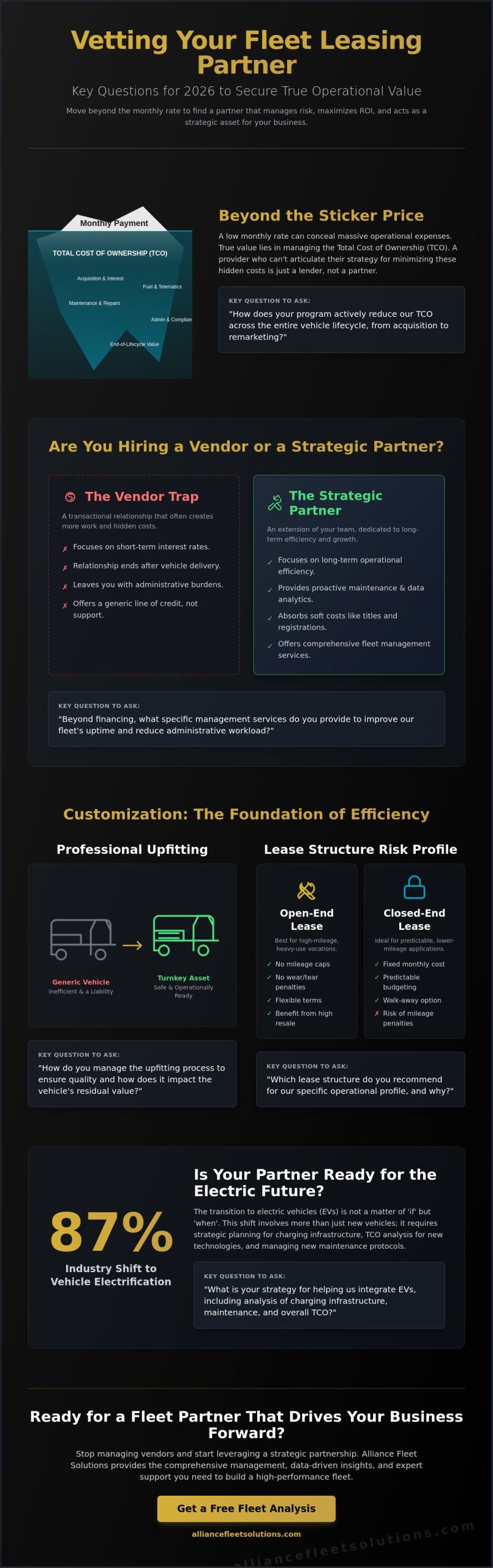
Comparing lease rates in a vacuum is a high-risk strategy that often backfires. While a low monthly payment looks good on a balance sheet, it doesn’t account for the hidden expenses that erode your margins. In 2026, with commercial vehicle prices remaining elevated and operational costs fluctuating, focusing solely on the sticker price is dangerous. You need to look at the Total Cost of Ownership (TCO). This comprehensive metric includes:
- Initial acquisition costs and interest rates.
- Fuel management and telematics integration.
- Preventive maintenance and emergency repairs.
- Administrative labor for licensing and compliance.
- Remarketing value at the end of the vehicle’s lifecycle.
A primary set of questions to ask a fleet leasing provider should focus on how they mitigate these variables. If a provider can’t explain their strategy for reducing vehicle downtime or managing administrative burdens, they’re likely just a lender in disguise. Managing titles, registrations, and maintenance logs takes hours of staff time. A strategic partner absorbs these soft costs, allowing your team to focus on core operations rather than chasing down repair estimates or plate renewals.
The Difference Between a Vendor and a Strategic Partner
Transactional leasing is a simple exchange of capital for equipment. A vendor-only approach usually ends once the credit is approved and the keys are handed over. However, comprehensive fleet management services provide the backbone for sustainable business growth. These partners offer proactive maintenance alerts and data analytics to predict failures before they happen. When vetting candidates, look for those who discuss long-term efficiency rather than just short-term interest rates. A partner should feel like an extension of your operations team.
Identifying Your Specific Fleet Needs
An off-the-lot truck rarely meets the demands of heavy-duty logistics. Industry-specific work trucks require specialized upfitting that impacts both performance and safety. Before signing any contract, audit your current fleet for recurring maintenance headaches. If you’re seeing consistent failures in specific components, you need a partner with the technical expertise to spec the right vehicle from the start. This prevents wrong-spec acquisitions that lead to premature wear and decreased resale value. Asking the right questions to ask a fleet leasing provider ensures your equipment is built for the job, not just for the budget.
Evaluating Customization: Questions on Upfitting and Lease Structures
A generic vehicle is often a liability in the industrial sector. If a truck arrives without the necessary shelving, racks, or safety equipment, it’s not an asset; it’s a project. One-size-fits-all vehicles lead to immediate operational inefficiencies as your team struggles to organize tools or secure cargo. When considering your options, the most technical questions to ask a fleet leasing provider should focus on the intersection of finance and physical equipment. You need to know how they treat the cost of customization and how those additions affect the vehicle’s value at the end of the term.
Professional upfitting significantly impacts both your front-end capital and your back-end residual value. If a provider manages upfitting via uncoordinated third parties, you risk delivery delays and inconsistent quality. A strategic partner integrates this process, ensuring the vehicle is delivered turnkey and ready for service. This coordination preserves the vehicle’s structural integrity and ensures that the additions actually enhance the remarketing potential rather than detracting from it. Asking about their professional upfitting capabilities reveals whether they understand the mechanics of your specific industry.
Open-End vs. Closed-End Leasing: Which Fits Your Risk Profile?
Choosing the right lease structure is a decision of risk management. Your choice should depend on how hard you run your equipment. Use this framework to evaluate your needs:
- Open-End Leasing: Best for high-mileage or heavy-use vocations. There are no mileage restrictions or wear-and-tear penalties. You gain the flexibility to shorten or extend the lease, and you benefit if the vehicle sells for more than the projected residual value.
- Closed-End Leasing: Ideal for predictable, lower-mileage applications. You get a fixed monthly cost and can walk away at the end of the term. This provides maximum budget certainty but carries strict limits on mileage and physical condition.
The Upfitting Integration Question
To ensure your fleet remains agile, you must confirm how the provider handles the “messy” parts of acquisition. Ask these direct questions during the vetting process:
- Can you roll the full cost of professional upfitting into the monthly lease payment to preserve our working capital?
- Who handles the engineering and design of our custom configurations to ensure they meet safety and weight-distribution standards?
- Do you provide a single point of contact for the entire acquisition and upfitting process to prevent communication gaps?
Turnkey delivery is the gold standard. When a vehicle arrives ready to work, you eliminate the weeks of downtime typically spent at local body shops. This proactive approach to vehicle acquisition ensures your drivers are on the road, not in the waiting room.
Operational Excellence: Asking About Maintenance, Fuel, and Telematics
Once your vehicles are upfitted and on the road, the focus shifts from acquisition to execution. While the financial structure of your lease is important, the daily management of efficient fleet operations determines your actual ROI. Maintenance isn’t just a recurring expense; it’s the primary lever for controlling your Total Cost of Ownership mid-lease. Without a structured program, a single catastrophic engine failure or a series of unmanaged repairs can quickly eclipse any savings gained from a competitive lease rate.
Your questions to ask a fleet leasing provider must probe their ability to handle the technical realities of modern logistics. Many providers offer basic fuel cards, but few provide the deep analytical oversight required to optimize fuel spend or catch maintenance overcharges. For mid-sized fleets that don’t have the budget for a dedicated internal fleet manager, a fractional fleet management model is a game changer. It provides the expertise of a seasoned professional to oversee your maintenance and telematics data without the cost of a full-time executive hire.
Maintenance Management and Downtime Reduction
Vehicle uptime is the lifeblood of your business. If a truck is sitting in a shop, it’s a liability rather than an asset. To ensure your partner is proactive rather than reactive, ask these specific questions:
- How do you handle emergency roadside assistance and repairs to minimize driver downtime?
- What is your process for auditing maintenance invoices for overcharges or unnecessary service recommendations?
- Do you provide predictive alerts based on real-time vehicle mileage and historical wear patterns?
A sophisticated approach to maintenance management involves a team of technical experts who review every repair order before it’s approved. This prevents “scope creep” at the service center and ensures that your vehicles remain compliant with FMCSA standards, which are increasingly tech-driven in 2026.
Telematics and Data Integration
In 2026, data is the only way to maintain a competitive edge. You shouldn’t have to manually export spreadsheets to understand your fleet’s performance. Verify their technical infrastructure with these questions:
- Does your platform integrate with our existing GPS and telematics hardware, or are we forced into a proprietary system?
- How do you translate raw telematics data into actionable reports that highlight fuel waste or unsafe driving habits?
Telematics serves as the essential bridge between vehicle health and driver safety. By integrating these data streams, you can move from reactive repairs to a predictive model that addresses mechanical issues before they lead to a breakdown on the highway. These questions to ask a fleet leasing provider will reveal if they are a true technology partner or simply a financing source.
Maximizing ROI: Questions on Fleet Lifecycle and Remarketing Strategy
The profitability of your lease is often decided on the day you turn the vehicle in. While acquisition gets the most attention, the “end of life” phase for a vehicle is just as critical for your total return on investment. The actual cost of your lease is fundamentally tied to the vehicle’s residual value at the end of the term. If your provider lacks a sophisticated resale strategy, you risk losing significant equity that could have been reinvested into your operations. Therefore, your questions to ask a fleet leasing provider must cover the transition from active service to the secondary market.
Strategic lifecycle planning prevents the “maintenance trap,” where the cost of keeping an aging vehicle on the road exceeds its operational value. By using data to determine the exact moment to pull a vehicle from service, you maximize its resale price while avoiding the spike in mechanical failures that typically occurs after specific mileage milestones. This level of precision requires a deep understanding of market trends and vehicle performance data. A partner who understands these nuances turns a depreciating asset into a source of recovered capital.
The Remarketing Process
Reselling a commercial vehicle requires more than just a local auction listing. To ensure you receive the maximum fair market value, you need to understand your provider’s specific sales engine. Ask these direct questions:
- What specific channels do you use to sell vehicles at the end of the lease?
- How do you leverage direct-to-retail remarketing versus wholesale auctions to increase our returns?
- What steps do you take to recondition vehicles to boost their final sale price?
Direct-to-retail remarketing often yields higher returns than traditional auctions because it reaches end-users who value the vehicle’s specific configuration and maintenance history. A partner with a robust network of buyers ensures your equipment is positioned in front of the right audience at the right time.
Lifecycle Planning and Fractional Management
For mid-sized businesses, the administrative burden of tracking every vehicle’s optimal replacement window is often overwhelming. This is where fractional support becomes a strategic asset, filling the gap between basic leasing and having a full-time internal fleet department. You should ask:
- Do you offer fractional fleet management to handle our daily administration and lifecycle tracking?
- How do you determine the optimal time to cycle a vehicle out of the fleet based on our specific usage patterns?
Fractional management provides you with a seasoned expert who monitors your fleet’s health and market conditions. This ensures your cycling strategy remains data-driven rather than based on guesswork. To optimize your fleet’s final value and reduce administrative stress, partner with an expert in vehicle remarketing and lifecycle management.
The Partnership Model: Why Alliance Fleet Solutions is the Strategic Choice
Identifying the right questions to ask a fleet leasing provider is only half the battle. The other half is finding a partner capable of delivering the technical and financial answers your business requires. Many providers offer a line of credit and a vehicle, but few offer a comprehensive operational backbone. Alliance Fleet Solutions positions itself as that essential backbone, integrating vehicle acquisition, maintenance management, and remarketing into a single, high-performance structure. We don’t just provide equipment; we provide the expertise needed to turn your fleet into a strategic business asset.
Our approach centers on flexibility and technical depth. While large, stationary competitors often push rigid, one-size-fits-all contracts, we understand that your operational needs change. We offer both open-end and closed-end leasing structures, allowing you to choose the risk profile that matches your vehicle usage intensity. By combining these financial options with our professional upfitting capabilities, we ensure your vehicles arrive turnkey and ready for the specific demands of your industry. This eliminates the “messy” middle ground of coordinating with multiple vendors and body shops.
A National Scope with Family-Owned Values
Alliance Fleet Solutions offers a national service footprint that provides consistency across your entire operation. Since our founding in 2018, we’ve committed to using modern fleet technology to drive efficiency while maintaining the personalized partnership of a family-owned business. Unlike “big box” leasing companies where you’re just another account number, we provide a collaborative relationship. We speak the language of business efficiency and financial performance, ensuring that your fleet management strategy aligns with your long-term growth goals.
Our technical authority is grounded in the heavy-duty industrial and logistics sectors. We understand the high stakes of operational downtime and the frustration of equipment failure. By focusing on proactive maintenance alerts and data-driven cycling strategies, we help you avoid the hidden costs that erode your margins. This blend of national reach and personalized service ensures that your fleet remains reliable, safe, and cost-effective throughout its entire lifecycle.
Taking the Next Step
The best way to evaluate a potential partner is to see how they analyze your current operations. We invite you to a comprehensive fleet assessment where we audit your current Total Cost of Ownership and identify opportunities for optimization. Our specialists are ready to help you move beyond the transactional vendor model and toward a partnership that prioritizes your uptime and ROI. Don’t let unmanaged vehicle lifecycles or administrative burdens slow your progress. Contact Alliance Fleet Solutions to optimize your fleet today and experience the value of a strategic operational asset.
Build a High-Performance Fleet Strategy Today
Success in modern logistics requires moving beyond the transactional mindset of simple vehicle acquisition. By focusing on the total cost of ownership and integrating professional upfitting from the start, you protect your margins and ensure your team has the right tools for the job. Mastering the specific questions to ask a fleet leasing provider allows you to identify a partner that manages the complex details of maintenance and remarketing; this keeps your drivers on the road and your capital working harder.
Alliance Fleet Solutions provides the technical expertise and operational backbone your business needs to thrive. Whether you require flexible open-end or closed-end leasing options, or comprehensive maintenance and fuel management programs, we’re here to support your growth. Our specialists are ready to help you navigate the high-stakes decisions of 2026 with confidence. Request a Free Fleet Assessment from Alliance Fleet Solutions to audit your current performance and unlock new efficiencies. It’s time to turn your fleet into a strategic asset that drives your business forward.
Frequently Asked Questions
What is the biggest mistake companies make when choosing a fleet leasing partner?
The most common error is treating fleet management as a commodity rather than a strategic operational asset. Many managers focus solely on the lowest monthly rate without considering the long-term impact of downtime or poor vehicle specs. This narrow focus often leads to higher total costs due to unmanaged repairs and administrative burdens that a strategic partner would otherwise absorb and manage on your behalf.
How does open-end leasing differ from closed-end leasing for businesses?
Open-end leases offer maximum flexibility with no mileage penalties or wear-and-tear charges; however, the business assumes the risk or reward of the vehicle’s residual value. Closed-end leases provide fixed monthly costs and allow you to walk away at the end of the term. These are ideal for predictable, lower-mileage applications where budget certainty is the priority over the potential for equity gains at resale.
Can upfitting costs be included in a commercial fleet lease?
Yes, a comprehensive provider like Alliance Fleet Solutions can roll professional upfitting costs into your monthly lease payment. This allows you to preserve working capital while ensuring your vehicles arrive turnkey and ready for service. Including these costs in the lease also ensures that the customization is professionally engineered to maintain safety standards and optimize the vehicle’s future resale value through high-quality installations.
What is fractional fleet management and do I need it?
Fractional fleet management is a service where an external expert oversees your fleet’s daily operations, including maintenance, fuel, and compliance. This model is essential for mid-sized businesses that need high-level expertise but don’t require a full-time, internal fleet manager. It provides the same operational oversight as a large corporation at a fraction of the traditional labor cost, allowing your team to focus on core business tasks.
How do fleet leasing providers help control fuel costs?
Providers use integrated fuel management programs that utilize specialized cards to offer network discounts and prevent unauthorized spending. When combined with telematics and GPS solutions, these programs track fuel efficiency and driver behavior in real time. This data allows you to identify waste and implement corrective measures. It significantly reduces one of the largest recurring expenses in your operation while improving overall driver accountability.
What happens to the vehicle at the end of a fleet lease?
At the end of the term, the provider manages the vehicle remarketing process to ensure the equipment is sold through the most profitable channels. Depending on your lease structure, the provider either returns the earned equity to your business or takes the vehicle back. Effective remarketing is one of the most important questions to ask a fleet leasing provider to ensure you maximize your final return on investment.
Is maintenance included in most commercial truck leases?
Maintenance is typically structured as a managed service rather than a flat inclusion. In this model, technical experts audit every repair invoice and service recommendation to ensure you only pay for necessary work. This proactive maintenance management prevents service centers from overcharging. It also ensures your fleet remains compliant with safety regulations without the stress of manual oversight from your internal administrative team.
How often should I cycle my fleet vehicles?
There is no universal timeline; the optimal cycle depends on your specific vehicle type, mileage, and maintenance trends. A data-driven lifecycle analysis determines the exact point when the cost of maintenance begins to exceed the vehicle’s operational value. Cycling your fleet at this specific point maximizes your resale value. It also ensures your drivers are always operating reliable, modern equipment that minimizes the risk of unexpected breakdowns.