
What if the difference between a routine delivery and a five-figure civil penalty is just one pound of gross vehicle weight? Many business owners believe their Class 1-3 vehicles are exempt from federal oversight, yet the 10,001-pound GVWR threshold is the invisible line that triggers strict FMCSA requirements. Understanding this boundary is the first step in building a reliable DOT compliance checklist for light duty fleets that protects your bottom line and your reputation.
It’s frustrating to manage a growing fleet while worrying about surprise audits or damage to your CSA score. We know that tracking driver qualification files and vehicle inspection reports feels like a distraction from your core business goals. This guide provides a clear “yes or no” framework to determine your specific obligations, including the 2026 UCR fee schedules and the biennial MCS-150 update. You’ll gain a repeatable system to master FMCSA regulations and ensure your operations remain both safe and profitable. We’ll walk through every essential document required to keep your drivers on the road and your business audit-ready.
Key Takeaways
- Identify if your Class 1-3 vehicles trigger FMCSA oversight by understanding the critical 10,001 lb GVWR and GCWR thresholds for interstate commerce.
- Access a comprehensive DOT compliance checklist for light duty fleets that covers essential vehicle markings, UL-rated safety equipment, and mandatory documentation.
- Learn how to implement a “Compliance Rhythm” that transforms complex paperwork and pre-trip inspections into manageable daily and monthly habits.
- Discover why administrative errors often trigger more audits than mechanical failures and how to proactively secure your driver qualification files.
- Explore how fractional fleet management can bridge the gap between operational growth and the technical demands of federal safety regulations.
The 10,001 lb Threshold: Does Your Light Duty Fleet Need DOT Compliance?
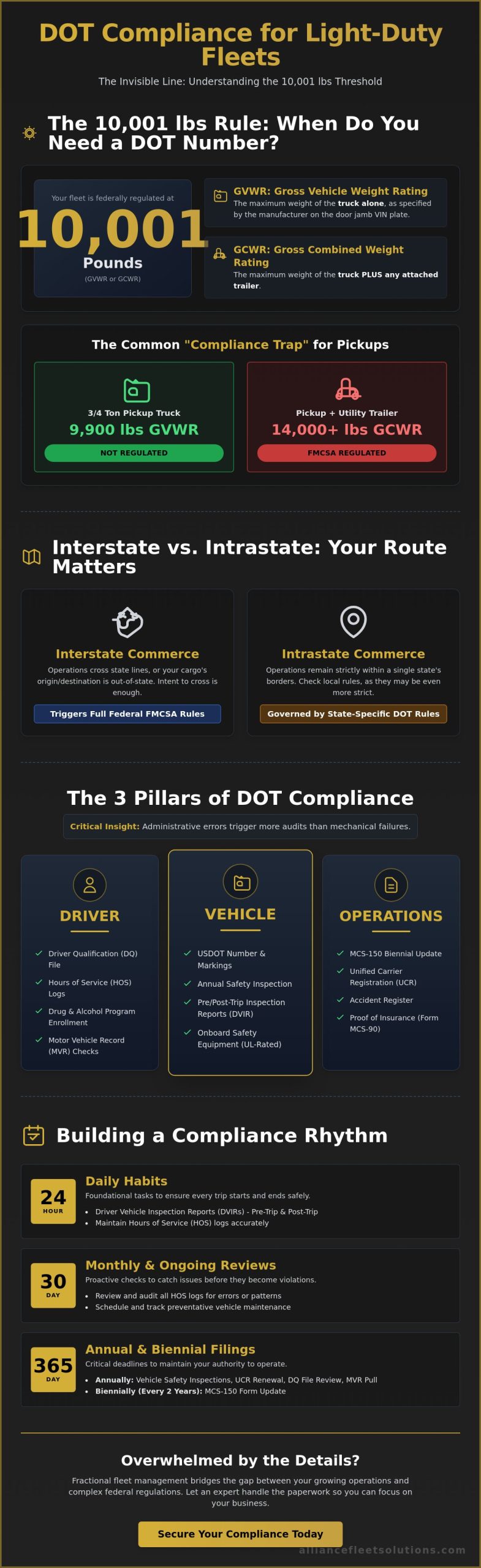
The Federal Motor Carrier Safety Administration (FMCSA) defines a Commercial Motor Vehicle (CMV) primarily by its weight. For most light-duty operators, the magic number is 10,001 pounds. If your vehicle or combination of vehicles exceeds this Gross Vehicle Weight Rating (GVWR) or Gross Combined Weight Rating (GCWR), you are legally required to maintain a DOT compliance checklist for light duty fleets. This weight threshold is the primary trigger for federal oversight, regardless of whether you consider your trucks “light” or “heavy.”
It’s vital to distinguish between GVWR and GCWR. The GVWR is the maximum weight rating of the power unit alone, as specified by the manufacturer. The GCWR includes the weight of the truck plus any trailer it’s towing. This distinction creates a common “compliance trap” for 3/4 ton pickups. A standard 2500-series truck often sits just under 10,000 pounds. Once you hitch even a small utility trailer to that truck, your GCWR almost certainly clears the 10,001-pound mark. This immediately subjects the driver and the business to federal safety regulations.
For 2026, the FMCSA has maintained this 10,001-pound threshold as the standard for interstate commerce. While civil penalties haven’t seen an inflation-based increase this year due to specific economic reporting delays, enforcement agencies are using more automated data to target high-risk carriers. This means even small fleets are under more scrutiny than ever before. Proactive management is no longer optional; it’s a financial necessity.
Interstate vs. Intrastate: Why Your Route Matters
Geography plays a massive role in your regulatory burden. Interstate commerce isn’t just about driving from New York to New Jersey. If your cargo originated in another state or is destined for a location outside your home state, the FMCSA considers it interstate commerce. This triggers the full suite of federal rules, including Hours of Service (HOS) regulations. Even an “intent” to cross state lines can be enough to bring your fleet under federal jurisdiction.
If you stay strictly within state lines, you operate under “intrastate” rules. However, many states have adopted federal standards or require their own state-specific DOT numbers for vehicles over a certain weight. You should verify the specific requirements for every state where you maintain a physical presence, as state-level variations can be more stringent than federal baselines.
The ‘Gray Area’ Vehicles: Vans, Pickups, and Box Trucks
Class 1-3 vehicles, including high-roof transit vans and light box trucks, often hover near the compliance line. You can find your vehicle’s official GVWR on the VIN plate located on the driver-side door jamb. Never rely on the “estimated” weight or the registration alone. Overloading a vehicle doesn’t just cause mechanical strain; it can push a previously exempt vehicle into a higher compliance tier. If a roadside inspection reveals your actual weight exceeds 10,000 pounds and you lack the proper filings, the resulting fines can devastate your quarterly margins. Using a robust DOT compliance checklist for light duty fleets ensures you aren’t caught off guard by these weight-based triggers.
The Essential DOT Pillars: Driver, Vehicle, and Operations
Effective fleet oversight relies on a stable three-legged stool: the driver, the vehicle, and the operational records. If one leg fails, the entire structure collapses during an FMCSA intervention. While many managers focus on mechanical upkeep, the reality of modern enforcement is that paperwork errors, specifically missing or incomplete files, trigger penalties more frequently than a bald tire or a cracked windshield. Maintaining a comprehensive DOT compliance checklist for light duty fleets requires a shift in focus from the garage to the office.
Centralizing this data is your best defense. In 2026, the FMCSA is increasingly utilizing data-driven enforcement, pulling from roadside inspection results and electronic records to target carriers. Utilizing fleet management services allows you to bridge the gap between daily operations and safety requirements by automating mileage tracking and driver behavior monitoring. This proactive approach transforms compliance from a reactive burden into a streamlined business process.
Driver Qualification Files (DQF) for Light Duty Drivers
Every driver operating a vehicle over the 10,001 lb threshold must have a completed DQF. This isn’t just for full-time CDL holders; it applies to any employee, even casual or part-time staff, who gets behind the wheel of a regulated vehicle. According to official FMCSA regulations, a compliant file must include a specific employment application, a current Motor Vehicle Record (MVR) pulled within the last 12 months, and a valid Medical Examiner’s Certificate. For 2026, the standard has shifted toward electronic record-keeping, making digital file management a necessity for growing businesses.
Hours of Service (HOS) and the ELD Mandate
Light-duty fleets often benefit from the short-haul exception. If your drivers stay within a 150 air-mile radius of their work reporting location and return home every day, they generally aren’t required to keep a standard logbook. However, they must still document their start and end times to prove they haven’t exceeded the 14-hour duty window.
The ELD mandate applies to light-duty trucks only if the driver is required to keep Records of Duty Status (RODS) for more than eight days in any 30-day period. Common violations often stem from “creeping” outside that 150-mile radius without a logging device. Integrating these tracking requirements into your DOT compliance checklist for light duty fleets ensures you never accidentally violate these technical thresholds. It’s about creating a system where the data works for you, rather than against you, during a surprise audit.
The Light Duty DOT Inspection Checklist: Equipment & Markings
A physical inspection is often the first point of contact between your driver and a DOT officer. While the paperwork discussed in previous sections provides the legal foundation, the hardware on your trucks provides the visible proof of your safety culture. A robust DOT compliance checklist for light duty fleets must prioritize both the functionality of the vehicle and the clarity of its markings. If a vehicle looks neglected, an inspector is far more likely to dig deeper into your driver qualification files and hours of service records.
Daily Vehicle Inspection Reports (DVIR) are the backbone of this process. For light-duty fleets, drivers must perform a walk-around before every shift to identify defects that could affect safety or result in a breakdown. For 2026, enforcement focus has intensified on trailer visibility for light-duty combinations. This includes ensuring all LED lighting is functional and that reflective tape meets the required coverage standards. Integrating these checks into your daily maintenance management routine prevents small issues from becoming expensive roadside failures.
Mandatory In-Cab Safety Equipment
Every regulated vehicle must carry specific emergency equipment within the cab. Fire extinguishers must be securely mounted and easily accessible. For most light-duty trucks, a 5 B:C rated extinguisher is sufficient, though vehicles carrying hazardous materials require a 10 B:C rating. You must also carry three bidirectional reflective triangles. If a breakdown occurs, drivers should place these at specific intervals (10 feet, 100 feet, and 200 feet) to alert oncoming traffic. Finally, ensure that spare fuses are available for every major circuit and that seat belts are in perfect working order. These small details are frequently cited in FMCSA regulations as mandatory safety items.
Exterior Markings and Placarding
Your USDOT number and legal company name must appear on both sides of the power unit. These markings need to be in a color that sharply contrasts with the vehicle’s paint and must be legible from a distance of 50 feet during daylight hours. While light-duty trucks rarely carry enough weight to require hazardous material placarding, certain specialized upfits or cargo types can trigger this requirement.
Don’t overlook the annual inspection sticker. Every vehicle in your DOT compliance checklist for light duty fleets requires a formal inspection every 12 months. This sticker should be placed in a visible location, typically on the driver-side door frame or the trailer tongue, and must correspond to a detailed report kept in your maintenance files. Keeping these markings clean and updated signals to enforcement that your operation is professional and organized.
Building a Compliance Rhythm: Daily, Monthly, and Annual Tasks
Successful fleet management relies on a steady, predictable cadence. You can’t wait for an audit notice to organize your records. Instead, you should weave regulatory requirements into your existing maintenance management workflows. This creates a “Compliance Rhythm” that makes safety a byproduct of daily operations rather than a separate, stressful task. By using a standardized DOT compliance checklist for light duty fleets, you ensure that no detail, from a flickering taillight to an expiring medical card, slips through the cracks.
The rhythm begins at the start of every shift. Training your drivers to perform a thorough pre-trip inspection is the most effective way to prevent roadside violations. When drivers treat the walk-around as a non-negotiable habit, they spot issues before they ever reach the highway. Monthly, your focus should shift to the office. Audit your driver qualification files to identify upcoming expirations for medical certificates or licenses. Annually, every vehicle must undergo a formal inspection under §396.17. Only qualified inspectors, who meet specific training or experience criteria, can perform these. You must keep these records for at least 14 months to remain compliant.
Understanding Your CSA Score and Intervention Thresholds
Compliance directly impacts your financial performance. The FMCSA uses the Safety Measurement System (SMS) to track your performance across seven Behavior Analysis and Safety Improvement Categories (BASICs). High scores in areas like Unsafe Driving or Vehicle Maintenance trigger interventions and roadside inspections. These scores also influence your business’s creditworthiness. Poor safety data can make it difficult to secure competitive commercial vehicle leasing terms or insurance rates. If you receive an incorrect violation, use the DataQs system to challenge the data and protect your record.
The Audit Preparation Workflow
Organizing for an audit requires meticulous record-keeping. If you’re a new carrier, expect a New Entrant Safety Audit within your first 12 months. Prepare an Accident Register even if your fleet has a perfect safety record; a blank log with “No Accidents” is better than no log at all. Maintain a 14-month history of maintenance records for every VIN in your fleet. This documentation proves you follow a systematic program of inspection, repair, and maintenance. It demonstrates expert control over your assets and protects your business from the stress of unexpected regulatory scrutiny.
Protect your business from regulatory risk by partnering with experts who understand the high stakes of fleet safety. Contact Alliance Fleet Solutions to integrate these compliance rhythms into your fleet management strategy.
Optimizing Compliance with Fractional Fleet Management
Managing a DOT compliance checklist for light duty fleets requires constant vigilance that most small to mid-sized business owners simply cannot sustain alone. Without a dedicated safety officer, administrative tasks like tracking medical card expirations or monitoring HOS logs often fall through the cracks. This creates significant regulatory exposure. Fractional fleet management solves this by providing expert oversight on a part-time or project basis, allowing you to maintain high safety standards without the overhead of a full-time executive hire.
Alliance Fleet Solutions integrates these requirements directly into our fleet management services. By leveraging advanced telematics and GPS solutions, we automate the data collection process for maintenance intervals and driver behavior. This technology doesn’t just track location; it creates a digital paper trail that simplifies audits and proves your commitment to safety. Beyond avoiding fines, a compliant fleet enjoys lower insurance premiums and maintains a higher resale value when it’s time for vehicle remarketing. Expert control over your documentation is a direct investment in your company’s financial performance.
Custom Upfitting and Compliance Safety
Professional upfitting is a critical area where light-duty fleets often accidentally trigger DOT status. Adding heavy duty shelving, ladder racks, or specialized tool vaults can push a vehicle with a 9,900 lb GVWR over the 10,001 lb threshold once cargo and drivers are included. We ensure your upfits are calculated with weight thresholds in mind, maintaining a safe buffer for your operations. Proper weight distribution is also essential for braking performance and overall stability. Our custom builds can include integrated storage for mandatory safety equipment, ensuring your fire extinguishers and triangles are always secure and accessible during a roadside inspection.
Partnering for Long-Term Fleet Health
Fractional management allows you to scale your operations without increasing your risk profile. As you add more units, we help you maintain a consistent safety culture across the entire fleet. This partnership extends to every aspect of your operation, including proactive fuel management programs that reduce total cost of ownership while keeping your data organized. By treating compliance as a strategic business asset, you protect your drivers and your bottom line simultaneously. It is time to move beyond the stress of surprise audits and build a resilient, audit-ready operation.
Ready to secure your fleet’s future? Schedule a compliance review with Alliance Fleet Solutions today to ensure your business stays ahead of 2026 regulations.
Secure Your Business Against Regulatory Risk
Mastering federal requirements starts with recognizing the 10,001 lb threshold and maintaining a strict cadence of daily inspections and monthly audits. Paperwork errors shouldn’t be the reason your operations stall. By focusing on the three pillars of driver, vehicle, and operational documentation, you transform a complex legal burden into a manageable business process. This proactive approach doesn’t just prevent fines; it optimizes your entire lifecycle from acquisition to remarketing.
Implementing a DOT compliance checklist for light duty fleets is easier when you have the right partner. Alliance Fleet Solutions provides the expert Fractional Fleet Management and comprehensive telematics integration you need to automate these tasks. With our national service and support, you can scale your fleet confidently while we handle the technical details of FMCSA oversight. Streamline your fleet’s DOT compliance with Alliance Fleet Solutions and protect your bottom line today. Your fleet is the backbone of your success, and staying compliant ensures that backbone remains strong and uninterrupted.
Frequently Asked Questions
Does a Ford F-150 or Chevy Silverado 1500 need a DOT number?
Generally, a half-ton pickup like a Ford F-150 or Chevy Silverado 1500 does not require a USDOT number because its GVWR is typically under 10,000 pounds. However, if you hitch a trailer and the combined weight rating (GCWR) exceeds 10,001 pounds in interstate commerce, you must register. This is a common oversight for businesses that use light trucks for hauling equipment across state lines.
What are the penalties for a light-duty fleet failing a DOT audit in 2026?
Penalties for failing a DOT audit in 2026 remain at 2025 levels because a government shutdown prevented the release of new inflation-based data. Fines can reach thousands of dollars per violation for record-keeping errors or safety defects. Beyond financial costs, a failed audit can lead to a “Conditional” or “Unsatisfactory” safety rating, which severely impacts your insurance rates and client contracts.
Do light-duty drivers need a Commercial Driver’s License (CDL) for DOT compliance?
Most light-duty drivers do not need a Commercial Driver’s License (CDL) if the vehicle’s weight rating is between 10,001 and 26,000 pounds. A standard driver’s license is sufficient for Class 1-3 vehicles as long as they aren’t transporting hazardous materials or more than 15 passengers. You must still include these drivers in your DOT compliance checklist for light duty fleets to ensure they meet medical and age requirements.
How often must light-duty commercial vehicles undergo a DOT inspection?
Light-duty commercial vehicles must undergo a formal DOT inspection at least once every 12 months. This annual inspection ensures the vehicle meets all safety standards outlined in the federal regulations. You must keep a copy of this inspection report on the vehicle and in your maintenance files for at least 14 months to satisfy audit requirements.
Is a medical card required for drivers of vehicles over 10,000 lbs?
Yes, any driver operating a vehicle with a GVWR or GCWR of 10,001 pounds or more in interstate commerce must carry a valid Medical Examiner’s Certificate. This card proves the driver is physically fit to operate a commercial motor vehicle safely. You need to verify that these certificates are issued by a professional on the National Registry of Certified Medical Examiners.
What is the 150 air-mile radius exception for light-duty trucks?
The 150 air-mile radius exception allows light-duty drivers to avoid keeping detailed logs or using Electronic Logging Devices (ELDs). To qualify, the driver must operate within 150 miles of their normal work location and return home within 14 consecutive hours. You must still record the driver’s total hours worked each day to prove they remain within these legal limits.
Can I perform my own annual DOT inspection for my fleet?
You can perform your own annual DOT inspections if the individual doing the work is properly qualified under federal law. The inspector must understand the specific inspection criteria and have at least one year of training or experience in truck maintenance. Many fleets prefer to outsource this task to ensure technical accuracy and reduce the risk of missed violations during a roadside check.
How do I check my company’s CSA score online?
You can check your company’s CSA score by visiting the FMCSA Safety Measurement System (SMS) website. You’ll need your USDOT number and your company PIN to access private data and detailed violation histories. Regularly monitoring this portal is a key part of an effective DOT compliance checklist for light duty fleets because it allows you to spot negative trends before they trigger an intervention.