
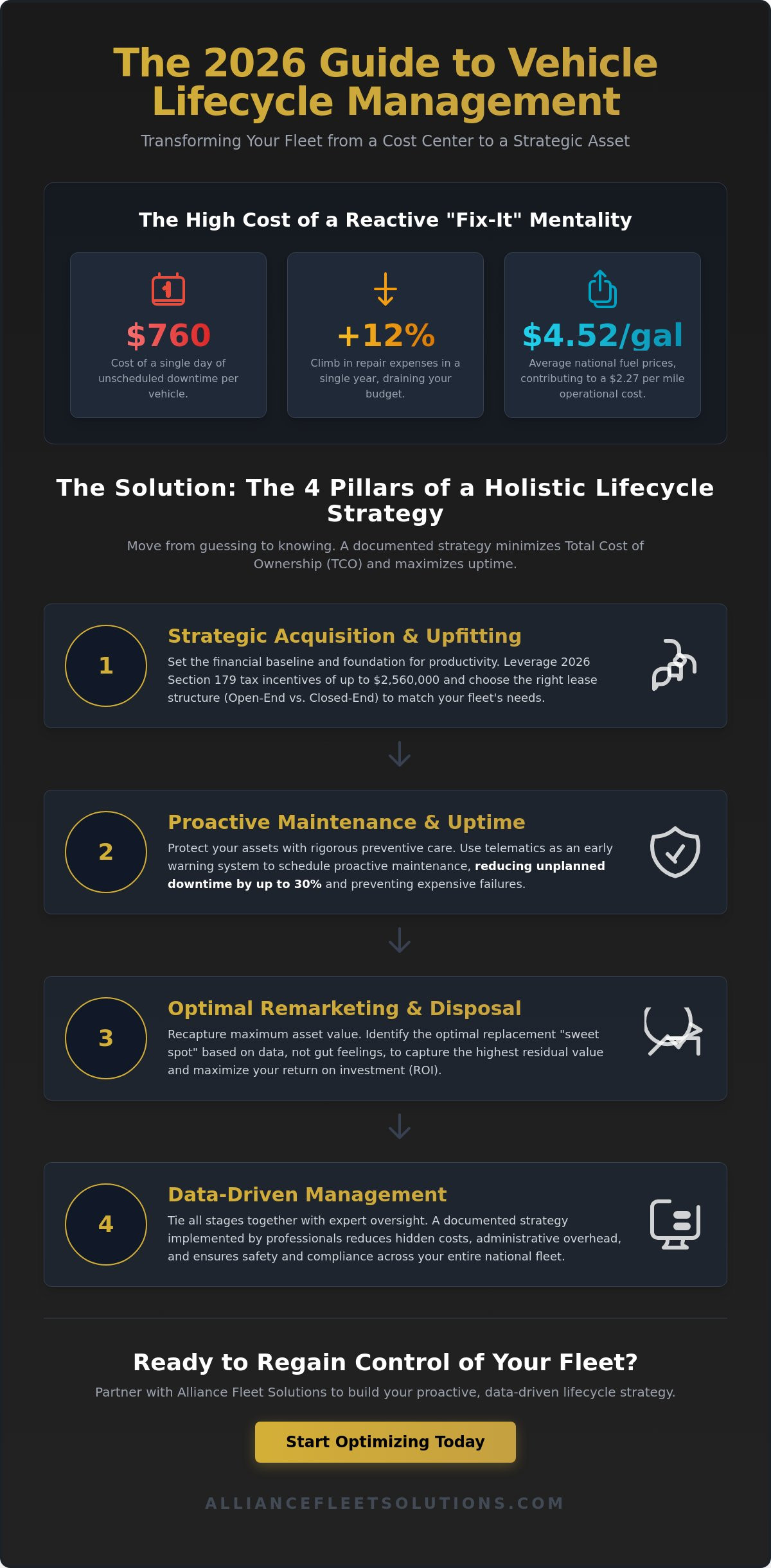
Did you know that a single day of unscheduled downtime for a carrier can cost as much as $760? When you multiply that figure across a fleet of twenty or fifty vehicles, a single mechanical failure quickly transforms from a minor nuisance into a major financial drain. You likely feel the weight of these rising operational costs every day, especially with national fuel prices averaging $4.52 per gallon and repair expenses climbing by 12% in a single year. It’s exhausting to manage every stage of a vehicle’s life when you’re already stretched thin and dealing with unpredictable maintenance schedules.
The good news is that you don’t have to settle for high downtime or poor resale values. By creating a vehicle lifecycle management strategy, you can regain control over your assets and significantly lower your cost per mile. This comprehensive 2026 guide will teach you how to build a data-driven fleet strategy that minimizes total cost of ownership and maximizes vehicle uptime from acquisition to disposal. We’ll explore how to leverage 2026 tax incentives like Section 179, streamline your upfitting process, and use predictive maintenance to reduce unplanned downtime by up to 30%.
Key Takeaways
- Transition from a reactive “fix-it” mentality to a holistic approach by creating a vehicle lifecycle management strategy that stabilizes your total cost of ownership.
- Learn how strategic acquisition and professional upfitting set the foundation for a vehicle’s productivity and long-term resale value.
- Discover how to use telematics as an early warning system to schedule proactive maintenance and prevent expensive, unscheduled downtime.
- Identify the optimal “sweet spot” for vehicle disposal to capture the highest residual value and maximize your return on investment.
- Explore how fractional fleet management provides expert oversight and reduces administrative overhead for mid-sized national fleets.
Defining Vehicle Lifecycle Management for Modern Fleets
Vehicle lifecycle management is more than just a tracking process. It’s a holistic approach to managing a vehicle’s utility and cost from the moment you sign the procurement papers to the day it hits the auction block. Many businesses treat these stages as separate silos, but true optimization happens when you view them as one continuous loop. By utilizing professional fleet management services, companies move away from the “fix-it-when-it-breaks” mentality and toward a proactive model that preserves capital and protects the bottom line.
In 2026, the stakes are higher than ever. With operational costs reaching an average of $2.27 per mile and regulatory shifts like the EPA’s recent rescission of greenhouse gas standards creating uncertainty, your strategy must be agile. Total Cost of Ownership (TCO) serves as your primary KPI. It isn’t just about the purchase price; it includes fuel, insurance, maintenance, and the eventual resale value. If you ignore these variables while creating a vehicle lifecycle management strategy, you risk leaving thousands of dollars on the table for every asset in your yard.
The Four Pillars of the Fleet Lifecycle
A successful lifecycle strategy rests on four distinct stages that work in harmony. First, acquisition and financing set your financial baseline. This is where you determine the most tax-efficient way to bring vehicles into your fleet. Second, operations and upfitting ensure the vehicle is ready for its specific job. Proper upfitting at the start prevents costly retrofits later and maximizes the vehicle’s functional life. Third, maintenance and uptime protect the asset’s health through rigorous preventive care and real-time monitoring. Finally, remarketing and disposal allow you to recapture maximum value when the vehicle reaches its peak replacement age. Each pillar supports the next; if one fails, the entire TCO calculation collapses.
Why a Documented Strategy is Non-Negotiable
Relying on “gut feelings” for replacement cycles doesn’t work in a modern economy. Fleet management professionals use data to move from guessing to knowing exactly when a vehicle becomes too expensive to keep. A documented strategy reduces hidden costs like administrative bloat and the need for expensive emergency rentals. It also ensures safety compliance across your entire national footprint, protecting your drivers and your brand reputation. When you’re creating a vehicle lifecycle management strategy, you’re building a defense against market volatility and ensuring your fleet remains a strategic business asset rather than a financial liability.
Strategic Acquisition: Setting the Foundation for Long-Term ROI
Sourcing vehicles requires a careful balance between national scale and local readiness. While you want the volume pricing of a national network, you can’t wait months for delivery while your existing trucks rack up expensive repair bills. When you’re creating a vehicle lifecycle management strategy, you should prioritize partners who can source assets across the country while managing the “last mile” of delivery and upfitting. This ensures your drivers get on the road faster, which is the cornerstone of efficient fleet operations. Leveraging the 2026 Section 179 deduction limit of $2,560,000 for qualifying equipment can also provide immediate tax relief, making strategic acquisition even more valuable for your cash flow.
Lease Structures: Open-End vs. Closed-End
Open-end leases are the industry standard for high-mileage commercial fleets. They offer the flexibility to cycle vehicles out based on actual market conditions rather than arbitrary dates. This flexibility is a critical component of fleet lifecycle management best practices. Conversely, closed-end leases provide budget certainty for fleets with predictable, lower mileage. Choosing the wrong structure can trap you in an asset that costs more to maintain than it’s worth. You must analyze how each lease term impacts your eventual remarketing success before signing the contract.
Lifecycle-Aware Upfitting
Professional upfitting is often overlooked as a strategic tool. A well-designed upfit doesn’t just help a technician find their tools; it preserves the vehicle’s “first life.” Over-customization is a common pitfall. If you weld specialized, permanent racks into a van, you’ve just slashed your potential buyer pool at disposal. Instead, use modular, weight-conscious systems. This reduces strain on tires and brakes, lowering your fuel costs while keeping the vehicle attractive for the secondary market. Think of upfitting as a way to improve driver productivity today and resale value tomorrow.
You must project residual values at the 36, 48, and 60-month marks during the acquisition phase. A vehicle that is $2,000 cheaper today but worth $5,000 less in four years is a poor investment. By analyzing these depreciation curves early, you can align your replacement cycles with the vehicle’s peak resale value. If you need help navigating these complex financial models, our vehicle acquisition experts can help you run the numbers to ensure your fleet remains a lean, profitable asset.
Maximizing Uptime Through Proactive Maintenance and Telematics
Operational success depends on keeping your assets in the field, not in the shop. While acquisition sets your financial baseline, your daily maintenance choices determine whether you actually achieve your projected ROI. By implementing a professional maintenance management program, you can prevent the catastrophic failures that derail delivery schedules and inflate repair budgets. The “Alliance” approach goes beyond simple data collection; it combines real-time telematics insights with immediate access to a national repair network. This ensures that when a fault code appears, you have a solution ready before the driver even notices a change in performance.
Telematics should serve as your early warning system, not just a tool for location tracking. Modern sensors monitor everything from engine temperature to brake pad wear, providing a clear picture of asset health across your entire footprint. Driver behavior monitoring is equally vital when creating a vehicle lifecycle management strategy. Excessive speeding, hard braking, and rapid acceleration don’t just increase safety risks; they accelerate the wear on engines, tires, and transmission systems. By coaching drivers based on data, you extend the functional life of every vehicle in your fleet.
Predictive vs. Preventive Maintenance
Preventive maintenance relies on rigid calendar dates or mileage intervals, which often leads to over-servicing or missing critical windows. Predictive maintenance is the use of real-time data to intervene before a fault code becomes a failure. This shift to usage-based service allows you to address issues exactly when they arise. The cost difference is staggering. A scheduled $200 sensor replacement during a routine stop is manageable; an emergency $2,000 breakdown on a highway, including towing and lost productivity, is a financial hit that most fleets can’t afford to repeat.
Leveraging Fuel Management Programs
Fuel is often a fleet’s largest variable expense, but it also provides a window into mechanical health. Integrating fuel management programs allows you to track consumption anomalies that may signal engine trouble or fuel theft. Excessive idling is a primary culprit for shortened engine lifecycles, as it increases soot buildup and maintenance frequency. When creating a vehicle lifecycle management strategy, use this data to identify “underperforming” vehicles. If a truck’s fuel efficiency drops significantly despite proper maintenance, it’s a clear signal that the asset should be prioritized for early replacement to avoid a steep decline in TCO.
The Exit Strategy: Remarketing and Vehicle Disposal
Every vehicle in your fleet eventually reaches a point of diminishing returns where the cost to keep it on the road exceeds its operational value. Remarketing isn’t just the final step in a vehicle’s life; it’s the critical closing loop when creating a vehicle lifecycle management strategy. If you treat disposal as an afterthought, you’re likely leaving thousands of dollars on the table. A professional approach to remarketing ensures you recapture the maximum residual value, which directly lowers your total cost of ownership (TCO) and provides the capital needed for your next round of acquisitions.
National reach is essential for securing the best price for used commercial assets. Local markets can become saturated with specific makes or models, driving prices down. By leveraging a broader network, you can move assets to regions where demand is higher and supply is low. Before the sale, you must decide which repairs are actually worth the investment. While major mechanical overhauls rarely offer a dollar-for-dollar return at auction, addressing glass chips, replacing worn tires, and professional detailing can significantly increase buyer interest and final sale price.
Timing the Replacement Cycle
Identifying the “Inflexion Point” is the most difficult part of lifecycle management. This is the moment when rising maintenance costs and the risk of $760-per-day downtime outweigh the depreciation savings of keeping an older truck. With repair and maintenance costs having increased by 12% recently, the window for profitable operation has narrowed. You must avoid the “Zombie Fleet” trap, which is the habit of keeping aging vehicles out of fear of new capital expenses. In 2026, with bank prime rates at 6.75%, the cost of financing new equipment is often lower than the cumulative cost of emergency repairs and lost productivity on a ten-year-old asset.
Professional Remarketing Channels
Choosing between auctions, direct sales, or wholesaler networks depends on your specific timeline and asset type. Auctions offer speed and transparency, while direct sales might yield higher margins for specialized upfitted vehicles. A managed remarketing process also handles the administrative burden of title transfers and liability releases, which protects your business from post-sale headaches. Most importantly, you must ensure data security. Every modern vehicle contains sensitive telematics and driver information. A professional disposal strategy includes a verified process for clearing all digital footprints before the asset leaves your control.
Don’t let your aging assets drain your profitability. If you’re ready to maximize the return on your used vehicles, our vehicle remarketing specialists can help you identify the perfect time to sell and handle every detail of the transaction.
Implementing Your Strategy with Fractional Fleet Management
Mid-sized national fleets often face a unique challenge. You’ve grown large enough that basic spreadsheets no longer suffice, yet you might not have the budget for a full-time, executive-level fleet director. This is where many businesses stall. They invest in expensive software expecting it to solve the problem, but software is only a tool. Without a dedicated expert to interpret the data and execute the plan, creating a vehicle lifecycle management strategy remains an unfulfilled goal. Fractional fleet management bridges this gap by providing high-level oversight without the full-time headcount.
Alliance Fleet Solutions acts as the strategic backbone for your operational success. Our fractional model allows you to leverage seasoned expertise to manage every stage of the vehicle loop. Industry data shows that businesses utilizing fractional fleet management can reduce their administrative overhead by 20% to 30%. We don’t just give you a dashboard; we provide the human intelligence required to turn those numbers into lower costs and higher uptime. This allows your internal team to focus on core business growth while we handle the technical complexities of fleet optimization.
Bridging the Gap Between Strategy and Execution
A professional partnership is the ultimate “uptime” insurance policy. As your business expands, your fleet management capacity must scale alongside it. An “Alliance” partner manages the daily lifecycle tasks that often slip through the cracks, such as auditing maintenance invoices or negotiating with national upfitting vendors. This proactive involvement ensures that your strategy isn’t just a document sitting on a shelf; it’s a living, breathing process that constantly seeks out efficiency gains and protects your bottom line from market volatility. It’s about having a seasoned expert who speaks the language of both the shop floor and the boardroom.
Your 90-Day Lifecycle Implementation Roadmap
Transitioning to a managed lifecycle model follows a logical, three-month progression to ensure long-term stability and ROI:
- Month 1: Data Audit and TCO Baseline. We conduct a comprehensive audit of your current assets to establish your TCO baseline and identify immediate “leaks” in your budget.
- Month 2: Acquisition and Upfitting Optimization. Our team refines your sourcing and upfitting standards to ensure every new asset enters the fleet with maximum earning potential.
- Month 3: Network Integration and Remarketing. We integrate your maintenance network and finalize a remarketing plan to begin recapturing value from your aging assets.
The first step in creating a vehicle lifecycle management strategy is knowing exactly where you stand today. Auditing your current fleet allows you to identify immediate cost-saving opportunities and set a clear path for 2026 and beyond. When you’re ready to move from reactive repairs to strategic fleet solutions, we’re here to provide the expert control your business deserves.
Secure Your Fleet’s Future in 2026 and Beyond
Success in modern logistics requires more than just keeping trucks on the road. It demands a sophisticated approach that balances immediate uptime with long-term financial health. By creating a vehicle lifecycle management strategy, you transform your fleet from a cost center into a strategic business asset. You’ve learned how proactive maintenance prevents $760-per-day downtime and how strategic remarketing recaptures vital capital at the ideal inflexion point. These aren’t just mechanical fixes; they’re business solutions designed to protect your bottom line in a volatile market.
You don’t have to manage this complex loop alone. Alliance Fleet Solutions provides the professional upfitting, national acquisition reach, and expert fractional management you need to reduce administrative overhead and stabilize your TCO. We act as your dedicated partner, ensuring every asset is optimized from the first mile to the final sale. Build your alliance with Alliance Fleet Solutions; get a custom lifecycle audit today. Your fleet is the backbone of your business. Let’s work together to ensure it stays strong, efficient, and profitable for years to come.
Frequently Asked Questions
What is the most important factor in a vehicle lifecycle management strategy?
Data-driven visibility across every stage is the most important factor when creating a vehicle lifecycle management strategy. You cannot optimize what you don’t measure. By integrating acquisition costs with real-time maintenance data and fuel consumption, you gain a clear view of each asset’s performance. This allows you to identify which models are underperforming and adjust your procurement strategy accordingly, ensuring your capital is always tied to the most efficient vehicles.
How do I calculate the total cost of ownership (TCO) for my fleet?
To calculate the total cost of ownership, you must subtract the vehicle’s residual value from the sum of all acquisition, operational, and administrative expenses. This includes the initial purchase or lease cost, fuel, insurance, taxes, and all maintenance expenditures. Analyzing TCO helps you understand the true cost of an asset over its entire life, rather than just the monthly payment. It’s the primary metric for determining the success of your fleet strategy.
When is the best time to replace a commercial vehicle?
The best time to replace a commercial vehicle is at the “inflexion point,” where the rising costs of maintenance and downtime begin to outweigh the depreciation savings of an older asset. For most high-utilization national fleets, this sweet spot typically occurs between 36 and 60 months. Keeping a vehicle longer often leads to unpredictable failures and a sharp decline in resale value, which ultimately increases your overall cost per mile.
Can fractional fleet management work for a small to mid-sized business?
Fractional fleet management is specifically designed to help small to mid-sized businesses gain expert oversight without the high salary of a full-time director. It allows you to scale your management capacity as your operations grow, providing access to national networks and strategic procurement advice. This model often reduces administrative overhead by up to 30%, making it a highly cost-effective solution for companies that need technical authority but lack internal bandwidth.
How does professional upfitting affect the resale value of a truck?
Professional upfitting improves resale value when you use modular, high-quality components that appeal to a wide secondary market. Over-customization can actually hurt your ROI by limiting the number of potential buyers. When creating a vehicle lifecycle management strategy, you should prioritize weight-conscious and versatile upfits. These choices protect the vehicle’s “first life” by reducing mechanical strain while ensuring the asset remains attractive and functional for the next owner.
Is it better to use open-end or closed-end leasing for a national fleet?
Open-end leasing is generally better for national fleets because it offers the mileage flexibility and terminal rental adjustment clauses needed for high-utilization vehicles. It allows you to cycle vehicles based on market demand rather than fixed dates. Closed-end leasing might be preferable for businesses with very predictable, low-mileage routes that require a fixed budget. However, open-end structures provide the agility most logistics companies need to maximize their remarketing returns.
What role does telematics play in predictive maintenance?
Telematics acts as the early warning system for predictive maintenance by monitoring engine diagnostics and fault codes in real time. Instead of waiting for a driver to report a problem, you receive an alert the moment a sensor detects an anomaly. This data allows you to intervene before a minor issue turns into a major breakdown. It shifts your schedule from calendar-based service to usage-based maintenance, ensuring you only spend money when it’s necessary.
How can I reduce vehicle downtime through lifecycle planning?
You can reduce vehicle downtime by aligning your maintenance schedule with the vehicle’s actual usage and prioritizing the replacement of high-risk assets. Lifecycle planning helps you identify “lemon” vehicles that consistently require more repairs than their peers. By replacing these assets early and using a proactive maintenance network, you avoid the $760 daily cost of unscheduled downtime. This organized approach ensures your technicians handle repairs on your schedule, not during an emergency.