
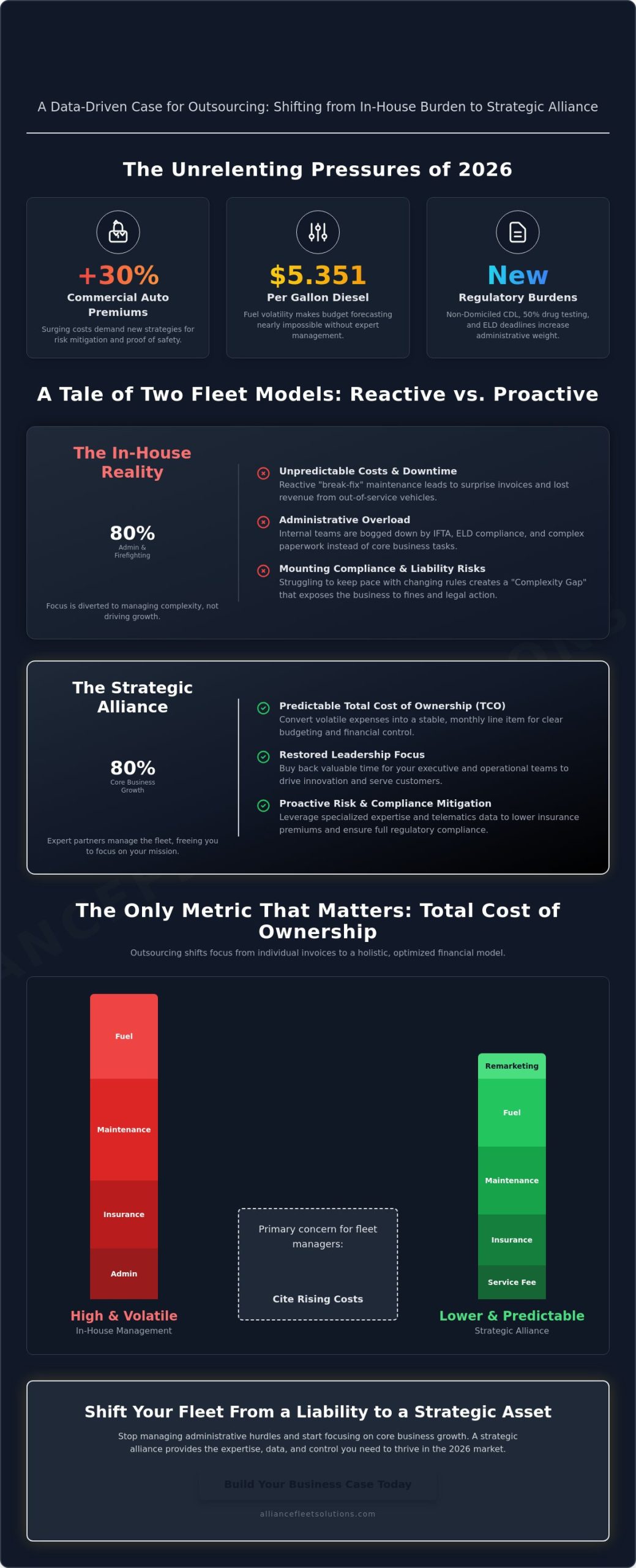
With commercial auto insurance premiums surging by 30% in early 2026 and national diesel prices averaging $5.351 per gallon in April, your fleet is no longer just a logistics tool. It’s a high-stakes financial variable that can either stabilize your margins or erode them. You likely feel the administrative weight of the new Non-Domiciled CDL Rule that took effect on March 16, 2026, alongside the mandatory 50% random drug testing rate. It’s a relentless cycle of compliance and rising costs that often distracts from your primary mission of serving customers.
We understand that modern logistics requires more than just mechanical fixes; it requires a strategic partnership. This article presents a data-driven business case for outsourcing fleet management, showing you how to quantify ROI and gain expert control over your operations. You’ll discover a 2026 framework to lower your Total Cost of Ownership (TCO) and convert unpredictable maintenance downtime into a reliable, monthly line item. We will examine how a professional alliance allows you to stop managing administrative hurdles and start focusing on core business growth.
Key Takeaways
- Quantify the “Complexity Gap” to demonstrate why traditional in-house management models are struggling to keep pace with 2026 market volatility.
- Develop a robust business case for outsourcing fleet management by aligning financial ROI with strategic risk mitigation and operational scalability.
- Uncover the full spectrum of fleet expenses, from hidden soft costs to the significant capital gains realized through professional vehicle remarketing.
- Shift the weight of 2026 regulatory compliance to a specialized partner while leveraging telematics data to lower insurance premiums.
- Implement a step-by-step transition plan using fractional management to restore focus on your core business goals.
The 2026 Fleet Landscape: Why In-House Management is a Growing Liability
Fleet operations in 2026 have reached a critical tipping point. Managing a vehicle lineup used to be a secondary task for a shop foreman or business owner. Today, it’s a complex financial and regulatory burden that can quickly erode profit margins. As the industry evolves, the comprehensive overview of fleet management now includes advanced data analytics, strict emission mandates, and volatile fuel markets. Relying on internal staff to keep pace with these shifts often creates a “Complexity Gap” that exposes your business to unnecessary risk.
Rising Operational Pressures in 2026
The financial strain on unmanaged fleets is quantifiable. In April 2026, national diesel prices averaged $5.351 per gallon, making fuel the most volatile variable on your balance sheet. Simultaneously, commercial auto insurance premiums have surged by up to 30% this year. Insurance carriers no longer offer competitive rates based on history alone; they demand real-time proof of safety through telematics. Without professional oversight, your fleet is likely missing the data discipline required to negotiate these costs down. This lack of precision becomes dangerously visible during the CVSA International Roadcheck scheduled for May 12-14, 2026. Fleets without rigorous, documented preventive maintenance schedules face significantly higher out-of-service rates, leading to lost revenue and damaged reputations.
The Opportunity Cost of In-House Administration
Internal administration is often the hidden drain on a company’s resources. When your team spends dozens of hours each month on IFTA reporting, ELD compliance, and tracking the April 14, 2026 ELD replacement deadline, they aren’t focusing on your core business growth. This is a fundamental pillar of the business case for outsourcing fleet management. You’re not just paying for mechanical repairs; you’re buying back the time your leadership needs to scale operations.
The regulatory environment changed permanently on March 16, 2026, with the implementation of the Non-Domiciled CDL Rule. This regulation shifted the liability profile for many commercial operators, requiring a level of administrative expertise that most mid-sized companies can’t maintain in-house. Mechanical fixes represent only 20% of the modern fleet equation. The remaining 80% consists of data management, risk mitigation, and predictive maintenance. In a high-inflation environment, waiting for a truck to break before fixing it is a losing strategy. A strategic alliance moves you from reactive chaos to managed precision, ensuring that your fleet remains an asset rather than a growing liability.
Defining the Business Case for Outsourcing Fleet Management
A business case for outsourcing fleet management is a formal strategic document that justifies the transition from internal operations to a managed partner alliance. It’s the bridge between daily logistical headaches and long-term financial stability. In 2026, building this case requires more than just showing a lower invoice; it requires demonstrating how a managed model protects the company against market volatility and regulatory shifts. It serves as a roadmap to move your fleet from a reactive cost center to a proactive business asset.
Executives focus on three core pillars: Financial ROI, Risk Mitigation, and Scalability. While a shop foreman might worry about a single engine overhaul, a CFO cares about the Total Cost of Ownership (TCO). This metric is the only one that truly matters in 2026. It combines acquisition, fuel, maintenance, and remarketing into a single, predictable figure. By focusing on TCO, you align the fleet’s performance with corporate goals like capital efficiency and risk reduction, especially as 54.4% of fleet managers now cite rising costs as their primary concern.
Core Components of the Proposal
Your proposal must begin with an Executive Summary that reframes the fleet as a strategic business asset. It should include a Situational Analysis that benchmarks your current in-house performance against 2026 industry standards. A critical part of this transition involves professional maintenance management. This service doesn’t just fix trucks; it stabilizes the budget by eliminating the “surprise” costs that often derail quarterly projections. This section should clearly contrast your current “reactive” state with the “predictive” future of an outsourced model.
Setting Measurable Success Metrics
Vague promises of “better service” won’t win board approval. You need concrete KPIs. A strong business case targets a 15-25% reduction in annual maintenance spend through volume-based parts pricing and labor rate negotiation. You should also project specific uptime improvements. By utilizing telematics and GPS solutions, you can identify underperforming assets and reduce idle time, which directly impacts the high diesel costs we’re seeing this April.
While standards for federal fleet management emphasize strict compliance and sustainability, your private fleet can use these same benchmarks to drive efficiency. Success also means defining clear KPIs for vehicle acquisition and professional upfitting. If you’re struggling to quantify these variables, evaluating a managed fleet solution can provide the data discipline needed to build a winning case. This approach ensures your fleet remains scalable and ready for whatever the 2026 market brings next.
Financial Modeling: Comparing In-House Costs vs. Outsourced Efficiency
Developing a robust business case for outsourcing fleet management requires moving beyond simple line-item comparisons. You must evaluate the total financial ecosystem of your vehicles. Many organizations struggle with “Hard Costs” like fuel and repairs while completely overlooking the “Soft Costs” of administrative labor and equipment downtime. From a business-oriented perspective, every hour your staff spends on maintenance logs is an hour stolen from revenue-generating activities. A managed model converts these variable, often hidden expenses into a single, predictable monthly fee.
Leasing structures play a pivotal role in this financial shift. We help clients navigate the choice between open-end leasing, which offers maximum flexibility for heavy-duty applications, and closed-end leasing, which provides a fixed-cost exit strategy. When paired with fuel management programs, these structures provide immediate cash flow relief. In a market where diesel costs reached $5.351 per gallon in April 2026, gaining even a 5% efficiency through managed fuel spend can save a mid-sized fleet thousands of dollars annually.
The Power of Aggregated Purchasing
Individual businesses simply can’t match the procurement scale of a national alliance. We leverage a vast network to secure deep discounts on parts, tires, and labor rates that are typically reserved for the nation’s largest carriers. This scale extends to professional upfitting as well. Instead of dealing with local third-party shops that lack specialized expertise, you gain access to standardized, high-quality builds at a fraction of the retail cost. This ensures your vehicles are road-ready faster and built to last longer.
Maximizing Resale and Lifecycle Value
The most significant revenue driver often missing from internal models is professional vehicle remarketing. Most in-house operations run vehicles until they fail, but data shows that vehicles 10 years or older account for 34% of service spend despite only covering 12% of total miles. We perform a “Sweet Spot” analysis to identify the exact moment to cycle your assets. By selling vehicles while they still hold high secondary market value, we maximize your capital recovery. This data-driven acquisition and disposal strategy reduces the overall depreciation hit and ensures your fleet stays modern, safe, and efficient.
Risk Mitigation and Compliance: Protecting the Bottom Line
Risk management in 2026 is no longer a passive activity. It’s a proactive defense against rising liability and shifting federal standards. A central pillar of the business case for outsourcing fleet management is the immediate transfer of regulatory burdens to a specialized partner. When you manage a fleet internally, your company carries 100% of the compliance risk. By aligning with an expert alliance, you distribute that weight and ensure that deadlines, like the March 16, 2026, Non-Domiciled CDL rule, don’t result in costly fines or operational shutdowns. We handle the administrative heavy lifting, allowing you to focus on efficient fleet operations that prioritize uptime over paperwork.
Safety and Liability Reduction
The threat of “nuclear verdicts” has made driver behavior monitoring a financial necessity. In 2026, a single major accident can bankrupt a mid-sized carrier. We integrate advanced telematics and GPS solutions to provide real-time coaching for your drivers. This doesn’t just prevent accidents; it builds a data-driven defense against high-cost claims. When your insurance carrier sees documented proactive safety training and a 50% random drug testing rate, they see a lower risk profile. This data discipline is the most effective tool to combat the 30% surge in insurance premiums we’ve seen this year. We also automate ELD and IFTA compliance, removing the human error that often triggers expensive audits.
Managing Market Volatility
A managed fleet model provides a safety net against unpredictable market shifts. Whether it’s hedging against persistent vehicle shortages or navigating diesel prices that hit $5.351 per gallon this April, an outsourced partner offers stability. Our professional acquisition networks ensure you get the equipment you need when you need it, avoiding the “spot market” premiums that plague unmanaged fleets. We also help you build a comprehensive disaster recovery plan. This ensures that if a vehicle goes down, your business doesn’t. If you’re ready to secure your fleet’s future, it’s time to consult with a fleet risk expert to build your strategic defense. This proactive approach ensures your bottom line remains protected from the volatility of the 2026 logistics landscape.
Implementation Strategy: The Fractional and Full-Service Alliance
Transitioning from a theoretical business case for outsourcing fleet management to operational reality requires a structured, logical approach. It’s not a “flip of a switch” event; it’s a strategic integration designed to restore order to your logistics. While the financial and risk-based arguments for outsourcing are undeniable in 2026, the success of the transition depends on the implementation model you choose. Moving from in-house chaos to managed precision involves a clear audit of current assets, a data migration phase, and the gradual rollout of professional oversight to minimize disruption to your daily routes.
The Fractional Management Model
For mid-sized companies operating between 20 and 100 vehicles, the fractional model is the most effective solution for 2026. Many businesses in this bracket don’t need a full-time, six-figure fleet executive, yet they suffer from the “Complexity Gap” we discussed earlier. Fractional fleet management provides access to seasoned experts who manage your acquisition, compliance, and maintenance on a part-time or project basis. This allows you to scale services up during peak seasonal demand or down during quieter periods. It’s a collaborative approach that blends your existing internal staff with our technical authority, ensuring a seamless transition without the overhead of a full-time department.
Selecting the Right Strategic Partner
Choosing a partner is about more than comparing service fees; it’s about evaluating total ROI. A true alliance partner understands that your fleet is the backbone of your company. In a year where 54.4% of managers are overwhelmed by rising costs, you need a partner that offers more than just software. The Alliance Fleet Solutions difference lies in our comprehensive lifecycle care. We don’t just track your trucks; we maximize their value through professional upfitting and data-driven remarketing strategies that recover capital at the end of the vehicle’s life.
Your next step is to move from analysis to action. We’ve seen how the March 16, 2026 CDL regulations and $5.351 diesel prices have pressured internal teams. By consolidating these burdens into a managed framework, you shift your focus back to what you do best: growing your business. If you’re ready to stabilize your costs and secure your operational future, it’s time to build your 2026 business case with Alliance Fleet Solutions. Let’s transform your fleet from a source of stress into a high-performing strategic asset.
Secure Your Strategic Advantage in the 2026 Logistics Market
The landscape of fleet operations has shifted from a mechanical necessity to a high-stakes financial strategy. By moving away from the inefficiencies of in-house management, you regain control over your Total Cost of Ownership and eliminate the administrative friction caused by the March 16, 2026 CDL regulations. Building a data-driven business case for outsourcing fleet management is the most effective way to protect your margins against 30% insurance hikes and volatile fuel prices. This transition replaces unpredictable downtime with a steady, logical maintenance schedule.
Since 2018, Alliance Fleet Solutions has served as the backbone for B2B fleets across the country. Our national coverage for vehicle acquisition and professional upfitting ensures your equipment is road-ready and compliant with all 2026 federal standards. We don’t just provide services; we build an alliance focused on your long-term reliability. Take the first step toward operational precision and request a custom ROI analysis for your fleet today. Your business deserves a partner that understands the mechanics of efficiency and the value of your time. Let’s build a stronger future for your fleet together.
Frequently Asked Questions
Is it actually cheaper to outsource fleet management in 2026?
It’s often cheaper because it bridges the “Complexity Gap” that causes in-house operations to leak capital through administrative overhead. While 54.4% of managers worry about rising costs, professional partners leverage established scale and specialized expertise to reduce your Total Cost of Ownership. You trade unpredictable equipment failure and emergency repair costs for a steady, logical maintenance schedule.
How much can a business save by outsourcing fleet operations?
Most businesses realize a 15-25% reduction in annual maintenance spend by accessing national parts networks and negotiated labor rates. Beyond direct repairs, you save through optimized vehicle cycling. Since vehicles over 10 years old account for 34% of service spend, a data-driven remarketing strategy recovers capital before depreciation accelerates, significantly improving your bottom line.
What is fractional fleet management and who is it for?
Fractional fleet management provides part-time access to a senior fleet executive for companies typically operating 20 to 100 vehicles. It’s designed for businesses that require high-level expertise in vehicle acquisition and compliance but don’t have the budget for a full-time director. You get the technical authority of a strategic alliance without the fixed executive salary.
Will I lose control over my drivers if I outsource?
You actually gain control through increased data transparency and real-time telematics integration. Outsourcing doesn’t mean stepping away from your team; it means equipping them with better tools and safety protocols. You’ll have clearer visibility into driver behavior and safety metrics, allowing you to coach your team based on objective performance data rather than guesswork.
How does outsourcing help with 2026 CDL and DOT compliance?
Professional partners automate the rigorous tracking required for the March 16, 2026 Non-Domiciled CDL rule and the 50% random drug testing rate. We also manage critical deadlines like the April 14, 2026 ELD replacement mandate. This specialized oversight removes the administrative burden from your staff and ensures you never miss a critical filing or inspection date.
What are the first steps in creating a business case for outsourcing?
The first step is conducting a thorough audit of your current Total Cost of Ownership (TCO), including both hard costs and hidden soft costs like staff time. This data forms the backbone of a business case for outsourcing fleet management. Once you identify the efficiency gaps in your internal operations, you can benchmark your performance against 2026 industry standards to justify the transition.
How long does the transition from in-house to outsourced fleet management take?
A typical transition takes 30 to 90 days depending on your fleet size and data readiness. The process begins with a detailed asset audit and data migration from your current logs into a managed system. We then implement preventive maintenance schedules and telematics integration. This phased approach ensures your routes remain active and your drivers stay productive during the shift to managed precision.
Can outsourcing help reduce our commercial insurance premiums?
Yes, outsourcing provides the documented safety proof that insurance carriers require to combat the 30% premium hikes seen in 2026. By utilizing telematics to monitor driver behavior and maintaining 100% compliance records, you present a significantly lower risk profile. This transparency allows you to negotiate better rates based on actual safety performance rather than generic industry averages.