
What if your fleet wasn’t a line-item expense, but a financial engine capable of protecting your margins against 2026 market volatility? For many directors, justifying the cost of a fleet management service to a CFO feels like an uphill battle against a spreadsheet that only recognizes cost centers and overhead. You know that a 15% reduction in vehicle downtime translates directly into bottom-line revenue, yet these critical soft costs often get lost in translation during quarterly budget reviews.
We agree that it’s frustrating to see strategic maintenance viewed as a luxury rather than a necessity. This guide provides the tools you need to transform your fleet from a perceived burden into a strategic ROI driver that aligns with your CFO’s specific financial goals. You’ll gain a data-backed framework for outsourcing and a clear method for reporting the measurable gains that keep your company competitive. We’ll show you how to move beyond mechanical fixes to create a proactive alliance that secures your budget and streamlines your entire operation.
Key Takeaways
- Shift the conversation from simple overhead to Total Cost of Ownership (TCO) to demonstrate how fleet optimization directly improves company EBITDA.
- Build a bulletproof business case by justifying the cost of a fleet management service to a CFO through the quantification of unmanaged maintenance and downtime.
- Learn to utilize financial engineering tools like open-end leasing to transform unpredictable repair spikes into stable, manageable operating expenses.
- Follow a structured audit framework to identify immediate savings opportunities within your fuel programs and administrative workflows.
- Discover how fractional fleet management offers high-level strategic oversight and technical authority without the cost of a full-time internal hire.
Shifting the Narrative: From Cost Center to Strategic Asset
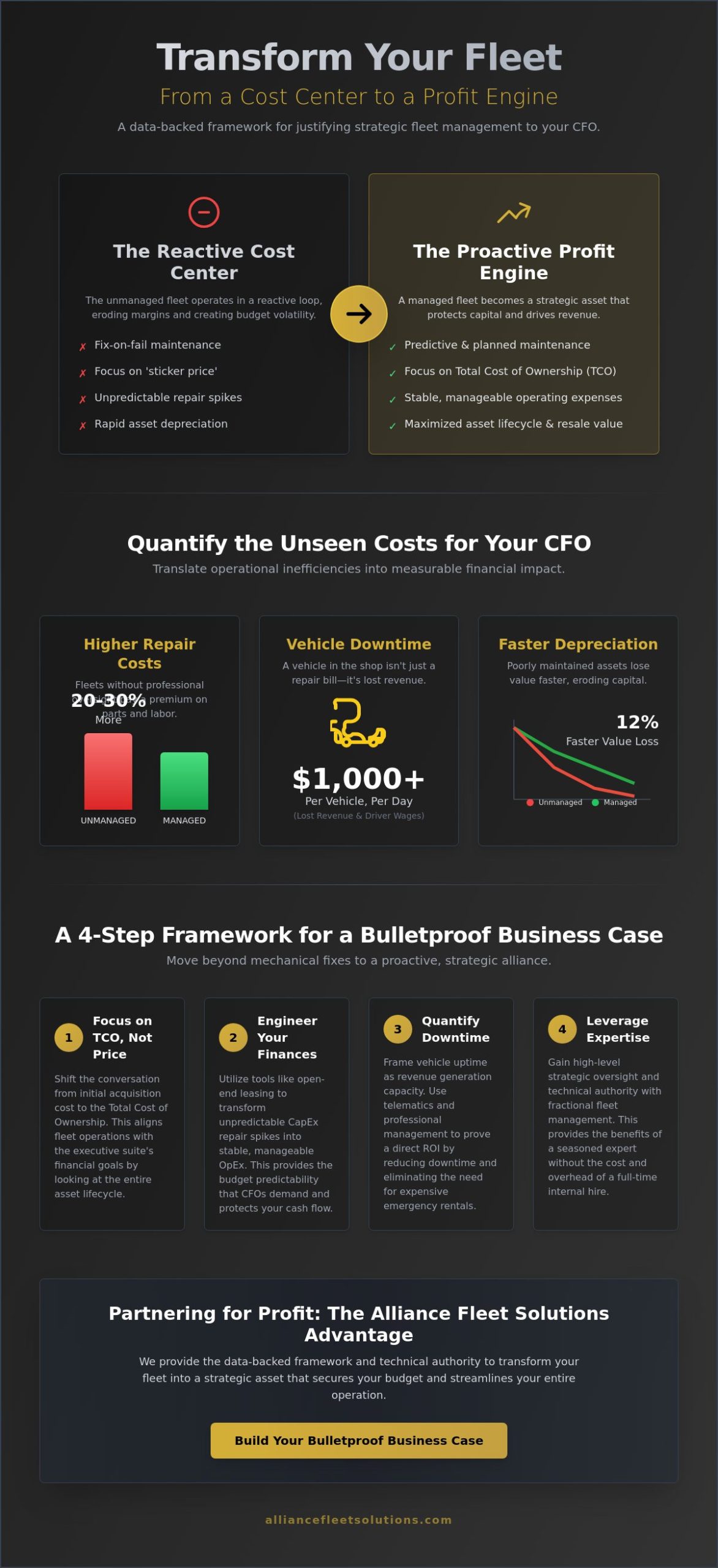
Stop viewing your vehicles as a collection of depreciating metal and start seeing them as a financial lever for EBITDA optimization. Most internal departments operate in a reactive loop; they fix trucks only when they break, which creates massive budget variance and erodes margins. Transitioning to a proactive model is the first step in justifying the cost of a fleet management service to a CFO who demands predictability and risk mitigation. By moving the focus from the initial purchase price to the long-term value, you align your operational needs with the financial goals of the executive suite.
Modern fleet management requires a sophisticated understanding of how every mile driven impacts the balance sheet. In 2026, supply chain volatility and fluctuating interest rates make internal, “gut-feeling” management a liability. A strategic partner provides the technical authority to navigate these risks, ensuring that your fleet remains an asset rather than a drain on capital. Total Cost of Ownership (TCO) is the sum of all direct and indirect costs associated with an asset throughout its entire lifecycle.
The CFO’s Language: Mapping KPIs to the Balance Sheet
To win budget approval, you must translate shop floor metrics into financial outcomes. Don’t just talk about vehicle uptime; frame it as revenue generation capacity. If a truck isn’t moving, it isn’t earning. Similarly, fuel efficiency isn’t just about “miles per gallon” anymore. It’s a direct operating margin improvement that offsets rising energy costs. When you discuss safety compliance, connect it immediately to risk exposure and the reduction of insurance premiums. CFOs value these connections because they quantify the “soft” benefits of professional oversight.
Why ‘Sticker Price’ is a Dangerous Metric in 2026
Focusing on the acquisition cost alone is a recipe for financial disaster. In the current market, poorly managed assets suffer from rapid depreciation, often losing value 12% faster than those under a rigorous maintenance schedule. Professional procurement helps your business avoid the “inventory trap” where you overpay for available units that don’t fit your long-term needs. A managed program ensures you acquire the right asset at the right time, maximizing the eventual resale value through vehicle remarketing and keeping your cash flow fluid. This shift from reactive buying to strategic lifecycle management is exactly what a finance department needs to see to justify the investment in a management partner.
Quantifying the Unseen: Maintenance, Downtime, and Lifecycle Savings
Unmanaged maintenance isn’t just an operational headache; it’s a financial leak that drains your bottom line. Industry data indicates that fleets without professional oversight pay 20% to 30% more for repairs than those using managed programs. This premium stems from paying retail labor rates and missing out on national parts discounts. When justifying the cost of a fleet management service to a CFO, you must expose these hidden premiums. Professional oversight ensures every repair is vetted, every warranty is claimed, and every dollar spent is necessary.
Predictive telematics now allow us to catch minor faults before they escalate into catastrophic failures. By shifting the budget from emergency, reactive repairs to planned maintenance, you eliminate the volatility that CFOs dislike. Implementing these cost-saving strategies ensures your fleet remains a modern, efficient asset. This proactive approach protects your equipment and your capital, turning a unpredictable expense into a controlled, strategic investment.
The True Cost of a ‘Down’ Vehicle
A truck sitting in a shop is a liability that costs more than just the mechanic’s bill. Beyond the repair invoice, you’re losing driver productivity and risking contract penalties for missed deliveries. In the heavy-duty logistics sector, daily downtime costs often exceed $1,000 per vehicle when you factor in lost revenue and driver wages. By utilizing data from professional maintenance management, you can prove a direct ROI on uptime. You eliminate the need for expensive emergency rentals and ensure your team stays on the road, where they generate profit.
Lifecycle Management: The Secret to Capital Preservation
Every vehicle reaches an “optimal replacement point” where the cost of maintenance begins to outpace the asset’s value. Identifying this moment is critical for capital preservation. Professional remarketing networks often secure 10% to 15% higher returns than local dealership trade-ins by accessing a broader buyer base. This extra capital can be reinvested into newer, more efficient models, further reducing your fuel and repair spend. Managing the “second life” of an asset is a technical discipline that maximizes your return on investment. For more specialized support in these areas, exploring integrated fleet solutions can help you master these lifecycle curves and protect your margins.
CapEx vs. OpEx: Financial Engineering of Fleet Leasing
Modern fleet management isn’t just about keeping trucks on the road; it’s about how those trucks sit on your balance sheet. For a finance department, the distinction between Capital Expenditure (CapEx) and Operating Expenditure (OpEx) is a critical lever for managing cash flow and corporate borrowing capacity. When justifying the cost of a fleet management service to a CFO, you must highlight how professional leasing structures transform unpredictable repair spikes into steady, predictable operating costs. This financial engineering allows the company to preserve its cash for core business growth rather than tying it up in depreciating mechanical assets.
In the current 2026 interest rate environment, capital is expensive. Financing a fleet through traditional debt can be significantly more costly than strategic leasing options that hedge against rate volatility. By utilizing off-balance-sheet financing, businesses can maintain a healthier debt-to-equity ratio, which is a key metric for creditors and investors alike. A professional partner doesn’t just manage vehicles; they manage the financial risk associated with those vehicles, ensuring that your fleet remains an agile part of your business strategy.
Leasing Structures and Cash Flow Predictability
Choosing between Open-End and Closed-End leasing is a pivotal decision for your 2026 budget. Open-End leasing offers the flexibility that high-utilization commercial fleets require, often resulting in lower monthly payments because the lessee assumes the residual value risk. This is ideal for specialized fleets where mileage is high and predictable. Conversely, Closed-End leases protect your business against market residual value volatility by shifting the risk back to the lessor. This level of predictability is essential for efficient fleet operations, as it shields your department from sudden drops in used vehicle prices at the end of the term.
The ‘Hidden Payroll’ of Internal Fleet Management
One of the most overlooked factors in justifying the cost of a fleet management service to a CFO is the administrative burden of self-management. Internal teams often spend 10 to 15 hours per week per 50 vehicles on non-core tasks like tag-and-title renewals, maintenance scheduling, and auditing complex fuel bills. This “hidden payroll” represents a significant opportunity cost. Similar efficiencies can be found in other operational areas; for example, many companies use REM Office Solutions for printer and copier leasing to eliminate the administrative burden of maintaining office hardware. Every hour your staff spends arguing with a shop over a repair invoice is an hour they aren’t focusing on revenue-generating logistics or customer service. Professional upfitting at the point of acquisition also reduces long-term modification costs, ensuring vehicles are ready for the field immediately without additional internal labor. Shifting these tasks to a dedicated partner allows your team to focus on the high-value activities that move the needle for your company.
The Business Case Framework: A Step-by-Step Guide for Fleet Managers
Success in justifying the cost of a fleet management service to a CFO depends on your ability to present a structured, data-driven argument. You aren’t just asking for a budget; you’re proposing a strategic partnership that captures lost revenue and stabilizes cash flow. Begin with an audit of your current “unmanaged” costs. This includes the administrative hours your team wastes on manual paperwork and the retail premiums you pay for local repairs. Once you’ve established this baseline, you can build a comparative model that highlights the efficiency gap between your current state and a managed program.
This framework moves the conversation away from the price of a service and toward the value of the outcome. By following a logical progression, you show the finance department that you’ve considered the technical, operational, and financial risks of the status quo. Your goal is to prove that the cost of doing nothing is higher than the investment in professional oversight.
- Step 1: Audit Administrative Drag. Document the specific man-hours spent on bill auditing, title management, and vendor coordination.
- Step 2: Project Operational Savings. Use established network discounts to forecast immediate reductions in parts and labor spend.
- Step 3: Quantify the Safety Dividend. Estimate the impact of telematics on accident rates and the subsequent reduction in liability and insurance premiums.
- Step 4: The 36-Month Comparison. Contrast the “Do Nothing” cost escalation against the “Managed” savings curve over a full three-year cycle.
- Step 5: Define Speed to Value. Outline a clear implementation timeline to show how quickly the CFO will see a measurable return on investment.
Building the ROI Model
Your ROI model must be airtight to survive executive scrutiny. By integrating fuel management programs, you can conservatively project a 10% to 15% reduction in total consumption through better route planning and idling reduction. Management networks also typically provide a 15% to 25% discount on parts and labor compared to retail shop rates. You should always present these ROI figures as a conservative, base-case scenario to maintain credibility with your finance team. Under-promising and over-delivering is the most effective way to secure long-term budget support and build trust with the C-suite.
Visualizing Success: Charts and Data Points CFOs Love
Financial executives process information best through visual trends that map directly to the bottom line. Present a “Cost per Mile” trendline that clearly shows the divergence between internal management and a professional partnership over time. A Total Cost of Ownership (TCO) waterfall chart helps break down where every dollar goes, from acquisition to remarketing. Finally, use asset utilization heatmaps from your telematics data to prove that your fleet is sized correctly for your current volume. If you’re ready to build your customized business case and stop the financial leak, request a consultation with Alliance Fleet Solutions to start your comprehensive fleet audit.
Partnering for Profit: The Alliance Fleet Solutions Advantage
Alliance Fleet Solutions acts as a direct extension of your finance department, providing the technical authority needed to protect your capital. We understand that your CFO isn’t just looking for a service provider; they’re looking for a partner that understands both the mechanics of the industry and the language of the balance sheet. This collaborative approach is central to justifying the cost of a fleet management service to a CFO who demands measurable results. Our team ensures that your vehicle acquisition and remarketing strategies stay optimized for 2026 market conditions, keeping your operations lean and your margins protected.
By leveraging our national reach, your business gains the leverage of a massive organization while maintaining the personalized service of a family-owned partner. We don’t just manage trucks; we build an alliance that focuses on your specific business goals. From professional upfitting that ensures your vehicles are field-ready on day one to the strategic oversight of your entire lifecycle, we handle the technical details so you can focus on growth.
Fractional Management: Scaling Expertise to Your Needs
Mid-sized fleets often face a difficult dilemma: they need high-level strategic oversight but can’t justify the six-figure salary of a full-time internal director. Fractional Fleet Management solves this by providing sophisticated data analysis and strategic planning on a flexible basis. This model can reduce management overhead by as much as 40% compared to a full-time hire while still offering the technical depth required to manage complex maintenance schedules. We bridge the communication gap between your shop foreman and your CFO, ensuring that every operational need is translated into a financial opportunity.
The Alliance Promise: More Than Just a Service Provider
Our commitment goes beyond mechanical fixes. We build personalized alliances that maximize uptime and ROI through proactive, expert control. Clients gain immediate access to our national maintenance networks and wholesale fuel pricing programs, which often yield immediate savings that offset the management investment. By integrating telematics and GPS solutions with our fractional oversight, we provide a holistic view of your fleet’s financial health. If you’re ready to transform your vehicles from a cost center into a strategic asset that drives profitability, join the Alliance Fleet Solutions network today.
Secure Your Fleet’s Financial Performance in 2026
Transforming your fleet from a cost center into a strategic asset requires a shift in perspective that prioritizes long-term Total Cost of Ownership. By quantifying the 20% to 30% premium often paid for unmanaged maintenance and utilizing sophisticated leasing structures, you provide the financial engineering your executive team expects. Successfully justifying the cost of a fleet management service to a CFO isn’t about defending a price; it’s about presenting a data-driven path to EBITDA optimization.
Alliance Fleet Solutions offers technical authority through a national network of maintenance partners and specialized fractional management options. Whether you need expertise in open or closed-end leasing, our team acts as the essential backbone of your logistics operation. You don’t have to navigate these complex financial waters alone. Our proactive approach ensures that your vehicles remain on the road and your capital remains fluid.
Build your business case with an Alliance Fleet Solutions ROI Audit and start maximizing your uptime today. Your fleet has the potential to be your company’s greatest competitive advantage, and we’re ready to help you prove it.
Frequently Asked Questions
How long does it typically take for a fleet management service to pay for itself?
Most organizations see a full return on investment within 6 to 12 months of implementation. Immediate savings typically originate from national maintenance network discounts and the elimination of retail part markups. Over the first year, the cumulative impact of reduced downtime and optimized fuel spend creates a self-funding model that stabilizes the operational budget.
Can a CFO see the impact of fleet management on EBITDA?
Yes, professional management directly improves EBITDA by lowering the cost of goods sold and operating expenses. By reducing maintenance spend by 20% and fuel consumption by 10%, you’re moving “frozen” capital back into the earnings column. These measurable improvements provide a clear trail for justifying the cost of a fleet management service to a CFO during quarterly reviews.
What is the biggest hidden cost of managing a fleet in-house?
Administrative drag is the most significant unseen expense in self-managed fleets. Internal teams frequently lose 15 hours per week per 50 vehicles to non-core tasks like bill auditing, title renewals, and vendor disputes. This diversion of talent represents a massive opportunity cost that often exceeds the visible price of a professional management partner.
Is fractional fleet management better than hiring a full-time fleet manager?
Fractional management is often the superior choice for mid-sized fleets with 20 to 150 units. It provides access to high-level strategic data and technical authority without the six-figure salary and benefits package of a full-time executive. This model allows your company to scale its expert oversight in direct proportion to its actual fleet growth.
How do fuel management programs contribute to cost justification?
Fuel programs provide the granular reporting needed to eliminate unauthorized spending and reduce excessive idling. Implementing a structured fuel policy typically results in a 10% to 15% reduction in total consumption. These hard-dollar savings are easy to track and serve as a primary data point when justifying the cost of a fleet management service to a CFO.
What financial metrics should I use to compare leasing vs. purchasing?
You should focus on Net Present Value (NPV) and the Internal Rate of Return (IRR) on your capital. Compare the lifecycle cost of a leased asset against the total cash outlay and depreciation of a purchase. Leasing often wins in a CFO’s eyes because it preserves corporate borrowing capacity and keeps debt-to-equity ratios healthy.
How does telematics data help in justifying fleet costs to a CFO?
Telematics provides the objective “proof of utility” for every asset on the balance sheet. It identifies underutilized vehicles that can be remarketed to recoup capital and highlights high-risk driver behaviors that increase insurance premiums. As you discover Letstrack, you’ll see how this data transforms vague operational guesses into the hard financial facts that finance departments require for budget approval.
Can fleet management help with corporate sustainability and ESG reporting?
Professional management systems automate the collection of emissions data required for 2026 ESG reporting standards. By optimizing routes and reducing fuel waste, you aren’t just saving money; you’re documenting a reduced carbon footprint. This alignment with corporate social responsibility goals provides another layer of strategic value beyond simple mechanical maintenance.