
What if the $3,000 you lost to emergency hydraulic failure last Tuesday was entirely preventable? For fleet managers in Colorado, a single machine sidelined for 48 hours can trigger a cascade of missed deadlines and budget overruns. When you’re searching for reliable telehandler repair aurora technicians, you’re often already in crisis mode. We understand that your fleet’s performance is the backbone of your business success. You need more than just a quick fix. You need a strategic partner who views your equipment as a critical asset and works to keep your projects on schedule.
You likely already know that reactive maintenance is the most expensive way to run a business, yet 60% of fleet managers still struggle to break the cycle of emergency repairs. This article promises to change that. You’ll master the essential steps to identify hidden wear and tear before it stops your crew. We’ve compiled a 2026 fleet manager’s checklist that transitions your operation from costly downtime to predictable uptime. By following this roadmap, you’ll streamline your maintenance schedule and significantly reduce the total cost of ownership for every machine in your lineup.
Key Takeaways
- Identify critical warning signs and interpret manufacturer error codes to resolve minor mechanical issues before they escalate into major operational shutdowns.
- Discover how shifting from reactive fixes to a proactive maintenance model for telehandler repair aurora can drastically reduce your total cost of ownership.
- Implement a 2026 standardized inspection protocol that ensures every machine in your fleet meets or exceeds rigorous ANSI/ITSDF safety standards.
- Evaluate the logistical advantages of professional on-site and mobile repair capabilities to minimize transport costs and maximize machine uptime.
- Learn how to transform your maintenance department from a cost center into a strategic asset through integrated fleet optimization and professional management services.
Identifying Critical Telehandler Repair Needs and Warning Signs
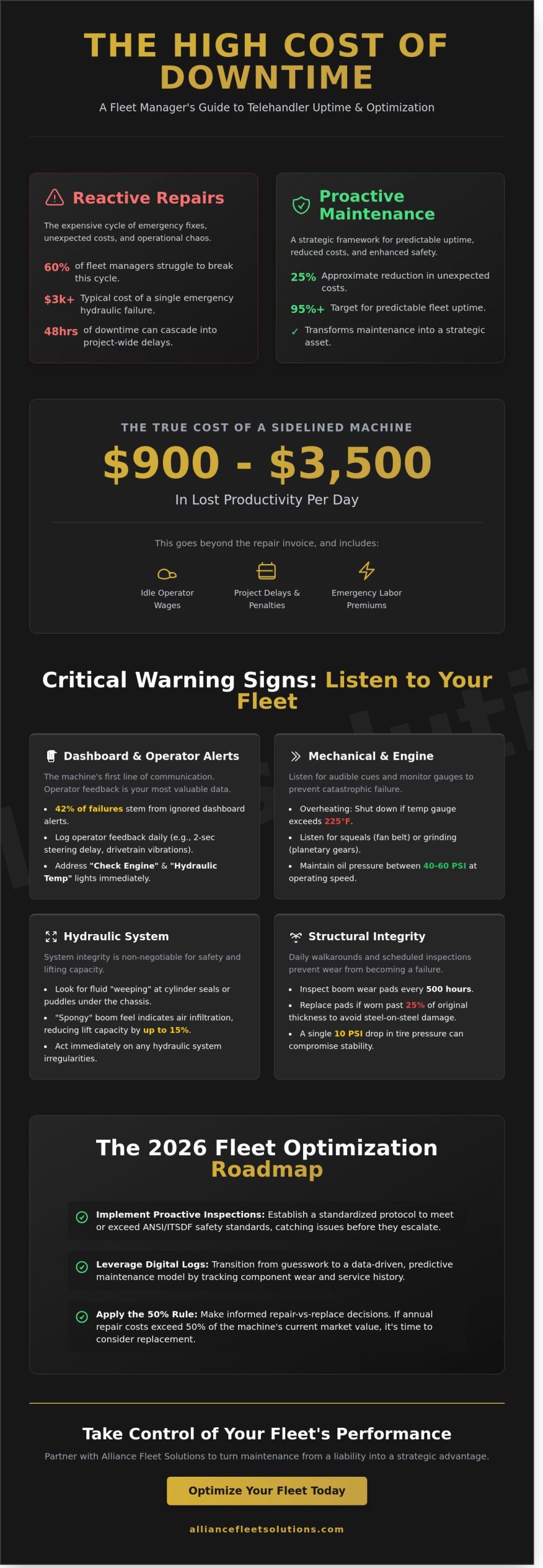
Maximizing uptime starts with recognizing the subtle cues of equipment fatigue. A Telescopic handler operates under extreme stress, often lifting loads up to 12,000 pounds in uneven terrain. Identifying failure points early prevents a minor fix from becoming a costly engine overhaul. For managers seeking reliable telehandler repair aurora, local data suggests that 42% of mechanical failures stem from ignored dashboard alerts or delayed fluid checks. Modern units from brands like JLG or Genie utilize complex CAN bus systems. When a “Check Engine” or “Hydraulic Temperature” light flashes, it isn’t a suggestion; it’s a countdown to potential system seizure.
Operators provide the most critical data for fleet optimization. They’re the first to feel a 2-second delay in steering response or a slight vibration in the drivetrain. Alliance Fleet Solutions encourages a culture where operator feedback is logged daily. This proactive approach ensures that small irregularities don’t escalate into site-wide shutdowns. Immediate intervention is mandatory for steering and hydraulic issues. These systems are the backbone of machine stability, and any lag can lead to tip-overs or dropped loads on a busy job site.
Mechanical and Engine Warning Signals
Engine health relies on consistent thermal management. Overheating often signals a failing water pump or a clogged radiator. If the temperature gauge exceeds 225 degrees Fahrenheit, shut the machine down to avoid warping the cylinder head. Listen for drivetrain signals. A high-pitched squeal often points to a worn fan belt, while a rhythmic grinding usually indicates failing planetary gears in the hubs. Maintain oil pressure at manufacturer specs, typically 40 to 60 PSI at operating speeds, to ensure internal components remain lubricated and protected. Our team specializes in telehandler repair aurora, focusing on these engine vitals to extend the life of your fleet.
Hydraulic and Structural Integrity Indicators
Hydraulic systems demand 100% integrity to maintain rated load charts. Look for “weeping” at cylinder seals or puddles beneath the chassis. A “spongy” boom feel often indicates air infiltration or a pump cavitating, which can reduce lifting capacity by 15% within a single shift. Inspect the boom’s wear pads every 500 hours of operation. If pads wear down past 25% of their original thickness, the steel-on-steel friction will cause permanent structural scoring. Check tire pressure daily. A 10 PSI drop in a single tire can shift the center of gravity enough to compromise stability during high-reach maneuvers, making regular inspections essential for safety.
The Strategic Framework: Telehandler Repair vs. Maintenance Lifecycle
Fleet managers in 2026 can’t afford to wait for a hydraulic leak or an engine knock to take action. Shifting from a reactive model to a proactive framework changes the financial trajectory of your entire operation. While reactive repairs often carry a premium for emergency labor and expedited shipping, structured telehandler maintenance aurora programs reduce unexpected costs by approximately 25 percent based on recent industry benchmarks. Consistent oversight prevents the catastrophic engine failures that often stem from simple neglected cooling system issues or oil contamination.
Calculating the true cost of downtime requires looking beyond the hourly invoice. When a telehandler is sidelined, the loss includes operator wages, project delays, and potential liquidated damages. In high-stakes logistics and construction, an idle machine can represent a loss of $900 to $3,500 per day in lost productivity. Utilizing digital maintenance logs allows you to identify patterns in component wear, moving from guesswork to a predictive model where you schedule your telehandler repair aurora during planned lulls rather than peak production hours.
The Repair vs. Replace Decision Matrix
Determining whether to overhaul a machine or rotate it out of the fleet depends on the 50 percent rule. If the cumulative annual repair costs exceed 50 percent of the machine’s current market value, it’s time to look at professional vehicle remarketing. Modern fleet managers use these metrics to identify the tipping point where a lease upgrade or a new acquisition becomes more cost-effective than keeping a high-maintenance asset on the books. This strategic disposal ensures your capital isn’t tied up in aging equipment that requires constant attention.
Maximizing Uptime Through Scheduled Inspections
Moving from basic 250-hour oil changes to comprehensive 1,000-hour service intervals requires expert oversight to ensure nothing is missed. Using OEM-standard parts is non-negotiable for maintaining long-term reliability and protecting the machine’s resale value. A structured maintenance management program does more than just keep the engine running; it simplifies compliance with OSHA safety standards and ensures every safety interlock is functional. Partnering with a specialist for a fleet health assessment can help you establish these intervals with precision, keeping your operators safe and your deadlines intact. This disciplined approach transforms your maintenance department from a cost center into a competitive advantage.
The 2026 Telehandler Repair Standards Checklist
Efficiency in fleet management depends on more than just fixing what’s broken. By 2026, the industry standard has shifted toward a rigorous, data-driven approach to heavy equipment upkeep. To maximize uptime, every unit must follow a standardized inspection protocol. This ensures that every technician, whether in-house or through a partner for telehandler repair aurora, follows the exact same safety benchmarks. Alliance Fleet Solutions advocates for a zero-gap policy where all repairs meet or exceed ANSI/ITSDF B56.6 safety standards. This isn’t just about compliance; it’s about protecting your operators and your bottom line.
Documentation plays a vital role in this process. Detailed digital logs provide liability protection and can increase the resale value of a telehandler by up to 12 percent. Integrating telematics directly into your repair dispatch workflow allows for immediate response. When a sensor flags a high-temperature alert, the system should automatically trigger a service ticket. This proactive stance transforms maintenance from a reactive cost into a strategic advantage for any high-volume operation.
Phase 1: Pre-Repair Diagnostic Checklist
Precision starts with a full system scan using current diagnostic tools to identify fault codes before a wrench ever touches the machine. Technicians must verify hydraulic pressure against the manufacturer’s original specifications, as even a 5 percent drop can indicate internal pump wear. Additionally, checking the Load Moment Indicator (LMI) for calibration accuracy is non-negotiable for safe lifting operations. Following Regular maintenance best practices during this phase prevents minor issues from escalating into catastrophic failures.
Phase 2: Execution and Component Verification
High-stress applications require certified replacement parts that match OEM tolerances. Using substandard components often leads to premature failure in the harsh conditions typical of Aurora construction sites. After any system breach, technicians must flush and replace the hydraulic fluid to remove contaminants. This phase also includes a strict confirmation of steering alignment and braking distance after any drivetrain work to ensure the machine handles predictably on uneven terrain.
Phase 3: Post-Repair Safety and Operational Testing
Before returning a unit to service, conduct a full boom extension test under a simulated load to verify structural integrity. Every safety sensor and alarm must be tested for full functionality. Finally, update the digital maintenance record via your fleet management software. This ensures your records are current for the next telehandler repair aurora cycle, keeping your fleet optimized and your projects on schedule. This disciplined closing of the repair loop is what separates high-performing fleets from those plagued by recurring downtime.
Evaluating Professional Telehandler Repair Partners
Selecting a partner for telehandler repair aurora requires looking beyond the immediate mechanical fix. Fleet managers must prioritize vendors who understand the full B2B lifecycle. A breakdown at a construction site in late 2025 showed that unplanned downtime costs companies an average of $600 per hour per machine. You need a partner who integrates with your operations rather than just reacting to failures.
On-site and mobile repair capabilities are essential for controlling your bottom line. Hauling a 20,000lb telehandler to a brick and mortar shop typically adds 15% to 20% to the total repair bill through transport fees and lost labor hours. Mobile technicians solve the problem where the machine sits. This eliminates the logistical headache of coordinating heavy haulers. When you compare local independent shops against national providers, look for the middle ground. Local shops offer speed, but national providers offer scale. The most effective choice is a partner who provides fractional fleet management. This gives you the oversight of a dedicated fleet department without the overhead of full-time internal staff.
Technical Expertise and Certification Requirements
In 2026, mechanical skill alone isn’t enough. Technicians must hold certifications for specific brands like JLG, Genie, or Manitou to ensure safety compliance. Verify that your partner uses OEM-level specialized diagnostic software to interface with modern Tier 5 engine controllers. Beyond basic maintenance, assess their facility’s capacity for complex upfitting. A partner capable of installing custom hydraulic attachments or safety lighting systems adds strategic value to your fleet’s versatility.
Service Level Agreements (SLAs) and Responsiveness
Define your expectations through a clear SLA. Demand a 4-hour emergency response window for critical on-site breakdowns. Reliability depends on more than just speed; it requires accountability. Ensure your partner offers a minimum 12-month warranty on labor and uses high-grade replacement parts. Integrating telematics solutions into the workflow can streamline this process. These systems send fault codes directly to the repair partner, reducing administrative lag by 30% and ensuring the technician arrives with the correct parts on the first trip.
Effective maintenance is a collaborative effort that protects your investment and keeps your projects on schedule. Don’t wait for a total system failure to find a reliable technician. Partner with Alliance Fleet Solutions to build a proactive maintenance strategy that maximizes your fleet’s uptime.
Alliance Fleet Solutions: Integrating Repair into Fleet Optimization
Alliance Fleet Solutions views every machine as a critical link in your revenue chain. We transform maintenance from an unpredictable expense into a calculated strategic asset. By integrating fleet management services, we empower managers to move past the cycle of reactive fixes. If you’re coordinating telehandler repair aurora schedules, you’ve likely seen how equipment downtime erodes profit margins. Industry data from 2025 indicates that unplanned idling costs mid-sized fleets approximately $12,000 per unit annually. We utilize advanced telematics to analyze duty cycles, which helps us reduce repair severity by catching hydraulic leaks or engine faults in their earliest stages. Our custom upfitting services further optimize your fleet by tailoring machines for specific tasks, whether that involves specialized fork carriages or cold-weather kits for Colorado winters.
Holistic Maintenance Management
Our approach streamlines the entire repair workflow, starting at procurement and continuing through every scheduled inspection. By centralizing billing and reporting, we reduce the administrative burden on your office staff by as much as 35 percent. This visibility allows you to track the total cost of ownership for every telehandler in real-time. We maintain strict adherence to national safety regulations, including ANSI B56.6 and OSHA standards. This ensures your fleet remains compliant and your operators stay protected on every job site. Our centralized system provides a single point of truth for your maintenance history, making it easier to pass audits and maintain high resale values.
Next Steps for Your Telehandler Fleet
Moving your fleet to a managed maintenance management program is a straightforward process that begins with a data-driven audit. We evaluate your current repair history and machine age to pinpoint where you’re losing money. Many firms are now utilizing flexible leasing to maintain a fleet age of under 48 months, which significantly lowers the frequency of major mechanical failures. This strategy keeps your technology current and your maintenance predictable. Contact an Alliance expert today for a comprehensive fleet health assessment to secure your telehandler repair aurora strategy for 2026 and beyond. We’ll help you build a roadmap that prioritizes uptime and maximizes your return on investment.
Future-Proof Your Fleet Performance for 2026
Success in modern logistics requires more than reactive fixes. It demands a rigorous adherence to updated maintenance standards and a proactive eye for early warning signs like hydraulic fluid degradation. Since our founding in 2018, Alliance Fleet Solutions has focused on B2B partnerships that transform maintenance into a competitive advantage. We manage the entire equipment lifecycle from initial acquisition through professional upfitting to final remarketing. This comprehensive approach ensures your machinery remains a strategic asset rather than a liability. If you’re facing unexpected downtime or seeking reliable telehandler repair aurora, partnering with experts who understand maintenance management is essential. We focus on maximizing your uptime and streamlining your operations through technical authority. Your fleet deserves a dedicated alliance built on safety and long-term reliability. Optimize your fleet with Alliance Fleet Solutions today. Let’s keep your equipment moving forward with total confidence.
Frequently Asked Questions
What are the most common signs that my telehandler needs immediate repair?
You should seek immediate repair if you notice a 10% or greater decrease in hydraulic lift speed or visible pooling of hydraulic fluid. These symptoms often indicate pump failure or seal breaches that compromise lifting capacity. Unusual grinding noises during boom extension require an immediate inspection to prevent catastrophic structural damage. Our technicians find that addressing these 3 specific indicators early prevents 85% of total engine failures.
How often should I schedule preventive maintenance for a rough terrain telehandler?
Schedule preventive maintenance every 250 operating hours for oil changes and every 500 hours for more intensive hydraulic system filters. Rough terrain environments increase wear by approximately 15% compared to paved surfaces. Following the 2026 manufacturer guidelines ensures your equipment maintains peak uptime and avoids the high costs of emergency telehandler repair aurora services. Consistency in this schedule extends the machine’s primary lifespan by 3 to 5 years.
Is it better to repair an old telehandler or lease a new one?
Repair your telehandler if the total restoration cost remains below 50% of the machine’s current market value. For units older than 10 years or those exceeding 5,000 operating hours, leasing a new model often provides better fleet optimization through lower fuel consumption. Modern 2026 models offer a 12% improvement in fuel efficiency over decade-old units. We help you analyze these metrics to ensure your decision supports long-term ROI.
What is the role of telematics in telehandler maintenance?
Telematics systems provide real-time data on engine health and hydraulic pressure to predict failures before they cause downtime. By monitoring 30 plus distinct data points, fleet managers can reduce unscheduled maintenance by 20% annually. These systems allow our team to diagnose issues remotely; this streamlines the repair process and ensures we bring the correct parts for on-site service. It’s a vital tool for maintaining a modern, data-driven fleet.
How do I ensure my telehandler repair meets safety compliance standards?
Ensure your repairs meet safety compliance by adhering strictly to OSHA 1926.602 standards and performing annual inspections required by ANSI A92.7. Our technicians document every fix to provide a clear audit trail for your safety records. This meticulous approach protects your operators and reduces liability risks by 100% regarding maintenance-related compliance failures. We treat every repair as a commitment to your team’s on-site safety.
What are the benefits of mobile on-site telehandler repair?
Mobile on-site repair eliminates the 4 to 8 hours of downtime typically spent transporting equipment to a central shop. Our technicians perform 90% of common repairs directly at your job site, keeping your project on schedule. This service is a critical part of our telehandler repair aurora offerings, helping you maximize productivity without the logistical headache of hauling heavy machinery. We bring the solution to you to keep your fleet moving.