
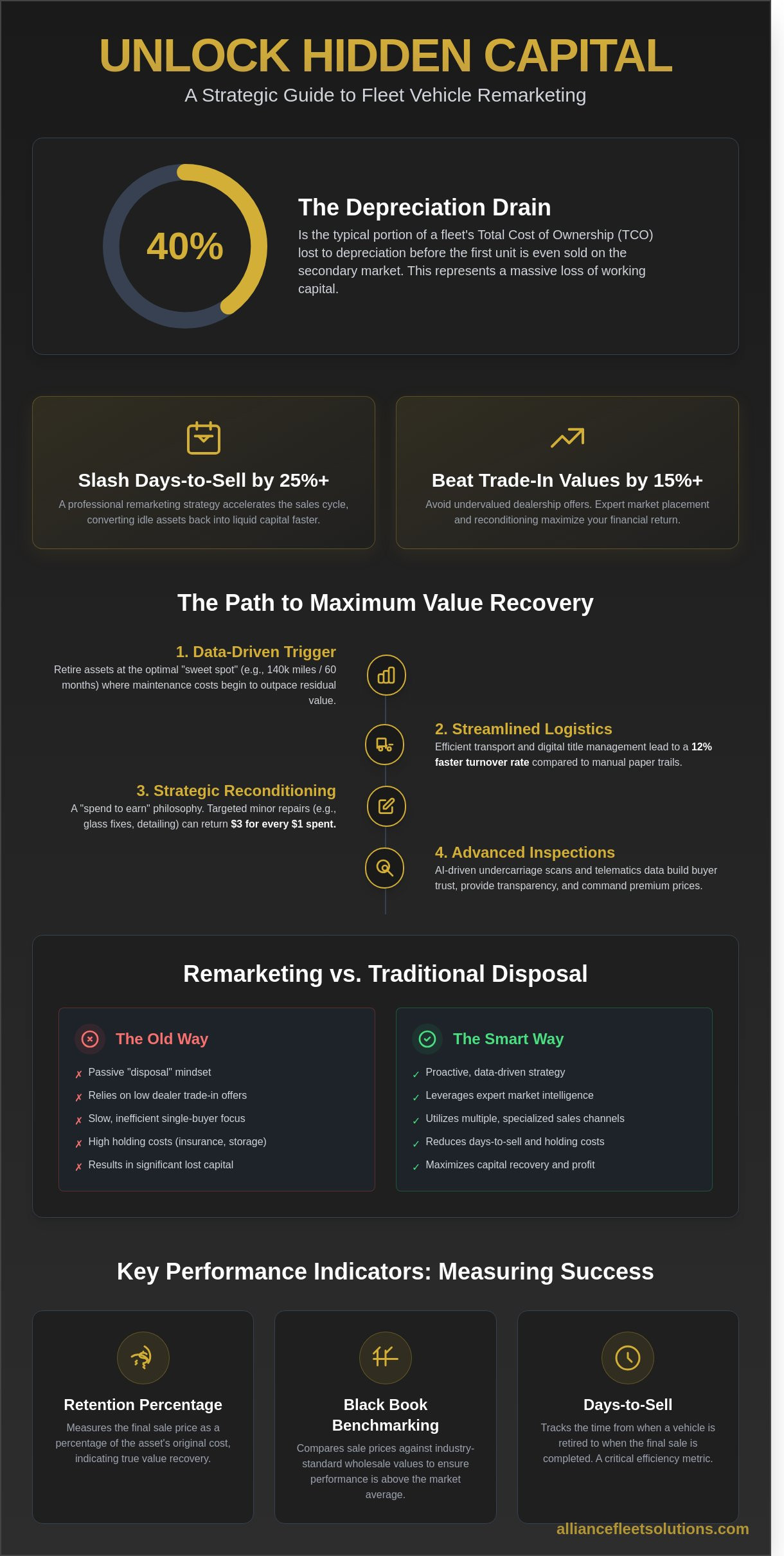
Did you know that depreciation typically swallows 40% of a heavy-duty fleet’s total cost of ownership before the first unit even hits the secondary market? This staggering loss represents capital that should be fueling your 2026 expansion or upgrading your logistics technology. We understand the frustration of watching high-value assets sit idle, losing value every day they aren’t generating revenue. Managing the transition from active service to final sale is often the most overlooked phase of the lifecycle, yet it’s where your profit margins are truly won or lost through professional vehicle remarketing.
We’ve designed this strategic guide to help you recover maximum capital and slash your “days-to-sell” metrics by at least 25%. You’ll discover how professional reconditioning and streamlined disposal logistics turn depreciating assets into a competitive advantage for your business. We’ll walk through the specific lifecycle management tactics and digital sales channels that will ensure your fleet remains a lean, high-performing business asset through a true partnership approach.
Key Takeaways
- Learn how to identify the optimal “exit strategy” by timing vehicle removal based on mileage and maintenance costs to maximize residual value.
- Master the essential KPIs, such as retention percentage and Black Book benchmarking, to accurately measure the success of your asset recovery.
- Evaluate the most effective disposal channels, from high-volume wholesale auctions to direct-to-employee sales, to find the right buyer for every asset.
- Discover how a professional vehicle remarketing approach transforms depreciating fleet equipment into a vital source of liquid capital.
- Explore how integrating expert logistics and market intelligence ensures a seamless transition from operational use to final sale.
What is Vehicle Remarketing? Defining the Fleet Exit Strategy
Vehicle remarketing is the systematic, data-driven process of selling off fleet assets to extract the highest possible residual value. It isn’t merely a “used car sale.” It represents the critical final phase of comprehensive fleet management. By the time a heavy-duty truck or delivery van reaches the end of its service life, its financial performance depends entirely on how effectively it’s offloaded. Vehicle remarketing ensures that depreciating equipment is converted back into working capital with precision, rather than being treated as an afterthought.
The financial stakes are massive. Depreciation typically accounts for 35% to 45% of a vehicle’s total cost of ownership (TCO). A 5% improvement in resale price can translate to thousands of dollars per unit across a mid-sized fleet. Moving from a passive “disposal” mindset to a proactive remarketing strategy allows managers to beat the standard trade-in values offered by dealerships. These retailers often undervalue commercial assets by 15% or more to protect their own margins. Professional management bridges this gap through expert timing and market placement.
The Role of Residual Value in Fleet Finance
Residual value is the predicted worth of a vehicle at the end of its term. In commercial finance, this figure dictates lease structures. Open-end leases place the residual risk on the fleet owner, while closed-end leases fix the value upfront. As we look at 2026 resale projections, market volatility is a primary concern. Rapid shifts in fuel technology and emissions standards mean that assets purchased in 2021 might face unpredictable demand. Accurate forecasting during procurement prevents “underwater” assets, where the remaining loan balance exceeds the actual market price. We help partners align their maintenance records with these forecasts to prove the asset’s worth to future buyers.
Remarketing vs. Traditional Used Car Sales
Remarketing differs from retail sales through its reliance on volume and specialized channel intermediaries. Instead of waiting for a single buyer, professional remarketers utilize wholesale auctions, private dealer networks, and employee purchase programs to move assets quickly. Efficiency is key. Every day a retired truck sits in a lot, it costs the business money in insurance and storage. Additionally, B2B transfers require strict regulatory compliance. This includes ensuring all Department of Transportation (DOT) markings are removed and titles are cleared to protect the brand’s reputation and legal standing. It’s a logistical operation that turns old iron back into liquid cash.
The De-Fleeting Process: From Operational Use to Final Sale
A successful vehicle remarketing strategy begins long before the asset hits the auction block. It starts with a data-driven trigger. In 2026, top-tier fleet managers don’t guess when to retire a truck; they use predictive analytics to identify the “sweet spot” where maintenance costs begin to outpace residual value. For a typical Class 6 delivery vehicle, this often occurs at the 140,000-mile mark or after 60 months of service. Pulling the asset at this precise moment ensures you capture the highest possible resale value before major component failures occur.
Once you identify a vehicle for disposal, logistics becomes the primary focus. Moving an asset from a remote field location to a centralized hub requires precision. Delays in transport directly cannibalize your returns. You must also prioritize title management. Missing or incorrect documentation is the most common reason for a sale to stall. Analysis of Government Fleet remarketing strategies indicates that organizations with digitized, “ready-to-transfer” titles see a 12% faster turnover rate than those relying on manual paper trails. After the title is cleared, the focus shifts to reconditioning. This “spend to earn” philosophy involves targeted minor repairs, such as glass chip fixes or professional detailing, which can return three dollars for every dollar spent.
Automated Vehicle Inspections and Health Data
By 2026, AI-driven undercarriage scans have become the industry standard for building buyer trust. High-definition imaging systems now detect frame stress and fluid leaks that the human eye might miss during a standard walk-around. This transparency allows you to command a premium price. Prospective buyers also demand telematics logs to verify maintenance history. When you can prove a truck had its oil changed every 7,500 miles without exception, you remove the “risk discount” buyers usually apply to used assets. Reconditioning ROI is the ratio of repair costs to increased auction hammer price. You can optimize your fleet lifecycle by using these digital health reports to decide which repairs will actually drive profit at sale.
The “Days-to-Sell” Metric: Why Speed Equals Capital
Every day a retired asset sits in a yard, it loses money. A standard light-duty van depreciates by approximately $22 per day in stagnant capital and physical aging. If your disposal chain is sluggish, a 30-day delay costs you $660 in pure equity per unit. Common bottlenecks include slow transport scheduling and backlogged inspection queues. To avoid these traps, you should integrate your de-fleeting software directly with your remarketing partner’s intake system. This ensures that the moment a driver turns in the keys, the transport order is dispatched. Reducing the time between the last operational shift and the final check is the fastest way to improve your vehicle remarketing outcomes and keep your capital fluid for new equipment acquisitions.
Key Performance Indicators (KPIs) for Successful Remarketing
Effective vehicle remarketing isn’t a matter of luck; it’s the result of rigorous data tracking and benchmarking. To maximize asset recovery, fleet managers must look beyond the final check and analyze the specific metrics that drive profitability. The primary benchmark for success remains the disposal price compared against industry standards like Black Book or CAP Clean. In 2026, top performing fleets aim for a sale price that reaches 102% to 105% of Black Book Clean values by timing their exits with specific market demand cycles.
- Retention Percentage: This metric measures the final sale price against the original MSRP or current book value. A high retention rate indicates a strong initial specification and superior maintenance throughout the asset’s lifecycle.
- Total Cost of Disposal: You must calculate the net recovery by subtracting transport costs, auction fees, and reconditioning expenses from the gross sale. If reconditioning costs exceed 3% of the projected sale price, the ROI often diminishes rapidly.
- Impact on TCO: A 5% increase in resale value isn’t just a bonus; it directly reduces the Total Cost of Ownership. For a standard Class 6 truck, this improvement can lower the monthly effective cost by $150 to $200 over the life of the vehicle.
Effectively managing these KPIs requires a strong connection between the fleet operations team and the company’s financial leadership. For emerging and mid-cap companies that may not have a full-time CFO, leveraging fractional financial services can be a game-changer. Resources like saunlimited.com offer expert consulting to ensure that operational gains from remarketing are fully integrated into the company’s overall financial strategy and growth plans.
Benchmarking Against Market Guides
Success requires a deep dive into 2026 valuation tools. While Black Book and NADA provide a baseline, regional market variations can shift values by as much as 12% for the same asset. National fleets often find that a truck in the Southeast fetches a higher premium than the same unit in the Pacific Northwest. According to Government Fleet remarketing insights, analyzing these regional trends allows managers to reroute assets to high-demand hubs before the sale. Adhering to NAAA Silver Certified standards ensures your vehicle meets the quality threshold buyers expect in a competitive secondary market.
The Maintenance Connection: Preserving Value Early
Asset recovery starts on day one. Implementing efficient fleet operations ensures that preventive care is documented and verifiable. Buyers in 2026 prioritize transparency. A vehicle with a digital service history often commands a “Maintenance Premium” of 10% to 15% over units with missing records. This proactive approach helps identify unmarketable assets early, allowing you to liquidate them before they become terminal losses. By prioritizing uptime now, you secure the highest possible return during the vehicle remarketing phase later.
Choosing the Right Disposal Channels: Strategic Options
Maximizing returns requires a surgical approach to asset disposal. A single channel rarely captures the full value of a diverse fleet. According to the 2025 Fleet Management Benchmarking Report, 42% of high-performing fleets now utilize at least three distinct channels to offload assets. Wholesale auctions remain the primary engine for high-volume liquidations. These platforms facilitate asset movement in under 14 days, providing immediate liquidity for organizations needing to clear yard space quickly. While speed is the primary benefit, the competitive bidding environment ensures you receive the current market floor price.
Savvy operators often pivot to direct-to-employee sales for their cleanest units. This strategy typically yields a 12% to 15% premium over wholesale prices. It functions as a powerful recruitment and retention tool while bypassing auction fees that can eat 5% of your gross recovery. For specialized heavy-duty assets, retail dealer networks offer a more targeted path. If you’re retiring specific high-demand models, such as Class 6 box trucks with low mileage, direct placement with a retail partner can bypass the volatility of the open auction block.
To better understand what these retail partners look for, it can be insightful to examine their business model and current inventory. For example, fleet managers can discover 585 Cars LLC to get a sense of how a dealership specializing in a wide variety of pre-owned vehicles operates and what the retail market demands.
- Wholesale Auctions: Best for high-volume, standard configuration assets requiring 48-hour removal.
- Direct-to-Employee: Ideal for light-duty vehicles and passenger cars with documented maintenance histories.
- Retail Networks: Most effective for specialized equipment or niche vocational trucks.
- Multi-channel Strategy: Prevents “dumping” assets into a saturated market, which can depress local prices by 8% or more.
The 2026 EV Remarketing Reality
By 2026, electric vehicle (EV) residual values have faced steeper depreciation curves than traditional diesel units. Data from the 2025 Residual Value Index shows that three-year-old EVs retain approximately 44% of their original MSRP, compared to 58% for internal combustion engines. To combat this, vehicle remarketing experts now prioritize battery health certifications. This metric has effectively replaced the odometer as the primary trust signal. Buyers in 2026 demand a state-of-health (SOH) report showing at least 92% capacity before committing to premium prices for electric work vans.
Physical vs. Digital Auctions
The shift toward “upstream” remarketing has transformed how fleets recover capital. This process allows you to list an asset for sale while it completes its final 21 days of active service. Digital platforms now capture 74% of all wholesale transactions, according to 2025 industry audits. While physical auctions still offer the benefit of onsite inspections, digital floor-planning speeds up the capital recovery cycle by an average of 6 days. This reduces the time your capital stays locked in a non-productive asset. You can streamline your fleet recovery process by integrating these digital tools into your standard maintenance exit workflows.
When using multiple online auction and sales platforms, managing communications and protecting your primary business phone lines from unwanted calls is a practical consideration. To handle account verifications and public-facing contact details securely, many fleet managers use temporary phone numbers. Services like RentalNumbers.com offer a straightforward way to obtain these numbers, keeping your main communication channels clear for core operations.
Maximizing Asset Recovery with Alliance Fleet Solutions
Alliance Fleet Solutions transforms the final stage of the vehicle lifecycle from a logistical burden into a high-yield financial event. By integrating fractional fleet management with end-of-life vehicle remarketing, we eliminate the friction between daily operations and asset disposal. Our team utilizes real-time market intelligence to ensure your assets aren’t just sold, but positioned in front of the right buyer at the precise moment demand peaks. This proactive approach manages everything from secure transport to complex title work. It’s about turning a depreciating asset into liquid capital with zero downtime for your staff.
Our Professional Remarketing Framework
We’ve engineered a system that prioritizes speed and transparency. Our national partner network allows us to reduce “days-to-sell” by an average of 18 days compared to traditional auction methods. Every transaction is backed by exhaustive reporting that tracks every cent from the initial 25-point inspection to the final deposit. You’ll see exactly where value was added through our data-driven approach.
- National buyer reach: Access to 5,000+ vetted commercial buyers across North America.
- Reconditioning expertise: Identifying high-ROI repairs that boost final sale prices.
- Regulatory compliance: Handling all state-specific title transfers and tax documentation.
In one 2024 engagement, a regional logistics firm saw a 12% increase in residual recovery by implementing our strategic reconditioning protocol on 45 Class 8 trucks. We don’t just list vehicles; we prepare them to win the highest bid by focusing on the specific mechanical details buyers value most in the 2026 market.
Getting Started: Your Fleet Exit Audit
Transitioning from an ad-hoc disposal process to a managed program starts with a comprehensive Fleet Exit Audit. We analyze your current depreciation schedules and maintenance logs to identify the optimal replacement window. It’s vital to partner with a firm that understands the full lifecycle, from initial upfitting to final vehicle remarketing. This holistic view ensures that your initial build-out doesn’t negatively impact your future resale value. We look at historical data to predict secondary market shifts, helping you exit at the top of the curve.
Our audit provides a clear roadmap for de-fleeting without disrupting your current service levels. We handle the logistics, so you can focus on the growth of your business. Ready to maximize your fleet’s resale value? Partner with Alliance Fleet Solutions today.
Secure Your Fleet’s Future Value Today
Navigating the 2026 landscape requires more than just listing assets for sale. Successful vehicle remarketing hinges on a proactive de-fleeting process and precise KPI tracking to ensure every asset delivers its maximum remaining value. You need a strategy that accounts for the specific depreciation curves of heavy-duty trucks and specialized upfitted equipment. By leveraging Alliance Fleet Solutions’ data-driven valuation models built for 2026 market conditions, you’ll move away from guesswork and toward concrete recovery targets.
Our team provides the technical authority and a national network of auction and retail partners needed to streamline this transition. We specialize in the complex resale of heavy-duty assets; this ensures your specialized equipment finds the right buyer at the highest possible price point. We act as your strategic partner to handle the high-stakes logistics so you can focus on core operations. Don’t leave your asset recovery to chance when the market shifts.
Maximize Your Fleet ROI with Professional Remarketing
We’re ready to help you turn your aging fleet into a powerful source of reinvestment capital for your next phase of growth.
Frequently Asked Questions
What is the difference between vehicle disposal and vehicle remarketing?
Vehicle disposal is the simple act of removing an asset from your fleet; vehicle remarketing is a multi-channel strategy designed to maximize the resale price of that asset. While disposal often involves wholesale dumping or scrapping, remarketing uses data analytics and reconditioning to target specific buyer personas. In 2026, firms using active remarketing strategies see a 12% higher return on investment compared to those using passive disposal methods.
How much does depreciation actually cost a commercial fleet?
Depreciation typically accounts for 35% to 45% of a commercial fleet’s total cost of ownership. For a standard Class 6 truck purchased at $85,000, depreciation can strip away $12,000 in value during the first 12 months of operation. Effective vehicle remarketing mitigates these losses by timing the sale when secondary market demand peaks; this often recovers 5% more of the initial capital than unmanaged sales.
Is it better to sell fleet vehicles to employees or at auction?
Selling at a professional auction is generally superior because it creates a competitive bidding environment that drives the price toward fair market value. Employee sales often result in a 15% lower recovery rate due to discounted pricing and increase corporate liability if the vehicle fails post-sale. Auctions provide a transparent paper trail and reach a global buyer pool, ensuring you don’t leave money on the table.
What is a “good” days-to-sell metric for a commercial fleet in 2026?
A “good” days-to-sell metric for a commercial fleet in 2026 is between 21 and 28 days from the date of de-fleeting. If your assets sit longer than 30 days, you face a 1.5% monthly value drop and mounting storage fees. Top-performing fleets use digital platforms to start the remarketing process 14 days before the vehicle actually leaves service, which significantly shortens the total turnaround time.
Does professional upfitting affect the remarketing value of a truck?
Professional upfitting typically adds 20% to 30% to the initial cost but only recovers about 10% of that value during remarketing. Highly specialized equipment like custom shelving or refrigeration units narrows your buyer pool significantly. We recommend using modular upfits that you can remove and reuse on new assets; “clean” trucks often sell 10 days faster than those with heavy, niche customizations.
How do I handle the remarketing of electric vehicles with aging batteries?
You handle electric vehicle remarketing by providing a certified State of Health (SOH) report showing the battery’s remaining capacity. In 2026, EVs with a battery SOH above 85% retain 50% of their original value, while those without documentation sell for 20% less. Transparency about charging cycles and thermal management history is the only way to reassure secondary buyers and secure a competitive price in the current market.
What documents are required for professional vehicle remarketing?
You need a clear title, a signed Bill of Sale, an Odometer Disclosure Statement, and a comprehensive maintenance log. Providing 3 years of digital service records increases buyer confidence and can boost the final sale price by $1,500 on average. Ensure all liens are released at least 10 days before the auction date to avoid administrative delays that could stall a potential deal and increase holding costs.
Can I remarket a vehicle that is still under an open-end lease?
You can remarket a vehicle under an open-end lease; the fleet owner typically bears the gain or loss on the final sale. If the vehicle sells for more than the depreciated book value, your company receives the credit. Because you’re responsible for the residual risk, using a professional partner is vital to ensure the final price exceeds the remaining lease balance and protects your bottom line.