
Most business owners don’t realize that their fleet stops being a tool and starts being a liability the moment they stop managing it and start simply reacting to it. Determining exactly when does a business need a fleet manager isn’t just about counting the trucks in your yard. Instead, it’s about identifying the “Complexity Threshold” where administrative friction begins to erode your profit margins. You’ve likely felt the sting of unpredictable maintenance costs or the frustration of a key vehicle sitting in the shop when it should be serving a customer.
It’s a common challenge as you scale. With 54.4% of fleet managers citing rising costs as their top concern in 2026, the burden of vehicle procurement, upfitting, and compliance with the upcoming 2027 EPA emissions standards can quickly overwhelm a growing operation. This article identifies the critical inflection points where professional fleet oversight transforms from an overhead expense into a high-ROI strategic asset. We’ll explore the signs of operational strain and show how shifting to a dedicated management model can reduce your total cost of ownership while freeing you to focus on core business growth.
Key Takeaways
- Identify the “Spreadsheet Ceiling” where manual tracking leads to missed maintenance and costly compliance failures.
- Learn why vehicle count isn’t the only factor in determining when does a business need a fleet manager, focusing instead on operational complexity.
- Calculate the real “Downtime Tax” and how focusing on Total Cost of Ownership (TCO) reveals the hidden expenses of unmanaged fleets.
- Evaluate the cost-benefit of a high-salary internal hire versus the scalable expertise of fractional fleet management services.
- Leverage strategic partnerships to access enterprise-level telematics and optimized leasing options without the traditional overhead.
Signs Your Business Has Outgrown DIY Fleet Oversight
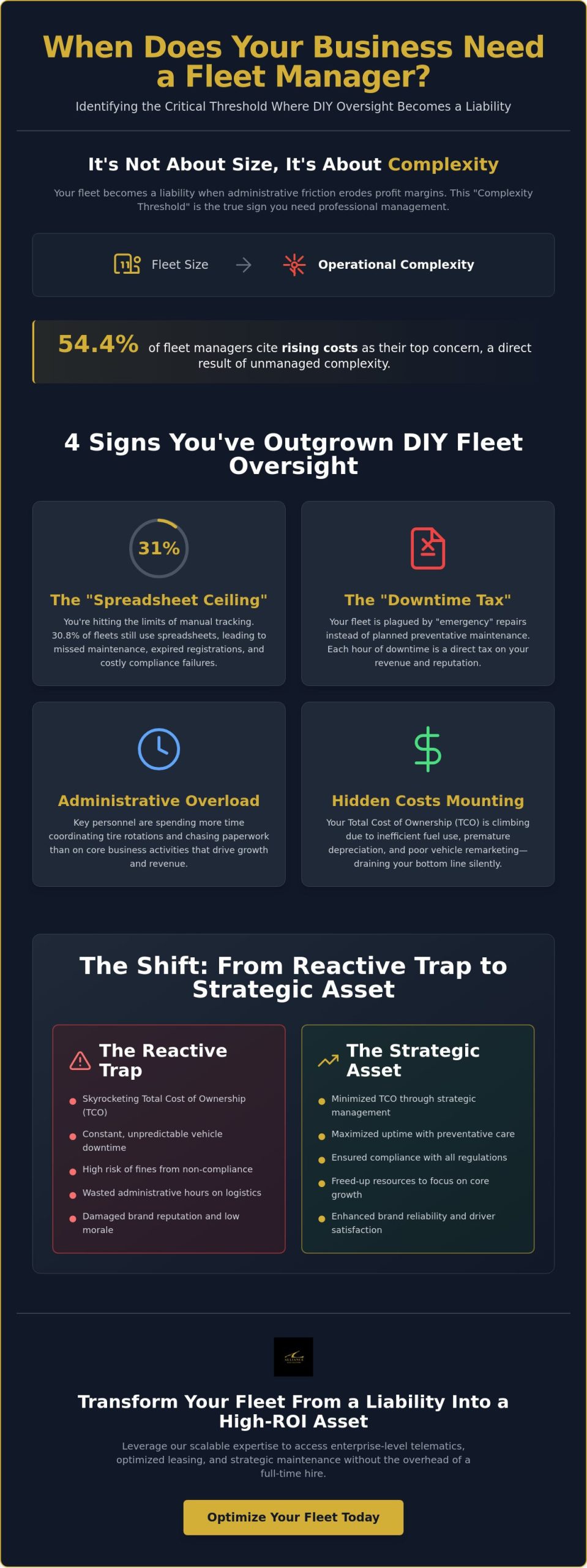
Scaling a business is a clear sign of success, but it often introduces a level of logistical complexity that outpaces manual tracking. Many companies reach what we call the “Spreadsheet Ceiling.” This is the point where a shared Excel file or a handwritten log no longer provides the oversight needed to maintain a professional operation. When you start missing oil changes or realize a registration expired three weeks ago while the truck is 200 miles away, your system has failed. Identifying exactly when does a business need a fleet manager involves looking at how much time you spend reacting to problems rather than preventing them. According to industry data from 2026, 30.8% of fleets still rely on spreadsheets for tracking, yet these same businesses often struggle with unexplained spikes in fuel and maintenance costs because they lack clear data attribution.
The Administrative Burden of Growing Fleets
How many hours a week do you lose to vehicle-related phone calls? If you’re spending your mornings coordinating tire rotations and your afternoons chasing down insurance cards, you aren’t growing your business; you’re just treading water. There is also the significant risk of non-compliance with national safety regulations. Missing a single filing can lead to heavy fines or a temporary fleet grounding. The administrative breaking point for an owner-operator occurs when vehicle logistics consistently prevent you from meeting with new prospects or managing your core team. Professional fleet management provides the structure needed to move past this friction and return your focus to high-level strategy.
Operational Red Flags You Can’t Ignore
A major red flag is the transition from planned preventative maintenance to frequent “emergency” repairs. If your trucks are visiting the shop for unexpected failures more often than for routine service, your current oversight is insufficient. This creates a “Downtime Tax” that erodes your margins and affects customer service. Additionally, inconsistent fuel spend across your team is a sign of trouble. Without telematics, it’s impossible to tell if high fuel costs are due to excessive idling, inefficient routing, or simple fuel theft.
Equipment issues don’t just hurt your wallet; they damage your reputation. A broken-down truck with your logo on the side is a rolling billboard for unreliability. When drivers are frustrated by poorly upfitted vehicles or frequent equipment failures, their morale drops. This leads to higher turnover in an already tight labor market. With the 2027 EPA heavy-duty emissions standards approaching, the complexity of vehicle procurement and maintenance will only increase. Professional oversight ensures you aren’t just buying vehicles, but building a high-ROI strategic asset.
The Hidden Costs of Managing a Fleet Without Professional Expertise
Managing a fleet without specialized knowledge often leads to “invisible” financial leaks that drain your bottom line. Most business owners focus on the monthly lease or loan payment, but that’s only a small fraction of the total financial impact. When determining when does a business need a fleet manager, you have to look beyond the initial invoice at the Total Cost of Ownership (TCO). Inefficient procurement, such as buying “off the lot” instead of utilizing strategic vehicle acquisition, often results in equipment that isn’t properly upfitted for the job. This mismatch leads to increased wear, higher fuel consumption, and premature asset failure.
Total Cost of Ownership (TCO) Erosion
The lifecycle of a commercial vehicle isn’t a straight line; it’s a curve where rising maintenance costs eventually intersect with diminishing resale value. Without professional maintenance management, assets depreciate prematurely because small issues aren’t caught before they become catastrophic. Implementing sustainable fleet management practices helps stabilize these costs by optimizing routes and reducing idle time. Every gallon of fuel saved and every avoided repair contributes directly to your profit margins. If you find your operational budget is constantly being hijacked by “surprise” expenses, it’s a clear signal that your DIY approach is costing more than a professional partnership.
The Remarketing Gap
One of the biggest areas where businesses lose money is vehicle disposal. Holding onto a truck for too long might seem like you’re “getting your money’s worth,” but the reality is often the opposite. There’s a specific “sweet spot” where a vehicle’s resale value is maximized relative to its remaining service life. A professional fleet manager tracks market trends to ensure you exit the asset at the peak of its value. Documented, consistent maintenance records are essential here. They prove the vehicle’s health to secondary buyers and can add thousands to the final sale price.
The “Downtime Tax” also plays a significant role in your true costs. When a truck sits in a shop for three days, you aren’t just paying the mechanic; you’re losing the revenue that truck should have generated. You also risk damaging client relationships through service delays. Balancing these factors requires a level of data analysis that most owners don’t have time to perform. Partnering with experts for fleet management can turn these hidden costs back into a strategic advantage for your company.
Complexity vs. Count: Determining Your Fleet Management Threshold
Traditionally, the industry points to the “15-vehicle rule” as the standard marker for hiring a dedicated manager. At this volume, the administrative friction mentioned in previous sections usually becomes unsustainable. However, vehicle count is a blunt instrument for measurement. A company with ten highly specialized, heavy-duty trucks operating across three state lines often faces more logistical hurdles than a local service business with twenty standard pickups; to see how these challenges are managed by professional relocation specialists, you can visit Southern Elite Van Lines. You must evaluate the specific friction points in your daily operation to decide if you’ve reached the tipping point.
When Complexity Trumps Quantity
Complexity is the true driver of cost. If your operation requires professional upfitting for specialized equipment, the margin for error disappears. Managing a diverse fleet, such as mixing cargo vans, Class 5 trucks, and trailers, requires deep technical knowledge of various maintenance schedules and parts availability. Coordination becomes even more difficult when logistics span national service areas. Without centralized control, you’re likely overpaying for local repairs or missing out on volume-based procurement discounts that a professional could secure.
Safety and Compliance Standards
Regulatory hurdles are another critical factor in deciding when does a business need a fleet manager. Compliance isn’t a part-time job. With the 2027 EPA emissions standards requiring nitrogen oxide reductions to 0.035 grams per horsepower-hour, the technical barrier for entry is rising. Inadequate driver safety programs carry massive legal risks. Professional oversight ensures every vehicle meets national standards and that your documentation is audit-ready at all times. This proactive approach protects your business from the “compliance tax” of fines and legal fees.
Finally, consider your tech stack. Many fleets “have data” through basic GPS, but they don’t execute on insights. A dedicated manager uses telematics to identify idling waste, aggressive driving, or route inefficiencies. They turn raw numbers into a strategic roadmap for growth. If you find yourself staring at a dashboard full of red alerts without a plan to fix them, you’ve reached your management threshold. Moving from manual tracking to executing on data-driven insights is where professional oversight pays for itself.
Full-Time Hire vs. Fractional Fleet Management Services
Once you recognize the signs of operational strain, the next hurdle is deciding how to implement professional oversight. Many owners struggle with the financial weight of a new executive salary. Deciding when does a business need a fleet manager often comes down to a simple cost-benefit analysis between a full-time internal hire and a fractional service provider. A qualified professional in this field typically commands a salary between $70,000 and $100,000. When you factor in benefits and payroll taxes, that’s a heavy commitment for a growing company to absorb all at once.
Management firms offer significant industry leverage that a single employee simply can’t match. They use established networks to access better pricing on parts, fuel, and vehicle acquisition. They also provide enterprise-level telematics and GPS solutions as part of their service package. This gives you the data needed to make informed decisions without the high upfront cost of software licenses and hardware installation. You get the tools of a national carrier on a mid-sized business budget.
The Fractional Management Advantage
Fractional fleet management allows you to access a team of specialists for the price of a single part-time clerk. Instead of one person trying to handle everything from maintenance to compliance, you get a collaborative group of experts. This model is highly scalable. You can increase or decrease support as your fleet grows or shrinks, ensuring you never pay for more management than you actually need. Fractional management bridges the gap for mid-sized fleets by providing executive-level strategy at a fraction of the cost of a full-time hire.
Comparing Your Options
Your choice depends on the specific needs of your daily operation. Determining when does a business need a fleet manager requires an honest look at your internal capacity versus your growth targets. An internal manager is often best for high-touch, hyper-local needs where daily dispatch and driver face-time are critical. However, an outsourced partner is usually superior for strategic TCO reduction, leasing structures, and lifecycle management. Many companies find success with hybrid models. They keep basic tasks in-house while utilizing external fuel management programs and maintenance oversight to curb waste.
Ready to optimize your overhead? Explore how Fractional Fleet Management can scale with your specific business goals.
Optimizing Your Operations with Alliance Fleet Solutions
Deciding exactly when does a business need a fleet manager is the first step toward long-term operational stability. Once you recognize that administrative friction is slowing your growth, you need a partner capable of transforming your fleet from a source of stress into a high-ROI strategic asset. Alliance Fleet Solutions moves beyond the traditional vendor relationship. We act as a professional extension of your management team, providing the technical authority and data-driven insights required to navigate the complexities of the modern logistics sector.
Financial flexibility is at the core of our approach. We offer customized leasing structures, including both open-end and closed-end options, to align with your specific cash flow requirements and financial goals. Open-end leasing provides the flexibility many growing businesses need, allowing you to benefit from the equity built in your vehicles. For those prioritizing budget predictability, our closed-end options mitigate the risk of market fluctuations. By aligning your acquisition strategy with your long-term business plan, we ensure your capital is always working as hard as your drivers.
A Solution Tailored to Your Growth
Our end-to-end lifecycle management covers every stage of an asset’s life. This begins with strategic vehicle acquisition and professional upfitting, ensuring every truck is ready for the specific demands of your industry from day one. We handle the technical details of procurement so you don’t have to settle for what’s available “off the lot.” As your business scales, Alliance Fleet Solutions scales with you. We utilize advanced telematics and GPS solutions to drive down fuel and maintenance costs, turning raw data into actionable progress. This proactive oversight prevents the “Downtime Tax” from eroding your margins and ensures your fleet remains a reliable tool for expansion.
Ready to Professionalize Your Fleet?
Transitioning to a managed fleet model doesn’t have to be a disruptive event. It starts with a clear-eyed look at your current expenses and operational bottlenecks. We help you identify hidden savings through a comprehensive fleet analysis, uncovering the “invisible” costs of DIY oversight that we discussed in earlier sections. Whether you need fractional fleet management to support a mid-sized team or full-scale maintenance management for a national operation, we provide the expertise to keep your vehicles on the road and your focus on the big picture. Partner with Alliance Fleet Solutions to optimize your fleet today and secure the backbone of your functional operation.
Take Control of Your Fleet’s Strategic Future
Identifying when does a business need a fleet manager is a pivotal moment for any growing company. It marks the transition from reactive maintenance and administrative friction to a data-driven strategy that prioritizes total cost of ownership. By moving past the “Spreadsheet Ceiling” and addressing the complexities of national logistics and regulatory compliance, you protect your margins and your brand’s reputation. Professional oversight ensures that your fleet remains a high-ROI asset instead of an administrative burden.
You don’t have to navigate this transition alone or absorb the high cost of a full-time executive salary. Our fractional management experts provide the technical authority you need to optimize your overhead. With national service coverage and flexible open-end or closed-end leasing options, Alliance Fleet Solutions acts as the strategic backbone of your operation. Don’t let operational friction stall your progress. Schedule a Fleet Strategy Consultation with Alliance Fleet Solutions today. Your business deserves a partner that understands the mechanics of efficiency and the language of financial performance. We’re ready to help you drive your business forward with confidence.
Frequently Asked Questions
What is the average fleet size that requires a dedicated manager?
While 15 vehicles is often cited as the traditional industry threshold, the decision depends more on operational complexity than a specific number. A business with 10 heavy-duty trucks operating across state lines often faces more logistical friction than a local company with 20 standard vans. If vehicle administration prevents you from focusing on core growth, you’ve reached the point where professional oversight is necessary regardless of your count.
Can a business outsource fleet management instead of hiring a full-time employee?
Yes, outsourcing is a highly effective alternative to hiring a full-time employee. Many businesses choose fractional fleet management to access a team of specialists without the overhead of a $70,000 to $100,000 executive salary. This approach provides enterprise-level tools and industry leverage while allowing your internal team to remain focused on customer acquisition and service delivery rather than chasing maintenance records.
What are the primary responsibilities of a commercial fleet manager?
A commercial fleet manager oversees the entire lifecycle of a vehicle, from initial procurement and professional upfitting to eventual remarketing. Their daily tasks include coordinating maintenance schedules, managing fuel programs, and ensuring strict compliance with national safety regulations. They also analyze telematics data to identify cost-saving opportunities and reduce the total cost of ownership across the entire operation to protect your profit margins.
How much does a professional fleet manager typically cost a business?
Hiring a dedicated internal fleet manager typically requires a salary between $70,000 and $100,000 plus benefits and payroll taxes. For companies not yet ready for that level of overhead, outsourcing provides a more scalable cost structure. Determining exactly when does a business need a fleet manager involves comparing this salary commitment against the potential savings found in reduced downtime and optimized vehicle lifecycles.
What is fractional fleet management and how does it work?
Fractional fleet management provides businesses with access to a team of industry experts for a fraction of the cost of a full-time hire. It works by assigning specialized tasks like maintenance oversight, leasing coordination, and compliance to an external partner. This model bridges the gap for mid-sized fleets that require professional strategy and technical authority but don’t yet have the volume to justify a dedicated internal department.
Does a small business with only 5 vehicles need a fleet manager?
A business with only five vehicles rarely needs a full-time manager, but they still benefit from professional oversight. At this scale, the primary goal is preventing the “Spreadsheet Ceiling” where manual tracking leads to missed service or expired registrations. Utilizing maintenance management services or fuel programs can provide the necessary control and cost savings without the need for a dedicated, high-salary staff member.
How does fleet management software differ from a fleet manager?
Fleet management software is a tool that collects data, whereas a fleet manager is the professional who executes strategy based on those insights. Software can track a vehicle’s location or fuel spend, but it cannot negotiate complex leasing structures or coordinate professional upfitting. A manager uses the software to identify idling waste or aggressive driving and then implements the necessary changes to improve your ROI.
What are the risks of managing a fleet without professional oversight?
Managing a fleet without professional oversight leads to unpredictable maintenance costs and increased vehicle downtime. Without a dedicated strategy, businesses often face the “Downtime Tax” where equipment failures disrupt customer service and damage your reputation. Additionally, the risk of non-compliance with safety regulations can result in heavy fines or legal liabilities that far outweigh the cost of partnering with a professional manager.