
What if the most effective fleet management cost reduction strategies have nothing to do with cutting services and everything to do with how you manage the vehicle lifecycle? With the average total cost of ownership reaching up to $1.12 per mile in May 2026, relying on reactive maintenance or outdated fuel tracking is no longer a viable business model. You’re likely feeling the weight of unpredictable maintenance spikes and the administrative burden of managing a complex operation. It’s frustrating to watch your ROI stagnate while fuel volatility and depreciation anxiety eat away at your margins.
We understand that your fleet is the backbone of your business, and every hour of downtime is a direct hit to your profitability. This guide promises to equip you with a strategic framework to master lifecycle strategies, from vehicle acquisition to expert remarketing. You’ll learn how to transform your operational tactics to achieve predictable monthly expenses and higher resale values at end-of-life. We will explore how integrating telematics, maintenance management, and professional upfitting can turn your fleet from a stress-inducing cost center into a streamlined, strategic asset.
Key Takeaways
- Identify hidden operational expenses beyond the initial purchase price by mastering Total Cost of Ownership (TCO) to stabilize your monthly budget.
- Learn how integrating telematics and fuel management programs eliminates unauthorized vehicle use and significantly reduces costly idle time.
- Discover why choosing between open-end and closed-end leasing, combined with professional upfitting, is critical for long-term commercial ROI.
- Implement fractional fleet management cost reduction strategies to slash internal administrative overhead while maintaining expert operational control.
- Maximize asset recovery at the end of the vehicle lifecycle through strategic remarketing services that outperform traditional trade-in values.
Mastering Total Cost of Ownership (TCO) in 2026
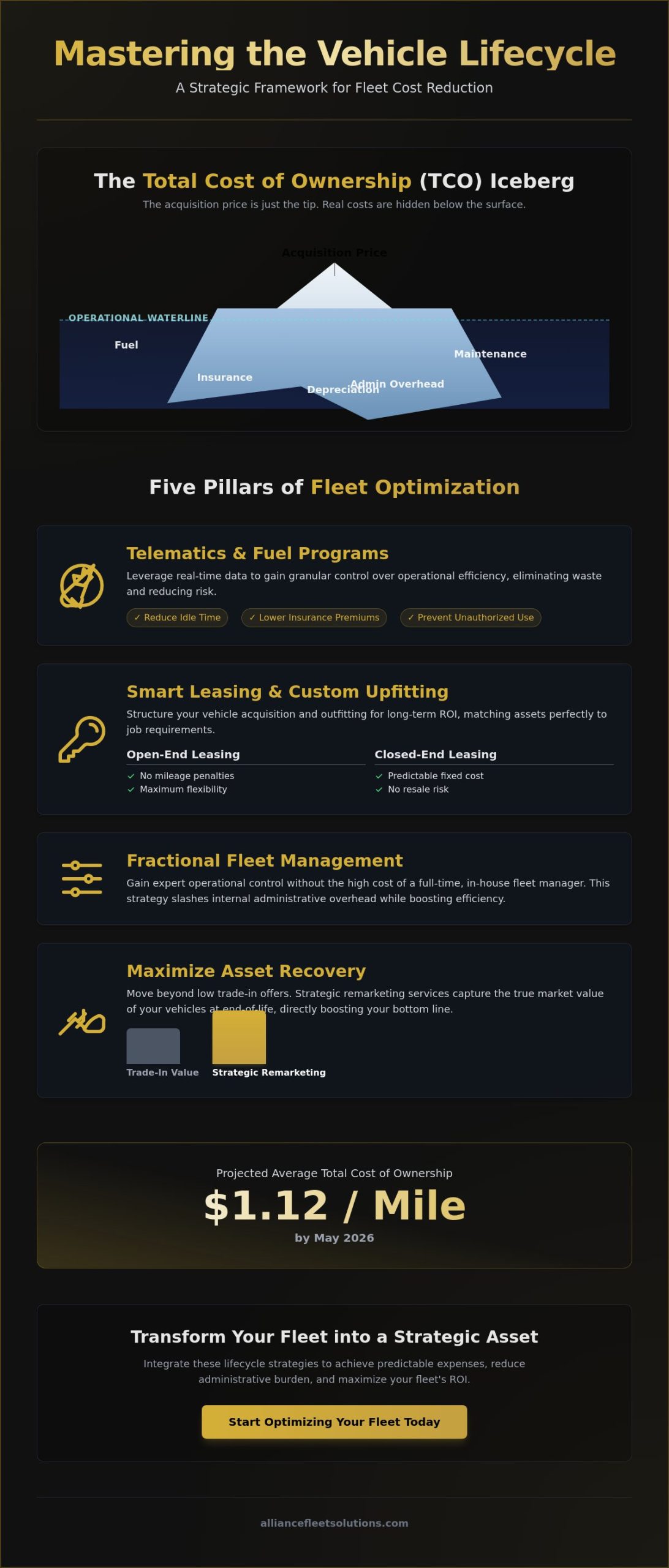
In the current logistics environment, looking only at the initial sticker price of a vehicle is a recipe for budget failure. Real success with fleet management cost reduction strategies begins with a fundamental shift toward Total Cost of Ownership (TCO). Think of your fleet costs as an iceberg. The acquisition price is the visible tip above the water, while the massive, submerged portion consists of fuel, insurance, maintenance, and administrative overhead. If you don’t account for those hidden depths, your financial projections will inevitably drift off course as operational realities set in.
Establishing a TCO baseline is the prerequisite for any meaningful optimization. You must audit your current spending across every department to identify exactly where “cost-leakage” occurs. This often happens in overlooked areas like excessive idle time, aggressive driving habits, or inefficient vehicle upfitting that doesn’t match the specific job requirements. Total Cost of Ownership represents the sum of all expenses incurred throughout a vehicle’s lifecycle, from initial procurement and upfitting to maintenance and final remarketing. Without this comprehensive view, you’re essentially managing your fleet in the dark, reacting to crises rather than preventing them.
Fixed vs. Variable Costs: Where to Cut
Reducing overhead requires a clear distinction between fixed and variable expenses. Fixed costs, such as taxes, permits, and lease payments, remain relatively stable but can be optimized through smarter vehicle acquisition and leasing structures. Effective fleet management functions integrate these fixed obligations into a predictable monthly schedule to avoid cash flow surprises. Conversely, variable costs like fuel and maintenance offer the greatest opportunity for immediate savings. By controlling driver-related wear and tear through better monitoring, you can prevent small operational inefficiencies from compounding into massive year-end deficits.
The Role of Data in TCO Accuracy
Manual spreadsheets are no longer sufficient for modern fleets. They lead to cost-blindness and delayed decision-making that can cost thousands in missed opportunities. Relying on fragmented data makes it impossible to see the real-time impact of rising fuel prices or maintenance surges across different vehicle classes. Integrating telematics data directly with your financial reporting provides the visibility needed to make proactive adjustments. When you align your cost-reduction KPIs with overall business goals, you stop reacting to equipment failures and start predicting them. This data-driven approach ensures that every dollar spent is a calculated investment in your fleet’s long-term reliability and ROI.
Leveraging Telematics and Fuel Programs for Operational Efficiency
Simple GPS tracking is a relic of the past. To execute effective fleet management cost reduction strategies in 2026, you must move toward advanced telematics-driven insights. This technology provides a granular look at how your assets are actually performing on the road. Real-time monitoring allows you to identify and eliminate unauthorized vehicle use, which often accounts for a significant portion of “hidden” operational waste. Beyond tracking location, these systems monitor engine diagnostics and idle time. With the average U.S. diesel price projected at $4.76 per gallon for 2026, every minute of unnecessary idling represents a direct hit to your bottom line.
There’s also a direct correlation between driver behavior and your fixed costs. Telematics data allows you to build safety profiles for every driver in your organization. High-risk behaviors like aggressive braking or speeding don’t just increase wear and tear; they drive up insurance premiums. By providing tangible data on safety improvements, you gain leverage when negotiating with underwriters. Integrating these data streams allows you to build a more resilient operation. Explore how Telematics and GPS Solutions can provide the clarity your business needs to stay competitive.
Optimizing Fuel Consumption with Integrated Programs
Fuel management isn’t just about finding the cheapest pump. Modern fuel cards provide the granular data required for comprehensive consumption audits, making it easy to spot fraud or billing discrepancies. By leveraging fuel management programs, you can identify specific vehicles that are underperforming compared to their class averages. This allows you to retire or repair inefficient assets before they drain your budget. Route optimization also plays a critical role here. Reducing miles driven by even a small percentage can save thousands in fuel and maintenance costs over the course of a year while maintaining your existing service levels.
Predictive Maintenance: Stopping Problems Before They Start
The cost difference between scheduled maintenance management and emergency repairs is staggering. Emergency fixes often involve towing fees, expedited parts shipping, and higher labor rates. Telematics alerts trigger proactive service intervals based on actual engine hours rather than arbitrary calendar dates. This approach helps you avoid “Downtime Decay,” which refers to the secondary costs of having a vehicle out of service, such as lost revenue and the expense of renting temporary replacements. Predictive maintenance ensures your fleet stays on the road, where it actually generates value for your business.
Leasing Structures and Custom Upfitting: Reducing Lifecycle Expenses
Most fleet management cost reduction strategies focus heavily on software, yet they often ignore the massive financial impact of your underlying lease structure. Choosing between open-end and closed-end leasing isn’t just a matter of preference; it dictates your long-term ROI and risk exposure. In a market where new Class 8 sleeper trucks cost approximately $172,000, being locked into the wrong financial vehicle can lead to thousands in unnecessary overhead. You need a structure that aligns with your specific usage patterns and cash flow requirements.
Open-end leasing remains the preferred choice for high-mileage commercial applications. It offers the flexibility to terminate the lease at any time after the first year, which is essential if your operational needs shift rapidly. Because there are no mileage restrictions or wear-and-tear penalties, you aren’t penalized for the hard work your vehicles perform. Conversely, closed-end leasing provides predictability for businesses with strict budget cycles and fixed mileage requirements. By shifting the residual risk to the lessor, you gain a fixed monthly cost that simplifies financial planning. Right-sizing your fleet through professional vehicle acquisition ensures you aren’t paying for excess capacity or underpowered assets that will fail prematurely.
Professional Upfitting as a Maintenance Prevention Tool
Custom-configured vehicles do more than just hold tools; they act as a primary maintenance prevention tool. Professional upfitting ensures the vehicle is engineered for its specific workload, preventing the premature suspension and brake wear caused by overloaded, off-the-shelf units. When a vehicle is balanced and organized correctly, it reduces operational strain on the chassis and powertrain. There is also a strong link between ergonomic upfitting and driver safety. A well-designed workspace reduces physical fatigue and improves retention, which helps you avoid the high costs associated with driver turnover and accidents.
Acquisition Timing and Market Leverage
Strategic procurement requires looking past the immediate need to fill a seat. With commercial vehicle loan interest rates ranging from 6% to over 30% depending on credit and asset age, timing your acquisition is critical for maximizing tax benefits and minimizing interest expense. Leveraging fleet management partnerships allows you to access volume pricing that is typically unavailable to individual businesses. This proactive approach helps you avoid the “emergency purchase” trap. When you buy from existing dealer stock during a crisis, you often overpay for features you don’t need or settle for a vehicle that isn’t optimized for your specific route requirements.
Fractional Fleet Management: Reducing Internal Overhead
One of the most overlooked fleet management cost reduction strategies involves re-evaluating your internal payroll and administrative structure. Fractional fleet management allows businesses to access executive-level expertise without the burden of a high-salary, full-time internal manager. Instead of paying for a dedicated department, you pay only for the management capacity you need. This model is particularly effective for companies scaling rapidly or those with seasonal fluctuations in vehicle use. You gain the ability to standardize efficient fleet operations across multiple locations without adding a single person to your permanent headcount.
Managing a fleet requires a specialized skill set that spans finance, logistics, and mechanical engineering. Small to medium-sized businesses often task an office manager or a business owner with these responsibilities, leading to costly errors and missed optimization opportunities. A fractional partner acts as a seasoned extension of your team, bringing a level of technical authority that is usually reserved for enterprise-level organizations. This partnership ensures that your operational decisions are grounded in data rather than guesswork. If your internal team is overwhelmed by the high-stakes needs of logistics, consider how Fractional Fleet Management can streamline your overhead and restore professional control.
Outsourcing the Administrative Burden
The paperwork trail associated with a commercial fleet is relentless. From managing Unified Carrier Registration (UCR) fees to tracking vehicle renewals, the administrative hours add up quickly. Fractional partners handle these repetitive tasks along with vendor negotiations for maintenance and parts. By leveraging their industry relationships, they often secure better pricing than an individual business could on its own. This allows you to focus your internal resources on core business growth while the logistics of your fleet are handled by experts who understand the mechanics of the industry.
Consistency and Compliance Across the Nation
Maintaining uniform safety standards is difficult in a decentralized fleet environment. A fractional manager ensures that every vehicle and driver meets strict DOT and regulatory requirements, regardless of their location. In 2026, FMCSA fines for non-compliance range from $1,099 to $16,550 per violation. These costs can be devastating for a small operation. Expert oversight significantly reduces the risk of these legal liabilities by ensuring that every USDOT and MC operating authority filing is current and accurate. This proactive approach to compliance protects your business from the financial and reputational damage of equipment failure or safety violations.
Maximizing Asset Recovery through Strategic Vehicle Remarketing
Remarketing represents the final chapter of a vehicle’s lifecycle, yet it’s often the most ignored component of fleet management cost reduction strategies. Many managers treat the disposal of an asset as a simple administrative task rather than a strategic opportunity to recoup capital. Accepting a standard dealer trade-in often leaves significant money on the table. Professional remarketing services outperform traditional trade-ins by utilizing specialized buyer networks and data-driven pricing models to ensure you receive the highest possible return on your investment.
Timing the market is critical for maximizing resale value. In April 2026, inventory levels for used heavy-duty trucks were down over 20% compared to the previous year, creating a unique window for sellers. However, auction values also decreased by 1.56% year-over-year, which means waiting even a few months too long can result in a lower recovery price. Maintenance records serve as your greatest asset during this process. A vehicle with a documented history of proactive care commands a premium on the secondary market because it reassures the buyer of the asset’s long-term reliability. When you prove the equipment was never neglected, you transform a used truck into a high-value commodity.
Optimizing Resale Value
Preparing an asset for sale requires more than just a quick wash. Strategic reconditioning, such as minor body work or interior detailing, offers a high ROI by significantly increasing buyer interest and final sale prices. Accessing multi-channel sales platforms ensures your assets are visible to a national audience rather than just local wholesalers. Industry experts report that strategic remarketing can recover up to 15% more value than standard wholesale transactions. This recovered capital can then be reinvested into your next acquisition cycle, effectively lowering the TCO of your entire fleet.
The Alliance Partnership Advantage
True operational efficiency isn’t achieved through isolated tactics; it requires a cohesive framework that connects every stage of the vehicle lifecycle. By integrating TCO analysis, telematics-driven maintenance, and fractional oversight into a single fleet management services model, you create a self-sustaining system of cost control. Alliance Fleet Solutions acts as the strategic backbone for your operation, providing the technical authority and logistical support needed to handle the high-stakes demands of the industry. Don’t let hidden costs erode your profitability. Review your current fleet expenses with a professional audit to identify where your recovery strategies can be strengthened today.
Securing Your Fleet’s Financial Future
Implementing sustainable fleet management cost reduction strategies requires a fundamental shift from reactive maintenance to proactive lifecycle management. By mastering Total Cost of Ownership and leveraging real-time telematics data, you transform your fleet from a series of unpredictable expenses into a predictable, strategic asset. We’ve explored how the right leasing structures, custom upfitting, and professional remarketing create a comprehensive framework that protects your margins from initial procurement to final disposal. These tactics ensure your operation remains resilient against fuel volatility and depreciation anxiety while boosting overall ROI.
Managing these operational complexities doesn’t have to fall entirely on your internal team. You can optimize your fleet today with Alliance Fleet Solutions. Our team provides national service coverage and comprehensive lifecycle management, bringing specialized expertise in both open-end and closed-end leasing to your specific business model. It’s time to stop letting operational downtime and administrative overhead dictate your bottom line. With a dedicated partner and a data-driven approach, you can achieve the long-term reliability and financial performance your business deserves.
Frequently Asked Questions
What is the most effective way to reduce fleet fuel costs?
The most effective way to reduce fleet fuel costs is by combining integrated fuel management programs with real-time telematics data. This dual approach allows you to identify excessive idling and optimize routing to eliminate unnecessary miles. With diesel prices projected at $4.76 per gallon for 2026, even small efficiencies lead to significant savings. Fuel cards also provide the granular data needed to spot fraud and billing discrepancies across your entire operation.
How does telematics directly contribute to cost reduction?
Telematics directly contributes to cost reduction by providing visibility into driver behavior and engine diagnostics. Monitoring aggressive braking and speeding helps lower insurance premiums and reduces vehicle wear. These systems also provide real-time alerts for engine fault codes, allowing you to address mechanical issues before they lead to expensive roadside failures. By eliminating unauthorized vehicle use and idling, you ensure every asset is utilized efficiently.
Is it cheaper to lease or buy commercial fleet vehicles in 2026?
Choosing between leasing and buying depends on your cash flow and usage patterns, but leasing often offers a lower total cost of ownership. Open-end leasing provides the flexibility high-mileage commercial fleets need without wear-and-tear penalties. For businesses requiring strict budget predictability, closed-end leasing shifts the residual risk to the lessor. Strategic leasing also allows you to conserve capital and maintain a newer, more fuel-efficient fleet that requires less maintenance.
What is fractional fleet management and is it right for my business?
Fractional fleet management is a service where you hire executive-level fleet expertise on a part-time or project basis. It’s an ideal choice for businesses that need professional oversight but don’t want the high salary costs of a full-time internal manager. This model allows you to scale management services up or down based on your seasonal needs. It ensures your fleet management cost reduction strategies are executed by experts who understand the complexities of the 2026 logistics market.
How can preventive maintenance management save money in the long run?
Preventive maintenance management saves money by replacing expensive emergency repairs with predictable, scheduled service. Addressing minor issues early prevents them from escalating into catastrophic engine or transmission failures. This approach significantly reduces “Downtime Decay,” which includes the lost revenue and rental costs incurred when a vehicle is out of service. Keeping your vehicles in peak condition also ensures they retain a higher resale value at the end of their lifecycle.
What is vehicle remarketing and how does it help the bottom line?
Vehicle remarketing is the strategic process of selling retired fleet assets to maximize recovery value. Instead of accepting low trade-in offers, professional remarketing uses specialized buyer networks and multi-channel sales platforms to find the highest bidder. Proper timing is essential. Pulling a vehicle from service when market demand is high can recover up to 15% more value than standard wholesale. This recovered capital directly offsets the cost of your next vehicle acquisition.
How does custom upfitting impact the total cost of ownership?
Custom upfitting impacts TCO by ensuring every vehicle is perfectly engineered for its specific workload. Properly balanced equipment reduces strain on the suspension and brakes, leading to fewer mechanical failures over time. Ergonomic designs also improve driver safety and comfort, which helps reduce the high costs associated with driver turnover and accidents. When a vehicle is upfitted correctly from the start, it operates more efficiently and lasts longer than a standard off-the-shelf unit.
What are the hidden costs of managing a fleet internally?
The hidden costs of internal fleet management include high administrative payroll and the risk of expensive compliance errors. Managing USDOT filings and registration renewals takes significant time away from your core business activities. Without a dedicated partner, you also lose out on volume pricing for parts, maintenance, and new vehicle acquisitions. In 2026, FMCSA non-compliance fines can reach $16,550 per violation, making professional oversight a critical financial safeguard for your fleet management cost reduction strategies.