
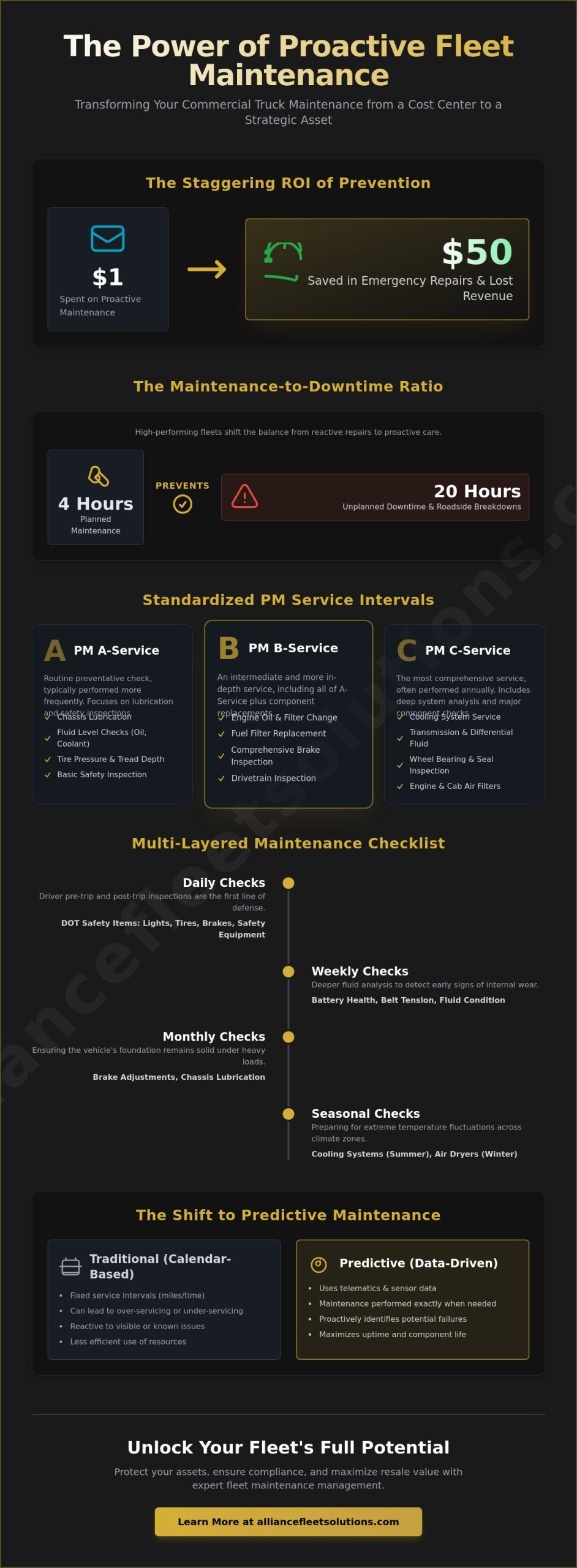
Every dollar spent on a proactive preventative maintenance schedule for commercial trucks can save your operation up to $50 in emergency repairs, roadside breakdowns, and lost revenue. It’s a staggering return on investment that many fleet managers overlook until a $19,000 FMCSA fine for a missing electronic DVIR lands on their desk. You already know that unexpected downtime is the fastest way to erode your bottom line and frustrate your drivers. Keeping a national fleet running smoothly requires more than just reacting to check engine lights. It demands a strategic approach that treats every service interval as an investment in your company’s future.
We understand the pressure of balancing a predictable budget with the need for 95% fleet uptime. This guide provides a comprehensive roadmap to mastering your fleet’s lifecycle through meticulous record-keeping and data-driven service intervals. You’ll learn how to navigate the 2026 digital compliance mandates, optimize your maintenance spend for maximum resale value, and implement a schedule that transforms your shop from a cost center into a strategic asset.
Key Takeaways
- Identify the critical “Maintenance-to-Downtime Ratio” that separates high-performing national fleets from those struggling with escalating emergency repair costs.
- Step-by-step guidance on creating a tiered preventative maintenance schedule for commercial trucks, covering everything from daily driver inspections to complex seasonal overhauls.
- Learn how to standardize A, B, and C service intervals to ensure consistent vehicle health and safety across every asset in your operation.
- Harness the power of telematics and GPS solutions to transition from traditional calendar-based maintenance to a more efficient, data-driven predictive model.
- Explore how fractional fleet management and maintenance management services provide the expert oversight needed to maximize vehicle resale value and long-term reliability.
The Strategic Value of a Preventative Maintenance Schedule
A robust preventative maintenance schedule for commercial trucks is the backbone of any profitable logistics operation. We define preventative maintenance (PM) as a proactive system of scheduled inspections, fluid replacements, and hardware updates designed to catch wear before it evolves into a failure. This isn’t just about changing oil; it’s about maintaining a healthy Maintenance-to-Downtime Ratio. In a high-performing fleet, you want to see a ratio where four hours of planned maintenance prevents twenty hours of unplanned downtime. When you shift the balance toward proactive care, you stabilize your operations and protect your drivers from the stress of roadside breakdowns.
Some managers believe skipping a service interval saves money in the short term. This is a dangerous misconception. In 2026, the secondary market for heavy-duty vehicles is more data-dependent than ever. Buyers and remarketing specialists prioritize trucks with a meticulous, digital service history. A vehicle with a documented preventative maintenance schedule for commercial trucks commands a significantly higher resale price because it represents lower risk to the next owner. By neglecting these checks, you aren’t saving costs. You’re actively devaluing your asset and inviting catastrophic failure.
Protecting Your Total Cost of Ownership (TCO)
Total Cost of Ownership (TCO) is the sum of acquisition, operation, and maintenance minus residual value. Regular motor vehicle service prevents the catastrophic failure chain, where a neglected sensor failure or a clogged filter eventually destroys a heavy-duty engine. Beyond avoiding major repairs, PM directly impacts daily operational costs. A clean air and fuel system ensures your engines operate at peak thermal efficiency, which keeps fuel consumption predictable and low. When your fleet runs efficiently, your TCO remains within a manageable range, allowing for more accurate financial forecasting.
Maintenance as a Requirement for Lease Compliance
Documented service history is a non-negotiable requirement for both open-end and closed-end leasing agreements. Proactive care ensures you avoid “excessive wear and tear” penalties when it’s time to cycle the vehicle out of your fleet. Effective Maintenance Management ensures every asset remains compliant with lease terms, protecting your company from unexpected end-of-term expenses. By following a strict preventative maintenance schedule for commercial trucks, you demonstrate a commitment to vehicle health that lease providers and future buyers value. It turns a mechanical necessity into a strategic business asset that safeguards your capital.
The Commercial Truck Maintenance Checklist: Daily to Seasonal
Execution is the bridge between a theoretical strategy and 95% fleet uptime. A preventative maintenance schedule for commercial trucks relies on a multi-layered approach that catches minor issues before they escalate into road calls. While the shop handles the heavy lifting, the process begins in the driver’s seat. Weekly checks should advance to battery health assessments, belt tension inspections, and deeper fluid analysis to detect early signs of internal wear. Monthly deep dives focus on brake adjustments and chassis lubrication to ensure the vehicle’s foundation remains solid under heavy loads. This granular attention to detail is what separates a reliable fleet from one plagued by “unexpected” repairs.
Seasonal adjustments are equally vital, especially for national fleets crossing diverse climate zones. Preparing for extreme temperature fluctuations requires a proactive look at cooling systems before summer heatwaves and air dryer cartridges before the first winter freeze. Utilizing a comprehensive diesel truck maintenance checklist ensures your technicians don’t overlook these critical transition points. By standardizing these checks, you create a culture of accountability that protects your assets year-round.
Daily Pre-Trip and Post-Trip Essentials
The driver is your first line of defense against downtime. Every 24 hours, essential DOT safety items like lights, tires, and safety equipment must be verified. With the FMCSA’s February 19, 2026, mandate regarding electronic DVIRs, maintaining a digital trail is now a regulatory necessity to avoid fines that can reach up to $19,000 per violation. Drivers should listen for unusual vibrations and watch for fresh leaks during their walk-around. Verifying tire pressure daily is particularly critical; even a 10% deviation from the recommended PSI can significantly degrade fuel economy and increase the risk of a high-speed blowout.
Specialized Maintenance for Upfitted Equipment
Standard OEM manuals often focus exclusively on the chassis, but vocational vehicles require a custom approach. If your fleet utilizes hydraulic lifts, refrigeration units, or crane attachments, these components need their own specific service intervals. High-wear parts in hydraulic systems or the calibration of a reefer unit can fail long before the engine requires an oil change. Ensuring safety compliance for this specialized hardware is essential for both operational efficiency and liability protection. If your fleet relies on complex machinery, our team provides Professional Upfitting and management services to ensure every attachment is as reliable as the truck carrying it. This customized oversight prevents the “catastrophic failure chain” from starting in your auxiliary equipment.
Understanding PM Service Levels: A, B, and C Intervals
Standardization eliminates guesswork. When your trucks operate across a national footprint, your vendors must follow the same playbook to ensure consistent safety and performance. A standardized preventative maintenance schedule for commercial trucks utilizes tiered service levels, commonly referred to as A, B, and C intervals. This system allows fleet managers to predict maintenance windows with high accuracy, ensuring that assets are only pulled from the road when necessary. Reliability isn’t accidental; it’s the result of a disciplined, tiered approach to equipment health.
Each level of service builds upon the previous one, creating a comprehensive safety net for the vehicle. While the frequency of these intervals depends on your specific application, the goal remains the same: identify potential failures before they result in an out-of-service order. By adhering to these tiers, you maintain compliance with the Federal Motor Carrier Safety Regulation Part 396, which mandates systematic inspection and maintenance for all motor carriers.
A-Service and B-Service Breakdown
The A-Service is your primary “safety and lube” check. It typically occurs every 10,000 to 15,000 miles and focuses on high-wear components. Technicians perform an oil change, grease all chassis fittings, and inspect air and fuel filters. In contrast, the B-Service is a mid-level deep dive performed every 30,000 to 45,000 miles. This interval includes everything in an A-Service plus transmission service, coolant flushes, and precision wheel alignments. These intervals must be adjusted for “severe duty” cycles. Trucks involved in heavy stop-and-go city driving or extreme idling require more frequent attention than those in long-haul, over-the-road applications.
The Long-Term C-Service and Annual DOT Inspection
The C-Service represents your major annual overhaul or high-mileage inspection. This is a comprehensive review of the vehicle’s structural and mechanical integrity. Technicians examine frame rails for stress fractures, replace worn suspension bushings, and pressure test the entire exhaust and aftertreatment system. This major service often coincides with the mandatory annual DOT inspection. While a DOT inspection typically costs between $150 and $350, failing to prepare for it can lead to much higher costs in fines and lost revenue. Incorporating Efficient Fleet Operations into your long-term planning ensures that these major service windows are scheduled during periods of lower demand. This proactive coordination maximizes your ROI and keeps your fleet’s uptime above the 95% threshold.
Leveraging Telematics for Predictive Maintenance Schedules
Traditional calendar-based models often lead to “over-maintenance” or, worse, missing a critical failure because a truck worked harder than expected between dates. By moving to a usage-based preventative maintenance schedule for commercial trucks, you align service intervals with actual wear and tear. Real-time data allows you to pull a vehicle for service based on engine hours, fuel burn, or specific mileage thresholds rather than an arbitrary date on a wall calendar. This precision keeps your fleet on the road longer and ensures that every dollar spent on maintenance is strictly necessary. It transforms your shop’s workflow from a reactive scramble into a steady, logical progression of planned events.
Integrating GPS data further optimizes this process by identifying the most convenient national service locations along a driver’s existing route. This minimizes out-of-route miles and ensures that even a national fleet remains easy to track. When you leverage data to dictate your maintenance needs, you eliminate the guesswork that often leads to high emergency repair costs. You’re no longer just maintaining a machine; you’re managing a high-performance business asset with expert control.
Real-Time Fault Monitoring and Remote Diagnostics
Modern telematics systems tap directly into J1939 engine data, creating a constant stream of information that flows from the truck to the fleet manager. This technology identifies engine fault codes before the “Check Engine” light even appears on the dashboard. This “knowing before you go” approach is a game changer for national logistics. Instead of a driver showing up at a repair shop with a vague symptom, your technicians already have the diagnostic data in hand. It significantly reduces labor hours spent on troubleshooting and allows you to prioritize repairs across a large fleet based on the actual severity of the fault. It’s about having the right parts ready before the truck even hits the bay.
Automating the Maintenance Workflow
Automation removes the risk of human error and ensures you never miss a critical service window. You can set up automated alerts for oil life, brake wear, and tire pressure deviations. This data doesn’t just keep the truck running; it supports broader business goals. For instance, maintaining peak engine health through data-driven alerts directly supports Fuel Management Programs by maximizing thermal efficiency and reducing waste. Having a digital, unalterable trail of every alert and subsequent repair also provides 100% compliance for audit protection. If you’re ready to stop guessing and start predicting your fleet’s health, explore our Telematics and GPS Solutions to see how real-time data can protect your bottom line.
Outsourcing Maintenance Management: The Alliance Fleet Advantage
Managing a national fleet requires more than just mechanical knowledge; it demands administrative precision and negotiating power. As your operation scales, the complexity of tracking every preventative maintenance schedule for commercial trucks across different states and service providers can quickly overwhelm your internal team. Fractional fleet management offers a scalable solution, providing the expertise of a full-scale fleet department without the overhead of a full-time staff. By partnering with us, you gain access to a national network of vetted service providers who understand our high standards for quality and speed. You’re no longer just a customer at a shop; you’re part of a managed network that prioritizes your uptime.
Consolidating your billing and reporting into a single, transparent stream simplifies your back-office operations. You’re no longer chasing invoices from dozens of different shops or trying to reconcile disparate maintenance logs. Instead, you receive a logical, organized overview of your fleet’s health and spending. This administrative efficiency is paired with our commitment to professional upfitting. By engineering your vehicles for their specific vocational tasks from day one, we create a low-maintenance fleet that experiences fewer auxiliary equipment failures. It’s a proactive approach that ensures your trucks are built to handle the specific stresses of your industry.
The Benefits of Managed Maintenance
Alliance Fleet Solutions leverages our industry relationships to negotiate national labor rates, directly lowering your per-mile operating costs. Our team of experts reviews every repair order to ensure you aren’t overcharged for unnecessary parts or inflated labor hours. We act as your technical advocate, catching errors and “service creep” that often go unnoticed by busy managers. This level of oversight allows you to focus on your core business goals while we handle the technical logistics and vendor relations. It’s about moving from a reactive state of frustration to a proactive state of expert control.
Customized Schedules for Your Specific Fleet
Every industry has unique demands, and a one-size-fits-all approach won’t suffice for a high-performing operation. We develop a PM program that matches your specific duty cycle, whether you’re handling heavy construction loads or high-frequency last-mile deliveries. By integrating your preventative maintenance schedule for commercial trucks with our Comprehensive Fleet Management Services, you ensure that every asset is optimized for maximum ROI. Contact Alliance Fleet Solutions today to build your custom 2026 maintenance roadmap and secure the long-term reliability your business depends on.
Securing Your Fleet’s Future through Proactive Care
Maintaining a high-performing fleet in 2026 requires a fusion of technical expertise and real-time data. You’ve seen how a structured preventative maintenance schedule for commercial trucks transforms your operation by reducing unplanned downtime and protecting your total cost of ownership. By standardizing A, B, and C service intervals and leveraging telematics for remote diagnostics, you move from a reactive posture to one of expert control. This proactive approach ensures your assets remain compliant with evolving FMCSA digital mandates while maximizing their eventual resale value.
Success in the logistics sector relies on steady, logical progress and the strength of your partnerships. Alliance Fleet Solutions provides the backbone for your operation through our national service network and expert fractional fleet management. We handle the technical logistics and telematics-integrated reporting, allowing you to focus on growing your core business with confidence. It’s time to stop worrying about the next breakdown and start investing in long-term reliability.
Optimize your fleet uptime with Alliance Maintenance Management and secure a competitive advantage for your business. Your fleet is the engine of your success, and we’re here to keep it running at peak performance.
Frequently Asked Questions
How often should a commercial truck have preventative maintenance?
Commercial trucks typically require basic preventative maintenance every 10,000 to 15,000 miles, though this interval depends heavily on your specific duty cycle. For vehicles involved in severe-duty applications like heavy hauling or stop-and-go city deliveries, these intervals should be shortened to account for increased engine stress. Following a consistent preventative maintenance schedule for commercial trucks ensures that high-wear items like oil and filters are replaced before they impact fuel efficiency or cause internal damage.
What is the difference between A-service and B-service for trucks?
The primary difference lies in the depth of the inspection and the specific components being serviced. An A-service is a “safety and lube” check that focuses on oil changes, grease fittings, and basic safety components like lights and tires. A B-service is a more intensive mid-level inspection that includes everything in an A-service plus drivetrain checks, transmission service, and deep coolant analysis. Standardizing these tiers across your operation allows for more predictable budgeting and shop scheduling.
Are daily pre-trip inspections legally required for commercial vehicles?
Yes, daily pre-trip and post-trip inspections are a federal legal requirement under FMCSA regulations. As of February 19, 2026, motor carriers must also adhere to stricter electronic DVIR rules that treat missing or illegible paper reports as significant violations. Failing to maintain these daily digital records can result in civil penalties reaching up to $19,000 per occurrence, making digital compliance a critical operational priority for every fleet manager.
Can telematics really reduce my maintenance costs?
Telematics significantly reduce maintenance costs by transitioning your fleet from traditional calendar-based service to a usage-based model. By monitoring real-time J1939 engine data, you can identify fault codes and performance dips before they trigger a “Check Engine” light or a roadside breakdown. This proactive approach prevents “over-maintenance” by ensuring that every service dollar is spent exactly when the data dictates, rather than on an arbitrary date.
What happens if I skip a scheduled maintenance interval on a leased truck?
Skipping a scheduled interval on a leased truck typically results in expensive “excessive wear and tear” penalties at the end of the term. Because open-end and closed-end leases require documented service history to protect the vehicle’s residual value, missing appointments can also void certain warranties. Maintaining a strict preventative maintenance schedule for commercial trucks is essential for lease compliance and maximizing your eventual vehicle remarketing returns.
How does upfitting change the maintenance schedule of a standard truck?
Professional upfitting adds specialized auxiliary components like hydraulic lifts or refrigeration units that require their own distinct service intervals. These systems often experience different wear patterns than the truck chassis and may need more frequent lubrication or pressure testing to remain safe. A comprehensive PM plan must integrate these vocational requirements to ensure that the entire asset, not just the engine, remains operational and compliant with safety standards.
What are the most common causes of commercial truck breakdowns?
The most common causes of commercial truck breakdowns include tire failures, brake system issues, and diesel aftertreatment (DPF) complications. In 2026, aftertreatment systems have become a significant maintenance cost center, often requiring specialized cleaning or sensor replacements to avoid engine derate conditions. Regular inspections of air systems and cooling components also prevent the majority of roadside incidents that lead to unplanned downtime and high emergency repair costs.
How do I track maintenance records for a national fleet?
Tracking maintenance for a national fleet is best managed through a centralized digital platform that consolidates data from multiple service locations. Alliance Fleet Solutions simplifies this process by providing a unified reporting stream and a single point of contact for all maintenance management needs. This eliminates the administrative burden of chasing paper logs and ensures that your entire fleet remains compliant and road-ready regardless of which state your vehicles are operating in.