
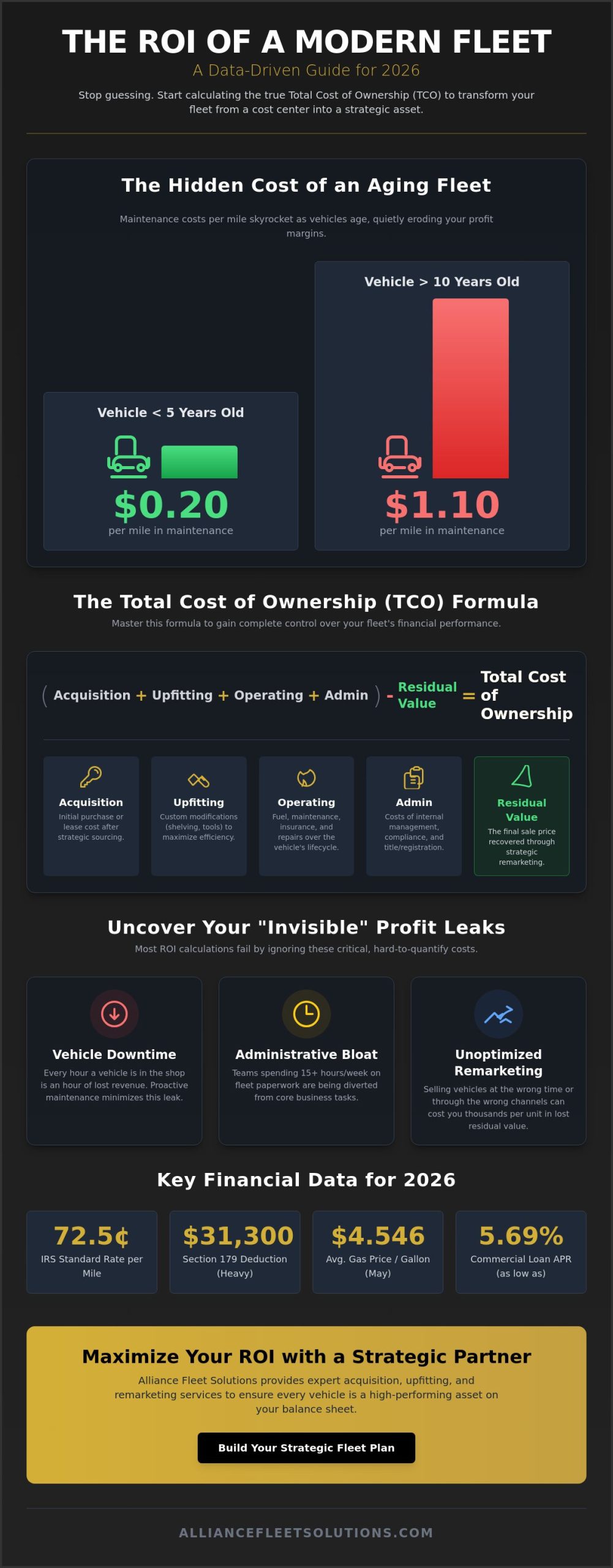
Did you know that operating a vehicle older than 10 years costs an average of $1.10 per mile in maintenance, while a vehicle under five years costs just $0.20? If your aging fleet is quietly eroding your margins through downtime and administrative bloat, you aren’t alone. Most fleet managers struggle to quantify the value of professional upfitting or predict resale values in a volatile market. You understand that a vehicle should be a strategic asset, yet it often feels like a bottomless cost center.
We’re here to change that dynamic by showing you exactly how to calculate fleet vehicle ROI using a data driven approach for 2026. By mastering the math behind Total Cost of Ownership (TCO) and lifecycle management, you can prove the real business value of every unit in your yard. This isn’t just about spreadsheets; it’s about building a professional alliance that optimizes your acquisition and remarketing strategies.
This guide provides a repeatable ROI formula that incorporates current 2026 realities, from the 72.5 cents per mile IRS standard rate to the $31,300 Section 179 deduction for heavy vehicles. We’ll preview how to lower your TCO and use hard data to determine when fractional management makes more sense than internal oversight. It’s time to stop guessing and start leading your fleet with technical authority and expert control.
Key Takeaways
- Master a comprehensive TCO formula that accounts for acquisition, professional upfitting, and administrative overhead to reveal your true operating costs.
- Identify and plug “invisible” profit leaks by quantifying the specific revenue lost during vehicle downtime and refining your end-of-life remarketing strategy.
- Learn exactly how to calculate fleet vehicle ROI by conducting a step-by-step audit of your current assets against 2026 baseline variables.
- Discover how fractional fleet management models can eliminate internal department bloat while ensuring every vehicle remains a strategic asset on your balance sheet.
Beyond the Spreadsheet: Redefining Fleet ROI in 2026
Fleet ROI is the measurable gain from your vehicle assets relative to their total lifecycle cost. It isn’t just a calculation; it’s a strategic pulse check for your entire operation. While many managers focus strictly on the initial sticker price, the true value lies in the spread between what you spend and what the asset produces over its lifetime. In 2026, the industry is shifting away from “tracking dots” on a map and toward managing asset equity. This means looking at your fleet as a revolving portfolio rather than a static expense. A basic Return on Investment (ROI) formula provides a starting point, but true optimization requires identifying hidden leaks like administrative bloat and unoptimized disposal strategies.
Strategic ROI optimization differs from simple cost-cutting. Cutting costs might mean delaying a mobile repair to save cash today, but that often leads to a $1.10 per mile maintenance bill on older units. Strategic optimization means spending $0.20 per mile on preventive maintenance for newer vehicles to ensure maximum uptime. This “Alliance” approach prioritizes the long-term health of the business over short-term savings. When you master how to calculate fleet vehicle ROI, you move from reacting to equipment failures to proactively managing high-value assets that drive revenue.
Hard ROI vs. Soft ROI: What Matters to Your CFO?
Hard ROI is built on concrete numbers that your CFO can verify. This includes fuel management, maintenance schedules, and acquisition costs. With regular gasoline averaging $4.546 per gallon in May 2026, even a 3% efficiency gain across 50 units represents significant capital. Soft ROI covers the variables that are harder to track but equally vital, such as driver safety, brand reputation, and administrative bandwidth. If your internal team spends 15 hours a week on title management and registration, that is a soft cost leak. Learning how to calculate fleet vehicle ROI involves quantifying these hours to justify fractional management solutions that free up your staff for higher-value tasks.
The Shift to Total Lifecycle Management
Focusing only on monthly lease payments is a trap that destroys long-term profitability. A low monthly payment on a vehicle that isn’t professionally upfitted for its specific role results in wasted labor hours and faster mechanical wear. Professional upfitting ensures the vehicle is a precision tool, not just a transport. By integrating comprehensive fleet management services, you protect the residual value of the asset from day one. This foresight ensures that when it’s time for remarketing, your vehicles command top dollar, directly boosting your final ROI figures.
The Total Cost of Ownership (TCO) Formula for Modern Fleets
To master how to calculate fleet vehicle ROI, you must first look beyond the purchase price and master the Total Cost of Ownership (TCO). The fundamental equation for modern fleet management is: (Acquisition + Upfitting + Operating + Admin) minus Residual Value. While most managers track fuel and repairs, they often overlook the residual value. This figure is the anchor of your ROI. If you don’t have a plan for strategic vehicle acquisition and eventual remarketing, you’re essentially guessing at your profit margins. A truck that sells for $5,000 more at the end of its life cycle directly improves your ROI by that same amount.
Your choice of leasing model also dictates the denominator of your ROI equation. Open-end leasing remains a favorite for commercial fleets in 2026 because it offers the flexibility to remarket vehicles when the market is strongest. Unlike closed-end leases that lock you into rigid terms, open-end structures allow you to manage the equity in your vehicles. This control is vital when commercial vehicle loan interest rates sit as low as 5.69% APR for top-tier credit. By managing the equity, you ensure the asset remains a tool for growth rather than a sinking cost.
Acquisition and Upfitting: The ROI Starts at Mile Zero
Strategic sourcing reduces your initial investment, which is the “I” in your ROI calculation. However, the real utility comes from professional upfitting. Custom shelving and mobile power solutions often pay for themselves within 18 months. They achieve this by reducing the time drivers spend searching for tools or parts. When a technician saves 15 minutes per stop through a better vehicle configuration, that efficiency translates directly into more billable hours. This “Utility ROI” ensures your vehicles are optimized for their specific mission from the very first mile.
Operational Variables: Fuel, Maintenance, and Telematics
Operational costs are the most volatile part of the TCO. With the national average price of regular gasoline at $4.546 per gallon as of May 2026, even small efficiency gains are significant. Implementing fuel management programs can help you target a 5% efficiency gain, which drastically lowers your per-mile cost. Maintenance also plays a critical role. Vehicles under five years old cost about $0.20 per mile to maintain, but that jumps to $1.10 per mile once they pass the 10-year mark. Prioritizing preventive maintenance over reactive repairs keeps your units in that lower cost bracket longer and protects your overall ROI.
The ‘Invisible’ Profit Leaks: Where Most ROI Calculations Fail
Even with a solid TCO formula, your balance sheet might still show red if you’re ignoring operational friction. Most managers treat a repair bill as an isolated expense. In reality, it’s just one piece of a larger puzzle. To truly understand how to calculate fleet vehicle ROI, you have to account for the revenue that isn’t being made while a driver sits in a waiting room. This is where the distinction between a mechanical “repair” and a strategic “fleet solution” becomes clear. One fixes a part; the other protects your margin.
Administrative bloat is another silent killer of profitability. Managing titles, registrations, and fuel cards for a fleet of 50 units can easily consume 20 hours of labor per week. When this work is handled by an internal team member whose primary role is elsewhere, the hidden cost is massive. Switching to fractional fleet management allows you to outsource these high-friction tasks to experts. This move doesn’t just cut costs; it reclaims administrative bandwidth that can be redirected toward core business growth, effectively turning a “cost of doing business” back into pure profit.
The True Cost of Vehicle Downtime
Downtime is the single greatest ROI killer in the logistics sector. To find the real impact on your bottom line, use this formula: (Driver Hourly Rate + Lost Opportunity Revenue) x Hours Offline. If a truck that generates $1,200 in daily revenue is down for two days, you haven’t just spent money on a fix; you’ve lost $2,400 in top-line growth plus the driver’s wages. By utilizing mobile repair and on-site capabilities, you eliminate the travel time to a shop and the multi-day wait for an open bay. This proactive shift is a core component of a Strategic Guide to Maintenance Management, ensuring your assets stay on the road where they belong.
Remarketing: Reclaiming Your Equity
Your ROI cycle isn’t complete until the vehicle is sold. Poor disposal strategies cost businesses thousands per unit every year. Professional, digitized maintenance records can boost a vehicle’s resale value by 10-15% because they provide buyers with verified proof of reliability. However, there’s a dangerous point of diminishing returns. Holding a vehicle past the point where maintenance costs spike-often reaching $1.10 per mile after 10 years-quickly erodes the equity you’ve built. Strategic vehicle remarketing ensures you exit the asset at the peak of its value, which is an integral part of how to calculate fleet vehicle ROI for any growing business.
Step-by-Step: How to Calculate Your Fleet ROI for 2026
Moving from high-level theory to execution requires a structured framework. To master how to calculate fleet vehicle ROI, you must follow a repeatable process that accounts for both historical data and future projections. This five-step method ensures your calculations remain grounded in the financial realities of 2026, such as the $4.546 national average for regular gasoline and rising insurance premiums that now average $1,764 annually per policy.
- Step 1: Audit your current TCO. Aggregate every expense for each unit, including the initial acquisition price, professional upfitting costs, and administrative labor. Subtract the projected residual value to find your baseline investment.
- Step 2: Identify ‘Baseline’ variables. Use current market data to set your expectations. Factor in the 2026 IRS business mileage rate of 72.5 cents per mile and maintenance costs that escalate from $0.20 to $1.10 per mile as vehicles age.
- Step 3: Project the ‘Intervention’ impact. Compare your current costs against a new strategy. For instance, calculate the savings of switching to fractional fleet management, which eliminates the need for a full-time internal fleet administrator.
- Step 4: Calculate the Net Present Value (NPV). Determine the value of your projected savings over the entire vehicle lifecycle, adjusted for the time value of money. This helps you understand the long-term impact of today’s capital expenditures.
- Step 5: Factor in the ‘Remarketing’ windfall. Add the final cash infusion from the sale of the asset. A well-maintained vehicle with a clean digital history often fetches 10% to 15% more than the market average.
By following these steps, you create a transparent financial roadmap. If you need help identifying these variables within your own operation, our team can help you implement fractional fleet management solutions to streamline the process.
Gathering Your Data: What You Need from Your Telematics
Telematics and GPS solutions provide the raw data necessary to prove your ROI. Focus on extracting specific metrics like idle time, fuel burn, and diagnostic trouble codes (DTCs). High idle times are direct profit leaks that are easy to quantify and fix. Furthermore, monitoring DTCs allows for predictive maintenance, catching a minor sensor issue before it turns into a $2,400 downtime event. This data creates an alliance between your digital insights and physical maintenance actions, ensuring your ROI calculations are based on reality rather than estimates.
Presenting the ROI to Stakeholders
When presenting how to calculate fleet vehicle ROI to your CFO or board, you must translate technical metrics into business outcomes. Don’t just talk about “miles per gallon”; talk about how a 5% fuel efficiency gain improves earnings per share. Use a “Cost of Doing Nothing” (CODN) analysis to show the financial risk of maintaining the status quo. If your current fleet is aging into the $1.10 per mile maintenance bracket, the CODN is the hundreds of thousands of dollars lost to preventable repairs and downtime over the next 12 months.
Maximizing ROI with Alliance Fleet Solutions
Alliance Fleet Solutions provides the strategic framework to turn your vehicles from mounting expenses into valuable equity. While previous sections detailed the technical math of how to calculate fleet vehicle ROI, the final step is execution. Our fractional fleet management model addresses the most common profit leak: administrative overhead. By outsourcing the management of your units, you eliminate the need for a full-time internal fleet department. This shift transforms a fixed salary expense into a flexible, scalable service that grows with your business requirements.
Professional upfitting acts as a force multiplier for your ROI. We design custom solutions that prioritize operational uptime, ensuring your drivers have exactly what they need at their fingertips. This optimization reduces on-site labor time, directly impacting your bottom line. Additionally, our open-end lease structures offer superior financial flexibility compared to rigid closed-end alternatives. You maintain control over the asset’s lifecycle, allowing you to remarket vehicles when the market conditions are most favorable. We don’t just fix trucks; we serve as the essential backbone of your functional fleet.
Why Partnership Beats Self-Management
Choosing an alliance over self-management gives you a distinct scale advantage. We leverage national buying power to streamline your vehicle acquisition, often securing terms that are unavailable to independent operators. This lower entry cost immediately improves the “I” in your ROI equation. Beyond the numbers, you reclaim vital internal bandwidth. Your team can focus on client acquisition and service delivery rather than the minutiae of fuel cards and registration renewals. For a deeper look at streamlining your daily workflow, consult our Efficient Fleet Operations Guide. We handle the technical depth so you can focus on high-stakes business decisions.
Getting Started with a Fleet ROI Audit
The path to a more profitable fleet begins with a clear understanding of your current data. During an initial consultation, we perform a comprehensive audit of your existing TCO and operational habits. We identify the specific points where downtime or poor disposal strategies are costing you money. From there, we build a “Lifecycle Roadmap” tailored to your specific industry needs, whether you’re managing heavy-duty trucks or light delivery vans. This roadmap provides the data needed to support how to calculate fleet vehicle ROI with precision and confidence. Schedule your fleet ROI audit with Alliance Fleet Solutions today to start optimizing your business assets for 2026 and beyond.
Transforming Your Fleet into a Strategic Business Asset
Navigating the complexities of 2026 requires more than just tracking expenses; it demands a shift toward active equity management. You’ve learned that mastering how to calculate fleet vehicle ROI means auditing every variable from initial acquisition to final remarketing. By identifying invisible profit leaks like downtime and administrative bloat, you position your business to thrive in a high stakes logistics environment. A well-maintained vehicle isn’t just a tool; it’s a revolving portfolio piece that supports your long term bottom line.
Alliance Fleet Solutions provides the technical authority and mobile repair support to ensure your assets remain on the road. Our fractional management model often reduces administrative overhead by up to 30%, allowing your team to focus on growth while we handle the mechanics of optimization. With professional upfitting tailored for maximum uptime and a national reach, we act as the backbone of your daily operations. It’s time to move past reactive repairs and embrace a proactive lifecycle strategy. Maximize your fleet’s ROI with a custom Alliance strategy today and build the reliable foundation your business deserves.
Frequently Asked Questions
What is the most accurate formula for fleet ROI?
The most accurate formula for 2026 is (Total Revenue Generated – TCO) / TCO. To use this effectively, you must understand how to calculate fleet vehicle ROI by including every hidden cost in the TCO denominator. This includes the initial purchase, professional upfitting, and administrative labor, minus the final remarketing value. Tracking these variables ensures your ROI reflects actual business impact rather than just fuel savings.
How much can I realistically save by outsourcing fleet management?
Businesses typically reduce administrative overhead by up to 30% through fractional fleet management. This saving stems from eliminating full-time salaries and leveraging the national buying power of a dedicated partner. By outsourcing tasks like registration and fuel management, your internal team reclaims roughly 20 hours of bandwidth per week to focus on core operations. This shift directly improves your operational margin without increasing your headcount.
Does professional upfitting actually increase a vehicle’s resale value?
Professional upfitting increases resale value by 10% to 15% when documented with detailed maintenance records. Buyers in the secondary market prioritize vehicles that are mission-ready and structurally sound. Custom shelving and power solutions also protect the interior from excessive wear and tear. This preservation of the asset’s condition ensures you capture a higher residual value, which is a critical component of how to calculate fleet vehicle ROI.
What is the difference between ROI and TCO in fleet management?
Total Cost of Ownership (TCO) measures the cumulative expense of an asset from acquisition to disposal. Return on Investment (ROI) measures the efficiency of that spending by comparing the net profit against the total costs. While TCO helps you budget for maintenance and fuel, ROI tells you if the vehicle is actually contributing to your bottom line. You need both metrics to make informed decisions about lifecycle management.
How do telematics solutions contribute to a positive ROI?
Telematics solutions contribute to ROI by reducing fuel burn and enabling predictive maintenance. A 5% gain in fuel efficiency is common when drivers reduce idle time, which is vital with gasoline prices at $4.546 per gallon. Diagnostic trouble codes allow you to fix minor issues before they become $2,400 downtime events. These incremental gains across a fleet result in substantial annual savings that far exceed the cost of the hardware.
When is the best time in a vehicle’s lifecycle to calculate its ROI?
You should calculate ROI annually, but the most critical windows occur at the five-year and 10-year marks. Maintenance costs typically sit at $0.20 per mile for the first five years before escalating toward $1.10 per mile after a decade. Performing a deep audit at these intervals helps you identify the point of diminishing returns. This data tells you exactly when to remarket the asset to protect your equity.
Can small fleets (under 10 vehicles) see a significant ROI from managed services?
Small fleets see a significant ROI by reclaiming administrative bandwidth that usually falls on the business owner. In a ten-vehicle operation, managing compliance and repairs can easily consume 15 hours of weekly labor. Fractional management allows these owners to redirect that time toward client acquisition and billable services. Even for small operators, the scale advantage of a professional alliance reduces the unit cost of acquisition and maintenance.
How do I calculate the ROI of a mobile maintenance program?
Calculate the ROI of mobile maintenance by using the formula (Revenue Protected + Driver Wages Saved) / Cost of Service. If a vehicle generates $1,200 in daily revenue, every hour it stays on the road instead of in a shop bay adds directly to your profit. Eliminating the travel time to a traditional shop and the wait for an open bay ensures your fleet maintains maximum uptime. This proactive approach turns maintenance from a cost into a revenue protector.