
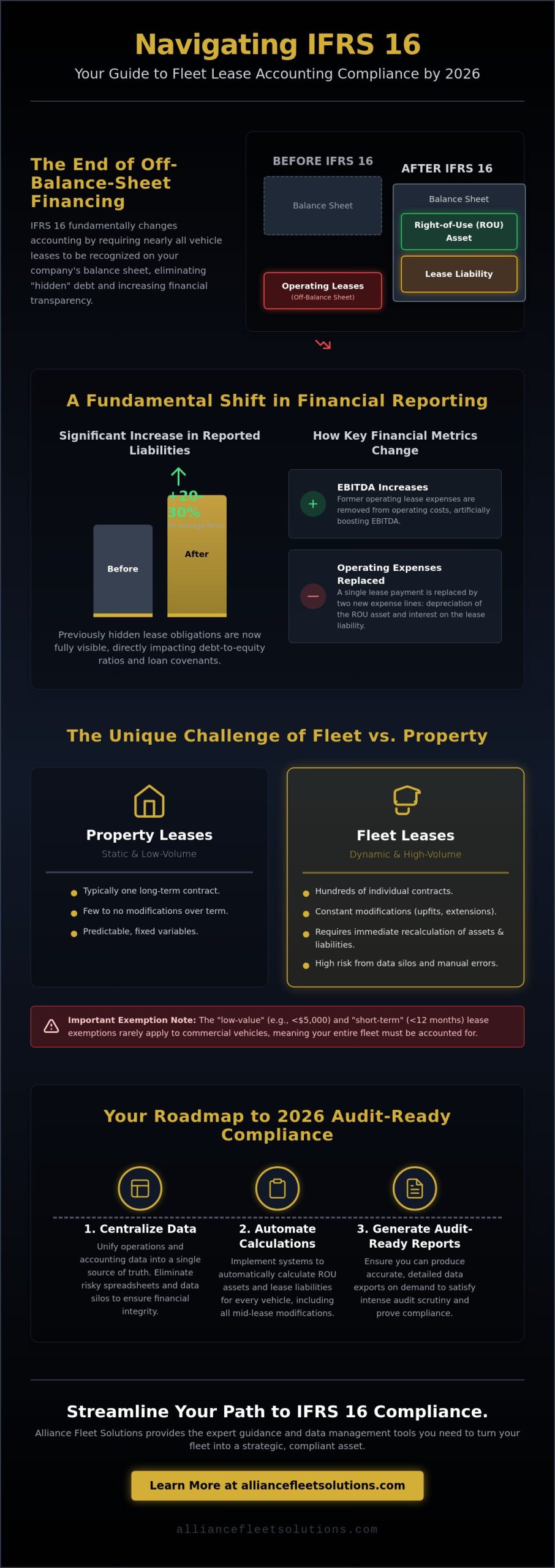
Did you know that the alignment of accounting standards like FRS 102 with international rules is expected to increase reported liabilities for the average company by 20% to 30%? For fleet managers, this isn’t just a change in paperwork; it’s a fundamental shift in how your company’s financial health is perceived. You likely already feel the weight of the administrative burden as you track every upfit and lease extension across your entire fleet. Understanding the impact of IFRS 16 on fleet lease accounting is no longer optional if you want to protect your debt-to-equity ratios and maintain a clean balance sheet.
At Alliance Fleet Solutions, we believe your fleet should be a strategic asset, not a financial liability. We’ll help you master these complexities and leverage strategic lease structures to protect your business efficiency. This guide explains how to automate data collection for audits and optimize your total cost of ownership under the 2026 standards. You’ll learn how to transform your fleet from an operational cost center into a streamlined, compliant, and high-performing component of your business strategy.
Key Takeaways
- Understand how IFRS 16 eliminates off-balance sheet financing by requiring nearly all vehicle leases to be recognized as both assets and liabilities.
- Learn why the high volume of vehicle data makes fleet accounting more complex than property leasing and how to manage these dynamic timelines.
- Discover the specific impact of IFRS 16 on fleet lease accounting regarding your EBITDA and the shift from operating expenses to depreciation.
- Compare the strategic advantages of open-end versus closed-end leasing to determine which model simplifies your Right-of-Use calculations.
- See how audit-ready data exports and expert guidance from Alliance Fleet Solutions can streamline your path to 2026 compliance.
What is IFRS 16 and Its Core Impact on Fleet Leasing?
The primary goal of the current accounting landscape is transparency. If you’re wondering What is IFRS 16?, it’s the standard that effectively ended “off-balance sheet” financing for commercial vehicle fleets. By May 2026, this regulation has moved past the initial implementation phase and into a period of intense audit scrutiny. The impact of IFRS 16 on fleet lease accounting means that virtually every vehicle lease must now appear on your balance sheet as both an asset and a liability. This change ensures that stakeholders see a complete picture of a company’s financial obligations, leaving no room for hidden debt.
Previously, many businesses treated vehicle leases as simple operating expenses. This kept large-scale fleet costs off the main financial statements, which often painted an incomplete picture of total debt. Under the 2026 standards, including the significant FRS 102 amendments for UK and Ireland entities, this distinction has vanished. Research indicates that companies implementing these rules typically see total liabilities increase by 5% to 9%. You aren’t just paying for a service anymore; you’re managing a complex financial instrument.
The Right-of-Use (ROU) Asset Explained
When you sign a lease, you gain the “right to use” that vehicle. This right is now quantified as a tangible asset on your financial statements. To calculate the initial value, you’ll combine the present value of lease payments with any initial direct costs, such as professional upfitting. For a 48-month commercial truck lease, the ROU asset represents your contractual right to operate that specific vehicle for the full four-year term, recorded as a non-current asset on your balance sheet. This valuation must be updated whenever you modify a lease or extend its term.
Lease Liabilities and the Impact on Debt Ratios
On the other side of the ledger, you must recognize a lease liability. This represents the present value of all future payments you’re obligated to make. Because these liabilities are now fully visible, they directly influence your debt-to-equity ratio. The transition to these models is expected to increase reported liabilities by 20% to 30% for the average firm. Fleet managers need to work closely with finance teams or advisory partners like SA Unlimited to ensure these shifts don’t breach existing loan covenants. It’s a high-stakes environment where the impact of IFRS 16 on fleet lease accounting can change your company’s creditworthiness overnight.
The Volume Challenge: Why Fleet Accounting Differs from Property
Property leases are typically static. A corporate office lease might last 10 years with zero changes. Fleet leases are the polar opposite. They’re high-volume and constantly shifting. If you manage 200 vehicles, you aren’t managing one lease; you’re managing 200 individual contracts with unique start dates, depreciation schedules, and end-of-term options. This complexity is where the impact of IFRS 16 on fleet lease accounting becomes a significant administrative hurdle for your finance team. You’re no longer just tracking a monthly bill; you’re managing a massive data set that requires constant updates.
Data silos represent a major risk for your business. If your operations team tracks vehicle delivery in one system while accounting uses another, your financial statements won’t reflect reality. Relying on manual spreadsheets is the fastest way to trigger audit red flags in 2026. Errors in a single cell can cascade across your entire balance sheet, leading to material misstatements. You need a single source of truth to ensure compliance and maintain your company’s financial integrity. The shift toward the FRS 102 amendments on January 1, 2026, makes this coordination even more vital for UK and Ireland entities.
Handling Lease Modifications and Upfitting
Commercial fleets rarely stay static. You might add professional upfitting mid-lease to improve utility, or you might extend a contract because of vehicle delivery delays. Each change is a “lease modification” under IFRS 16. This requires you to recalculate the ROU asset and lease liability immediately. Without centralized fleet management data, these adjustments are nearly impossible to track accurately across hundreds of assets. Your accounting team needs to know the exact date and cost of every modification to keep your books audit-ready.
The “Low-Value” and “Short-Term” Exemptions
The standard allows exemptions for certain assets to simplify reporting. While some firms use an internal $5,000 threshold for office equipment, the IASB specifically states that vehicles don’t qualify for the “low-value” exemption regardless of their cost. You can use the short-term exemption for leases under 12 months to keep them off the balance sheet. While this seems like an easy fix, it’s rarely the most cost-effective operational strategy. Constant turnover increases procurement costs, reduces your ability to customize vehicles, and ultimately disrupts your fleet uptime.
Financial Metrics: How IFRS 16 Changes Your Fleet ROI
The impact of IFRS 16 on fleet lease accounting isn’t just a technical ledger entry. It’s a fundamental change in how your fleet’s Return on Investment (ROI) is measured. Traditionally, fleet leases were categorized as operating expenses (OpEx). Now, they function like capital expenditures (CapEx). You’ll see your lease payments split into two distinct parts: depreciation of the Right-of-Use asset and interest on the lease liability. This shift typically leads to a higher reported EBITDA. While your cash flow remains the same, your profitability on paper might appear stronger because the rent expense is removed from the operating cost line.
This newfound transparency changes the Lease vs. Buy debate. Since both options now reside on the balance sheet, the decision rests on operational efficiency and cash management rather than accounting optics. You can now more easily identify underutilized assets. When a vehicle sits idle, it’s no longer just a hidden cost in a monthly bill; it’s a depreciating asset and a growing liability clearly visible on your financial statements. This visibility allows you to make data-driven decisions about fleet size and vehicle utilization that were previously obscured by off-balance sheet reporting.
Depreciation vs. Lease Payments
Under IFRS 16, you’ll likely notice a front-loaded expense pattern. Interest costs are higher in the early years of a lease, similar to a mortgage. This means your profit and loss statement might take a harder hit when you first refresh your fleet. Managing these cycles requires a proactive approach to avoid volatility in your annual reports. For a deeper look at how to align these financial shifts with your operational goals, see our 2026 Strategic Guide for Business Growth. This guide helps you navigate the timing of fleet refreshes to maintain steady financial performance.
Total Cost of Ownership (TCO) in the IFRS 16 Era
Your TCO model must evolve beyond the simple monthly payment. You have to account for the administrative costs of compliance and the complexities of professional upfitting. Adding specialized equipment to a truck mid-lease triggers a revaluation of the ROU asset, a detail many businesses overlook. This complexity is why the impact of IFRS 16 on fleet lease accounting requires sophisticated data management. By integrating vehicle remarketing data, you can more accurately project residual values. This allows you to adjust your ROU assets in real-time, ensuring your balance sheet reflects the true market value of your fleet assets.
Strategic Lease Selection: Open-End vs. Closed-End under IFRS 16
Your choice of lease structure now dictates the complexity of your financial reporting. Before the 2026 standards, many managers chose lease types based solely on cash flow or residual value risk. Today, the impact of IFRS 16 on fleet lease accounting means that the structure of your contract directly determines how much data your accounting team must track. Open-end and closed-end models offer different advantages, but they require very different approaches to Right-of-Use (ROU) asset calculations and liability estimates.
Terminal Rental Adjustment Clause (TRAC) leases, a staple of open-end leasing, present a unique reporting challenge. While they offer the best tax advantages and lower monthly costs for heavy-duty vehicles, they often feature flexible terms. IFRS 16 requires you to record a liability based on the “reasonably certain” lease term. If you typically keep a tractor-trailer for 60 months despite a 12-month minimum contract, your auditors will expect you to account for the full five-year period. This adds a layer of estimation that isn’t present in simpler fixed-term agreements.
The Flexibility of Open-End Leases
Open-end leasing remains the backbone of the heavy-duty trucking industry because it places the residual value risk on the lessee. This allows for lower monthly payments and the ability to cycle out vehicles exactly when it’s most profitable. However, from an accounting perspective, you must constantly evaluate your “reasonably certain” end dates. If market conditions change and you decide to extend your fleet’s lifecycle by 12 months, you’ve triggered a lease modification. This requires an immediate recalculation of your balance sheet liabilities, making high-quality data management essential for compliance.
Predictability with Closed-End Models
Closed-end leasing simplifies the audit process by providing a fixed end date and a set payment schedule. There’s no residual value risk to calculate, and the ROU asset remains stable throughout the life of the lease. This predictability reduces the administrative overhead for your accounting department, which can be a major priority for businesses with high-volume fleets. When you prioritize Efficient Fleet Operations, a closed-end model can sometimes offer a “set it and forget it” accounting advantage that balances out the slightly higher monthly cost.
Choosing the right structure requires a balance between operational flexibility and financial reporting simplicity. If you’re unsure which model best protects your debt-to-equity ratios, we can help. Contact Alliance Fleet Solutions today to evaluate your current lease structures and ensure they’re optimized for 2026 compliance.
How Alliance Fleet Solutions Simplifies IFRS 16 Compliance
Compliance doesn’t have to be an administrative burden. We provide audit-ready data exports that plug directly into your ERP system, eliminating the risk of manual entry errors that often lead to non-compliance. This level of precision ensures the impact of IFRS 16 on fleet lease accounting is managed smoothly across your entire organization. Our fractional fleet management services handle the heavy lifting of high-volume reporting, allowing your team to focus on core operations while we maintain the integrity of your balance sheet through 2026 and beyond.
We offer expert guidance on selecting lease structures that align with your specific financial goals. Whether your business requires the flexibility of open-end leasing for heavy-duty trucks or the predictability of closed-end models for light-duty vehicles, we help you understand the long-term accounting implications. By integrating maintenance and fuel data, we provide a holistic view of asset value. This transparency allows you to justify lease modifications to auditors with concrete data rather than estimates.
Data Integrity and Telematics Integration
Telematics data is now a critical audit tool. We use telematics to prove actual vehicle usage, which helps validate your “reasonably certain” lease term estimates for auditors. Alliance also ensures that every dollar spent on professional upfitting is accurately captured and added to the ROU asset value from day one. This integration prevents the data silos that typically lead to undervalued assets. For a deeper look at how data drives efficiency, read our Strategic Guide to Maintenance Management. We ensure your operational data and financial reporting work in perfect synergy.
Your Alliance: Partnering for Financial and Operational Success
We move beyond the traditional vendor relationship to create a strategic alliance that protects your balance sheet. Our customized reporting satisfies the technical requirements of the CFO while giving the fleet manager the operational insights needed to maximize uptime. We speak the language of business efficiency and ROI, ensuring your fleet remains a functional backbone for your company. It’s about providing expert control in a high-stakes regulatory environment.
Don’t let the complexity of new accounting standards disrupt your momentum. You need a partner who understands the mechanics of the logistics industry and the nuances of international financial reporting. Take the first step toward a cleaner balance sheet today. Request a comprehensive fleet lease audit from Alliance Fleet Solutions to assess your IFRS 16 readiness and optimize your fleet’s financial performance for 2026.
Secure Your Fleet’s Financial Future and Compliance
The transition to new reporting standards isn’t just an accounting hurdle; it’s an opportunity to refine your fleet’s operational efficiency. By now, it’s clear that managing the impact of IFRS 16 on fleet lease accounting demands more than just spreadsheets. You must navigate the 20% to 30% increase in reported liabilities expected for most firms while maintaining accurate records for every upfitted vehicle in your lineup. Whether you utilize the flexibility of open-end TRAC leases or the predictability of closed-end models, your data must be audit-ready by the January 1, 2026, deadline for FRS 102 alignment.
Alliance Fleet Solutions provides the technical authority and partnership you need to stay ahead. We offer comprehensive data reporting that plugs directly into your financial systems, ensuring every specialized upfitting cost is accounted for correctly. Our team brings deep expertise in both open-end and closed-end leasing structures to help you protect your debt-to-equity ratios. Don’t let regulatory shifts slow your momentum. Partner with Alliance Fleet Solutions for audit-ready leasing and management. We’ll handle the complexities so you can focus on keeping your fleet moving safely and efficiently.
Frequently Asked Questions
Does IFRS 16 apply to all commercial vehicle leases?
Yes, IFRS 16 applies to nearly all commercial vehicle leases. The only exceptions are leases with a term of 12 months or less that don’t include a purchase option. For most logistics and service fleets, this means every truck and van must now appear on the balance sheet. This change ensures full transparency for stakeholders by revealing the true scale of a company’s financial commitments.
What is the difference between an operating lease and a finance lease under IFRS 16?
For lessees, the traditional distinction between operating and finance leases has been eliminated. Under the new standard, both lease types are treated similarly and recognized as Right-of-Use (ROU) assets and lease liabilities. This represents a major shift from previous standards where operating leases were kept off the balance sheet as simple rental expenses, often obscuring a company’s true debt levels.
How does IFRS 16 affect my company’s EBITDA?
Your reported EBITDA will typically increase because of how expenses are now categorized. The impact of IFRS 16 on fleet lease accounting moves lease costs from the operating expense line to depreciation and interest. While your actual cash flow doesn’t change, your paper profitability looks higher because rent is no longer deducted before calculating EBITDA. This can significantly affect your financial analysis and debt covenants.
Can I still use off-balance sheet financing for my fleet?
Off-balance sheet financing is now restricted to very specific and narrow scenarios. You can only keep leases off the balance sheet if they’re shorter than 12 months or involve low-value assets. Since vehicles are explicitly excluded from the low-value exemption by the IASB, most companies find that maintaining off-balance sheet status for a functional fleet is operationally impractical and more expensive in the long run.
How do I handle vehicle upfitting costs under IFRS 16?
You must capitalize professional upfitting costs as part of the Right-of-Use asset’s initial value. If you add equipment mid-lease, it’s considered a lease modification. This requires your accounting team to recalculate the asset value and liability immediately. Accurate tracking of these costs is essential to avoid audit discrepancies and ensure your financial statements reflect the vehicle’s true utility and investment value.
Is there an exemption for low-value fleet assets?
No, there is no low-value exemption for vehicles under this standard. While IFRS 16 allows companies to expense assets worth roughly $5,000 or less, the IASB has clarified that cars and trucks don’t qualify for this treatment regardless of their cost. Every vehicle in your fleet must be accounted for as a capitalized asset to comply with the 2026 audit requirements and FRS 102 alignment.
How does an open-end lease work with IFRS 16 reporting?
Open-end leases require you to determine a “reasonably certain” lease term for reporting. Even if your contract allows for month-to-month flexibility after the initial term, you must record the liability based on your actual intended usage. If your historical data shows you keep trucks for 60 months, auditors will expect your lease liability to reflect that five-year commitment rather than just the minimum contract term.
What data do I need from my fleet provider to be audit-ready?
To remain audit-ready, you need precise data exports that include lease start dates, incremental borrowing rates, and detailed payment schedules. Your provider should also supply documentation for initial direct costs and any modifications made during the year. Having this data ready to plug into your ERP system is the only way to manage the high volume of a modern commercial fleet without triggering compliance errors.