
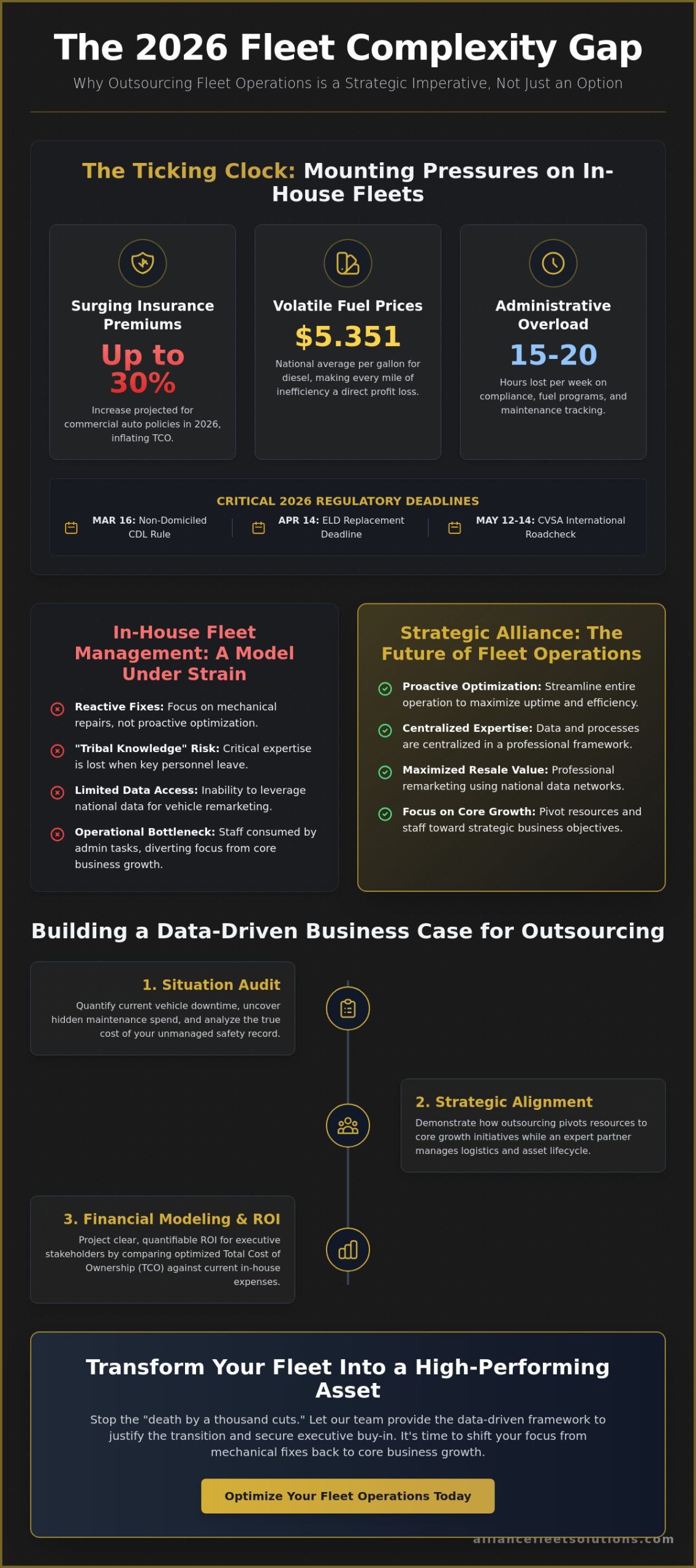
With commercial auto insurance premiums surging by up to 30% in 2026 and diesel prices holding at a national average of $5.351 per gallon, is your internal fleet operation still an asset, or has it become a liability? Many organizations find that the administrative “death by a thousand cuts” from maintenance tracking and new regulations, such as the March 16, 2026, non-domiciled CDL rule, has overwhelmed their internal staff. Leveraging a professional business case template for outsourcing fleet operations is no longer just an administrative task; it’s a strategic move to protect your bottom line and ensure long term scalability.
You likely recognize that your team lacks the specialized expertise to manage rising total cost of ownership while keeping up with events like the May 12-14 CVSA Roadcheck. We promise to provide you with a comprehensive, data-driven framework to justify an operational transition and secure the executive buy-in you need. This guide previews a clear path to ROI, explores how to navigate the post-incentive EV landscape, and demonstrates how fractional fleet management can transform your vehicles into a high performing business asset. We’ll show you exactly how to shift your focus from mechanical fixes back to your core business growth.
Key Takeaways
- Understand how to bridge the 2026 complexity gap by viewing fleet outsourcing as a strategic partnership rather than a simple vendor transaction.
- Utilize a professional business case template for outsourcing fleet operations to quantify operational bottlenecks and project clear ROI for executive stakeholders.
- Discover the financial advantages of professional vehicle acquisition and how to choose between open-end and closed-end leasing structures.
- Master a two-phase implementation strategy that focuses on precise data collection and aligning internal finance and operations teams.
- Identify the key qualities of a fleet partner that acts as a supportive extension of your team through national maintenance and telematics solutions.
The Strategic Drivers: Why Outsource Fleet Operations in 2026?
In 2026, fleet operations have moved far beyond simple vehicle maintenance. Successful organizations now view fleet management as a strategic partnership rather than a basic vendor transaction. This shift is driven by the 2026 “Complexity Gap,” where the rapid integration of telematics, the expiration of federal EV purchase credits, and tightening regulatory standards create a barrier for internal teams. When your staff spends hours managing fuel programs or tracking the April 14, 2026 ELD replacement deadline, they aren’t focusing on your core business strategy. Using a business case template for outsourcing fleet operations helps leadership see that an integrated alliance model provides the technical authority needed to navigate these high stakes.
Professional Fleet Management ensures your company isn’t just reacting to equipment failure but proactively optimizing every asset. While a transactional vendor might just fix a truck, a strategic partner streamlines your entire operation to maximize uptime. This level of expert control is essential as diesel prices remain high at $5.351 per gallon, making every mile of inefficiency a direct hit to your profitability. This approach moves you away from mechanical fixes toward comprehensive fleet solutions that act as a backbone for your growth.
The Burden of In-House Fleet Administration
Internal fleet management often suffers from “death by a thousand cuts.” Administrative staff frequently lose 15 to 20 hours per week managing fuel programs or ensuring compliance with the 50% random drug testing rate required for 2026. Maintaining technical expertise is difficult when the vehicle market evolves so quickly. If your fleet manager leaves, they often take “tribal knowledge” with them, leaving your logistics backbone vulnerable. Transitioning to a managed model eliminates this risk by centralizing data and processes within a professional framework that can withstand the scrutiny of the May 12-14, 2026 International Roadcheck.
Market Volatility and Vehicle Lifecycle Management
Vehicle values and disposal costs fluctuate wildly in the current market. Professional vehicle remarketing maximizes your resale value by using national data networks that internal teams can’t access. Similarly, professional upfitting ensures that every vehicle is built for maximum utility from day one, which reduces long term repair costs and improves driver safety. Total Cost of Ownership (TCO) is the primary metric for 2026 fleet success, encompassing every expense from acquisition and fuel to insurance premiums that have risen by up to 30%.
Core Components of a Professional Fleet Outsourcing Business Case
Building a persuasive business case template for outsourcing fleet operations requires more than a simple cost comparison. You must frame the current in-house model as a financial and operational bottleneck that prevents your company from scaling. Start with a Situation Audit that quantifies current vehicle downtime and identifies hidden maintenance spend. For instance, with commercial auto insurance premiums rising by up to 30% in 2026, an unmanaged safety record can inflate your monthly costs to over $2,500 per heavy-duty truck. This audit reveals the true cost of staying the course while highlighting the specialized expertise needed to manage these rising expenses.
Strategic alignment is the next pillar of your framework. Your proposal should demonstrate how outsourcing allows the organization to pivot resources toward core growth while maintaining expert control over logistics. When defining the scope of services, look to established benchmarks like GSA Fleet Management Solutions to structure your maintenance, fuel, and leasing programs. Integrating these functions into a single alliance model ensures that vehicle acquisition and remarketing aren’t just isolated transactions, but part of a continuous lifecycle strategy. If you’re ready to see how these pieces fit your specific needs, our team can help you optimize your fleet operations through a tailored management plan.
Financial Analysis and ROI Projections
A professional business case contrasts direct lease payments with the heavy burden of indirect administrative overhead. While a monthly lease is a visible line item, the cost of internal staff managing a 50% random drug testing rate or tracking the 2026 International Roadcheck is often buried. Your ROI projections should cover a 3-5 year horizon to show the cumulative effect of fleet optimization. Don’t overlook soft savings; reducing the risk of nuclear verdicts, which have added $30 billion to commercial auto claims since 2012, provides a massive return on investment through lower liability and improved driver safety.
Risk Assessment and Mitigation
The most common objection to outsourcing is the perceived loss of control. You can mitigate this by emphasizing the role of telematics and real-time reporting. Modern GPS solutions provide more transparency than most in-house spreadsheets ever could. Additionally, highlight the compliance risks of an in-house model. With the March 16, 2026, non-domiciled CDL rule and strict medical certification requirements, an expert partner ensures you stay ahead of federal mandates. A fractional fleet management approach allows you to transition gradually, reducing operational friction while immediately improving your compliance standing.
Financial Modeling: Comparing In-House Costs vs. Outsourced Efficiency
A primary hurdle in any business case template for outsourcing fleet operations is proving that a partner’s scale outperforms internal purchasing power. Most in-house operations pay retail or near-retail prices for parts, labor, and new units. Professional vehicle acquisition leverages a massive volume advantage that significantly lowers the initial capitalized cost. Unlike traditional models that force an all-or-nothing choice, fractional fleet management offers a scalable middle ground. This allows your business to access high level expertise and national pricing tiers without committing to a full scale operational overhaul. It’s a strategic way to bridge the gap between your current capacity and your 2026 growth targets.
Beyond acquisition, professional upfitting ensures that your vehicles are equipped with industry specific shelving, safety gear, and telematics from day one. This prevents the premature wear and tear that occurs when generic vehicles are pushed beyond their design limits. By implementing a centralized maintenance management strategy, companies can slash emergency repair costs that often plague unmanaged fleets. This proactive approach ensures that your drivers stay on the road rather than waiting in repair shop lobbies, directly protecting your revenue streams.
The Impact of Professional Maintenance and Fuel Programs
Professional maintenance programs provide access to nationwide networks with pre-negotiated labor rates and parts discounts. These savings are quantifiable and immediate. With diesel prices averaging $5.351 per gallon in April 2026, fuel management programs have become an essential tool for fraud prevention and consumption tracking. These programs eliminate the “administrative leakage” of lost receipts and unauthorized spending. Integrated telematics data justifies the cost of outsourcing by maximizing uptime, ensuring that every asset in your alliance is performing at peak efficiency.
Leasing Structures as a Capital Strategy
Choosing the right leasing model is a critical component of your capital strategy. Open-end leasing offers maximum flexibility for commercial fleets, providing cash flow benefits that traditional financing cannot match. Mastering Effective Fleet Management Practices requires a deep understanding of how these capital structures influence operational agility. Professional vehicle remarketing then acts as a back-end ROI booster, ensuring you capture the highest possible residual value at the end of the lifecycle. In a 2026 market where commercial auto insurance has risen by up to 30%, these optimized leasing and remarketing cycles are vital for maintaining a healthy bottom line.
Step-by-Step Implementation: Using the Business Case Template
Turning a strategic concept into an operational reality requires a structured roadmap. Your business case template for outsourcing fleet operations should begin with a Phase 1 data collection period covering at least 12 months of maintenance, fuel, and lease data. This historical baseline is crucial for benchmarking against current 2026 market volatility, such as the $5.351 per gallon diesel average. Phase 2 involves deep-dive stakeholder interviews to identify specific friction points. While the finance team might worry about the 10% to 30% rise in commercial insurance premiums, your operations director is likely more concerned with vehicle downtime and the administrative burden of the March 16, 2026 CDL rules.
Phase 3 focuses on service mapping. You must decide if your organization needs fractional fleet management to supplement internal staff or a full-service transition that handles everything from vehicle acquisition to remarketing. Finally, Phase 4 is the presentation phase. You’ll need to tailor your pitch; the CFO requires a hard ROI projection and cash flow analysis, while the Operations Director needs to see how an alliance model ensures 100% compliance with FMCSA random testing rates. This phased approach transforms a generic request into a professional, data-backed strategic proposal that addresses high-stakes business needs.
Gathering the Right Metrics
To build a winning case, you must look beyond the surface of monthly invoices. Focus on these essential KPIs to quantify the “Complexity Gap” in your current model:
- Cost per mile: Include fuel, maintenance, and insurance.
- Vehicle downtime days: Track the revenue lost when a truck is out of service.
- Fuel slippage: Identify discrepancies between miles driven and fuel purchased.
Use these metrics to audit current efficient fleet operations and uncover “hidden” costs buried in departmental budgets, such as the labor hours staff spend on manual ELD compliance. Uncovering these leaks is the first step toward uptime maximization. If you’re ready to stop the administrative drain, you can start building your custom fleet strategy with our expert team today.
Drafting the Proposal
When you begin writing, use action-oriented language that mirrors the urgency of the logistics industry. Instead of saying you want to “fix trucks,” state that the goal is to “maximize uptime through preventive maintenance.” This shift in vocabulary elevates the conversation from mechanical repair to strategic business asset management. Utilize visual aids like ROI charts and lifecycle cost graphs to show the 3-5 year cumulative savings. Finally, set clear 30-60-90 day transition milestones. This reassures leadership that the shift to an outsourced model will be steady, logical, and handled with expert control, minimizing any risk of operational equipment failure during the handoff.
Choosing Your Alliance: Transitioning to Managed Fleet Solutions
Selecting the right partner to execute your business case template for outsourcing fleet operations is the final step in securing your company’s operational future. This isn’t about replacing your internal team; it’s about empowering them. The right partner acts as a supportive extension of your staff, providing the technical authority and national reach that individual departments often lack. Whether you’re navigating the $5.351 per gallon diesel market or preparing for the May 12-14, 2026 International Roadcheck, a strategic alliance ensures you have expert control over every asset. This relationship moves your organization away from the stress of equipment failure and toward a model of steady, logical progress.
National coverage is a non-negotiable requirement for maintenance and acquisition. It ensures that your preventive maintenance schedule stays on track regardless of your vehicles’ geographic locations. This also ensures that professional upfitting is handled by experts who understand 2026 safety standards and specialized cargo securement rules. By utilizing a fleet management service, you transition from reactive repairs to a proactive lifecycle strategy that streamlines your entire logistics backbone. You gain access to a seasoned expert who speaks the language of business efficiency and return on investment.
The Alliance Fleet Solutions Difference
Our fractional fleet management model is designed for businesses that need specialized expertise without a total operational overhaul. This partnership-driven approach focuses on vehicle lifecycle management, from the first acquisition to the final remarketing. We don’t just provide a service; we provide a functional fleet that mirrors your business’s commitment to excellence. Our mobile and on-site capabilities distinguish us from traditional shops, offering a signature promise of uptime maximization. We encourage a direct consultation to help you tailor your business case template for outsourcing fleet operations to your specific vehicle count and operational goals.
Next Steps: From Business Case to Reality
Transitioning from a plan to a functional reality starts with a comprehensive fleet audit. This process identifies immediate opportunities for cost savings and identifies the “administrative leakage” discussed in previous sections. Your 2026 goal is clear: you need a fleet that drives revenue rather than draining resources. By shifting the burden of administration and maintenance to a seasoned partner, you reclaim the internal capacity needed for core business growth. Contact Alliance Fleet Solutions to build your custom fleet strategy and take the first step toward a more reliable, efficient operation today.
Secure Your Operational Advantage for 2026
Transitioning to managed fleet solutions is a vital step for organizations aiming to thrive despite 2026 market volatility. By utilizing a business case template for outsourcing fleet operations, you provide leadership with the concrete data needed to move beyond administrative bottlenecks and rising insurance premiums. You’ve seen how specialized expertise in vehicle upfitting and lifecycle management transforms your fleet from a cost center into a high performing business asset. Alliance Fleet Solutions provides national reach with localized service reliability, ensuring your trucks stay on the road while you focus on core growth.
Whether you require a full operational shift or one of our flexible fractional management models tailored to your specific needs, you gain a partner dedicated to your long term success. Ready to build your business case? Download our strategic fleet audit guide or contact an Alliance expert today. Your path to a more efficient, dependable operation is ready whenever you are.
Frequently Asked Questions
How do I calculate the ROI of outsourcing fleet operations?
ROI is calculated by subtracting the total cost of the outsourcing partnership from the combined sum of current maintenance spend, administrative labor hours, and downtime losses. Using a professional business case template for outsourcing fleet operations allows you to visualize these savings over a 36 to 60 month lifecycle. You must include “soft” savings like reduced liability from professionally managed safety programs to get an accurate figure that satisfies executive stakeholders.
What are the most common mistakes in a fleet management business case?
The most common mistake is focusing exclusively on monthly lease payments while ignoring the total cost of ownership. Many proposals fail to quantify the 15 to 20 hours per week staff spend on fuel tracking or regulatory compliance. Overlooking the impact of rising insurance premiums, which increased by up to 30% in late 2025 according to MoneyGeek, also leads to an incomplete financial projection that risks underestimating the value of professional risk management.
Should I choose full outsourcing or fractional fleet management?
Choose fractional fleet management if you have an existing team that needs specialized technical authority rather than a total replacement. Full outsourcing is the better choice for organizations that want to eliminate the administrative burden entirely and reallocate internal staff to core revenue activities. A flexible business case template for outsourcing fleet operations should compare both models to find the right balance of internal control and external expertise for your 2026 growth goals.
How does outsourcing impact our internal fleet manager’s role?
Outsourcing shifts your internal fleet manager from a reactive, administrative role to a proactive, strategic one. Instead of spending days on maintenance scheduling or fuel fraud tracking, they focus on optimizing asset utilization and driver performance. This transition allows your team to act as a high level bridge between the business and the fleet partner, ensuring that your logistics strategy remains aligned with long term profitability.
What data do I need before I start writing my business case?
You need a minimum of 12 months of historical data covering maintenance invoices, fuel receipts, and current lease or loan terms. Additionally, you should track your “downtime days” to calculate the revenue lost when vehicles are out of service. This baseline is essential for identifying the current “Complexity Gap” and proving the financial benefit of a managed solution compared to the status quo.
Can outsourcing fleet operations help with our EV transition goals in 2026?
Outsourcing is critical for 2026 EV goals because federal tax credits for commercial vehicle purchases terminated after September 30, 2025. A professional partner helps you navigate the remaining charger tax credits available until June 30, 2026. They provide the TCO analysis needed to justify the transition based on long term fuel savings and state level incentives rather than immediate federal purchase rebates.
How do I address concerns about losing control of our vehicles?
Address control concerns by demonstrating how telematics and GPS solutions provide more transparency than manual in-house tracking. You retain final authority over all major decisions while your partner handles the daily mechanical and administrative execution. This alliance model actually increases your control by providing real time data on every asset’s location, health, and cost per mile, which most internal spreadsheets cannot provide.
What is the typical timeframe to see cost savings after outsourcing?
Most companies see initial savings in maintenance and fuel costs within the first 90 to 180 days due to negotiated vendor rates and fraud prevention programs. However, the full ROI of fleet optimization typically realizes over a 3 to 5 year period as you cycle through professional acquisition and maximized resale value. This timeframe accounts for the complete vehicle lifecycle and the reduction in administrative “death by a thousand cuts.”