
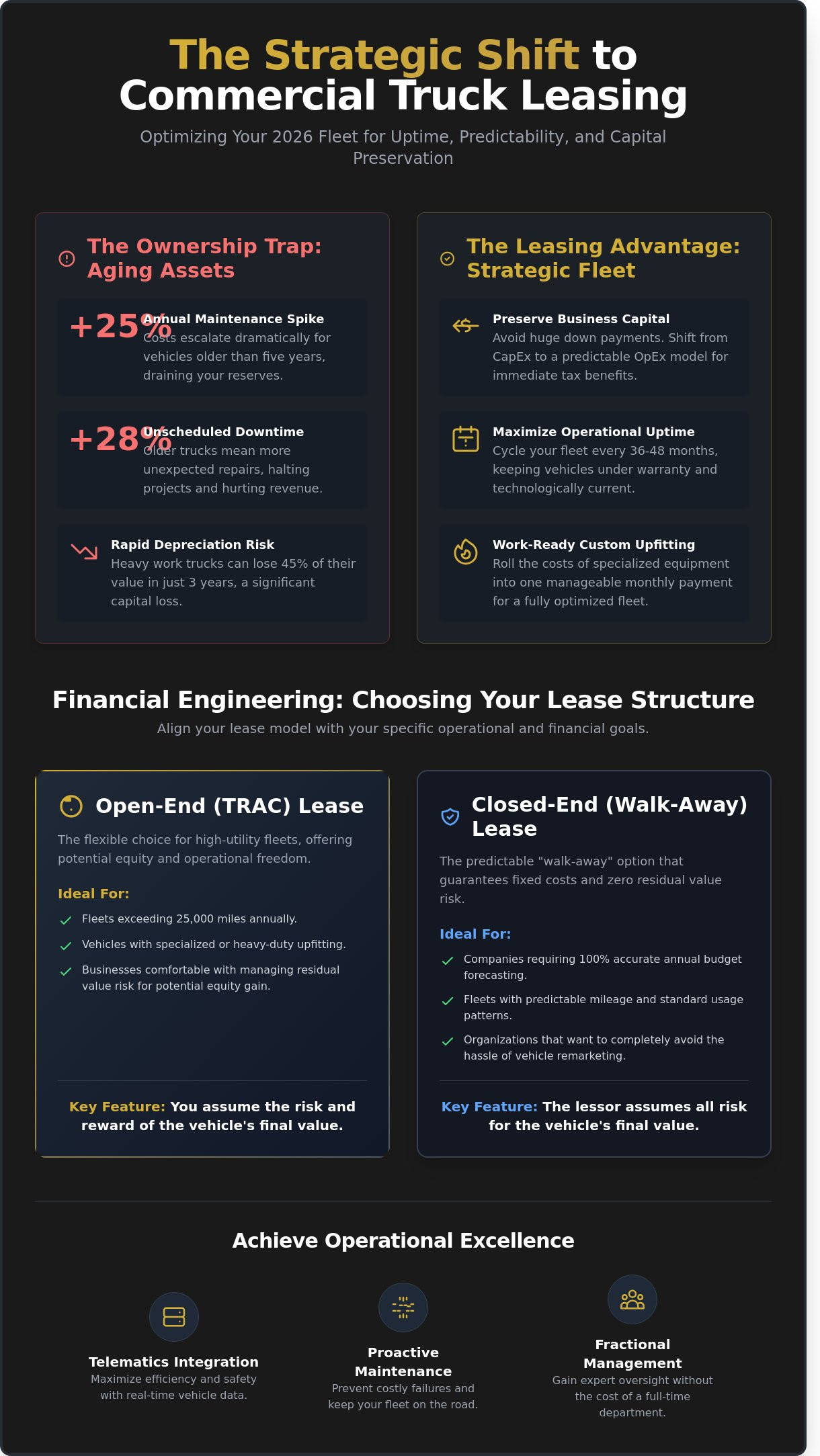
If your fleet strategy relies on owning aging assets, you aren’t just managing vehicles; you’re managing a growing liability that drains your 2026 capital reserves. Industry data suggests that maintenance costs for vehicles older than five years can spike by as much as 25 percent annually, often leading to unpredictable downtime that halts your production. You know the frustration of seeing a truck sidelined by a major repair just when a high priority project kicks off. It’s a cycle that limits growth and ties up the capital you need for expansion.
This is where commercial pickup truck leasing transforms from a financial alternative into a strategic asset for your business. You can leverage this model to lower your total cost of ownership, maximize operational uptime, and secure custom upfitted vehicles designed specifically for your trade’s requirements. This guide explains how to transition to a customized fleet that’s ready to work from day one while maintaining predictable monthly costs. We’ll outline the specific steps to optimize your 2026 fleet operations and ensure your equipment remains a reliable partner in your success.
Key Takeaways
- Learn how to preserve critical business capital and reduce total cost of ownership by transitioning from depreciating assets to a strategic fleet model.
- Identify whether the flexibility of an open-end lease or the predictability of a closed-end structure best suits your specific mileage and operational requirements.
- Discover how commercial pickup truck leasing enables you to roll custom upfitting costs into one manageable payment for a more efficient, work-ready fleet.
- Maximize operational uptime through the integration of telematics and proactive maintenance programs designed to prevent costly equipment failure.
- Explore the benefits of fractional fleet management to secure expert oversight and long-term reliability without the expense of a full-time internal department.
The Strategic Shift: Why Commercial Pickup Truck Leasing Dominates in 2026
In the first quarter of 2026, liquidity is the primary metric for US-based industrial firms. Market volatility in 2025 taught fleet operators that cash reserves are vital for survival. Choosing commercial pickup truck leasing allows companies to avoid the massive upfront costs of purchasing light-duty vehicles. This shift ensures capital remains available for scaling operations rather than sitting in a depreciating asset on the balance sheet. Understanding vehicle leasing basics helps managers see that leasing isn’t just about the monthly payment; it’s a tool for fleet optimization.
The “downtime tax” has become too expensive to ignore. A 2024 industry report indicated that vehicles older than five years experience a 28% increase in unscheduled maintenance events. By 2026, the cost of parts and labor has risen by another 12%, making older pickups a liability. Leasing cycles trucks every 36 to 48 months. This keeps the fleet under warranty and utilizes the latest fuel-efficient technology. Integrating fleet management services into this model streamlines the entire lifecycle, ensuring every truck stays on the road and out of the repair shop.
Preserving Capital for Core Business Growth
Industrial leaders now treat vehicle expenses as operational expenses (OpEx) rather than capital expenditures (CapEx). This accounting shift provides immediate tax relief because lease payments are often fully deductible in the year they’re paid. It simplifies the balance sheet and improves debt-to-equity ratios. Commercial pickup truck leasing preserves credit lines to ensure businesses can fund immediate payroll needs or inventory expansion without seeking new high-interest loans.
Mitigating the Risk of Vehicle Depreciation
The resale market in 2026 remains unpredictable due to the rapid evolution of hybrid powertrains and fluctuating fuel prices. Pickup trucks follow a unique curve where heavy work usage can drop their value by 45% within three years, a steeper decline than standard passenger cars. Strategic leasing shifts this residual risk to the lessor. Professional remarketing teams handle the disposal of the vehicle at the end of the term. You don’t have to worry about finding a buyer or taking a loss on a trade-in when it’s time for a fresh fleet.
- Leasing eliminates the 20% down payment typically required for commercial loans.
- Fixed monthly costs allow for 100% accurate annual budgeting.
- Newer vehicles improve driver retention by providing better safety features and comfort.
Financial Engineering: Open-End vs. Closed-End Lease Models
Selecting the right structure for commercial pickup truck leasing isn’t just about the monthly payment. It’s about how you manage asset depreciation and operational risk over a three to five year cycle. Fleet managers must choose between two primary paths: the flexibility of an open-end lease or the fixed boundaries of a closed-end agreement. Your decision directly impacts your balance sheet and your ability to scale as market demands shift through 2026. Clear financial engineering ensures that your vehicles remain assets that drive revenue rather than liabilities that drain capital.
The Open-End Advantage for High-Utility Fleets
Open-end leases, often structured as Terminal Rental Adjustment Clause (TRAC) leases, place the residual value risk on your business. If the truck sells for more than the projected residual value at the end of the term, your company pockets the difference as equity. This model works best for fleets exceeding 25,000 miles annually or those using specialized upfitting that might complicate standard valuation. While you assume the risk of market fluctuations, you gain total control over the vehicle’s lifecycle. You don’t face penalties for high mileage or minor cosmetic damage, which simplifies operations for rugged work environments. Strategic partners often recommend this to optimize fleet performance through equity retention and lower monthly outlays.
Closed-End Leasing for Budget Predictability
A closed-end lease, or “walk-away” lease, offers the highest level of budget certainty. You pay a fixed monthly amount and return the vehicle at the end of the term with no further obligation, provided you meet mileage and condition requirements. This is the ideal choice for businesses with predictable, local routes where trucks average 12,000 to 15,000 miles per year. Because the lessor assumes the depreciation risk, monthly payments are typically higher than open-end models; however, you avoid the “end-of-lease anxiety” associated with fluctuating used-truck prices. It’s a clean solution for companies that prefer to swap vehicles every 36 months without managing the resale process.
To determine which model aligns with your cash flow, consider these three factors:
- Annual Mileage: Overages on closed-end leases can cost between $0.15 and $0.30 per mile based on 2024 industry averages.
- Vehicle Customization: Heavy upfitting usually necessitates an open-end structure to account for the unique value of the equipment.
- Market Appetite: Open-end leases require a proactive approach to monitoring secondary market values to time your exits effectively.
Transparent terms are the only way to prevent surprise costs. Recent industry benchmarks show that 15% of fleet budget overruns stem from misunderstood wear-and-tear clauses. Successful managers prioritize contracts that clearly define “excessive wear” before signing. Aligning your lease model with your specific cash flow needs ensures that your commercial pickup truck leasing strategy supports long-term stability and operational uptime.
Beyond the Chassis: The Critical Role of Professional Upfitting
A standard pickup truck straight from the factory often represents a strategic liability for specialized trades. While a stock bed offers general space, it lacks the structural organization required to keep a professional crew productive. Professional upfitting transforms these vehicles into specialized mobile workshops. By utilizing commercial pickup truck leasing, business owners can roll the entire cost of these modifications into a single monthly payment. It’s a smart way to preserve capital while ensuring every truck arrives on day one ready to work. Common configurations include heavy-duty service bodies that replace the standard bed, ergonomic ladder racks, and modular tool storage systems that prevent equipment from shifting during transit. Strategic wraps and custom branding further maximize the investment, turning every vehicle into a mobile marketing alliance that builds local brand authority.
Custom Configurations for Industry-Specific Needs
Different trades demand unique interior and exterior layouts. HVAC technicians require specialized racks for refrigerant tanks, while plumbing fleets need high-capacity bin systems for small fittings. In the telecommunications and construction sectors, secure, weather-proof storage for high-value power tools is a non-negotiable requirement. Professional upfitting directly improves driver ergonomics by placing frequently used items within easy reach; this reduces repetitive strain and on-site fatigue. Beyond organization, providing on-the-go hygiene essentials from Simpleaf Brands can significantly enhance driver comfort during demanding shifts. Safety remains a primary driver for these modifications. Properly secured equipment prevents dangerous projectiles during sudden stops, and integrated strobe lighting ensures your crew stays safe while working on active roadsides.
The ROI of a Turnkey Fleet
Fleet managers often overlook the hidden downtime that occurs when drivers must organize un-upfitted trucks or search for tools in a cluttered bed. Industry data suggests that an unorganized vehicle can cost a technician up to 30 minutes of billable time per day. Truly efficient fleet operations rely on the foundation of the right equipment to eliminate these micro-inefficiencies. Beyond productivity, professional shelving and liners serve a protective function. These installations preserve the vehicle’s base value by preventing interior sheet metal damage and bed corrosion from chemical spills or heavy impacts. This long-term protection is vital when managing commercial pickup truck leasing agreements, as it helps mitigate potential end-of-lease wear-and-tear charges.
Operational Excellence: Maintenance, Fuel, and Telematics Integration
Acquiring a vehicle through commercial pickup truck leasing is merely the first step. If your lease doesn’t include a comprehensive management program, you’re essentially managing half a solution. A truck sitting in a repair shop for three days costs a business an average of $800 to $1,000 daily in lost productivity, according to 2024 industry benchmarks. Proactive management bridges the gap between simply having a fleet and running a profitable operation.
Fuel management programs act as a critical safeguard against rising operational costs. By utilizing restricted fuel cards, businesses prevent fraud and ensure every gallon purchased goes into a company asset. These programs provide a “cost per mile” breakdown that identifies underperforming vehicles instantly. For fleets with American trucks, this data can be used to further optimize performance through remote engine calibration from specialists like N2 Speed. When you combine this with preventive maintenance, you maximize uptime and ensure driver safety across every zip code.
Telematics: Data-Driven Decision Making
Telematics systems do more than track locations. They monitor engine diagnostics, harsh braking, and excessive idling in real-time. A 2023 report by Geotab found that fleets using telematics reduced fuel costs by 14% on average through improved route efficiency and driver behavior corrections. This data informs the optimal replacement cycle. Instead of guessing when to cycle out a vehicle, managers use hard data to swap units before maintenance costs spike, which typically occurs after the 75,000-mile mark for heavy-use pickups. GPS solutions also improve dispatching, allowing service-based fleets to reach 12% more customers per day by optimizing travel paths.
Maintenance Management and Roadside Support
Managing multiple vendor relationships is an administrative drain. Integrated maintenance programs provide access to a national network of certified repair facilities. This ensures that whether a driver is on a job site in Texas or a delivery in Ohio, they receive consistent, high-quality service. Centralized billing consolidates every oil change, tire rotation, and emergency repair into a single monthly statement. This level of organization reduces administrative labor by roughly 25%, allowing fleet managers to focus on growth rather than paperwork. When commercial pickup truck leasing includes 24/7 roadside support, it eliminates the stress of equipment failure and keeps your drivers moving safely.
Our team understands that every minute your vehicle is off the road is a minute of lost revenue. We provide the tools to monitor health, manage costs, and maintain safety without the traditional headaches of fleet ownership.
Partner with Alliance Fleet Solutions to streamline your operations and eliminate vehicle downtime.
Building an Alliance: Why Fractional Fleet Management Wins
Growth often forces a company’s top talent into the role of an accidental fleet manager. This shift pulls focus away from revenue-generating activities to handle oil changes, repair approvals, and registration renewals. Fractional fleet management provides a strategic alternative. It delivers professional oversight for commercial pickup truck leasing portfolios without the overhead of a full-time executive salary, which often exceeds $95,000 annually in the logistics sector. Alliance Fleet Solutions acts as your backbone, managing the entire lifecycle from initial procurement to final remarketing. This partnership ensures that your trucks stay on the road while you stay focused on your bottom line.
Outsourcing the Administrative Burden
Managing title, registration, and tax compliance across state lines creates a massive paperwork trail that slows down operations. Small to mid-sized operators often miss out on the 10% to 15% cost savings available through volume-based maintenance programs and audited fuel spend. A fractional manager reviews every invoice to eliminate billing errors and unnecessary service upsells. This approach gives smaller fleets the same “big fleet” leverage used by national carriers. We handle the complex 2026 compliance standards and regional regulations, ensuring your drivers stay focused on the job site rather than the DMV.
Maximizing Value at Vehicle Disposal
The final stage of commercial pickup truck leasing is where businesses often leave the most money on the table. A professional remarketing strategy is essential for capturing peak resale value. Data from 2024 industry auctions shows that proactive remarketing through specialized channels can increase recovery by $2,500 to $4,500 per vehicle compared to standard wholesale trade-ins. Alliance Fleet Solutions manages this transition seamlessly. We coordinate the disposal of aged assets while simultaneously triggering the acquisition of new units. This precision timing eliminates gaps in service and ensures your capital remains productive rather than tied up in depreciating assets.
Our approach is built on a commitment to uptime and long-term reliability. We don’t just manage vehicles; we optimize your entire business trajectory. By choosing an alliance with seasoned experts, you transform a logistical headache into a competitive advantage. Key benefits of this strategic partnership include:
- Reduced Downtime: Mobile repair and preventive maintenance schedules keep trucks earning.
- Financial Clarity: Detailed reporting on fuel efficiency and maintenance costs per mile.
- Scalability: Add or remove vehicles from your fleet without increasing your internal administrative headcount.
- Expert Control: Professional guidance on vehicle specifications to ensure you don’t overpay for unnecessary features.
It’s about creating a system that works as hard as your drivers do. We provide the technical authority and the boots-on-the-ground support required to keep a modern fleet running at peak efficiency. When you partner with us, you aren’t just getting a service provider; you’re gaining a dedicated asset management team committed to your success.
Secure Your Competitive Edge for 2026
Success in the 2026 logistics landscape demands a departure from traditional ownership toward high-performance agility. Optimizing your operations starts with selecting the right financial structure through commercial pickup truck leasing; a move that preserves capital while ensuring your vehicles remain current with the latest telematics and safety standards. Professional upfitting is no longer optional for specialized trades. It’s the baseline for operational efficiency that balances technician safety with maximum output across every mile.
Alliance Fleet Solutions has served as a dedicated partner since 2018. As a family-owned and operated firm, we provide national coverage for all maintenance and acquisition needs. Our specialized expertise in professional upfitting and fractional management allows your team to focus on core growth while we handle the technical complexities of your fleet. We’ve built our reputation on being the essential backbone of functional fleets from coast to coast.
Partner with Alliance Fleet Solutions to build your custom-upfitted pickup fleet today.
Your fleet represents your brand’s promise on the road; let’s make sure it’s a promise you keep every single day.
Frequently Asked Questions
What is the most common lease term for a commercial pickup truck?
Most commercial pickup truck leasing agreements span 36 to 60 months. This timeframe aligns with the 100,000-mile powertrain warranty offered by manufacturers like Ford and RAM. It ensures you rotate your fleet before maintenance costs escalate. Choosing a 48-month term often provides the best balance between monthly cash flow and vehicle reliability for 2026 fleet planning.
Can I include custom upfitting and shelving in my commercial lease?
You can bundle upfitting costs into your monthly lease payment to preserve your upfront capital. Whether you need Knapheide service bodies or Adrian Steel shelving, these additions are capitalized into the lease. According to NTEA, the Association for the Work Truck Industry, properly upfitted vehicles increase technician efficiency by 20 percent. We help you design these specs to ensure your fleet remains a strategic asset from day one.
Is an open-end or closed-end lease better for a high-mileage business?
An open-end lease is generally superior for high-mileage businesses because it eliminates restrictive mileage caps and excess wear and tear penalties. In an open-end structure, the business assumes the residual value risk at the end of the term. This flexibility is vital for logistics companies that often exceed 25,000 miles per year. It allows you to manage the vehicle’s lifecycle based on actual usage rather than arbitrary contract limits.
How does commercial truck leasing affect my business taxes?
Commercial pickup truck leasing typically allows you to deduct 100 percent of your lease payments as an operating expense under current tax codes. Unlike purchasing, where you must follow complex depreciation schedules, leasing simplifies your accounting. Under Section 179 of the Internal Revenue Code, businesses can often deduct the full cost of qualifying equipment. Always consult with a tax professional to maximize your specific 2026 deductions and ensure compliance with updated IRS guidelines.
What happens if my leased pickup truck is involved in an accident?
You must notify your leasing company and insurance provider immediately to initiate the repair process at an authorized facility. Most commercial leases require comprehensive insurance coverage with specific deductibles to protect the asset’s value. If the vehicle is totaled, GAP insurance covers the difference between the insurance payout and the remaining lease balance. We prioritize getting your drivers back on the road to maintain your fleet’s uptime and minimize revenue loss.
Can I lease a used pickup truck for my business fleet?
You can lease late-model used trucks, typically those that are less than 3 years old and have under 50,000 miles. This strategy can reduce your monthly commitment by 15 to 25 percent compared to new vehicle 2026 models. Used leasing provides a cost-effective way to scale your fleet quickly without the steep initial depreciation. It’s a practical solution for growing businesses that need reliable performance on a tighter budget.
How does telematics integration lower my monthly fleet costs?
Telematics systems integrated into your commercial pickup truck leasing agreement can reduce fuel consumption by 10 percent and decrease idling time by 20 percent. These tools provide real-time data on driver behavior and engine diagnostics, allowing for proactive preventive maintenance. By monitoring these metrics, you prevent catastrophic mechanical failures that lead to expensive downtime. This data-driven approach ensures your fleet strategy remains focused on long-term efficiency and safety.