
Most fleet managers don’t realize that the wrong lease structure can quietly erode their bottom line until the vehicle is returned and the unexpected invoices start rolling in. Whether it’s a surprise bill for excess wear or a rigid mileage cap that restricts your growth, these hidden costs can cripple a logistics operation. You’re likely balancing the need for specialized, custom upfitted equipment with the constant pressure to keep your monthly cash flow predictable. It’s a high-stakes environment where one wrong financial decision can impact your operational flexibility for years.
We understand that your fleet is the backbone of your business, and you need a strategy that treats it as a strategic asset rather than a liability. This guide will help you master the debate of open-end vs closed-end lease for commercial vehicles so you can protect your capital and minimize the total cost of ownership. We’ll examine how the 2026 lease accounting standards, specifically ASC 842, shift assets onto your balance sheet and how to choose a structure that maximizes resale value. By the end of this article, you’ll have a clear roadmap to align your leasing choices with your long-term business goals.
Key Takeaways
- Master the mechanics of the Terminal Rental Adjustment Clause (TRAC) to leverage open-end leases as a “pay-for-use” mechanism with an ownership mindset.
- Leverage the “walk-away” advantage of closed-end leases to simplify your budgeting and shield your business from market volatility and depreciation.
- Compare the financial risks and mileage flexibility of an open-end vs closed-end lease for commercial vehicles to determine which aligns best with your operational demands.
- Learn how to integrate professional upfitting into your lease structure to ensure your specialized equipment is funded efficiently without high upfront costs.
- Align your fleet’s residual value with your actual usage patterns to minimize the total cost of ownership across the entire vehicle lifecycle.
Decoding the Commercial Lease Structure for 2026
Commercial leasing serves as a powerful strategic funding mechanism for business growth. It allows companies to acquire the heavy-duty assets they need without the massive upfront capital expenditure of a direct purchase. In 2026, the decision between an open-end vs closed-end lease for commercial vehicles has become a critical focal point for fleet managers. This is largely driven by updated lease accounting standards like ASC 842, which require most leases to be recognized on the balance sheet as both an asset and a liability. This change directly impacts debt-to-equity ratios and overall borrowing capacity for logistics firms and industrial operators.
At the center of every lease agreement is the concept of residual value. This is the estimated market worth of the vehicle at the end of the lease term. Understanding how this value is calculated, and who is responsible if the actual market price differs from the estimate, is the financial fork in the road for your fleet strategy. You must decide whether you prefer the security of predictable, fixed costs or the potential to build equity in your vehicles through careful maintenance and remarketing.
Why the Lease Model Dictates Your Fleet’s ROI
Your choice of lease structure ripples through your entire financial operation. A model that prioritizes cash flow might allow you to scale your fleet faster to meet new project demands, while a model focused on risk mitigation protects you from market downturns. In the logistics sector, operational uptime is the primary driver of revenue. If your financing structure doesn’t account for the unique wear and tear of your industry, you may find yourself facing steep penalties that erase your profit margins. Aligning your funding with your actual vehicle usage ensures that your fleet remains a productive asset rather than a drain on capital.
The Core Difference: Who Carries the Residual Risk?
Residual risk is the possibility that a vehicle will be worth less than expected at the end of the term. In a commercial setting, heavy-duty usage and high mileage can make this risk substantial. The fundamental difference between these structures lies in who bears this burden. In a Closed-End Lease: Predictability and ‘Walk-Away’ Terms, the lessor assumes the risk of depreciation. If the vehicle is worth less than projected, the lessor takes the hit. Conversely, an open-end lease shifts that responsibility to the lessee. This decision forms the foundation of your fleet management strategy, determining whether you act as a temporary user or a long-term stakeholder in the vehicle’s lifecycle.
Open-End Leases: Flexibility and the TRAC Clause
Open-end leases function as a “pay-for-use” model while maintaining an ownership mindset. Unlike other structures, you aren’t just renting space in a vehicle; you’re managing a depreciating asset. This model is the standard for businesses that need complete control over their fleet’s lifecycle and want to benefit from the vehicle’s eventual resale. It bridges the gap between traditional leasing and full ownership, providing the tax benefits of the former with the equity potential of the latter.
The core of this structure is the Terminal Rental Adjustment Clause (TRAC). A TRAC lease is a tax-advantaged commercial financing tool that allows the lessee to assume the residual value risk in exchange for lower monthly payments and greater operational freedom.
Understanding the TRAC Adjustment Process
At the end of the term, a final audit compares the vehicle’s remaining book value with its actual market value. This is the moment of truth for your fleet’s financial performance. If the vehicle sells for more than the projected residual, your business receives a check for the positive adjustment. However, if the market value has dropped or the vehicle was poorly maintained, you’ll owe a negative adjustment to cover the balance. Because you are the one who profits or loses at the sale, having a partner for vehicle remarketing is essential to ensure you get top dollar for your assets.
Ideal Use Cases for Open-End Structures
When evaluating an open-end vs closed-end lease for commercial vehicles, high-utilization fleets usually find the open-end route more sustainable. This is primarily due to the absence of mileage restrictions. In 2026, excess mileage fees typically range from $0.15 to $0.25 per mile, which can quickly devastate the budget of a delivery or long-haul operation. Open-end leases eliminate this worry entirely, allowing your drivers to go where the work is without checking the odometer.
This structure is also the logical choice for vehicles requiring professional upfitting. Whether you need specialized refrigeration units or custom service bodies, an open-end lease treats the upfit as part of the vehicle’s total value. You aren’t penalized for modifying the vehicle because you’re the one responsible for its final disposition. It’s the ideal solution for fleets with unpredictable project sizes that need the flexibility to extend or shorten service life based on real-time operational demands rather than rigid contract dates.
Closed-End Leases: Predictability and ‘Walk-Away’ Terms
Closed-end leases represent the ultimate hedge against market volatility. While the open-end model asks you to gamble on the vehicle’s future resale value, the closed-end structure shifts that entire burden to the lessor. You simply pay for the portion of the vehicle’s life you use. At the end of the term, you return the keys and walk away. This “walk-away” advantage is the primary reason many businesses choose this route when comparing an open-end vs closed-end lease for commercial vehicles. It provides a level of financial insulation that is particularly valuable if you aren’t prepared to manage the complexities of vehicle remarketing yourself.
Budgeting becomes a straightforward exercise with this model. Your monthly payments are fixed, allowing for precise financial forecasting throughout the lease term. This structure is best suited for standard, non-specialized vehicles like sedans, SUVs, or light-duty trucks that don’t require extensive upfitting. Since the lessor owns the residual risk, they require the vehicle to be returned in a specific condition, which makes it less ideal for heavy industrial use where damage is common.
Fixed Costs and Mileage Constraints
Predictability comes with a trade-off: strict adherence to mileage caps and condition requirements. In 2026, excess mileage fees typically range from $0.15 to $0.25 per mile. For a fleet with 50 vehicles, even a slight miscalculation in route planning can result in thousands of dollars in unbudgeted expenses at the end of the term. Accurate data from telematics and GPS solutions is essential here. You must ensure your drivers stay within the agreed-upon limits. Additionally, you should budget for “wear and tear” fees. Unlike the open-end model where you control the repair process, the lessor will bill you for any damage that exceeds their “normal use” standards.
When Predictability Outweighs Flexibility
A closed-end structure is the logical choice for sales fleets or executive vehicles that follow consistent, predictable routes. It ensures your monthly overhead remains stable regardless of how the used vehicle market fluctuates. While most leases now appear on the balance sheet due to ASC 842, the simplified nature of these contracts still offers administrative relief for busy finance departments. Achieving Efficient Fleet Operations: Maximizing ROI requires matching the lease type to the vehicle’s specific duty cycle. If your vehicles perform light-duty tasks with consistent mileage, the closed-end model’s protection against depreciation often outweighs the flexibility of an open-end agreement.
The 5-Point Comparison: Risk, Mileage, and Remarketing
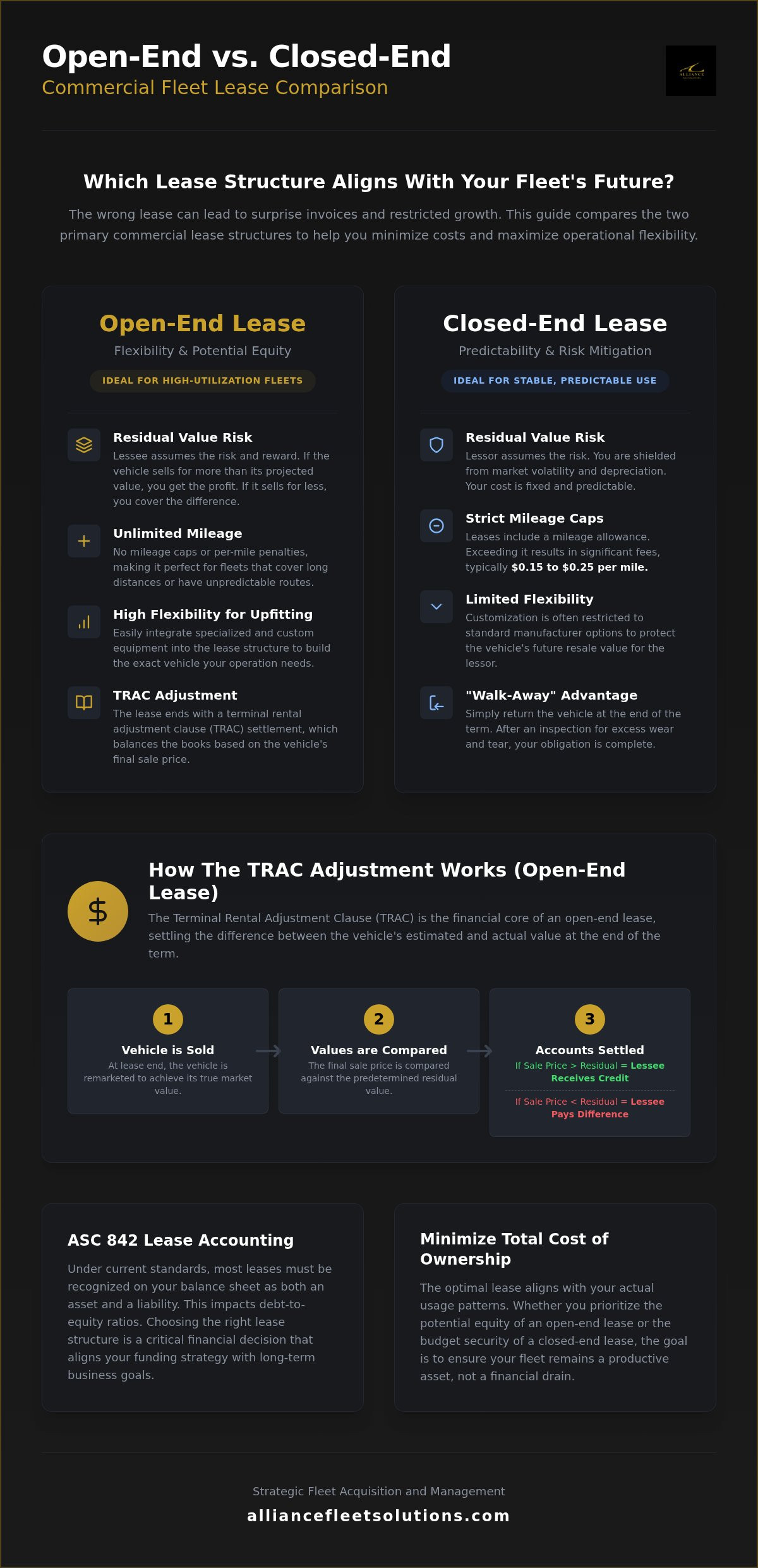
Selecting the right financing model requires a direct showdown between your operational habits and your financial risk tolerance. When comparing an open-end vs closed-end lease for commercial vehicles, the decision typically hinges on five core pillars. In an open-end agreement, you act as the stakeholder, assuming the depreciation risk but also retaining any profit from the vehicle’s eventual sale. A closed-end lease functions more like a traditional rental where the lessor carries the risk, providing you with a guaranteed “exit price” regardless of market fluctuations.
- Financial Risk: Open-end lessees bear the risk of market value drops; closed-end lessors assume all depreciation risk.
- Mileage Flexibility: Open-end offers unlimited mileage; closed-end has strict caps with per-mile penalties.
- Upfitting: Open-end is ideal for specialized modifications; closed-end is better for “off-the-lot” standard vehicles.
- Maintenance: Both require upkeep, but open-end lessees have more control over repair choices to protect their equity.
- Remarketing: Open-end lets you profit from high resale values; closed-end offers no equity potential.
Comparing Maintenance and Upfitting Impacts
Professional upfitting often forces a move toward the open-end model. Custom service bodies, refrigeration units, and specialized shelving can be difficult for a lessor to value at the end of a closed-end term. By choosing an open-end structure, you ensure that the value of these modifications is captured during the remarketing process rather than being treated as “excessive alteration.” To protect this investment, integrating proactive maintenance management is essential. Keeping a detailed service history and using telematics to monitor vehicle health ensures that the asset remains in peak condition, which directly translates to a higher return when it’s time to cycle the vehicle out of the fleet.
The Role of Vehicle Remarketing in Lease Success
Remarketing is the “secret sauce” that determines the final ROI of an open-end lease. Because your final payment is tied to the vehicle’s sale price, the efficiency of the disposal process is paramount. You need a partner who understands the secondary market for heavy-duty assets and can navigate shifting demand to secure the highest possible price. Alliance Fleet Solutions manages this entire transition, leveraging national reach to maximize resale value for our clients. We turn the end-of-lease phase from a potential liability into a strategic opportunity to recoup capital. If you want to see how a tailored structure can improve your bottom line, view our vehicle acquisition and leasing options to find the perfect fit for your fleet.
Strategic Fleet Acquisition with Alliance Fleet Solutions
Choosing between an open-end vs closed-end lease for commercial vehicles isn’t just a financial checkbox; it’s a strategic decision that defines your fleet’s future. Alliance Fleet Solutions acts as the dependable backbone of your functional operation, ensuring that your financing structure matches your operational reality. We move beyond simple transactions to build long-term partnerships. Our team understands that a fleet manager’s primary goal is to minimize downtime and protect capital, which is why we offer tailored guidance that balances technical authority with accessible support.
We specialize in customizing lease structures to match your specific industry upfitting needs. Whether your business requires heavy-duty service bodies or specialized refrigeration, we integrate these costs into the lease without the typical penalties associated with “non-standard” vehicles. Our fractional fleet management service provides the expert oversight needed to manage complex lease portfolios, allowing you to access high-level strategy without the overhead of a full-time in-house department. This holistic approach ensures your fleet remains agile and responsive to changing project sizes.
Managing the Lifecycle from Procurement to Disposal
Our proactive approach begins with vehicle acquisition and sourcing, where we leverage our deep industry connections to find the right assets at the right time. We handle the entire remarketing process, which is often the biggest headache for businesses using open-end structures. By managing the transition from service life to the secondary market, we protect your equity and maximize the return on every vehicle. Alliance Fleet Solutions provides national service coverage to ensure seamless fleet scaling across your entire operation, regardless of where your projects take you. This national reach allows us to move assets efficiently and tap into the best resale markets across the country.
Your Next Steps: Consulting with a Fleet Expert
The transition from in-house management to a managed lease model can feel daunting, but it’s a necessary step to optimize your total cost of ownership in 2026. A custom fleet audit is the best way to determine the ideal lease mix for your unique duty cycles. We analyze your mileage patterns, upfitting requirements, and cash flow goals to recommend a structure that provides both predictability and flexibility. Don’t let unpredictable end-of-lease costs or rigid mileage caps hinder your growth. Partner with Alliance Fleet Solutions for your 2026 vehicle acquisition strategy.
Building a Resilient Fleet Strategy for 2026 and Beyond
Navigating the choice between an open-end vs closed-end lease for commercial vehicles requires a deep understanding of your operational duty cycles and financial risk tolerance. If your fleet relies on specialized, custom upfitted trucks with high mileage, the flexibility of an open-end TRAC lease is likely your best path. Conversely, for standard vehicles with predictable routes, the walk-away security of a closed-end agreement provides the budget stability your finance department needs.
Success doesn’t end at the signing of a contract. It depends on proactive maintenance and a strategic approach to the entire vehicle lifecycle. Alliance Fleet Solutions provides the technical expertise to manage this complexity through specialized professional upfitting and expert vehicle remarketing services. Our comprehensive fractional fleet management ensures your assets remain productive from procurement to disposal.
You don’t have to navigate these financial complexities alone. Let us help you determine the optimal mix of structures to protect your capital and maximize your ROI. Optimize your fleet financing with Alliance Fleet Solutions and position your business for long-term growth. We look forward to building a dependable partnership with your team.
Frequently Asked Questions
What is the main difference between an open-end and a closed-end lease?
The primary difference lies in who assumes the residual value risk. In an open-end lease, the lessee is responsible for the difference between the book value and the final sale price. In a closed-end lease, the lessor carries that risk, allowing the lessee to return the vehicle and walk away. This distinction is the core of the open-end vs closed-end lease for commercial vehicles debate.
Which lease type is better for high-mileage commercial trucks?
Open-end leases are generally superior for high-mileage commercial trucks because they do not impose mileage restrictions. Since you are responsible for the vehicle’s final value, you aren’t penalized for high utilization. This eliminates the risk of paying excess mileage fees, which in 2026 typically range from $0.15 to $0.25 per mile, protecting your operational budget from unpredictable end-of-term costs.
Can I upfit a vehicle that is on a closed-end lease?
While possible, upfitting a vehicle on a closed-end lease is difficult because the lessor requires the asset to be returned in a standard condition. Extensive modifications can negatively impact the vehicle’s residual value from the lessor’s perspective. If your operation requires specialized equipment like custom service bodies or refrigeration, an open-end structure is much more accommodating as it allows you to capture the value of those modifications.
What happens if my vehicle is worth less than the book value at the end of an open-end lease?
If the vehicle’s market value is lower than the remaining book value at the end of an open-end lease, the lessee must pay the difference. This is known as a terminal rental adjustment. To mitigate this risk, it’s vital to work with a partner who provides expert vehicle remarketing. Professional disposal ensures the vehicle is sold for the highest possible market price, reducing the likelihood of a significant final payment.
Is an open-end lease considered a purchase or a rental for tax purposes?
For tax purposes, an open-end TRAC lease is typically treated as a true lease rather than a purchase, despite the lessee assuming residual risk. This allows the business to deduct the full lease payment as an operating expense. Under 2026 accounting standards like ASC 842, these leases still appear on the balance sheet, but they offer distinct tax advantages compared to traditional financing or ownership models.
How do mileage penalties work in a closed-end commercial lease?
Mileage penalties in a closed-end lease are triggered when the vehicle exceeds a pre-negotiated limit. These fees are calculated on a per-mile basis and are billed upon the vehicle’s return. In 2026, these charges often fall between $0.15 and $0.25 per mile. For a fleet with high-utilization demands, these costs can accumulate quickly, making accurate route planning and telematics monitoring essential for maintaining lease compliance.
What is a TRAC lease and how does it benefit my business?
A Terminal Rental Adjustment Clause (TRAC) lease is a specific type of open-end lease designed for commercial vehicles. It contains a provision that allows for a final adjustment of the rental payments based on the vehicle’s sale price. This structure provides the tax benefits of a lease while giving the business the equity potential of ownership. It is a cornerstone of the open-end vs closed-end lease for commercial vehicles comparison.
Does Alliance Fleet Solutions handle vehicle disposal at the end of the lease?
Yes, Alliance Fleet Solutions manages the entire vehicle disposal process through our professional vehicle remarketing services. We leverage a national network to ensure your assets are sold at peak market value, which is especially critical for open-end lessees. Our team handles the logistics of the sale so you can focus on your core operations while we work to maximize the final return on your fleet investment.