
Did you know that a well-documented service history can increase a commercial vehicle’s resale value by as much as 20% compared to those with incomplete records? In an industry where high depreciation rates often feel like an unavoidable cost of doing business, many managers struggle to prove a vehicle’s true worth to secondary buyers. It’s frustrating to leave money on the table simply because you can’t verify the care your assets received. You’ve likely felt the pressure of deciding exactly when to cycle vehicles out of your fleet to maximize returns while avoiding the sting of equipment failure.
Understanding how fleet maintenance impacts resale value is no longer just about mechanical upkeep; it’s a core financial strategy. This guide will show you how proactive maintenance and meticulous digital record-keeping can significantly increase your fleet’s recovery value at the end of its lifecycle. We’ll examine the impact of the February 2026 FMCSA digital compliance updates, explore how to leverage 100% bonus depreciation, and provide a clear roadmap for vehicle remarketing. By shifting from reactive fixes to a strategic maintenance partnership, you’ll reduce your total cost of ownership and gain higher confidence in your final sale results.
Key Takeaways
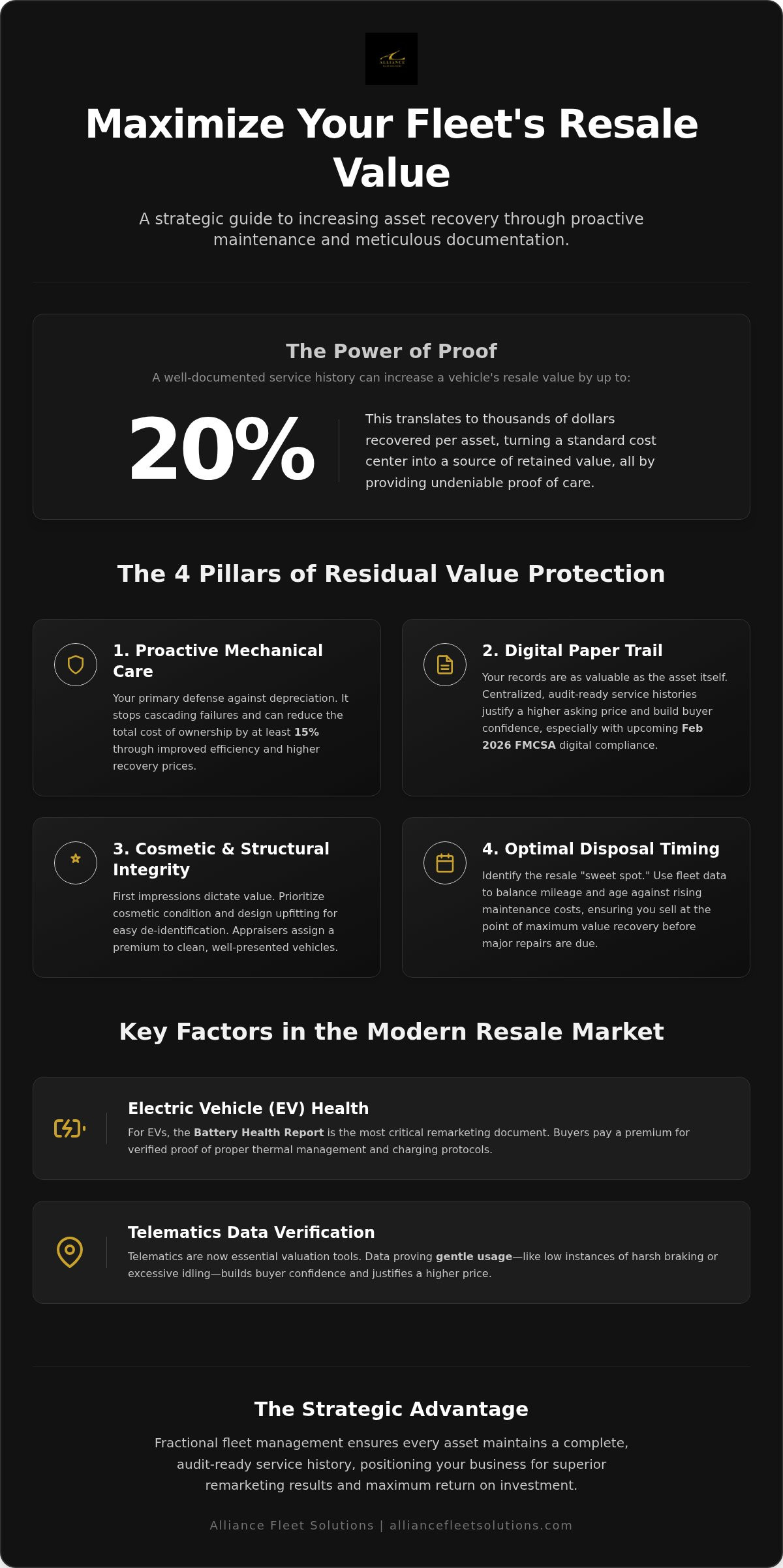
- Learn why preventative care is your primary defense against asset depreciation and how it stops the cascading mechanical failures that slash vehicle value.
- Discover how fleet maintenance impacts resale value by building a digital paper trail that serves as undeniable proof of quality for secondary buyers.
- Protect your long-term ROI by designing professional upfitting for easy de-identification and prioritizing the cosmetic condition that appraisers see first.
- Identify the “sweet spot” for vehicle disposal by using fleet data to balance mileage and age against rising maintenance costs for maximum recovery.
- See how fractional fleet management ensures every asset maintains an audit-ready service history, positioning your business for superior remarketing results.
The Direct Correlation Between Maintenance and Asset Depreciation
Depreciation remains the most significant expense within fleet management. Many managers view it as a fixed, uncontrollable cost, but that’s a costly misconception. The rate at which an asset loses value is directly tied to the quality of its service history. When you prioritize a strategy of Residual Value Protection, you’re doing more than just keeping trucks on the road. You’re actively preserving the equity within your fleet.
Consistent upkeep is the only way to prevent cascading failures. A simple, neglected leak can eventually lead to catastrophic engine damage that slashes resale value by thousands of dollars overnight. In the 2026 market, buyers demand mechanical transparency. They want to see that every component was serviced before it reached a point of failure. This proactive approach is exactly how fleet maintenance impacts resale value most effectively, as it removes the fear factor for the next owner.
Mechanical Integrity as a Buyer Trust Signal
Secondary buyers treat a complete service log as a vital insurance policy. They’ll consistently pay a premium for vehicles with zero deferred maintenance because it eliminates their immediate risk of downtime. Engine and transmission health are the primary drivers of auction performance. If a buyer sees evidence of skipped oil changes or ignored transmission flushes, they’ll adjust their bid downward to account for potential repairs. Understanding how fleet maintenance impacts resale value allows managers to treat service as a profit center rather than a cost center. Industry data suggests that consistent maintenance habits can reduce the total cost of ownership by at least 15% through improved fuel efficiency and higher recovery prices.
EV Maintenance and Battery Health in 2026
The 2026 resale market has placed a new emphasis on electric vehicle health. The battery health report has replaced the traditional engine inspection as the most critical document for EV remarketing. Buyers look for proof that thermal management systems were maintained to preserve long-term battery capacity. If a battery has been subjected to extreme temperatures or improper charging cycles without documentation, its value plummets. Preserving capacity requires more than just charging; it involves managing software updates and cooling systems diligently. Documenting these digital and thermal service events is now a mandatory step for any fleet looking to maximize its electric asset ROI.
Building a Digital Paper Trail: Why Documentation is Your Best Remarketing Tool
In the modern remarketing environment, your records are as important as the metal itself. Remote buyers often make purchasing decisions based on data before they ever see the vehicle in person. This digital paper trail serves as the physical proof of an asset’s value. Without it, you face a stiff maintenance penalty at trade-in. If you can’t prove a service occurred, a savvy buyer will assume it was neglected and lower their offer accordingly.
Integrating professional maintenance management is the most reliable way to avoid these valuation gaps. By centralizing every repair order and inspection report, you create a narrative of care that justifies a higher asking price. This is exactly how fleet maintenance impacts resale value in a competitive market; it replaces uncertainty with verified facts. When your documentation is audit-ready, you move from a position of defense to one of strength during price negotiations.
The Role of Telematics in Verifying Vehicle History
Telematics and GPS solutions have moved beyond simple tracking to become essential valuation tools. In 2026, buyers want to see more than just oil change dates. They want data proving gentle usage, such as adherence to speed limits and low instances of harsh braking. Automated alerts ensure no service interval is missed, while real-time diagnostic data builds buyer confidence in the vehicle’s current state. This transparency allows you to command a premium by proving the asset hasn’t been abused during its service life.
Fractional Management: Professional Oversight of Your Records
Small to mid-sized fleets often struggle with record consistency because they lack dedicated administrative staff. This is where fractional fleet management becomes a strategic asset. These experts act as the custodian of value for your fleet, ensuring every tire rotation and software update is logged in a buyer-accessible format. They bridge the gap between daily operations and long-term financial recovery. By providing professional oversight, they ensure that the question of how fleet maintenance impacts resale value is answered with a resounding increase in your bottom line. If you want to professionalize your record-keeping without the overhead of a full-time hire, partnering with Alliance Fleet Solutions can help you maintain the meticulous history that top-tier buyers demand.
Beyond the Engine: How Upfitting and Cosmetic Care Protect Your ROI
Asset recovery begins with a visual inspection. While mechanical logs prove what’s happening under the hood, the physical condition of the vehicle provides the first, most influential impression for an appraiser. A truck with a torn seat, cracked dashboard, or dented panels signals a culture of neglect. This is a critical way how fleet maintenance impacts resale value; if a driver didn’t care for the cabin, a buyer assumes they didn’t care for the engine either. Protecting the base asset through protective equipment like heavy duty floor liners and high quality seat covers is a small investment that pays significant dividends at the auction block.
Strategic planning during the acquisition phase is equally vital. When you invest in professional upfitting, the equipment should be designed for easy de-identification. This means avoiding permanent modifications that leave gaping holes or scarred surfaces when branding and specialized tools are removed. A vehicle that’s easy to return to a “blank canvas” state will always attract a wider range of buyers than one permanently altered for a niche task.
Strategic Upfitting for Secondary Market Appeal
Choosing modular upfits is a superior strategy for long term recovery. These systems can be repurposed or removed without damaging the vehicle’s structural integrity. While highly niche modifications might serve a specific operational need, they often shrink the pool of secondary buyers. Stick to industry standard configurations where possible. If your operation requires specialized gear, ensure that upfit maintenance is included in the overall service file. A well maintained crane or refrigeration unit can add value, but only if you can prove it has been inspected and serviced regularly alongside the chassis.
The “Curb Appeal” Factor in Commercial Remarketing
Value bleed often happens through small, unaddressed issues. Minor dents, glass chips, and scratched paint should be handled immediately rather than waiting for the end of the vehicle’s lifecycle. In the 2026 market, professional detailing before a sale isn’t just a luxury; it’s a requirement for top tier pricing. A clean interior and polished exterior suggest a well managed fleet. This perceived level of care gives buyers the confidence to bid higher, knowing they won’t have to spend thousands on reconditioning before putting the asset to work. Your maintenance schedule must include these cosmetic touchpoints to ensure the vehicle’s “curb appeal” matches its mechanical excellence.
Strategic Lifecycle Management: Timing the Market for Maximum Recovery
Maximizing your asset recovery isn’t a matter of luck. It’s the result of precise timing. The “Sweet Spot” for vehicle disposal occurs when you balance mileage, age, and rising maintenance costs against the projected resale price. Holding a vehicle too long invites expensive repairs that erode your profit, while selling too early fails to capitalize on the asset’s utility. Understanding how fleet maintenance impacts resale value allows you to forecast exactly when an asset’s maintenance costs will start to outweigh its market worth. Efficient fleet operations rely on real-time data to predict this optimal exit point before the cost-of-ownership curve spikes.
You must also consider external factors like seasonal market fluctuations. Demand for commercial vehicles often peaks in the spring as construction and logistics activity ramps up. Additionally, the release of new models can immediately depress the value of your current fleet. By staying informed on manufacturer cycles, you can move assets before they become “previous generation” inventory. This proactive approach ensures you’re selling when demand is high and supply is manageable.
Mileage Thresholds and Their Psychological Impact
Buyers often fixate on specific round numbers. Crossing the 100,000-mile mark creates a psychological “cliff” that can lead to a sharp drop in bids. However, meticulous records showing consistent care can mitigate this mileage penalty. This is a primary example of how fleet maintenance impacts resale value; a high-mileage truck with a perfect digital service history often out-sells a lower-mileage unit with missing logs. For light-duty trucks in 2026, targeting a remarketing window between 70,000 and 85,000 miles typically yields the best balance of asset utilization and high recovery value.
Remarketing Channels: Finding the Right Buyer
Choosing the right channel is just as vital as the timing itself. Wholesale auctions offer speed, but direct-to-market sales or driver purchase programs often net higher returns. Professional remarketing services navigate these channels to find the highest bidder, ensuring you don’t settle for the first low offer. Reconditioning also plays a major role; spending a small amount on professional cleaning and minor repairs can increase the final sale price by significantly more than the cost of the work. A data-driven strategy ensures you never miss the window for maximum ROI. If you’re ready to optimize your disposal schedule, contact Alliance Fleet Solutions to build a custom remarketing plan.
Maximizing Resale Value with Alliance Fleet Solutions
Alliance Fleet Solutions integrates maintenance management and vehicle remarketing into a single, cohesive lifecycle strategy. We don’t just fix trucks; we manage financial assets. By overseeing every service event from day one, we eliminate the uncertainty that usually plagues the remarketing process. Our fractional management services provide the meticulous, audit-ready histories that top-tier buyers demand, ensuring you never face a “missing record” penalty at the auction block. We act as the strategic backbone of your operation, turning routine upkeep into a documented competitive advantage.
Our Proactive Maintenance Management Approach
We handle the heavy lifting of scheduling, vendor oversight, and technical documentation so your team can stay focused on core operations. Our national network ensures your assets receive consistent, professional care whether they’re in a local yard or across the country. This isn’t just about avoiding downtime. It’s about positioning every vehicle for a premium sale later. We understand exactly how fleet maintenance impacts resale value, and we use that knowledge to keep your fleet on the road today while commanding high prices tomorrow. By centralizing your data, we make it easy to prove the quality of your assets to any prospective buyer.
Partnering for Long-Term Fleet Success
As a family-owned and operated firm founded in 2018, we act as a supportive partner rather than a distant service provider. We understand the high stakes of the logistics sector and speak the language of business efficiency. We help you navigate the entire journey from vehicle acquisition to final disposal. Our team ensures that your maintenance habits align with your long-term financial goals, protecting your bottom line at every turn.
We invite you to a “Fleet Lifecycle Review” to assess your current resale potential and identify opportunities to boost your recovery ROI. Don’t leave your recovery value to chance. Understanding how fleet maintenance impacts resale value shouldn’t be a mystery; it should be a measurable part of your profit margin. Optimize your fleet’s resale value with our expert management services today.
Securing Long-Term Equity in Your Fleet Assets
Maximizing your recovery value starts long before you list a vehicle for sale. It begins with a commitment to proactive care and the creation of an undeniable digital paper trail. By focusing on the “sweet spot” for disposal and maintaining meticulous service logs, you ensure that your equipment remains a liquid asset rather than a financial liability. This strategic approach is exactly how fleet maintenance impacts resale value, allowing you to command top-tier bids even in a crowded market.
Partnering with an expert ensures these complex processes don’t distract from your daily operations. Since 2018, we’ve provided proven B2B lifecycle strategies that integrate comprehensive maintenance with professional remarketing results. Our expert fractional fleet management team acts as your strategic backbone, protecting your ROI from acquisition to final disposal. Maximize Your Fleet’s Resale Value with Alliance Fleet Solutions and gain the confidence that comes with expert control. Your fleet is the essential foundation of your business; let’s make sure it pays you back at the end of the road.
Frequently Asked Questions
How much does a full service history actually increase resale value?
A well-documented history can provide a premium of 15% to 20% over vehicles with missing records. This documentation proves that the owner followed manufacturer-recommended intervals, which reduces the buyer’s risk of immediate mechanical failure. Beyond the price bump, these assets often sell twice as fast as those without logs. This speed is a major factor in how fleet maintenance impacts resale value, as it minimizes the time capital is tied up in idle equipment.
Is it worth repairing cosmetic damage before selling a fleet vehicle?
Yes, minor reconditioning often yields a 2-to-1 return on investment at the time of sale. Appraisers look for “front-line ready” vehicles that don’t require immediate shop time. Fixing windshield chips, small dents, and torn upholstery prevents buyers from using these flaws as leverage to negotiate deep discounts. A clean, damage-free appearance signals that the vehicle was operated by professional drivers who respected the equipment, which builds significant buyer confidence.
What are the most important maintenance records to keep for resale?
You should prioritize engine oil analysis, transmission services, and brake inspections alongside annual DOT records. In 2026, digital timestamps for these services are essential to satisfy FMCSA compliance and buyer scrutiny. Keeping records of cooling system flushes and software updates is also vital for modern assets. These specific logs demonstrate a proactive approach to preventing major component failures, which is the primary way how fleet maintenance impacts resale value for savvy secondary buyers.
How does vehicle color affect the resale value of a commercial fleet?
White remains the industry standard for resale because it’s the easiest color for a secondary buyer to re-brand. High-optic or niche company colors often require a full wrap or repaint, which can lead to a color penalty of several thousand dollars at auction. If your fleet uses custom colors, consider using high-quality vinyl wraps over a factory white base. This protects the original paint while ensuring the widest possible appeal when it’s time to sell.
What is the best mileage to sell a commercial truck for maximum ROI?
For heavy-duty trucks, the optimal window often falls between 400,000 and 500,000 miles, just before major engine overhauls are typically required. Light-duty assets generally see the best recovery between 70,000 and 85,000 miles. Selling before these major thresholds allows you to capture the asset’s peak utility while avoiding the steep depreciation that occurs once a vehicle is perceived as high-mileage. Data-driven monitoring helps you identify the exact moment before maintenance costs spike.
Does professional upfitting always decrease the resale value of a van?
Not necessarily; professional upfitting only decreases value if the modifications are too niche or cause permanent damage. Modular shelving, partitions, and safety lighting that follow industry standards can actually increase value for buyers in the same sector. The key is ensuring the upfit is high-quality and well-maintained. If the equipment is easily removable without leaving structural scars, you retain the flexibility to sell the vehicle as a standard cargo van or a specialized work tool.
How do EV battery health reports impact used vehicle prices in 2026?
In 2026, a certified battery health report is the single most important document for an electric vehicle’s resale. These reports provide a state of health percentage that tells the buyer exactly how much range remains compared to the original specs. Vehicles with reports showing high capacity retention command significant premiums. Without this transparency, buyers will assume the worst regarding battery degradation, leading to low-ball offers that can’t be countered without technical proof of the battery’s condition.
What are the benefits of using a professional vehicle remarketing service?
Professional remarketing services provide access to a national network of buyers that far exceeds local wholesale auctions. They handle the complexities of title transfers, reconditioning oversight, and price negotiations, ensuring you receive the highest possible market rate. By integrating these services with your maintenance management, you create a seamless transition from operation to disposal. This partnership ensures that your exit strategy is as organized and professional as your daily maintenance schedule.