
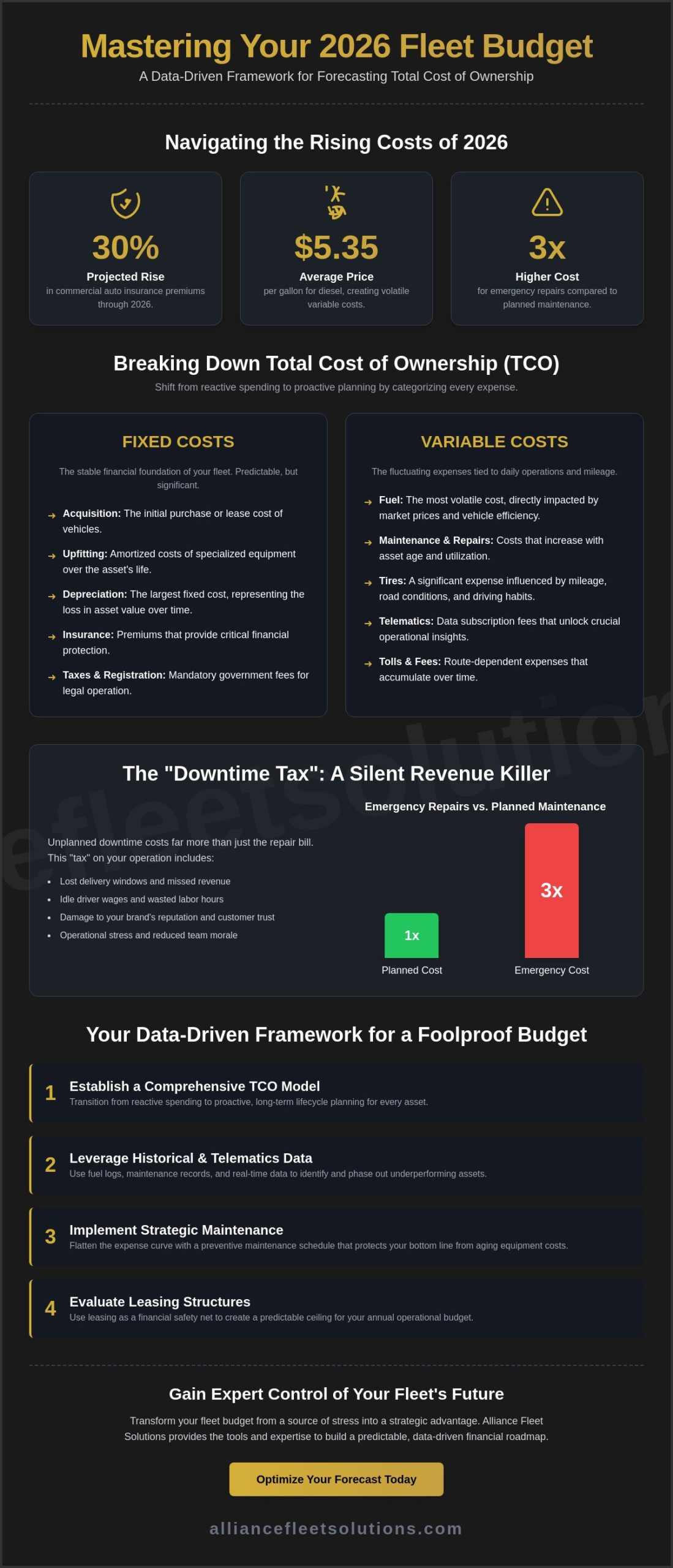
With commercial auto insurance premiums projected to rise by as much as 30% through 2026, your historical budget is no longer a reliable baseline for the year ahead. It’s frustrating to watch a single transmission failure or a spike in diesel prices, currently averaging $5.35 per gallon, derail your monthly cash flow. You know that reacting to these costs after they happen is a recipe for operational stress, especially when you need to justify new vehicle acquisitions to leadership. Learning how to forecast fleet expenses requires more than just looking at last year’s spreadsheets; it demands a proactive look at vehicle lifecycle structures and leasing models.
We understand that your goal is to turn these unpredictable operating costs into a clear, manageable financial roadmap. This guide provides a data-driven framework to help you master the art of fleet budgeting. We’ll explore how to leverage telematics data, manage fluctuating fuel costs, and use professional upfitting to extend asset life. By the end of this article, you’ll have the technical authority to present a foolproof 2026 plan that secures executive buy-in and keeps your operation running smoothly.
Key Takeaways
- Establish a comprehensive Total Cost of Ownership (TCO) model to transition from reactive spending to proactive, long-term lifecycle planning.
- Master how to forecast fleet expenses by effectively separating fixed acquisition costs from volatile variable expenses like fuel and emergency repairs.
- Evaluate how specific leasing structures can serve as a financial safety net, providing a predictable ceiling for your annual operational budget.
- Implement a data-driven framework that utilizes historical fuel logs and maintenance records to identify and phase out under-performing assets.
- Leverage strategic maintenance management to flatten the expense curve and protect your bottom line against the rising costs of aging equipment.
The Strategic Importance of Accurate Fleet Expense Forecasting in 2026
Fleet forecasting is the systematic estimation of future Total Cost of Ownership (TCO) across the entire vehicle lifecycle. It is the backbone of a functional operation. As we move through 2026, the logistics sector faces unique pressures that demand higher precision than ever before. With national diesel prices averaging $5.35 per gallon and commercial insurance premiums climbing by up to 30%, a static budget is no longer sufficient. You must navigate volatile energy markets and evolving vehicle technologies with a proactive mindset. Mastering how to forecast fleet expenses requires a fundamental shift from “rearview mirror” accounting to forward-looking financial modeling. This transition does more than just balance the books; it protects your business liquidity and strengthens your credit positioning for future vehicle acquisitions.
When you treat fleet costs as a predictable variable rather than a series of surprises, you elevate your role from a service provider to a strategic business asset. Accurate forecasts allow you to communicate effectively with executive leadership, providing them with a clear roadmap of when and why capital expenditures are necessary. This level of technical authority builds trust and ensures that your fleet has the resources it needs to maintain peak operational efficiency without compromising safety or reliability.
Moving Beyond Historical Guesswork
Relying on last year’s spend to predict next year’s maintenance is a risky strategy that often leads to budget shortfalls. Inflation continues to impact the cost of parts, labor, and professional upfitting services, making historical data an unreliable guide for 2026. A modern budget must account for these rising costs while transitioning to a multi-variable model. This framework factors in specific asset age and utilization patterns rather than just generic averages. Older vehicles don’t just cost more to maintain; they fail more frequently and require more expensive parts. By understanding how to forecast fleet expenses using these specific variables, you can anticipate financial spikes before they disrupt your monthly cash flow.
The Hidden Costs of Unpredictable Fleet Operations
Unplanned downtime is a silent revenue killer often referred to as the “downtime tax.” These costs extend far beyond the initial repair bill. They include lost delivery windows, idle driver wages, and potential damage to your brand reputation. Industry data confirms that emergency repairs typically cost three times more than planned preventive maintenance. This financial drain is compounded by the stress it places on your team. There is a significant psychological benefit to budget stability for operational managers. When you aren’t constantly putting out financial fires, you can focus on long-term efficiency and safety. A predictable budget provides the expert control needed to lead a high-stakes operation with confidence and momentum.
Breaking Down Total Cost of Ownership (TCO) Components
To understand how to forecast fleet expenses effectively, you must dismantle the Total Cost of Ownership (TCO) into its core pillars. Categorizing your spend into fixed and variable components creates a transparent framework that executive leadership can easily digest. Fixed costs remain steady regardless of mileage, while variable costs fluctuate based on daily operations. Balancing these two categories is the only way to avoid the financial shock of unmanaged growth. When you view every vehicle as a long-term investment rather than a monthly bill, you gain the expert control needed to stabilize your bottom line.
Fixed Costs: Acquisition, Upfitting, and Depreciation
Fixed costs provide the financial skeleton of your operation. These include vehicle acquisition, taxes, registration, and commercial insurance premiums, which are currently seeing increases of 10% to 30%. Professional upfitting is frequently miscategorized as a one-time capital expense. To master how to forecast fleet expenses, you should amortize upfitting costs over the entire service life of the asset. This approach prevents a massive budget spike in year one and accurately reflects the value the equipment adds to your workflow. Depreciation is the final, and often largest, fixed cost. It represents the loss in value from the moment of purchase to the point of vehicle remarketing. By monitoring current market trends, you can predict the residual value of your assets and time your replacements to maximize returns.
Variable Costs: Fuel, Maintenance, and Telematics Insights
Variable costs are the moving parts of your budget that require constant monitoring. Fuel is the most volatile element here. With 2026 projections placing regular gasoline at $2.82 per gallon and diesel at $5.35, even a small drop in efficiency can cost thousands across a medium-sized fleet. You can forecast this spend by layering historical MPG data against projected price indices. Maintenance costs follow a predictable upward curve as vehicles age. Routine oil changes and tire rotations in the first year eventually give way to major component failures, such as transmission or engine overhauls, in years four and five. Integrating telematics and gps solutions provides the raw data needed to validate these assumptions. This technology tracks idle time, aggressive driving, and engine diagnostics, turning guesswork into actionable intelligence.
If you find that your current data is too fragmented to provide a clear picture, exploring professional maintenance management can help you consolidate these variables into a single, reliable roadmap.
How Leasing Structures Define Your Budget Predictability
Leasing isn’t just a method of vehicle acquisition; it’s the primary lever you use to control budget volatility. The structure of your lease determines who carries the risk of market fluctuations and equipment aging. When you’re determining how to forecast fleet expenses, you must decide whether you want the flexibility of ownership or the certainty of a fixed monthly payment. This choice dictates how you layer your financial projections for the next three to five years. By selecting a structure that aligns with your cash flow needs, you move from reactive spending to expert control over your operational bottom line.
Open-End vs. Closed-End Leasing: Forecasting Implications
Open-end leasing provides the highest level of operational flexibility. It’s often the preferred choice for fleets with specialized upfitting or unpredictable mileage. In this model, you essentially manage the vehicle’s depreciation yourself. While this can lead to lower total costs if you maintain the asset well, it requires a sophisticated approach to how to forecast fleet expenses. You must accurately predict the vehicle’s market value at the end of the term to avoid a “balloon” payment that could disrupt your cash flow. It’s a high-stakes model that rewards technical precision and diligent maintenance.
Closed-end leasing offers a much tighter financial “safety net” for business owners. You pay a fixed monthly amount for a set period, usually 36 to 48 months. At the end of the lease, you simply return the vehicle. The lessor assumes all the risk regarding the residual value. This model is ideal for managers who prioritize absolute budget predictability. It turns a complex variable into a simple, static line item. If you’re operating 2026 commercial vans, for example, you can lock in specific rates and walk away from the remarketing headache entirely. It simplifies your roadmap by creating a hard ceiling on your acquisition costs.
Remarketing and Residual Value: The End-of-Life Factor
The final stage of the vehicle lifecycle is where many budgets either balance out or fall into the red. Effective vehicle remarketing strategies turn your aging assets into budget-balancing credits. Forecasting the optimal “cycle point” is a technical skill that separates elite managers from the rest. This is the exact moment when the rising maintenance costs of an aging vehicle begin to outweigh its remaining resale value.
In 2026, the used commercial vehicle market remains sensitive to supply chain recovery and shifting demand for last-mile delivery assets. You shouldn’t just guess when to sell. Use historical auction data and current remarketing trends to identify the “sweet spot” for replacement. By cycling vehicles out before they hit the steep part of the maintenance curve, you protect your ROI and ensure your fleet remains a modern, efficient asset rather than a financial liability. This proactive approach ensures your operation stays grounded in long-term reliability and safety.
Building Your 2026 Fleet Budget: A Data-Driven Framework
Creating a budget that survives the fiscal year requires a shift from static spreadsheets to a dynamic, data-driven framework. You can’t simply add a flat percentage to last year’s totals and expect accuracy. Instead, you must build your projections from the ground up, using real-world utilization data and current market indicators. This process ensures that your financial roadmap remains grounded in operational reality. When you master how to forecast fleet expenses through a structured step-by-step approach, you provide your business with the expert control needed to navigate the high-stakes logistics sector.
- Step 1: Audit Utilization. Review every asset to identify under-performing vehicles. If a truck has high maintenance costs but low mileage, it’s a prime candidate for remarketing.
- Step 2: Aggregate Historical Data. Pull records from your maintenance logs and fuel management programs. This data provides the baseline for your variable cost assumptions.
- Step 3: Apply Inflationary Multipliers. Adjust your estimates for parts and labor. With commercial insurance premiums rising by up to 30%, your multipliers must reflect these hard market conditions.
- Step 4: Integrate Capital Projects. Account for planned vehicle acquisitions, such as the 2026 Mercedes-Benz Sprinter models currently available with 4.90% APR financing. Include the cost of professional upfitting as a core fixed line item.
- Step 5: Stress-Test the Model. Run “what-if” scenarios. Determine how your cash flow changes if diesel prices climb past the current $5.35 average or if emergency downtime increases by 10%.
Leveraging Telematics for Predictive Maintenance Costs
Telematics does more than track locations; it provides a window into future expenses. By monitoring engine diagnostics in real-time, you can identify a failing alternator or a cooling system leak before it leads to a $100,000 crash or a total engine seizure. There’s also a direct correlation between aggressive driver behavior and accelerated brake and tire wear. Predictive maintenance is no longer an optional efficiency; it is a fundamental budgetary requirement for any 2026 fleet operation aiming for fiscal stability. This proactive approach ensures your maintenance spend is a planned investment rather than an emergency drain on liquidity.
Accounting for Professional Upfitting and Specialized Equipment
Specialized equipment requires its own dedicated spot in your forecasting model. Custom configurations, such as refrigeration units, lift gates, or heavy-duty shelving, have maintenance needs that differ from the chassis itself. You must budget for the periodic inspection and repair of these upfitted components to ensure they reach their projected service life. If you don’t account for these specialized needs, you’ll find your “variable” maintenance budget quickly overwhelmed by equipment failures. Aligning these costs with the vehicle’s lifecycle ensures that your upfitted assets remain a strategic business asset from acquisition to remarketing.
Ready to turn your unpredictable costs into a manageable roadmap? Let our experts help you design a comprehensive fleet management strategy that secures your 2026 financial performance.
Optimizing Your Forecast with Alliance Fleet Solutions
Alliance Fleet Solutions doesn’t just provide services; we act as the essential backbone of your functional operation. Understanding how to forecast fleet expenses effectively often requires an outside perspective that can bridge the gap between mechanical maintenance and financial performance. We stabilize your operational costs by integrating your data into a cohesive strategy. By utilizing our maintenance management programs, you can flatten the expense curve and eliminate the “downtime tax” discussed earlier. Our team customizes lease structures to match your specific industry’s cash flow cycles, ensuring your payments align with your revenue peaks rather than fighting against them. We view technical tasks as comprehensive business solutions that elevate your brand’s reliability.
Fractional Fleet Management: Expert Analysis Without the Overhead
Mid-sized fleets often face a unique challenge. You need enterprise-level forecasting expertise, but the budget doesn’t always allow for a full-time fleet director. Our Fractional Fleet Management service fills this gap. We provide the technical authority and data integration you need on a fractional basis, identifying cost-saving opportunities that internal teams might miss. This model reduces the administrative burden of tracking thousands of individual transactions and maintenance logs. It allows you to focus on growing your business while we handle the high-stakes complexity of your financial roadmap. Our experts analyze your utilization patterns to ensure every dollar spent on how to forecast fleet expenses results in measurable operational gain and long-term asset health.
Strategic Vehicle Acquisition and Procurement Planning
Successful budgeting depends on timing. If a vehicle doesn’t arrive when your budget allows, your entire forecast can fall apart. We navigate the complexities of supply chain lead times to ensure your fleet stays modern and efficient. By leveraging our national volume purchasing power, we lower your initial acquisition costs and improve your long-term ROI. This strategic approach to procurement, combined with professional upfitting, ensures your assets are ready for service from day one. We ensure that upfitted components are amortized correctly, protecting your liquidity and ensuring your fleet remains a strategic business asset from acquisition to remarketing.
Partner with Alliance Fleet Solutions to build a predictable, high-performance fleet. Let’s turn your 2026 financial planning into a competitive advantage that secures your business’s future and keeps your operations moving forward with confidence.
Secure Your Operational Momentum for 2026
Success in the coming year depends on your ability to transform volatile data into a steady financial roadmap. By dismantling Total Cost of Ownership and selecting lease structures that act as a safety net, you protect your business from the “downtime tax” and rising insurance premiums. Mastering how to forecast fleet expenses isn’t just about balancing a spreadsheet; it’s about establishing the expert control needed to lead your team with confidence. Accurate modeling ensures that your fleet remains a strategic asset rather than an unpredictable liability.
Since 2018, Alliance Fleet Solutions has provided the technical authority and national coverage required to lower TCO across diverse industries. We specialize in expert fractional fleet management and streamlined acquisition and upfitting plans, acting as the supportive partner your operation deserves. Don’t let unpredictable repairs or fuel spikes derail your progress. Take Control of Your Fleet Costs with a Strategic Consultation from Alliance Fleet Solutions. Your 2026 goals are within reach when you have a dependable backbone supporting every mile. Let’s build a high-performance fleet that drives your success forward.
Frequently Asked Questions
What is the most accurate way to forecast fuel expenses?
The most accurate method involves layering your fleet’s historical MPG data against projected fuel price indices. For 2026, the national average for diesel is approximately $5.35 per gallon, while regular gasoline is forecasted at $2.82. By applying these specific values to your actual utilization rates, you create a realistic baseline. This approach is far more reliable than relying on generic historical spend, which often fails to account for current market volatility.
How often should I update my fleet expense forecast?
You should update your fleet expense forecast at least quarterly to stay ahead of market volatility. Fuel prices and insurance premiums, which are currently rising by 10% to 30%, can shift rapidly within a single fiscal year. Frequent updates allow you to adjust for changes in vehicle utilization or unexpected maintenance trends. This steady rhythm ensures your budget remains a functional business tool rather than an outdated document that no longer reflects reality.
Does leasing or owning a fleet make forecasting easier?
Closed-end leasing simplifies the process by providing a fixed monthly cost that acts as a budget ceiling. This structure shifts the risk of residual value to the lessor, making your financial roadmap much more predictable. While ownership offers more control, it complicates how to forecast fleet expenses because you must accurately predict depreciation and vehicle remarketing trends. Choosing the right model depends on your business’s specific risk tolerance and cash flow needs.
How do I account for vehicle downtime in my budget?
Account for downtime by tracking the “downtime tax,” which includes lost revenue, idle driver wages, and emergency rental costs. Since emergency repairs typically cost three times more than planned preventive maintenance, you must include a buffer for aging assets. Using telematics to monitor vehicle health can help reduce these surprises. This proactive approach ensures that equipment failure doesn’t derail your monthly cash flow or compromise your long-term commitment to reliability and safety.
What are the biggest hidden costs in fleet management?
The biggest hidden costs are depreciation and the rising price of commercial auto insurance. Depreciation is the single largest expense in fleet management, yet it is often left out of monthly cash flow discussions. Additionally, insurance premiums are expected to rise by as much as 30% through 2026. Other overlooked costs include the administrative time required for digital compliance and the accelerated wear on tires and brakes caused by aggressive driver behavior.
Can telematics data really predict future maintenance costs?
Telematics data provides the technical authority needed to move from reactive repairs to predictive maintenance. By monitoring engine diagnostics and fault codes, you can identify a failing component before it causes a total engine seizure or a $100,000 crash. This technology is a vital tool for anyone determining how to forecast fleet expenses, as it allows you to schedule maintenance during planned downtime, effectively flattening your variable cost curve.
How does vehicle upfitting affect the total cost of ownership?
Vehicle upfitting increases the initial acquisition price but can significantly lower your long-term Total Cost of Ownership by improving efficiency. To keep your budget manageable, you should amortize these professional upfitting costs over the vehicle’s entire service life. It’s also important to budget for the maintenance of specialized components like lift gates or refrigeration units. Properly maintained upfitted equipment ensures your assets remain strategic business tools rather than becoming a source of unplanned downtime.
What is fractional fleet management and how does it help with budgeting?
Fractional fleet management provides access to enterprise-level expertise without the overhead of a full-time executive salary. This service helps with budgeting by providing expert analysis of your utilization data and identifying cost-saving opportunities that internal teams often overlook. It reduces the administrative burden of tracking thousands of individual transactions. This partnership allows you to maintain expert control over your 2026 financial planning while focusing on the core growth of your operation.