
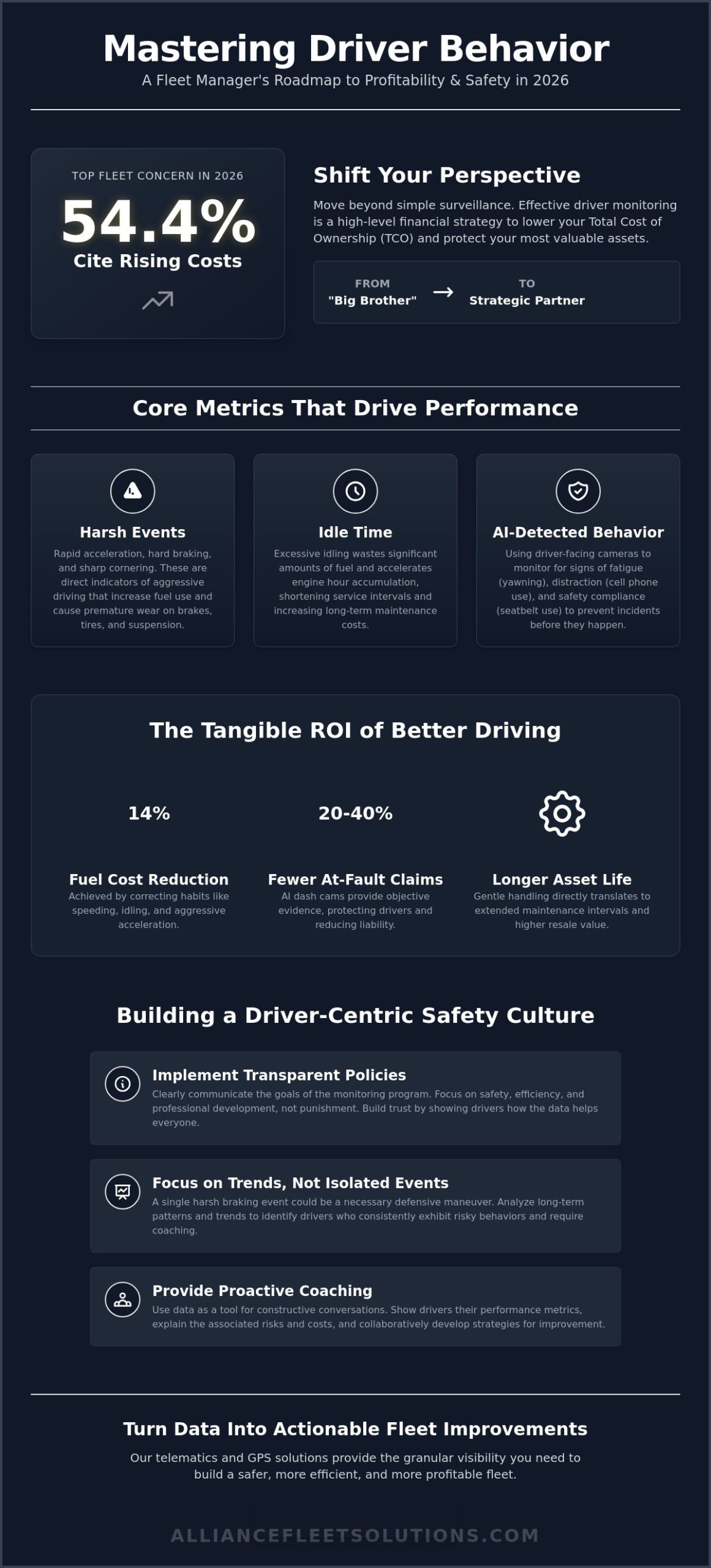
With 54.4% of fleet managers citing rising costs as their top concern in 2026, the difference between a profitable year and a deficit often comes down to what happens in the driver’s seat. You’re likely feeling the pressure of projected insurance premium hikes and the constant drain of fuel waste from idling or speeding. It’s frustrating to invest in high-quality equipment only to see it degraded by harsh handling or to face driver pushback when you mention “Big Brother” surveillance. We understand that your fleet is the backbone of your business, and protecting those assets requires more than just hardware.
This guide will show you how to master driver behavior monitoring best practices to transform monitoring into a strategic partnership. You’ll learn how to reduce maintenance costs, improve safety, and secure a measurable ROI on your telematics and GPS solutions. We’ll explore a framework for building a safety-first culture that rewards professional accountability while utilizing AI-driven insights to keep your operations lean, compliant, and profitable. From navigating the latest FMCSA enforcement rules to optimizing fuel management programs, this roadmap ensures your fleet remains a competitive asset.
Key Takeaways
- Shift your perspective on monitoring from a surveillance tool to a high-level financial strategy that lowers your Total Cost of Ownership.
- Identify the high-impact metrics, such as harsh braking and idle time, that significantly influence fuel waste and long-term engine health.
- Master driver behavior monitoring best practices by implementing transparent safety policies that prioritize professional accountability over punitive measures.
- Learn how gentle vehicle handling directly translates to extended maintenance intervals and more accurate predictive service schedules.
- Discover how fractional fleet management provides the specialized expertise needed to turn complex behavior data into actionable operational improvements.
The Strategic Role of Driver Behavior Monitoring in 2026
Fleet management in 2026 has transitioned from simple asset tracking to a high-stakes game of data-driven precision. Implementing driver behavior monitoring best practices is no longer just a safety initiative; it’s a comprehensive financial strategy. By treating every mile as a measurable performance metric, you can fundamentally lower your Total Cost of Ownership (TCO). This shift moves your operation away from reactive tracking, where data is only reviewed after an incident. Instead, modern managers utilize a Driver Monitoring System (DMS) to facilitate proactive behavioral coaching. This approach stabilizes your business against the projected rise in commercial auto insurance premiums throughout 2026 by proving to underwriters that your fleet is a lower risk.
Beyond Safety: The Financial Impact of Driver Habits
Aggressive driving acts as an invisible tax on your daily operations. Rapid acceleration and hard braking do more than just increase collision risks; they force engines and braking systems to work far beyond their optimal efficiency. Fleets that leverage telematics to correct these habits have reported fuel cost reductions of up to 14%. This efficiency isn’t just about cutting idle time. It’s the result of smoother transitions and consistent speeds that preserve the integrity of your equipment. A 10% reduction in speeding across your fleet contributes significantly to these fuel savings while simultaneously preventing the premature wear of tires and brake pads.
Regulatory Compliance and Liability Protection
Liability is a constant threat in the logistics sector, but data provides a powerful shield. When an incident occurs, having an objective record of driver behavior is your most reliable defense in “he-said-she-said” scenarios. AI-enabled dash cams have been shown to reduce at-fault accident claims by 20% to 40% by providing clear evidence of non-fault. Beyond the courtroom, these data logs streamline ELD compliance and ensure your fleet is prepared for federal safety audits. Perhaps most importantly, consistent monitoring mitigates the legal risk of “Negligent Entrustment.” By actively identifying and coaching high-risk behaviors, you demonstrate a professional commitment to safety that protects your company from claims that you ignored known driver performance issues.
Core Metrics: What Your Monitoring System Should Track
Effective driver behavior monitoring best practices start with identifying which data points actually move the needle for your operation. While basic GPS provides location, high-impact metrics like harsh braking, rapid acceleration, and sharp cornering reveal the mechanical stress placed on your assets. These “G-force” events are direct indicators of aggressive driving that leads to premature maintenance needs. Beyond these sudden movements, monitoring idle time is critical for fuel management. Excessive idling doesn’t just waste fuel; it accelerates engine hour accumulation, which shortens oil life and service intervals. By tracking these core metrics, you gain the visibility needed to protect your equipment from unnecessary wear.
Modern systems distinguish between “event-based” data and “trend-based” behavioral patterns. A single harsh braking event might be a defensive maneuver that prevented a collision. However, a trend of frequent hard braking over a month suggests a driver who consistently follows too closely. Focusing on these long-term patterns allows you to address the root cause of risk rather than reacting to isolated incidents. If you’re ready to move beyond basic tracking, our Telematics and GPS Solutions provide the granular visibility required for high-performance management.
The Rise of AI-Powered Behavioral Insights
AI dash cams have revolutionized how we define driver safety. These systems now detect signs of fatigue and distraction, such as yawning or cell phone use, in real-time. To get a complete picture, you need both road-facing and driver-facing cameras. Road-facing cameras provide context for external events, while driver-facing sensors monitor for seatbelt compliance and alert drivers to dangerous habits before an accident occurs. Integrating these insights with Advanced Driver Assistance Systems (ADAS) gives you a 360-degree view of fleet risk and driver performance.
Contextual Speeding vs. Posted Speed Limits
Tracking speed against the posted limit is only the first step. The real value in 2026 lies in contextual speeding. Driving 55 mph in a 60 mph zone might be “legal,” but it’s dangerous during a heavy rainstorm or in high-traffic areas. Advanced monitoring tools compare vehicle speed against real-time weather and traffic data to determine if a driver is operating safely for the conditions. Geofencing also allows you to trigger specific behavior alerts in high-risk zones like warehouse yards or school districts. Use this checklist to align your metrics with your industry needs:
- Safety: Harsh braking, sharp cornering, and seatbelt use.
- Efficiency: Idle time, rapid acceleration, and out-of-route miles.
- Compliance: HOS violations and unauthorized vehicle use.
- Risk: Distracted driving and fatigue detection.
Best Practices for Implementing a Driver-Centric Monitoring Culture
Technology is only as effective as the people using it. While the hardware provides the data, your drivers provide the results. Many fleet managers encounter immediate resistance when introducing telematics, often labeled as “Big Brother” surveillance. Overcoming this stigma is the most critical hurdle in your safety journey. Successful driver behavior monitoring best practices focus on transparency and partnership rather than pure surveillance. You must frame the system as a tool for driver protection and professional development. When drivers understand that data can exonerate them in an accident or help them earn performance bonuses, the “us versus them” mentality begins to dissolve.
Building this culture starts with a formal, written Driver Safety Policy. This document should clearly outline the goals of the monitoring program, the specific metrics being tracked, and how that data influences employment or rewards. It’s a roadmap for accountability that leaves no room for ambiguity. For businesses without a dedicated safety officer, utilizing Fractional Fleet Management can provide the objective, third-party oversight needed to manage these programs fairly. An external partner brings a level of professional distance that helps keep coaching sessions focused on data and safety rather than personal friction. This structured approach ensures you Optimize Your Fleet: Strategies That Work by aligning driver habits with business objectives.
Gamification and Driver Scorecards
Turning safety into a game is one of the most effective ways to drive engagement. Scorecards transform abstract data like “harsh braking” into a tangible ranking that drivers can see and improve upon. Best practices involve creating incentive programs that offer monthly bonuses, extra PTO, or public recognition for those with the highest safety scores. Competition should always be healthy and constructive. Transparency is essential here; drivers must know exactly how their scores are calculated. If a driver feels a score is unfair due to a specific route or vehicle issue, provide a clear process for review to maintain trust in the system.
Privacy, Transparency, and Legal Boundaries
You must be explicit about what data you collect and who has access to it. In 2026, navigating state-specific privacy laws regarding in-cab recording is a primary responsibility for fleet owners. Some jurisdictions require explicit consent for driver-facing cameras, while others have strict rules about audio recording. Always consult with legal counsel to ensure your monitoring program complies with local regulations. Beyond the law, respect your team’s privacy by limiting data access to essential personnel only. When drivers know their privacy is respected, they’re much more likely to embrace the safety benefits of the system.
Connecting Driver Behavior to Fleet ROI and Maintenance
The financial health of your fleet depends on how your assets are treated on the road. While previous sections focused on safety and culture, the mechanical impact of driver habits is where you’ll see the most significant impact on your bottom line. Gentle driving is the most effective way to extend the interval between routine maintenance tasks. When drivers avoid unnecessary idling and aggressive maneuvers, they reduce the thermal stress on engines and the friction wear on brake systems. Implementing driver behavior monitoring best practices allows you to move beyond static service schedules and embrace a more sophisticated maintenance management strategy.
By analyzing behavior data, you can develop predictive maintenance schedules that reflect the actual wear and tear on each vehicle. A truck driven primarily in stop-and-go city traffic with frequent harsh braking requires a different service cadence than a long-haul vehicle maintained at steady highway speeds. This data-driven approach prevents over-servicing while ensuring that high-risk vehicles receive attention before a minor issue turns into a catastrophic failure. If you want to optimize your fleet’s lifecycle, our Maintenance Management programs provide the expert oversight needed to turn behavior data into a lower cost per mile.
Impact on Lease Terms and Remarketing
Documented driver behavior data is a powerful asset during vehicle remarketing. In open-end leasing structures, the client holds the residual risk, making behavior monitoring a vital financial safeguard. If you can prove a vehicle was operated within safe parameters throughout its life, you can often command a higher resale value at the end of the term. Comprehensive behavior logs act as a certified history that validates the vehicle’s condition for prospective buyers during remarketing. This transparency reduces the uncertainty that often devalues used commercial assets.
Upfitting for Safety and Monitoring
Maximizing the ROI of your monitoring system starts before the vehicle even hits the road. Professional upfitting should include the seamless integration of telematics and safety hardware to ensure reliable data collection from day one. Beyond the electronics, custom configurations like shelving and partitions impact vehicle handling and driver fatigue. A poorly balanced load can lead to sharp cornering alerts or increased braking distances, which may unfairly skew driver scores. Ensuring your fleet is properly upfitted is a core component of The Ultimate Guide to Fleet Management, as it aligns the physical capabilities of the vehicle with your behavioral goals.
Scaling Your Safety Program with Managed Fleet Solutions
Implementing driver behavior monitoring best practices shouldn’t be a burden on your internal team. Software alone won’t reduce your liability or lower your TCO; it takes consistent, expert management to move the needle. Alliance Fleet Solutions serves as the backbone of your operation, transforming raw telematics data into high-level business intelligence. We don’t just provide a dashboard. We provide the technical authority and partnership necessary to ensure your safety program scales alongside your business growth. View your monitoring data not as a series of alerts, but as a strategic asset that preserves your capital and protects your reputation.
For organizations without a dedicated safety officer, Fractional Fleet Management offers a strategic advantage. You get access to seasoned experts who monitor trends, conduct coaching sessions, and refine your safety policies without the overhead of a full-time executive. This proactive oversight ensures that small behavioral issues don’t escalate into costly accidents or insurance hikes. Additionally, by integrating our Fuel Management Programs with behavior data, you can identify discrepancies that suggest fuel theft or mechanical inefficiencies. If a vehicle shows high fuel consumption but low idle time and steady speeds, it’s a clear signal to investigate mechanical health. It’s about seeing the whole picture, not just isolated events.
The Alliance Advantage: Beyond the Software
A software vendor sells you a subscription. A partner like Alliance provides a single point of contact for your entire lifecycle, from vehicle acquisition to remarketing. We analyze your data to identify systemic issues that software might miss, such as specific routes that encourage aggressive driving or equipment configurations that lead to driver fatigue. This comprehensive view ensures your fleet remains a strategic asset rather than a source of stress. We bridge the gap between technical data and financial performance, allowing you to focus on your core business while we handle the complexities of fleet health.
Next Steps: Evaluating Your Current Fleet Safety
Transitioning from manual tracking to an integrated solution requires a clear understanding of your current performance. Use this 5-point audit to evaluate your existing program:
- Review Frequency: Are behavior alerts reviewed and addressed within 48 hours?
- Documentation: Is every coaching session recorded to protect against negligent entrustment claims?
- Driver Engagement: Do your drivers have access to their own scorecards and performance metrics?
- Maintenance Link: Is your behavior data used to trigger predictive maintenance tasks?
- ROI Tracking: Can you clearly measure the impact of monitoring on your insurance and fuel costs?
If your current system falls short, it’s time to move toward a professional partnership. Effective driver behavior monitoring best practices are built on expert oversight and integrated solutions. Contact Alliance Fleet Solutions today to learn how our Telematics and GPS Solutions can transform your fleet into a model of safety and efficiency.
Securing Your Fleet’s Competitive Edge
The transition from basic GPS tracking to a sophisticated safety culture is the most effective way to protect your business assets and profit margins. You now have the strategic framework to move beyond simple surveillance and embrace a management model that prioritizes professional accountability. By focusing on high-impact metrics like harsh braking and idle time, you don’t just improve safety; you directly extend the lifespan of your vehicles and reduce operational waste. Consistent application of driver behavior monitoring best practices ensures that every mile driven contributes to your company’s long-term stability.
Success in the heavy-duty logistics sector requires a partner who understands the mechanics of business efficiency. Whether you’re leveraging our Fractional Fleet Management expertise or utilizing integrated Telematics and GPS Solutions, the goal is to turn raw data into a decisive advantage. Our comprehensive maintenance and fuel programs provide the expert support needed to manage these complexities with confidence. Optimize your fleet safety with a professional management partner. We’re ready to help you build a safer, more profitable operation today.
Frequently Asked Questions
Is driver behavior monitoring legal in the United States?
Monitoring is legal across the U.S., though specific regulations regarding privacy and in-cab cameras vary by state. You should ensure your written safety policy clearly outlines what data is collected and how it’s used. Clear disclosure in employment contracts protects the business from privacy claims while setting professional expectations for every driver on the road. It’s a standard practice for maintaining safety and compliance in the logistics sector.
How much can driver behavior monitoring save on fuel costs?
Fleets utilizing telematics have reported fuel cost reductions of up to 14% by correcting inefficient habits. These savings primarily result from identifying excessive idling and reducing aggressive behaviors like rapid acceleration. Small changes in how a driver handles the vehicle lead to significant cumulative savings across your entire fleet. This direct impact on ROI makes behavior tracking an essential financial strategy for any modern operation.
Will driver monitoring systems increase my employee turnover?
Turnover typically doesn’t increase if you implement the system with a focus on coaching rather than punishment. When you use data to recognize and reward top performers, it can actually improve retention by making your best drivers feel valued. Drivers appreciate having objective proof of their professional skills. Creating a culture of accountability helps your team understand that the system is there to support their safety and career growth.
What is the difference between telematics and driver behavior monitoring?
Telematics refers to the hardware and communication technology that transmits vehicle data to your management office. Driver behavior monitoring is the strategic analysis of that data to evaluate how a person operates the vehicle. While telematics tells you where the truck is, behavior monitoring tells you how it’s being driven. Both are necessary components of a comprehensive fleet management program that prioritizes safety and efficiency.
Can driver behavior data be used in court after an accident?
Data logs and AI dash cam footage are powerful tools for liability protection and are frequently used as evidence in court. This objective record can exonerate your drivers in “he-said-she-said” accident scenarios by proving they followed safety protocols. By following driver behavior monitoring best practices, you provide your legal team with the evidence needed to protect your company from high-cost settlements and unfair liability claims.
How do I introduce a monitoring system to my team without losing their trust?
Introduce the system by focusing on driver protection and exoneration first. Explain how the data defends them against false claims and helps identify mechanical issues before they cause a breakdown on the road. Being open about the specific metrics you track prevents the “Big Brother” stigma from taking root. When drivers see the system as a safety net rather than a surveillance tactic, they’re much more likely to support it.
What are the best incentives for high-performing drivers?
The most effective incentives are those tied directly to objective safety scorecards, such as monthly bonuses or extra paid time off. You might also use public recognition to highlight the “Driver of the Month” based on their performance metrics. These rewards reinforce positive habits and foster healthy competition within your team. Using driver behavior monitoring best practices ensures that your incentive program is fair, transparent, and based on verifiable data.
Does driver behavior monitoring work for small fleets?
Monitoring is often more critical for small fleets where a single accident can be financially devastating to the business. Modern telematics and GPS solutions are highly scalable, allowing smaller operations to access the same safety benefits as large corporations. Managed services provide the expert oversight you need without requiring you to hire a dedicated safety manager. It’s an essential tool for any small business looking to control costs and improve safety.