
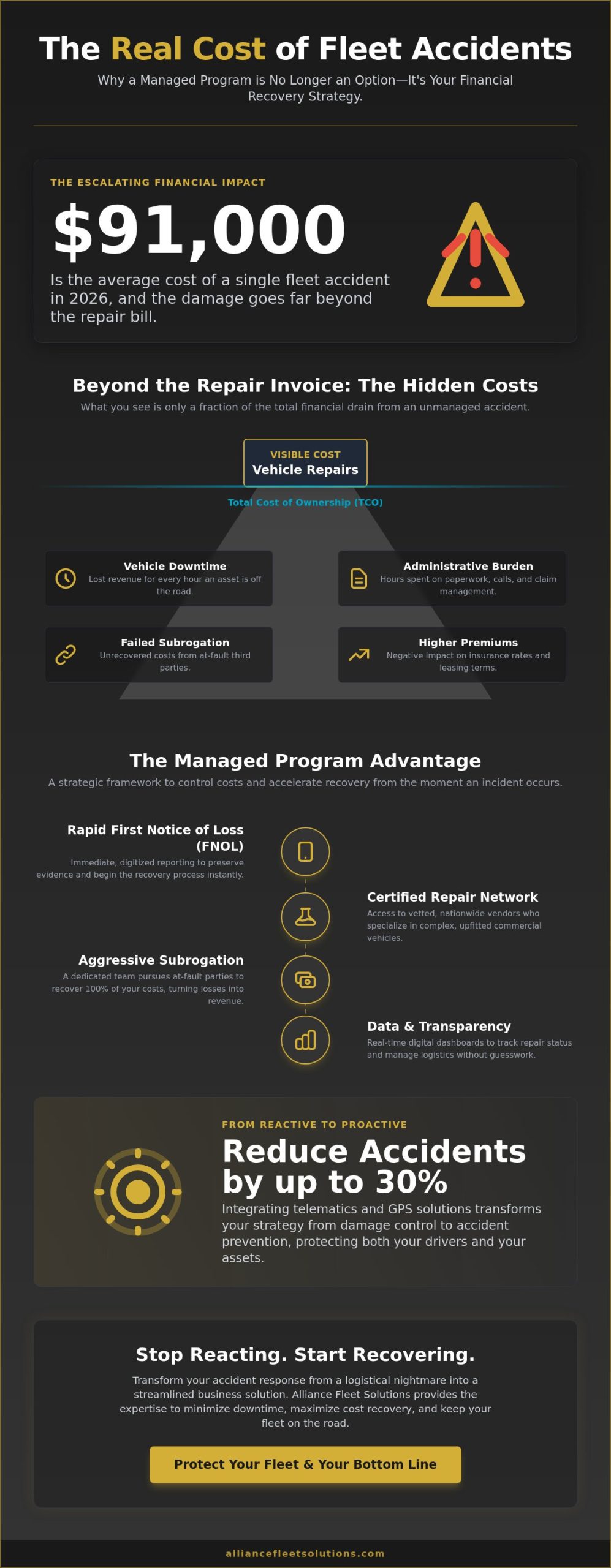
Did you know the average cost of a single fleet accident has climbed to $91,000 in 2026? For most logistics managers, an accident isn’t just a safety concern; it’s a logistical nightmare involving high administrative burdens, extended vehicle downtime, and unrecovered costs from third parties. It’s frustrating to watch your bottom line suffer while a critical asset sits idle. Implementing a professional fleet accident management program is no longer just a safety measure; it’s a financial recovery strategy that ensures your business remains resilient in a high-stakes environment.
We understand that you need more than just a repair schedule; you need a partner who views technical tasks as comprehensive business solutions. You’ll learn how to minimize downtime, recover costs through aggressive subrogation, and protect your margins. We’ll also preview how the latest 2026 FMCSA digital compliance rules impact your operations and how telematics can reduce your accident rates by up to 30%. This guide provides the roadmap to faster return-to-service and improved driver safety for your entire operation.
Key Takeaways
- Discover why a professional fleet accident management program acts as a financial recovery tool that goes beyond standard insurance to protect your operational budget.
- Learn how rapid First Notice of Loss (FNOL) and aggressive subrogation strategies can recover significant capital from at-fault third parties.
- Compare the limitations of DIY software against the comprehensive support of managed services and fractional fleet management for mid-sized operations.
- Understand how integrating telematics and GPS solutions transforms your strategy from reactive repairs to proactive accident prevention.
- Explore how aligning accident recovery with professional upfitting keeps your vehicles specialized and ready for a faster return-to-service.
What is a Fleet Accident Management Program and Why Does It Matter?
A fleet accident management program is a strategic framework designed to handle the entire lifecycle of a vehicle collision. It starts the moment a driver reports the First Notice of Loss (FNOL) and continues through repair coordination and subrogation. While many business owners assume their standard insurance policy covers these bases, insurance is primarily a financial safety net for physical repairs. A managed program, by contrast, is an operational engine that minimizes the chaos following an incident. It acts as a dedicated partner, managing the technical details so your team can focus on core logistics.
The true cost of an accident often exceeds the body shop’s invoice. Beyond the physical damage, you face “hidden costs” like administrative labor, lost productivity, and the administrative stress of managing complex claims. When you calculate the Total Cost of Ownership (TCO), these variables can inflate the price of an accident far beyond the $91,000 industry average recorded in 2026. A professional Accident management approach streamlines these tasks. It ensures that every hour usually spent on paperwork is replaced by an hour spent on profitable operations.
The Financial Impact of Unmanaged Accidents
Specialized vehicles represent a significant capital investment. When an asset with professional upfitting is off the road, the loss of revenue is immediate and compounding. Unmanaged accidents often lead to failed subrogation; if you don’t aggressively pursue at-fault third parties, you’re leaving company profits on the table. Your accident history also directly influences your commercial vehicle leasing terms. High loss ratios can lead to less favorable rates in open-end leasing structures, where the business bears more of the residual risk. Managed programs help maintain the asset’s value, protecting your bottom line during the vehicle’s eventual remarketing.
Protecting Your Assets and Your Drivers
Providing drivers with reliable support during the high-stress moments following a collision is crucial for retention. A managed program offers a clear, calm protocol for the driver, which improves the overall safety culture of the organization. By maintaining a meticulous digital trail of every incident, business owners also reduce their legal liability. While results vary by industry, fleets utilizing a professional fleet accident management program typically see a faster return-to-service for their vehicles. This proactive stance transforms a mechanical fix into a comprehensive business solution that keeps your fleet moving safely and efficiently.
The Core Components of an Effective Accident Management Strategy
Speed serves as the foundation of any resilient fleet accident management program. The process begins with the First Notice of Loss (FNOL), which is the immediate report of an incident. In the logistics sector, every hour of delay in reporting an accident correlates with increased claim costs and extended vehicle downtime. Rapid FNOL ensures that evidence is preserved, witnesses are contacted, and the repair cycle begins before the vehicle even leaves the scene. By digitizing this initial step, managers gain an immediate advantage in controlling the narrative and the subsequent expenses.
A nationwide network of certified repair facilities is equally vital, especially for fleets utilizing specialized equipment. You can’t trust a highly technical, upfitted asset to a generalist body shop. A managed strategy provides access to vendors who understand the specific requirements of heavy-duty industrial vehicles. This network ensures that repairs meet original manufacturer standards, preserving the safety and longevity of the asset. Throughout this process, data transparency remains a non-negotiable requirement. Modern managers utilize real-time digital dashboards to track repair progress, allowing them to adjust delivery schedules and manage client expectations without making a single phone call.
Mastering the Subrogation Process
Subrogation is the legal process where your management partner pursues the at-fault party’s insurance company to recover costs paid out for a claim. While standard insurance adjusters often settle for the quickest path to closure, dedicated subrogation specialists focus on maximizing your recovery. They possess the technical expertise to argue for the full value of repairs and associated administrative fees. Subrogation serves as a critical profit-recovery tool for 2026, ensuring that at-fault third parties remain financially accountable for the disruption they cause to your operations. This aggressive recovery of capital directly offsets the total cost of the incident.
Streamlining Repair Management
Balancing high-quality repairs with the need for a rapid return-to-service requires expert oversight. Post-accident inspections should integrate seamlessly with your broader maintenance management schedule to ensure no secondary mechanical issues were triggered by the collision. When a vehicle features professional upfitting, the repair must return the equipment to its exact operational specifications. This level of detail prevents future equipment failure and maintains the integrity of your fleet. If you want to see how a structured partnership can simplify these complex logistics, you can explore our comprehensive fleet solutions to find a plan that fits your specific operational needs.
Software vs. Managed Services: Choosing the Right Approach
Many businesses fall into the trap of thinking a mobile app can handle the aftermath of a collision. While digital tools are excellent for data collection, software alone cannot negotiate a complex subrogation claim or hold a body shop accountable for a delayed repair. A truly effective fleet accident management program requires a balance between technological efficiency and human expertise. Choosing between a DIY software approach and a managed service depends on whether you want a digital filing cabinet or a strategic partner who actively recovers your capital.
Software records what happened, but it doesn’t solve the problem. When a liability dispute arises, human intuition and industry experience are required to determine fault and challenge unfair insurance adjustments. We position ourselves as the backbone of your operation, acting as an extension of your team rather than just another vendor. This partnership ensures that technical tasks are handled by experts who speak the language of both the body shop and the insurance adjuster, moving beyond the limitations of automated alerts.
When Software is Not Enough
The administrative burden of managing a fleet shouldn’t be underestimated. Using standalone apps often creates data silos where accident reports don’t talk to your maintenance logs or leasing data. This lack of integration is a major hurdle to efficient fleet operations. Without a managed partner, your staff must still spend hours chasing repair updates and verifying mechanic signatures. A managed service removes this “alert fatigue” by handling the logistics for you, ensuring that every data point is used to drive ROI rather than just filling up a database.
The Fractional Management Advantage
For fleets with 10 to 100 vehicles, hiring a full-time accident clerk is rarely cost-effective. This is where Fractional Fleet Management provides a distinct advantage. It allows small to mid-sized businesses to access enterprise-level expertise without the overhead of a dedicated in-house department. By outsourcing these duties, business owners can focus on core growth while knowing their accident lifecycle is under expert control. The cost-benefit is clear: the money saved through better subrogation recovery and reduced downtime typically far outweighs the service fee, making it a more sustainable model than DIY management.
Integrating Telematics and Prevention into Your Program
A resilient fleet accident management program evolves from a reactive safety net into a proactive shield through the integration of modern technology. While recovering costs is essential, the most efficient way to protect your bottom line is to ensure the accident never occurs. Advanced telematics and GPS solutions provide the granular visibility needed to identify high-risk driving behaviors before they result in a collision. By monitoring speed, cornering, and braking patterns, managers can intervene with targeted coaching that addresses the root causes of road risk. This data-driven approach can reduce fleet accidents by as much as 20% to 30%.
Objective evidence is the strongest tool in any liability dispute. Dash cams and impact sensors remove the ambiguity from claims, providing a clear digital record of events. This transparency doesn’t just protect the company from fraudulent third-party claims; it also protects your drivers by proving their adherence to safety protocols. When data shows a driver acted correctly, the administrative burden of the claim drops significantly. This allows for a much faster resolution and preserves your company’s reputation.
Leveraging Data for Accident Prevention
Predictive analytics use harsh braking and rapid acceleration data to identify drivers who are statistically more likely to be involved in a future incident. Modern telematics integration also speeds up the FNOL process by automatically triggering an alert the moment a high-G force event is detected. This instant notification allows your management team to begin the recovery process while the vehicle is still at the scene. Real-time synchronized data drastically reduces corporate liability in 2026 by demonstrating a proactive and documented commitment to public safety.
Building a Driver Safety Program
Establishing a “Safety First” culture requires more than just a handbook; it requires consistent, data-driven feedback. There is a direct, measurable connection between safe driving habits and operational cost savings. For example, smooth acceleration and consistent speeds don’t just prevent accidents; they also maximize your vehicle’s fuel economy. Integrating fuel management programs with safety data allows you to reward drivers who excel in both efficiency and caution. This holistic approach turns safety into a competitive advantage rather than a compliance chore. If you’re ready to modernize your approach, request a consultation for our telematics and GPS solutions to see how we can protect your fleet.
How Alliance Fleet Solutions Optimizes the Accident Lifecycle
Alliance Fleet Solutions acts as the essential backbone of a functional, resilient fleet operation. We don’t view a fleet accident management program as an isolated administrative task or a reactive safety net. Instead, it’s a critical phase within the entire vehicle lifecycle that requires expert oversight. By consolidating leasing, maintenance, and accident recovery under one roof, we eliminate the friction that usually slows down return-to-service times. This integrated approach ensures that data flows seamlessly between departments, providing a clear picture of an asset’s health and financial performance from acquisition to disposal.
A single-partner model creates massive efficiencies for business owners. When your accident manager already understands your leasing structure and maintenance history, the path to resolution is much shorter. You won’t have to act as a middleman between three different vendors during a crisis. We take charge of the technical details, projecting an image of calm, expert control that alleviates the stress of operational downtime. This ensures that every mechanical fix is treated as a comprehensive business solution designed to protect your margins.
Seamless Integration from Acquisition to Disposal
When a collision involves a vehicle with professional upfitting, the complexity of the repair doubles. Generalist body shops often overlook the technical specifications of specialized industrial equipment, leading to future failures. We ensure every asset is repaired to OEM and industry standards, preserving both safety and the integrity of your upfitted gear. This level of detail remains vital when it comes time for vehicle remarketing. Having a complete, transparent record of accident repairs allows us to defend the vehicle’s value during resale. We reduce the traditional conflict between the leasing company and the accident manager because we represent your total business interest, prioritizing the long-term recovery of your capital.
Your Strategic Partner in Fleet Resilience
Our commitment goes beyond mechanical fixes; we focus on protecting your business capital and maintaining your operational momentum. The chaos following a collision requires a professional, no-nonsense response that handles the heavy lifting for you. Alliance manages the entire lifecycle, from the initial reporting to the final subrogation recovery. This proactive stance is what distinguishes a service provider from a strategic business asset. Whether you utilize open-end leasing or closed-end leasing, our fleet accident management program adapts to your specific financial goals. Safeguarding your fleet’s future requires a partner who understands the mechanics of the industry and the language of business efficiency. Partner with Alliance Fleet Solutions to build a more resilient fleet today.
Building a More Resilient Fleet for 2026
Your fleet remains one of your most significant capital investments. Protecting that investment requires moving beyond reactive repairs and toward a proactive, integrated fleet accident management program. By focusing on rapid FNOL, aggressive subrogation, and the seamless integration of telematics data, you transform a logistical headache into a streamlined process that preserves your bottom line. We’ve explored how the right partnership reduces the administrative burden of claims and ensures that specialized, upfitted vehicles return to service faster.
Alliance Fleet Solutions provides the expert subrogation specialists needed to maximize your cost recovery and a nationwide network of certified repair facilities to maintain OEM standards. Our comprehensive integration with telematics and leasing programs ensures your operation remains efficient and compliant with the latest industry standards. Don’t let the chaos of a collision derail your operational momentum. Protect your fleet and minimize downtime with Alliance Fleet Solutions. We are ready to act as the essential backbone of your functional operation, ensuring your business stays moving regardless of the challenges on the road.
Frequently Asked Questions
What is the first step a driver should take after a fleet accident?
After ensuring personal safety and contacting emergency services, the driver must report the incident to the fleet manager or management partner immediately. This triggers the First Notice of Loss (FNOL) process, which is critical for preserving evidence and starting the repair cycle. Rapid reporting ensures that data from telematics systems is captured while the details are fresh, allowing the management team to take control of the situation right away.
How does an accident management program differ from commercial auto insurance?
Commercial auto insurance provides a financial payout for covered damages, while a fleet accident management program handles the operational logistics of the entire incident. Insurance companies focus on settling the claim, but a managed program oversees the entire lifecycle, including vehicle recovery, repair quality control, and administrative paperwork. This comprehensive oversight minimizes the hidden costs of downtime that standard insurance policies often ignore.
What is subrogation and how does it help my business recover money?
Subrogation is the legal process where your management partner pursues the at-fault party’s insurer to recover costs you’ve already paid. This includes your deductible, repair expenses, and sometimes even loss of use fees. By utilizing dedicated specialists, your business recovers capital that would otherwise be lost, directly offsetting the total cost of the accident and protecting your operational budget from third party negligence.
Can a fleet accident management program help reduce my insurance premiums?
Yes, consistently using a managed program can lead to lower insurance premiums over time by improving your fleet’s safety profile. These programs use data to identify risky behaviors and implement driver coaching, which reduces the frequency and severity of claims. Insurance providers often offer better rates to companies that demonstrate a proactive, documented commitment to reducing road risk and managing incidents with professional oversight.
How does telematics data assist in the accident claims process?
Telematics data provides an objective digital record of the moments leading up to and during a collision, such as vehicle speed and braking force. This evidence is vital for determining fault and defending against fraudulent claims. Additionally, impact sensors can trigger an automatic notification to the management team, allowing the recovery process to begin before the driver even has the chance to place a phone call.
What happens if a specialized upfitted vehicle is totaled in an accident?
If a vehicle with professional upfitting is totaled, our vehicle remarketing team works to recover the maximum salvage value from the remaining assets. Simultaneously, our acquisition and upfitting specialists coordinate to source and prepare a replacement vehicle that meets your exact operational specifications. This integrated approach ensures that the loss of a specialized asset doesn’t result in a permanent gap in your service capabilities or revenue stream.
How long does it typically take to get a vehicle back on the road with a managed program?
While repair times depend on the extent of the damage, a managed program significantly reduces the duration of the repair cycle compared to unmanaged fleets. By utilizing a nationwide network of certified shops and real time tracking, we eliminate the administrative delays that often keep vehicles sitting idle. Our goal is to streamline every step, from the initial estimate to the final inspection, ensuring a faster return to service.
Is a managed program cost-effective for a small business fleet?
A managed program is highly cost-effective for small fleets, particularly through a fractional fleet management model. Small businesses often lack the internal resources to hire a full time accident clerk, making the expertise of an external partner invaluable. The capital recovered through aggressive subrogation and the reduction in downtime costs typically provide a significant return on the service investment for smaller operations.