
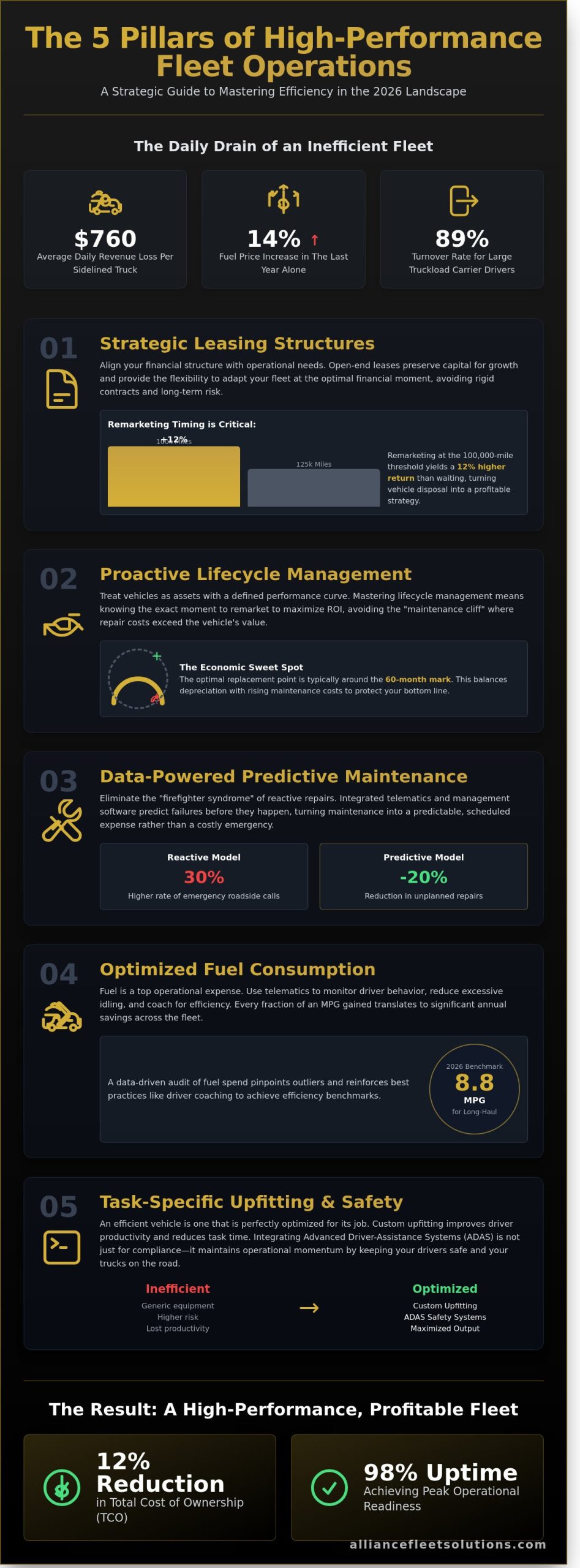
If your vehicles aren’t moving, you’re losing more than just time; you’re bleeding an average of $760 per day for every truck stuck in the shop. You already know that unpredictable maintenance schedules and fuel prices that rose by 14% last year make it nearly impossible to hit your quarterly targets. It’s frustrating to manage fragmented data across multiple platforms while insurance premiums continue to climb. Achieving efficient fleet operations isn’t just a goal for 2026; it’s the only way to protect your bottom line in a high-stakes logistics market.
We’ve designed this guide to help you master the core pillars of fleet efficiency, ensuring you reduce your total cost of ownership by at least 12% through proactive strategies. You’ll learn how to transform your vehicles from simple transport tools into strategic business assets that hold their value. We’ll walk you through the exact steps to create predictable monthly expenses, streamline driver productivity, and maximize your remarketing returns when it’s time to sell. It’s time to take expert control of your assets and turn every mile into a measurable return on investment.
Key Takeaways
- Shift your focus from initial purchase prices to Total Cost of Ownership (TCO) to unlock hidden profitability in the 2026 landscape.
- Master the art of lifecycle management to determine the exact moment to remarket vehicles for the highest possible return on investment.
- Eliminate “firefighter syndrome” by transitioning to efficient fleet operations powered by integrated management software and predictive maintenance.
- Execute a data-driven audit of your fuel and maintenance spend to pinpoint cost outliers and streamline your current asset inventory.
- Learn how to transform your service provider into a strategic partner that integrates leasing, upfitting, and management for long-term success.
Defining Efficient Fleet Operations in the 2026 Landscape
As we enter 2026, the definition of efficient fleet operations has evolved beyond simple fuel savings. Leading logistics firms now measure success through Total Cost of Ownership (TCO) rather than just the initial purchase price of a vehicle. A 2025 study by the American Transportation Research Institute (ATRI) found that operational costs rose to $2.27 per mile, meaning every cent saved across the vehicle lifecycle is vital for profitability. We’ve seen a definitive shift where predictive maintenance provides a 20% reduction in unplanned repairs compared to the reactive cycles of the previous decade. Transitioning to a data-driven model allows managers to fix components before they fail, turning maintenance into a predictable line item rather than a budget-breaking surprise.
An inefficient fleet acts as a leaky bucket for business capital. It drains resources through emergency surcharges and erodes driver morale. When a truck breaks down, the driver loses valuable hours of service and potential income. This frustration contributes to the high turnover rates that currently average 89% for large truckload carriers. True efficiency happens at the intersection of real-time telematics, driver behavior monitoring, and precise physical vehicle specifications. By aligning these factors, you create a strategic alliance between your hardware and your human capital. Our focus is to ensure your equipment remains a productive asset rather than a liability sitting in a shop.
These principles apply universally, from industrial logistics to executive transport. A premier chauffeur service like Epic Limousines, for instance, builds its entire brand on the pristine condition and reliability of its high-end fleet, proving that meticulous asset management is key to success in any vehicle-dependent business.
In the United States, a provider like MSP Car Service demonstrates this same principle. Their entire operation depends on immaculate vehicle maintenance and scheduling to serve the Minneapolis-St. Paul corporate transport market. For any company whose brand relies on punctuality and presentation, whether it’s a national logistics firm or a local executive car service, rigorous fleet management is the foundation of their reputation.
In the Dallas-Fort Worth Metroplex, the success of a premium service like 1Executive Car is built on this very foundation, where pristine vehicle condition and guaranteed punctuality are non-negotiable elements of their brand promise.
This extends to the moving and storage sector as well. A family-owned company like All American Moving And Storage relies entirely on the operational readiness of its truck fleet to meet customer commitments and safeguard belongings during transit, proving that disciplined asset management is vital for local service businesses.
Similarly, in the Pacific Northwest, the success of a high-end provider like NG Town Car Service hinges on the same commitment to operational excellence. For executive transport, where punctuality and vehicle condition are paramount, their fleet management strategy is a direct reflection of their brand’s promise of reliability and luxury.
This principle of meticulous asset management is universal, extending even to marine-based businesses. For a company in the tourism and recreation sector, such as Blue Barracuda Charters, the reliability and safety of their boat fleet are paramount. Their success hinges on the same pillars of proactive maintenance and operational readiness that define any high-performing fleet, whether on land or at sea.
In the luxury marine sector of Southern California, this is even more pronounced. A premier charter service’s entire brand promise rests on the flawless condition and operational readiness of their yachts. For a provider like bellaboating.com, meticulous fleet management is the foundation for delivering the high-end experiences their clients expect.
The True Cost of Vehicle Downtime
Industry data shows that an out-of-service Class 8 vehicle costs a company between $500 and $800 per day in lost revenue. This figure excludes the $160 average hourly rate for emergency mobile repairs or the long-term damage to customer trust. When a delivery window is missed by more than three hours, the probability of contract renewal drops by 15% according to recent logistics surveys. One stalled unit creates a ripple effect. It forces other drivers to deviate from their optimized routes to cover the load, which increases fleet-wide fuel burn and accelerates wear on remaining vehicles.
Efficiency vs. Effectiveness: Finding the Balance
Cutting maintenance budgets by 12% might look good on a quarterly spreadsheet, but it often leads to catastrophic engine failures that cost $35,000 or more. 2026 benchmarks for efficient fleet operations require a minimum of 8.8 MPG for long-haul routes and a 98% uptime rate. Prioritizing driver safety through advanced driver-assistance systems (ADAS) isn’t just a compliance check; it’s a strategy to maintain operational momentum. A safe fleet is a productive fleet. We help you streamline these processes, ensuring that your cost-saving measures never compromise the mechanical integrity or the safety of your drivers on the road.
The 5 Strategic Pillars of High-Performance Fleet Operations
To master efficient fleet operations, you’ve got to treat your vehicles as mobile assets rather than just tools. High-performance fleets built for 2026 rely on five core pillars that balance immediate uptime with long-term ROI. These include aligning your financial structure with cash flow, managing lifecycles to avoid the maintenance cliff, and using predictive data for preventive maintenance. Additionally, managing fuel consumption through driver coaching and ensuring every vehicle is physically optimized for its specific task are non-negotiable requirements for profitability. For example, moving to a predictive maintenance model can reduce emergency roadside service calls by 30% while extending the functional life of heavy-duty components.
Leasing Structures as an Efficiency Tool
Choosing between lease types dictates your capital agility. Closed-end leases offer fixed costs and zero residual risk, which suits businesses with predictable, low-mileage routes. However, most service-oriented fleets benefit from open-end structures. By using this model, open-end leasing preserves capital for growth. These flexible terms allow you to refresh your fleet as soon as a vehicle reaches its peak resale value, typically around the 60-month mark, rather than being locked into a rigid contract. Remarketing at the 100,000-mile threshold often yields a 12% higher return than waiting until 125,000 miles, making timing a critical financial lever.
Telematics and GPS: The Nervous System of the Fleet
Modern efficient fleet operations don’t just track dots on a map. They use engine diagnostics to identify a failing alternator weeks before a driver gets stranded. Data from 2025 shows that real-time alerts for excessive idling can save a company up to $1,200 per vehicle annually in wasted fuel. Integrating telematics and gps solutions provides the visibility needed to curb unauthorized use and improve driver safety scores by 22% on average. This technology acts as your early warning system, turning reactive repairs into planned events that don’t disrupt your service schedule.
As these telematics systems become more integrated, they also create critical new challenges for network management and cybersecurity. To ensure your team is equipped with the necessary skills to protect this data infrastructure, you can discover Insoft Services.
Of course, the success of these advanced systems depends on a robust IT and telecommunications backbone. Ensuring seamless data flow from every vehicle to your central office requires specialized support. This is where firms like SolaaS LTD provide the tailored and scalable infrastructure necessary to power modern fleet operations.
To see how award-winning IT support can help you integrate these technologies seamlessly and drive further efficiency, you can learn more about bespoke solutions tailored for business growth.
This level of data integration is pushing the industry toward even greater automation. For example, some companies now explore voice agents that allow drivers to report maintenance needs or log updates hands-free, streamlining the process from the road to the back office.
As fleets adopt more digital tools for tracking, fuel management, and logistics, managers often need to register for various online services. For those looking to keep their main phone lines secure and free from spam during these sign-ups, services like RentalNumbers.com provide temporary numbers for SMS verification.
Professional Upfitting: Building for the Job
Stock vehicles often cause operational bottlenecks that eat into your margins. When a technician spends 10 minutes searching for a part because of poor shelving, you’re losing money. Professional upfitting solves this by tailoring the interior to the specific industry task. Consider these benefits:
- Custom storage solutions can increase a driver’s stops-per-day by 15%.
- Weight-optimized aluminum shelving improves fuel efficiency by 3% compared to steel alternatives.
- On-board power solutions eliminate the need for idling to run tools, saving an average of one gallon of fuel per hour.
If you’re looking to reduce friction in your daily workflows, consulting with a fleet specialist can help identify which upfitting configurations will maximize your field team’s output and safety.
Overcoming the #1 Efficiency Killer: Reactive Management
Reactive management, often called “Firefighter Syndrome,” destroys ROI by forcing fleets into a perpetual state of crisis. When you wait for a breakdown to occur, repair costs typically spike by 300% compared to scheduled service. Moving beyond manual spreadsheets is the first step toward efficient fleet operations. By 2026, relying on Excel for a 50-vehicle fleet creates a 15% margin of error in service interval tracking. Integrated fleet management software centralizes every data point, allowing managers to identify “lemon” vehicles that consume 20% more budget than the fleet average before they drain quarterly profits.
For a masterclass in proactive management, one only needs to look at the commercial aviation industry, where predictive maintenance isn’t just about efficiency—it’s a fundamental requirement. This rigorous approach is instilled from day one in professional training, with premier flight academies like 2FLY Airborne teaching future pilots the importance of an operations-first mindset.
Just as pilots train for technical excellence, fleet managers must cultivate the leadership skills necessary to guide their own crews. To build a more cohesive culture, you can explore Online courses on teamwork that focus on high-performance dynamics and strategic communication.
- Identify high-cost assets using real-time repair history.
- Eliminate manual entry errors that lead to missed DOT inspections.
- Automate service alerts to prevent catastrophic engine failures.
- Centralize records to simplify compliance audits and insurance renewals, a process made easier when working with a specialized provider like SI Insurance.
Transitioning to an integrated system isn’t just about digital record-keeping. It’s about visibility. When maintenance records live in a single, accessible hub, you can spot patterns that manual logs hide. For example, if a specific truck model shows a 25% higher failure rate in cooling systems at the 80,000-mile mark, you can proactively replace those components across the entire fleet. This shift from “fixing what’s broken” to “preventing the break” is what separates profitable fleets from those struggling with unpredictable overhead.
For large-scale operations, this central hub is often powered by robust enterprise resource planning (ERP) systems. Ensuring these complex platforms are optimized for tasks like payroll, compliance, and financial reporting is a specialized skill. Experts in this area, like PS WebSolution, focus on automating these back-end processes, which frees up managers to focus on the fleet itself rather than administrative bottlenecks.
The Power of Fractional Fleet Management
Many mid-sized companies lack the $130,000 annual budget required for a dedicated, full-time Fleet Director. Fractional fleet management bridges this gap, providing enterprise-level strategy at a fraction of the executive salary. These partners handle the exhausting busy work of registration renewals, titling, and fine management. By leveraging a partner’s collective buying power, fleets often see a 12% reduction in parts procurement costs and better priority during vehicle acquisition cycles. It’s a strategic alliance that turns a cost center into a streamlined asset.
This strategic mindset also applies to the leadership responsible for these assets. A director’s ability to command respect and project competence is just as vital as the fleet’s uptime. This principle of professional presentation is explored by designers like Alvin Valley, who view well-crafted attire as a key component of executive presence.
This principle of leveraging specialized expertise applies across all industries. For example, a growing legal practice might not have an in-house marketing director but can achieve significant growth by partnering with a specialized law firm marketing agency to build a predictable client acquisition system. In both cases, the goal is to turn a complex operational challenge into a streamlined, revenue-generating asset.
This need for specialized guidance is even more critical for companies managing international operations. For instance, a logistics firm expanding from Italy into the U.S. market must navigate complex cross-border business and immigration laws, a challenge that requires a dedicated legal partner. In these situations, firms like Tosolini, Toniutti & Partners become essential for structuring the business and securing visas for key personnel, ensuring the entire operation, from assets to people, is legally sound.
Similarly, for companies looking to tap into the rapidly growing markets of the Middle East, establishing a base in a major logistics hub is key. The process of a dubai free zone company setup offers a strategic advantage, providing access to global trade routes and a favorable business environment. This move allows a company to extend its operational reach and build a resilient international supply chain, a process often facilitated by partners like Global Exclusive Trading (GET) who specialize in connecting domestic and international markets.
Predictive Maintenance Strategies
The 2026 standard for high-performing fleets centers on predictive maintenance driven by real-time telematics. Instead of static schedules based on fixed 5,000-mile increments, sensors dictate a living maintenance plan based on actual engine hours and load stress. Bringing the shop to the vehicle through mobile repair is no longer a luxury; it’s a necessity for efficient fleet operations. This model eliminates the 2.5 hours of average dead time spent transporting trucks to brick-and-mortar facilities. On-site service ensures your drivers stay on their routes, directly boosting your total uptime and reducing fuel waste from unnecessary transit to repair shops.
This on-site service model extends beyond mechanical repairs. Common issues like a lost or damaged transponder key can halt operations instantly, making a rapid mobile response crucial. For fleets needing this type of specialized support to minimize downtime, you can discover Prestige Mobile Locksmith and see how on-site key replacement services work.
The right service partner makes all the difference in executing this model. For businesses running fleets that include European vehicles, for instance, you can discover Euro Performance Auto Shop LLC to see the value of specialized, expert service.
Implementing a Data-Driven Efficiency Audit
Achieving efficient fleet operations requires a shift from reactive maintenance to rigorous, data-led scrutiny. By Q2 2026; successful managers are using a five-step audit to eliminate hidden costs and streamline their logistics backbone. This isn’t a surface-level review; it’s a deep dive into the mechanics of your business. Use these steps to build your 2026 strategy:
- Inventory and Lifecycle Stage: Catalog every asset and its current mileage. Identify units approaching the 200,000-mile mark where repair costs typically spike by 25% or more.
- 12-Month Spend Analysis: Review all fuel and maintenance invoices from the past year. Focus on identifying the “bottom 10%” of your fleet. These outliers often account for 30% of total repair spend.
- Upfitting Evaluation: Compare current vehicle specs against actual job-site requirements. If a service van carries 600 lbs of unused shelving, it’s wasting fuel and increasing brake wear every single day.
- Driver Performance Benchmarking: Analyze telematics data for idling, harsh braking, and speeding. Improving driver behavior can reduce fuel consumption by 10% across the board.
- Financing and Lease Review: Audit your current debt or lease obligations. In the 2026 economic climate; restructuring high-interest terms can save a mid-sized fleet $45,000 in annual overhead.
Identifying ‘Waste’ in the Fleet Lifecycle
Holding onto assets for too long is a common trap that erodes ROI. When you keep a Class 8 truck past its optimal trade cycle, the total cost per mile (TCPM) begins to outpace the cost of a new lease. We’ve seen maintenance costs rise by $0.15 per mile once a vehicle passes its fifth year of service. The 2026 used vehicle market remains competitive; so remarketing underutilized assets now is a strategic move. If a truck’s utilization rate stays below 60% for two consecutive quarters, it’s a candidate for redeployment or sale. Don’t let depreciating metal sit idle in your yard.
Alternatively, some managers now turn to the sharing economy to generate revenue from underutilized assets. Rental marketplaces like life4rent.com provide a platform to list and rent out equipment, turning idle time into income and offsetting the costs of ownership.
Fuel Management: Beyond the Pump
Fuel represents roughly 32% of total operating costs, making it a primary target for optimization. You need a strategy that targets more than just the price per gallon. Implementing fuel management programs helps prevent unauthorized spending and card fraud, which accounts for 3% of average fleet spend. Route optimization also plays a critical role in your sustainability goals. By reducing idle time by 20 minutes per day across a 50-vehicle fleet, a company can lower its carbon footprint by 15 metric tons of CO2 annually while saving thousands in fuel costs.
Stop letting hidden inefficiencies drain your bottom line. Partner with us to optimize your fleet performance and secure your 2026 ROI.
Building an Alliance: Strategic Partnership for Long-Term ROI
Achieving efficient fleet operations requires more than a simple vendor list. You need a partner that views your ROI as their primary metric. A vendor sells you a part; a partner secures your uptime. Alliance Fleet Solutions bridges the gap between massive national infrastructure and the dedicated attention of a family-owned business. We integrate leasing, upfitting, and ongoing management into a single, cohesive workflow. This eliminates the communication silos that often lead to a 15% to 20% increase in hidden operational costs.
Effectively managing this network of dealers, service centers, and suppliers is a discipline in itself, known as partner relationship management. For those looking to formalize and automate these interactions, you can visit Computer Market Research for a comprehensive guide on the subject.
Our national reach provides the scale needed for volume pricing and rapid parts sourcing; however, we maintain the professional touch of a family-owned firm. You won’t get lost in a corporate call center. Instead, you gain a dedicated team that treats your uptime as a personal priority. We move beyond simple maintenance by offering a full-spectrum alliance that aligns your vehicle acquisition with your long-term financial goals.
Customized Acquisition and Upfitting
Selecting the right vehicle starts with data, not a catalog. We analyze your specific duty cycles to source assets that match your industry’s demands. Our team manages the second stage manufacturing process to ensure every truck is road-ready the moment it hits your lot. This involves overseeing the installation of specialized equipment, from heavy-duty cranes to climate-controlled storage units, to ensure they meet rigorous safety standards. Professional upfitting ensures weight is distributed correctly across the chassis, which significantly reduces premature suspension wear and tire degradation. This proactive engineering prevents the mechanical failures that common off-the-lot solutions often face within their first 24 months of service.
The Future of Your Fleet: 2026 and Beyond
The next decade brings a complex shift toward mixed fleets. Managing a combination of Internal Combustion Engine (ICE) and Electric Vehicles (EV) requires a sophisticated maintenance strategy. We help you stay ahead of EPA 2027 emissions standards and evolving FMCSA safety regulations without sacrificing productivity. It’s essential for maintaining efficient fleet operations as regulations tighten and technology evolves. Your transition to new energy platforms must be profitable, not just compliant.
This evolution also includes the rise of micro-mobility for last-mile urban delivery. Companies looking to diversify their fleet can partner with Bike2Mobility to implement professional cargo bike leasing, ensuring efficient operations even in highly congested city centers.
Moving from analysis to action requires a customized plan built for your specific geographic footprint and cargo requirements. We don’t believe in one-size-fits-all solutions. Our experts evaluate your current performance metrics to build a roadmap that reduces total cost of ownership and extends vehicle lifecycles. Consult with an Alliance Fleet expert today to start building a fleet strategy that thrives in 2026 and the years to follow.
Master Your Fleet’s Future for 2026 and Beyond
Achieving efficient fleet operations requires moving beyond the 42% failure rate often seen in reactive maintenance models. By implementing a data-driven efficiency audit and focusing on the five strategic pillars outlined in this guide, you’ll reduce vehicle downtime by an average of 15% before the 2026 fiscal year begins. Success isn’t just about fixing trucks; it’s about building an alliance that treats your fleet as a strategic business asset rather than a cost center. Organizations that prioritize proactive management see a direct correlation to long-term ROI and operational stability. You don’t have to navigate these technical complexities alone.
Alliance Fleet Solutions provides the professional backbone for this transition. We deliver fractional management expertise that scales with your specific needs, comprehensive upfitting services tailored to your industry demands, and nationwide acquisition power to ensure your team never waits for necessary assets. Streamline your operations with Alliance Fleet Solutions today and secure the reliability your business deserves. Our team is ready to help you turn every mile into a measurable advantage. Let’s build a more resilient future together.
Frequently Asked Questions
What is the most effective way to reduce fleet operating costs quickly?
Implementing a rigorous preventive maintenance schedule is the fastest way to slash expenses. By catching minor issues before they escalate, you can reduce unscheduled repair costs by 30% and extend vehicle life. Focusing on efficient fleet operations ensures that your assets stay on the road rather than sitting in a shop. This proactive approach prevents the 15% premium typically paid for emergency towing and last minute parts sourcing.
How does telematics improve operational efficiency for small fleets?
Telematics provides small fleets with the same data visibility used by national carriers to optimize routes and monitor driver behavior. You’ll typically see a 10% reduction in fuel consumption within the first 90 days of implementation. These systems alert you to idling habits and engine fault codes instantly. This allows you to address mechanical issues before a total breakdown occurs, keeping your 5 to 20 vehicle fleet competitive and profitable.
Should I choose open-end or closed-end leasing for my business vehicles?
Choose open-end leasing if your vehicles exceed 15,000 miles annually and you want more control over the asset’s lifecycle. Approximately 85% of commercial fleets prefer open-end structures because they don’t have mileage restrictions or wear and tear penalties. Closed-end leases suit businesses that prefer a fixed monthly cost and plan to return the keys after 36 months. We recommend open-end agreements for specialized trucks to maximize your long term ROI.
What is fractional fleet management and is it right for my company?
Fractional fleet management is a service where you hire an expert consultant to handle your operations for a set number of hours each month. It’s ideal for companies with 10 to 50 vehicles that don’t need a full-time manager but require professional oversight. This model typically saves businesses 40% in overhead costs compared to a traditional salary. It ensures your efficient fleet operations are guided by a seasoned pro without the executive price tag.
How can professional upfitting improve my fleet’s bottom line?
Professional upfitting improves your bottom line by organizing tools and equipment to reduce time spent searching for gear. A well designed interior layout can increase technician productivity by 20% per service call. Using lightweight materials like aluminum shelving also improves fuel economy and prevents exceeding Gross Vehicle Weight Ratings. This strategic investment ensures your vehicles are mobile workshops that facilitate faster job completion and higher daily revenue.
What are the key metrics I should track for fleet efficiency?
You should track vehicle uptime, cost per mile (CPM), and fuel economy as your primary benchmarks. Aim for a 95% uptime rate to ensure your fleet meets customer demand consistently. CPM should include maintenance, fuel, and depreciation to give you a true picture of asset performance. Monitoring these figures monthly allows you to identify underperforming units that cost 25% more than the fleet average, signaling it’s time for a replacement.
Beyond these operational metrics, it’s also critical to track mileage for financial purposes like tax deductions. Maintaining IRS-proof logs can be a complex task, but dedicated platforms like MileageWise are designed to automate this process, ensuring accuracy and compliance.
How often should I review my fleet’s vehicle remarketing strategy?
Review your vehicle remarketing strategy every 6 months to capitalize on shifting used vehicle market values. Resale prices can fluctuate by 10% based on seasonal demand and supply chain cycles. By analyzing current data twice a year, you can time your replacements to capture peak trade-in values. This proactive cycle ensures you don’t hold onto aging assets that require a 20% increase in maintenance spend during their final year of service.