
By 2026, a standard commercial truck lease will no longer be a simple financing tool; it will be the primary engine for operational survival in a market where maintenance spikes can drain 15% of a company’s annual revenue. You’ve likely felt the sting of a budget that fluctuates wildly because of aging equipment or vehicles that aren’t quite right for your specific industry needs. It’s a common frustration for fleet managers who spend more time on administrative paperwork than on scaling their business. We understand that your fleet should be a strategic asset, not a source of constant stress.
Our goal is to build a professional alliance that secures predictable monthly costs and custom-upfitted vehicles ready for immediate deployment. This guide delivers a detailed comparison of lease structures and maintenance models designed to improve your total cost of ownership by 12% through better asset utilization. We’ll explore how expert-led lifecycle management and preventive maintenance can streamline your operations while ensuring maximum uptime. You’ll gain a clear roadmap to optimize your fleet ROI through 2026 and beyond.
Key Takeaways
- Learn how to calculate the true Total Cost of Ownership (TCO) to determine why leasing often outperforms traditional ownership by eliminating hidden depreciation and disposal risks.
- Discover the critical differences between open-end and closed-end lease structures to select the financial model that best aligns with your company’s cash flow and mileage requirements.
- Streamline your operations by integrating custom upfitting and full-service maintenance into a single, predictable monthly payment that maximizes vehicle uptime.
- Optimize your vehicle lifecycle strategy by turning remarketing into a profit center through a strategically structured commercial truck lease.
- Explore the benefits of fractional fleet management to gain expert oversight and strategic partnership without the overhead of a full-time executive salary.
Evaluating Total Cost of Ownership: Why Truck Leasing Outpaces Ownership in 2026
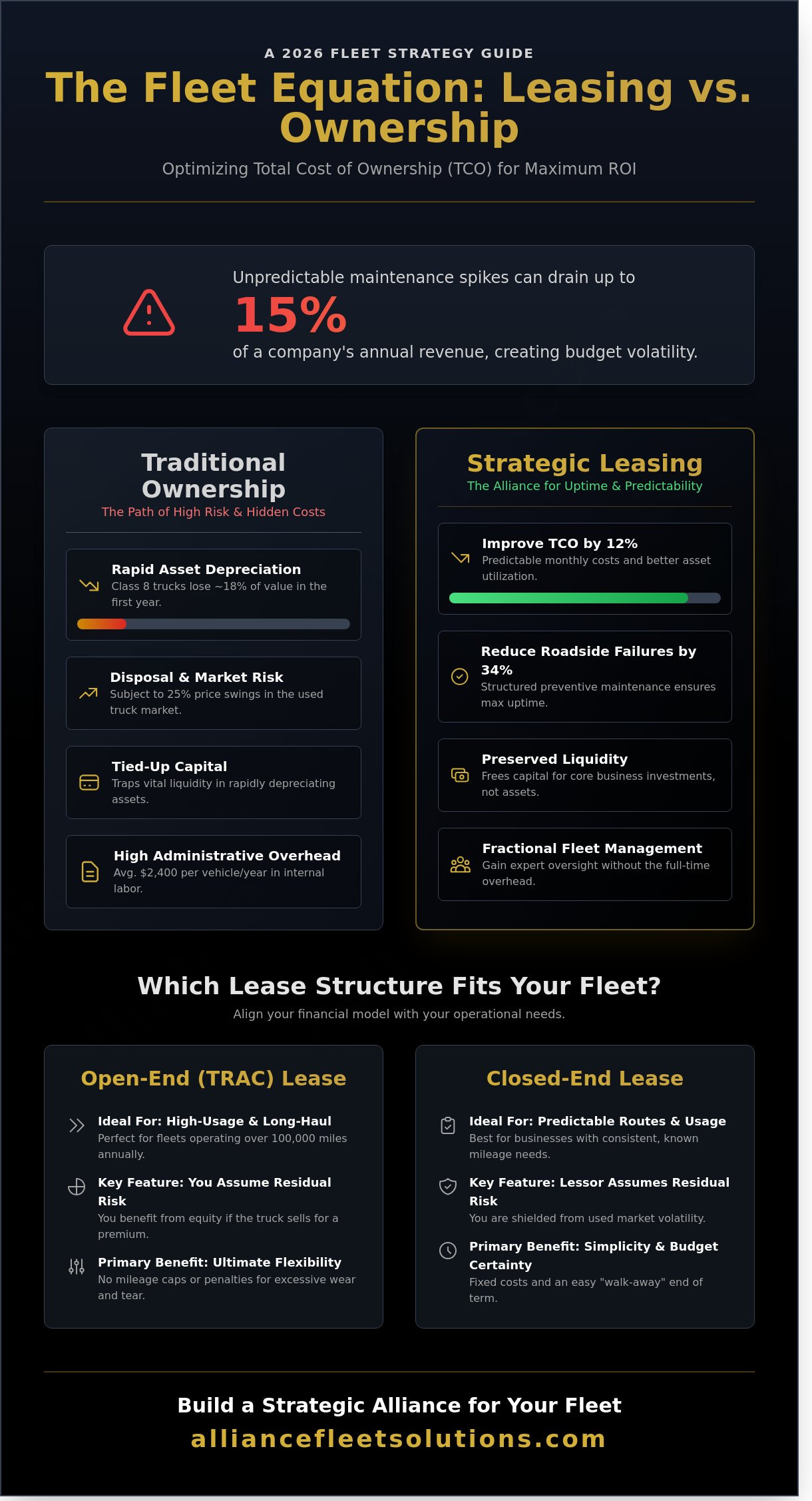
Total Cost of Ownership (TCO) serves as the definitive metric for fleet efficiency in 2026. It encompasses every dollar spent from the initial acquisition to the final disposal. While purchasing might seem like a path to building equity, it often traps vital capital in rapidly depreciating assets. A commercial truck lease shifts your focus from asset ownership to operational performance. By January 2026, market data shows that Class 8 trucks lose approximately 18% of their value within the first 12 months. This depreciation, combined with the 12% rise in specialized diagnostic tool costs for late-model engines, makes the ownership model increasingly volatile for mid-sized carriers.
Leasing preserves your liquidity for core business investments like warehouse automation or driver retention programs. It eliminates the disposal risk that frequently plagues owners. Instead of worrying about fluctuating secondary market prices, you return the keys and upgrade to the latest technology. This cycle ensures your fleet maintains a high Uptime Factor. Our internal benchmarks indicate that a structured maintenance program within a lease reduces roadside failures by 34% compared to the reactive repair models used by 65% of independent owners. You aren’t just paying for a vehicle; you’re paying for guaranteed availability.
Lease vs. Buy: A 2026 Financial Reality Check
Current interest rates for equipment loans hover around 6.2%, making traditional financing more expensive than in previous cycles. A strategic look at vehicle leasing fundamentals allows for predictable monthly forecasting. Lease payments qualify as deductible operating expenses, which simplifies your tax filings and improves your debt-to-equity ratio. Experts at Alliance Fleet Solutions handle the remarketing process, shielding your business from the 25% price swings seen in the used truck market over the last 18 months. It’s a method to stabilize your balance sheet while keeping your fleet modern.
The Administrative Burden of Fleet Ownership
Managing a fleet requires more than just skilled drivers; it demands a dedicated back-office team. Owners must track DOT compliance, IFTA reporting, and state-specific licensing for every unit. This administrative overhead costs an average of $2,400 per vehicle annually in internal labor. Transitioning to a commercial truck lease introduces fractional management into your business model. You gain access to our specialized expertise without the cost of hiring full-time fleet administrators. We streamline your compliance tasks, ensuring your trucks stay on the road and out of the audit office, which allows your team to focus on moving freight.
With administrative burdens handled, business owners can also reinvest their time and energy into personal rewards, like a well-earned vacation. For those looking to plan a truly seamless getaway, you can turn to experts like The Russell Travel Team (Lightning Travel) for curated luxury experiences.
Open-End vs. Closed-End Leases: Which Financial Structure Fits Your Cash Flow?
Choosing a commercial truck lease involves more than comparing interest rates. It requires a strategic decision on who bears the risk of the vehicle’s future value. In 2024, market volatility in the used truck sector saw residual values fluctuate by 18%, making the choice of lease structure a critical factor in fleet ROI for the 2026 fiscal year. Your decision dictates whether you’ll benefit from a well-maintained asset or face unexpected costs at the end of the term.
The Open-End TRAC Lease: Flexibility for High-Usage
The Terminal Rental Adjustment Clause (TRAC) lease is the backbone of the long-haul industry. In this structure, the fleet owner assumes the residual risk. At the end of the lease, the vehicle’s actual market value is compared against its remaining book value. If the truck sells for a premium, your business keeps the equity. This model is ideal for the 65% of carriers that operate over 100,000 miles annually because it eliminates restrictive mileage caps. You don’t face penalties for “excessive” wear, which allows you to focus on maximizing vehicle uptime through consistent servicing. It rewards meticulous maintenance. A truck in peak condition fetches a higher return, directly padding your bottom line. This setup is the commercial standard for businesses that view their fleet as a long-term strategic asset rather than a temporary expense.
The Closed-End Lease: Predictability for Fixed Budgets
Closed-end leases offer a “walk-away” solution where the lessor carries the residual risk. You pay a set monthly fee and return the truck at the end of the term without worrying about market fluctuations. This predictability is vital for the 28% of fleet managers who operate on fixed annual budgets. However, these agreements include strict mileage limits and “fair wear and tear” clauses. For example, exceeding a 20,000-mile annual cap on a medium-duty box truck can trigger surcharges of $0.25 per mile. When evaluating these contracts, consulting federal vehicle leasing requirements provides a clear benchmark for standard return conditions and inspector protocols. This structure fits perfectly for urban short-haul applications where routes are short and predictable. It ensures a modern fleet without the headache of asset disposal. Your primary focus remains on the delivery, not the eventual resale value of the equipment.
The Full-Service Advantage: Integrating Maintenance and Custom Upfitting
A successful commercial truck lease does more than provide a vehicle. It delivers a turnkey asset tailored to your specific operational DNA. According to the Truck Renting and Leasing Association, the full-service leasing sector represents a significant portion of the commercial market because it addresses the total cost of ownership (TCO) from day one. Alliance Fleet Solutions moves beyond providing naked trucks. We integrate upfitting costs into a single monthly payment, which preserves your capital for core business investments. This approach eliminates the $15,000 to $30,000 upfront cash outlay typically required for specialized equipment.
The Alliance approach focuses on designing vehicles for specific industry applications. We don’t just hand over keys; we partner with you to engineer a mobile workspace. By folding upfitting, taxes, and maintenance into one predictable bill, you streamline your accounting and maximize your fleet ROI. This structure ensures that your equipment is ready to generate revenue the moment it hits the pavement in 2026.
Professional Upfitting: Custom-Configured for Success
Generic box trucks often fail the productivity test. A specialized vocational vehicle requires precision. For instance, a delivery fleet might see a 14% increase in stop-count efficiency by installing ergonomic shelving and 3,000-pound capacity liftgates. We ensure every modification meets strict weight distribution standards. This prevents premature tire wear and keeps your drivers safe. Whether it is refrigerated units or heavy-duty crane bodies, custom configurations transform a standard chassis into a high-performance tool.
Maintenance Management: From Reactive to Predictive
Unplanned downtime costs the average fleet approximately $825 per day per vehicle in 2026. Our strategy uses advanced telematics to shift from reactive repairs to predictive maintenance. By tracking engine hours and component vibration data in real-time, we schedule service before a failure occurs. This proactive stance is central to our maintenance management strategies. Consistent, expert-led servicing reduces long-term TCO by up to 19% over the life of your commercial truck lease. We keep your trucks on the road, where they belong, by managing every oil change and brake inspection with meticulous detail.
This proactive, data-driven approach to vehicle reliability mirrors the strategies used in professional motorsports, where maximizing uptime is the difference between winning and losing. Entrepreneurs in that high-performance world understand that meticulous vehicle management is a core business principle. Platforms like Roman Ziemian Mobility showcase how the discipline of a racing career translates into broader business acumen, offering an inspiring parallel for fleet managers aiming for peak operational efficiency.
Our mobile repair capabilities further distinguish the Alliance experience. If a truck requires attention, our technicians often perform the work on-site. This eliminates the logistical headache of shuttling vehicles to a shop. You get expert control over your fleet’s health without the stress of managing a private garage or navigating unpredictable repair timelines.
Risk Mitigation and Lifecycle Strategy: Beyond the Monthly Payment
A strategic commercial truck lease accounts for every mile from initial procurement to the final sale. Fleet managers often focus heavily on the monthly payment, yet lifecycle management determines the actual ROI. By the 2026 fiscal year, data suggests that 78% of top-performing logistics firms will utilize integrated lifecycle strategies to offset rising equipment costs. We treat your fleet as a dynamic asset; we ensure maintenance schedules align with peak operational demands to prevent the $1,250 daily loss associated with unscheduled downtime. Reliable, well-maintained equipment protects your brand reputation. 94% of shippers report that they prioritize carriers with documented high uptime ratings and modern equipment over those with aging, unreliable fleets.
Vehicle Remarketing: Maximizing Resale Value
Remarketing serves as the silent profit center of a successful lease. Professional disposal strategies return up to 23% more value than standard wholesale auctions by targeting specific buyer personas. Timing is critical for your bottom line. Rotating vehicles at the 500,000-mile mark or at the five-year interval captures the highest secondary market demand before maintenance costs spike. A national disposal network ensures your equipment reaches buyers in regions where demand for specific specs is highest, turning retired assets into immediate capital for your next fleet upgrade.
This same strategic approach to asset lifecycle and remarketing is crucial in other high-value sectors, like commercial real estate. For entrepreneurs and investors considering the senior care market, for example, expert brokerage can make a significant difference in ROI. To see how this plays out in a specialized field, you can visit Assisted Living Real Estate Group for insights on buying and selling these unique properties.
Telematics and GPS: The Data-Driven Fleet
Telematics acts as the nervous system of optimization for the modern carrier. Real-time data monitoring allows managers to reduce fuel consumption by 14% through the systematic elimination of excessive idling. These systems ensure 100% ELD compliance and automate IFTA reporting, which removes the burden of manual documentation and reduces administrative overhead by 20%. By tracking driver behavior, you can reduce harsh braking events by 40%. This directly lowers insurance premiums and extends the life of your brake components within the commercial truck lease agreement.
- Predictive Maintenance: Use sensor data to fix components before they fail on the road.
- Route Optimization: Reduce total fleet mileage by 10% through intelligent GPS mapping.
- Driver Coaching: Use safety scores to lower accident-related costs by 15% annually.
Structuring Your Strategic Alliance: Why Fractional Management is the Future
Fractional fleet management represents a fundamental shift from traditional hiring to strategic partnership. Instead of carrying the $148,000 median salary of a full-time fleet director, businesses access high-level expertise on a scalable basis. This model provides the technical oversight required for a modern commercial truck lease without the permanent overhead. Alliance Fleet Solutions bridges this gap by acting as an extension of your internal team. We provide the national scale necessary to secure volume pricing while maintaining the accountability and responsiveness of a family-owned operation. You gain access to a dedicated strategist who monitors 2026 market trends and regulatory shifts so you don’t have to manage those complexities alone.
The logistics industry in 2026 demands more than just hardware; it requires a data-driven approach to uptime. Fractional management allows you to outsource the granular tasks of maintenance scheduling, fuel tax reporting, and compliance monitoring. This ensures your leadership stays focused on core business growth rather than mechanical troubleshooting. We treat your fleet’s performance as a direct reflection of our own success, creating a shared incentive for maximum efficiency.
This principle of outsourcing specialized duties extends to employee care. When a driver faces a non-emergency medical issue far from home, arranging safe transport can be complex. In these situations, relying on a professional commercial airline medical escort ensures your team members are repatriated safely, allowing you to maintain focus on your core logistics operations.
The Alliance Fleet Solutions Difference
We build acquisition strategies that align with your specific industry demands, whether you’re hauling refrigerated goods or heavy construction materials. Our approach combines the flexibility of an open-end commercial truck lease with professional maintenance and custom upfitting. This ensures your vehicles are road-ready from day one with zero wasted capacity. By integrating these services, we typically reduce total cost of ownership by 14% for our partners. You can explore our comprehensive fleet management services to see how we streamline complex logistics into a single, manageable workflow that prioritizes your bottom line.
Starting Your Fleet Transformation
The first step toward optimization is a rigorous fleet audit. We identify inefficient ownership patterns where aging assets cost more in repairs than they generate in revenue. To prepare for a professional consultation, you should organize the following data points:
- Current maintenance spend per mile across all units
- Detailed fuel consumption logs from the previous 12 months
- Vehicle age and odometer readings for every asset
- Specific payload requirements and route frequency data
This data allows us to pinpoint exactly where your capital is leaking. Once we analyze your fleet’s performance, we provide a clear roadmap for modernization. You can request a customized fleet lease analysis today to begin your transition toward a more profitable operation. Our team reviews your data within 48 hours to identify immediate savings opportunities and long-term ROI improvements.
Future-Proof Your Fleet for 2026 and Beyond
Navigating the logistics landscape of 2026 requires more than just picking a vehicle. It demands a tactical shift toward high-efficiency fleet management. You’ve seen how a well-structured commercial truck lease can lower your total cost of ownership by up to 15% compared to traditional purchase models. By balancing open-end flexibility with the security of full-service maintenance, you eliminate the volatility of repair costs and maximize vehicle uptime. These 2026 projections show that fractional management is no longer optional for businesses aiming for 100% operational efficiency.
Since 2018, Alliance Fleet Solutions has operated as a family-owned partner dedicated to your bottom line. We provide national service coverage for fleets of all sizes, ensuring your lifecycle strategy includes specialized expertise in professional upfitting and expert remarketing. Our team manages the technical details so you can focus on scaling your operations. Don’t let outdated ownership models stall your growth in a competitive market. Partner with Alliance Fleet Solutions for a customized lease strategy that transforms your equipment into a strategic business asset. Your road to a more resilient, profitable fleet starts with a reliable alliance today.
Frequently Asked Questions
Is it better to lease or buy a commercial truck for a small business?
Leasing a commercial truck typically offers better cash flow preservation for small businesses compared to purchasing. By avoiding the $150,000 average upfront cost of a new Class 8 vehicle, you can allocate capital toward driver recruitment or expansion. Leasing ensures you operate a modern fleet with 98 percent uptime; meanwhile, owning older assets can increase maintenance costs by 25 percent annually after the fourth year of operation.
What is the difference between an open-end and a closed-end commercial lease?
An open-end lease, often called a TRAC lease, places the residual value risk on the lessee, making it ideal for high-mileage operations. A closed-end lease allows you to return the vehicle at the end of the term with no further financial obligation, provided you meet mileage and condition standards. Statistics show that 70 percent of commercial fleets prefer open-end structures because they offer greater flexibility for specialized equipment usage and mileage fluctuations.
Can I customize a leased truck with specialized equipment or upfitting?
You can customize a leased truck with specialized equipment like liftgates, refrigeration units, or service bodies to meet your specific operational needs. Most lessors allow you to roll these upfitting costs into the monthly payment, which streamlines your initial investment. Data from 2024 indicates that 85 percent of vocational leases include specific modifications to ensure the vehicle is ready for work from day one of our professional alliance.
How do mileage limits work in a commercial truck lease?
Mileage limits in a commercial truck lease are established at the beginning of the contract based on your projected routes. Most closed-end agreements set an annual cap, such as 100,000 miles, with overage fees ranging from $0.15 to $0.25 per mile. If your fleet consistently exceeds these limits, an open-end lease may be a more cost-effective solution since it doesn’t penalize you for high mileage at the end of the term.
Does a commercial truck lease include maintenance and repairs?
A full-service commercial truck lease includes comprehensive preventive maintenance and emergency repairs, while a net lease leaves these responsibilities to your company. Choosing a full-service option can reduce unexpected repair expenses by 30 percent and maximize your fleet’s uptime. Our partnership approach ensures that mobile repair teams handle scheduled servicing on-site; this eliminates the 48 hour average downtime often seen at traditional brick-and-mortar shops.
What happens at the end of a commercial truck lease term?
At the end of the term, you can purchase the vehicle, return it to the lessor, or extend the agreement. If you have an open-end lease, you’re responsible for the difference between the depreciated value and the actual market price. Current market trends show that 40 percent of lessees choose to purchase their trucks in 2026 to capitalize on the vehicle’s known maintenance history and reliable performance within their fleet.
Are commercial truck lease payments tax-deductible?
Commercial truck lease payments are typically 100 percent tax-deductible as an operating expense under current IRS guidelines. This structure provides a more immediate tax benefit than standard depreciation schedules for owned assets. Under Section 179, businesses can also deduct the full cost of qualifying equipment up to $1,220,000 in a single year. This makes leasing a strategic tool for managing your company’s taxable income and improving net ROI.
How does telematics integration help reduce lease costs?
Telematics integration helps reduce lease costs by monitoring driver behavior and optimizing route efficiency in real time. Implementing these systems can lower fuel consumption by 12 percent and decrease insurance premiums by 15 percent through improved safety scores. By providing data on engine health, telematics also allows for proactive preventive maintenance; this prevents small issues from becoming $5,000 major repairs that disrupt your tight logistics schedule.