
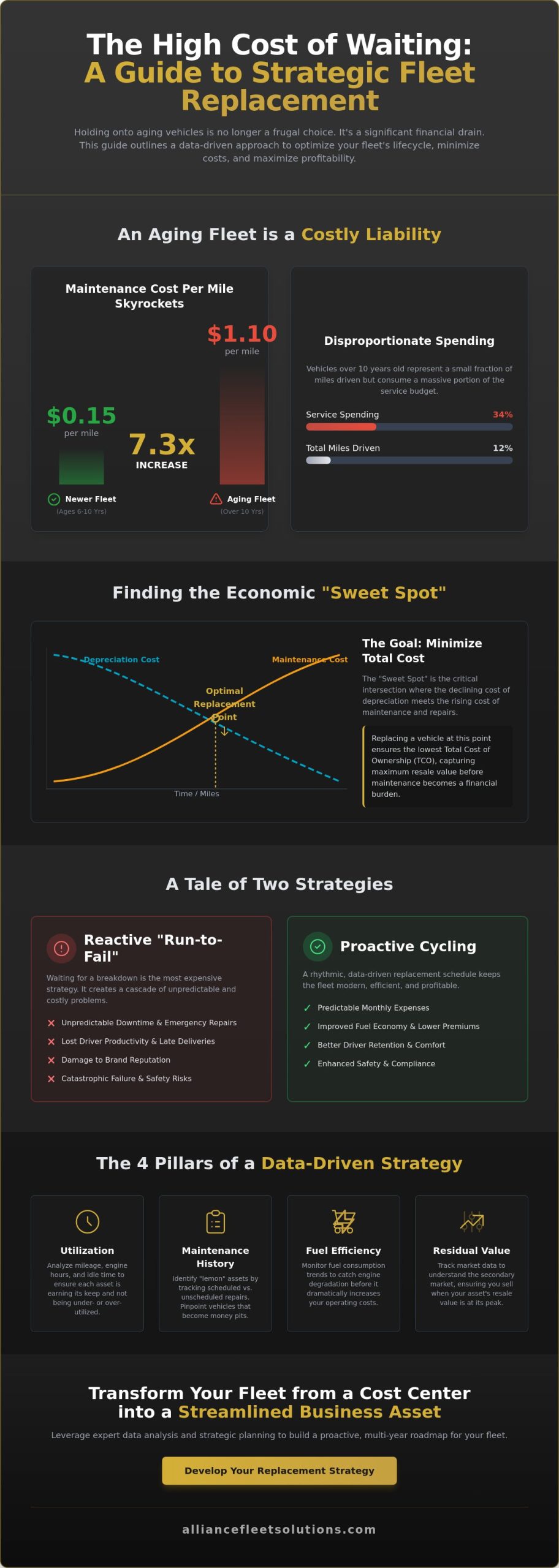
Vehicles over 10 years old account for 34% of service spending despite covering only 12% of total miles driven. At a staggering $1.10 per mile in maintenance costs compared to just $0.15 for newer models, holding onto aging assets is no longer a frugal choice. You’re likely feeling the pressure of rising operational costs and the 15% tariff surcharge that has pushed new Class 8 sleeper prices toward $172,000. Effective fleet vehicle replacement planning isn’t just about buying new trucks; it’s a strategic alliance between data and financial timing.
We understand the stress of managing complex upfitting lead times while trying to maintain high resale values at disposal. This guide provides the tools you need to master proactive vehicle cycling strategies that minimize total cost of ownership and ensure your monthly expenses remain predictable. We’ll explore how to navigate today’s interest rates and leasing structures to transform your fleet from a cost center into a streamlined business asset that maximizes uptime and profitability.
Key Takeaways
- Identify the mathematical “Sweet Spot” where declining depreciation meets rising maintenance costs to optimize your asset retirement schedule.
- Master the four pillars of data-driven fleet vehicle replacement planning to move beyond generic mileage benchmarks that often fail specialized industries.
- Learn how specific leasing structures empower your business to cycle vehicles more effectively than traditional outright ownership.
- Transition from year-to-year emergency planning to a proactive multi-year roadmap that ensures predictable expenses and high resale values.
- Leverage fractional fleet management to access the technical data and vendor relationships required to streamline your lifecycle optimization.
What is Fleet Vehicle Replacement Planning?
Fleet vehicle replacement planning is a data-driven strategy to determine the exact moment a vehicle should be retired from service. It moves beyond guesswork and gut feelings. Within the broader scope of Fleet management, this process ensures that every asset contributes to the bottom line rather than draining it. By analyzing specific data points, we identify the precise time to cycle an asset out of your fleet to capture the highest possible return on investment.
Every vehicle follows a predictable cost curve known as the “Sweet Spot.” In the early stages of a vehicle’s life, your primary expense is depreciation. As the truck ages, depreciation slows down, but maintenance costs begin a steep climb. The Sweet Spot is the intersection where the declining cost of depreciation meets the rising cost of repairs. Missing this window means you’re either overpaying for a new asset too soon or hemorrhaging cash on a vehicle that’s become a liability. In 2026, with the national average for diesel and gas remaining volatile, missing this window can devastate your quarterly margins.
The current market context adds new layers of complexity. While supply chains have largely stabilized, new Class 8 sleeper prices have climbed to approximately $172,000. This increase, driven by a 15% tariff surcharge on imported components, makes the timing of your acquisition critical. Additionally, the expiration of federal EV tax credits in late 2025 requires a more calculated approach to zero-emission transitions. We help you navigate these variables to ensure your replacement cycle remains profitable.
The Financial Risk of Delayed Replacement
If you wait until a truck breaks down on the highway, you’ve already lost. The repair bill is just the start. You’re also facing lost driver productivity, potential late-delivery penalties, and damage to your brand’s reputation. Data shows that vehicles over 10 years old cost $1.10 per mile to maintain, while vehicles aged 6 to 10 years cost only $0.15 per mile. We use Total Cost of Ownership (TCO) as our primary metric to track these shifts. TCO accounts for fuel, insurance, maintenance, and capital costs to reveal the true price of keeping an aging asset on the road.
Proactive vs. Reactive Cycling
Reactive fleets follow a “run-to-fail” model that leads to unpredictable downtime and emergency repairs. Proactive cycling is the rhythmic replacement of vehicles to maintain a modern, efficient fleet. A younger fleet offers several strategic advantages:
- Significant improvements in fuel economy across the latest engine models.
- Lower insurance premiums due to advanced collision-avoidance technology.
- Better driver retention by providing reliable, comfortable equipment.
- Enhanced safety compliance and fewer FMCSA intervention risks.
The Optimal Replacement Point is the specific intersection where the sum of capital expenses and operating expenses reaches its absolute minimum.
The Core Components of a Data-Driven Replacement Strategy
Successful fleet vehicle replacement planning requires looking beyond the odometer. While many organizations rely on generic “average” benchmarks, such as a 100,000-mile retirement target, these numbers often mislead managers in specialized industries. A heavy-duty truck idling at a construction site faces different wear than a long-haul tractor. We recommend following a data-driven replacement policy that prioritizes four core pillars: utilization, maintenance history, fuel efficiency, and residual value.
Utilization data reveals if an asset is actually earning its keep. Maintenance history identifies vehicles that have become “money pits” through frequent unscheduled repairs. Fuel efficiency tracking catches engine degradation before it spikes your operating costs. Finally, monitoring residual value ensures you sell when the secondary market is strongest. Integrating telematics solutions allows you to identify “lemon” assets early, preventing a single problematic vehicle from skewing your entire budget.
Calculating Total Cost of Ownership (TCO)
The TCO formula is the most powerful tool for justifying your budget to a CFO. It’s calculated as (Acquisition + Upfitting + Operating Costs) – Resale Value. To get an accurate picture, your operating cost checklist must include:
- Preventative maintenance and scheduled inspections
- Tire replacement cycles based on specific duty types
- Fuel consumption trends and environmental surcharges
- Unscheduled repair costs and associated downtime losses
When you present a TCO analysis, you move the conversation from “we need new trucks” to “we are optimizing capital allocation.” This level of financial clarity is why many firms choose to outsource their fleet management to experts who can track these metrics in real-time. It ensures that every dollar spent is backed by hard data.
Accounting for Upfitting and Custom Configurations
Custom-configured work trucks introduce a unique challenge. In 2026, the “Upfitting Factor” requires a 12 to 18 month planning horizon. Specialized equipment like refrigeration units or hydraulic cranes often depreciates at a different rate than the chassis. In some cases, high-quality upfitted equipment has “Second Life” potential, meaning it can be refurbished and moved to a new chassis. However, procurement lead times for professional upfitting remain significant. You can’t wait until a truck fails to order its replacement. You must account for the time needed for design, installation, and delivery to avoid costly gaps in your service capability.
Leasing Structures: How Financing Dictates Replacement Timing
Your choice of financing acts as the throttle for your fleet vehicle replacement planning. It’s a common misconception that owning a vehicle “outright” is always the most cost-effective path. In reality, ownership often traps valuable capital in a depreciating asset while exposing the business to the full brunt of rising maintenance costs. In 2026, with interest rates for new commercial trucks hovering between 5% and 9%, the cost of capital must be balanced against the operational gains of a modern fleet. By utilizing commercial vehicle leasing, you maintain the liquidity required to cycle vehicles exactly when they hit their mathematical “Sweet Spot.” This strategy mirrors the federal fleet management framework, which highlights acquisition planning as a vital component of an optimal fleet.
Open-End vs. Closed-End Leasing for Replacement
Open-end leasing is the preferred choice for high-mileage, specialized fleets. Since the lessee assumes the residual risk, you have the flexibility to terminate the lease at any time without mileage penalties. This is essential for vehicles with custom upfitting that may need to stay in service slightly longer or be retired early based on performance data. Closed-end leasing, however, offers a “walk-away” model with fixed monthly payments and set mileage limits. It’s a predictable solution for businesses that prioritize budget stability over total cycling flexibility.
| Business Use Case | Recommended Lease Type | Strategic Benefit |
|---|---|---|
| HVAC & Specialized Trades | Open-End Leasing | Maximum flexibility for custom-upfitted trucks. |
| Last-Mile Delivery | Closed-End Leasing | Predictable monthly costs and simple turnover. |
The Role of Vehicle Remarketing
Vehicle remarketing is the strategic engine that powers your next acquisition. It isn’t just about selling a used truck; it’s about maximizing the return on your initial investment to lower the “Net Capital Cost” of the replacement. A strong remarketing program utilizes diverse channels, including wholesale networks and digital auctions, to ensure your retired assets command top dollar. In the current market, where a new Class 8 sleeper can cost $172,000, capturing every cent of residual value is critical. Effective remarketing ensures that your fleet vehicle replacement planning remains a sustainable cycle of reinvestment rather than a series of disconnected capital shocks.
Step-by-Step Roadmap for Fleet Replacement Planning
Moving from theory to execution requires a standardized workflow. Fleet vehicle replacement planning should never be a reaction to an engine failure on the side of the highway. Instead, it must be a multi-year outlook that anticipates needs before they become emergencies. By establishing a rigorous roadmap, you can stabilize your annual budgeting and ensure your team always has the tools they need to perform safely and efficiently.
Phase 1: Asset Evaluation and Threshold Setting
The first step involves a deep audit of your current inventory. You need to leverage your maintenance management data to see which vehicles are trending toward that $1.10 per mile cost threshold. Use telematics to track idle time and engine hours, as these often tell a truer story than the odometer alone. Next, set specific replacement triggers based on vehicle class. For instance, a Class 1 light-duty truck might have a five-year cycle, while a Class 6 medium-duty truck might be slated for seven. Finally, identify “at-risk” vehicles that may struggle with 2026 regulatory updates. The FMCSA’s transition to a fully electronic medical certification process and modifications to ELD rules mean your technology must be current. Additionally, the expiration of federal EV tax credits in late 2025 adds a layer of financial urgency to your zero-emission transition plans.
Phase 2: Procurement, Upfitting, and Remarketing
Once you’ve identified which assets to retire, you must secure financing or leasing approval. Use the TCO projections we established earlier to prove the ROI to your stakeholders. Given the $10,000 price increase on new Class 8 trucks due to 2026 tariffs, early approval is vital. Execute your procurement and professional upfitting as early as possible. With lead times for custom work trucks often exceeding 12 months, waiting until the last minute creates unacceptable downtime. Don’t forget to include your drivers in the selection process. Their feedback on cabin ergonomics and safety features can significantly improve retention and reduce on-road incidents.
The final step is managing the remarketing of the retired asset. Capturing peak residual value requires a clean maintenance record and strategic sale timing. If you want to streamline this entire roadmap, contact Alliance Fleet Solutions for a customized replacement strategy. We handle the data, the vendors, and the logistics so you can focus on your core business.
Strategic Alliance: Fractional Fleet Management for Replacement
Many mid-sized businesses operate under the assumption that they must hire a full-time executive to master fleet vehicle replacement planning. In reality, fractional fleet management offers a more efficient path to high-level strategy. This model allows you to tap into the expertise of a seasoned fleet director without the overhead of a permanent salary. Alliance Fleet Solutions acts as the essential backbone of your operation, managing the critical alliance between your procurement, maintenance, and finance departments. We provide the data. You get the results.
In the 2026 logistics environment, where a single Class 8 sleeper truck costs $172,000 and financing rates sit between 5% and 9%, you can’t afford a trial-and-error approach. An external partner brings the data and vendor relationships that a busy business owner often lacks. We provide the technical depth needed to navigate 15% tariff surcharges and complex upfitting lead times, ensuring your replacement cycle remains on schedule and within budget. This managed approach is no longer a luxury; it is a competitive necessity.
Outsourcing the Lifecycle: Why It Works
Leveraging a partner’s national buying power is one of the most immediate benefits of outsourcing. We secure acquisition pricing that is typically reserved for the largest national carriers, directly lowering your initial capital outlay. Beyond the purchase price, fractional management significantly reduces the “soft costs” associated with internal administrative labor. Your team stays focused on core operations while we handle the heavy lifting of vendor negotiations and lifecycle tracking. The math is simple. Reduced administrative friction leads to higher profitability.
You also benefit from independent, unbiased advice. Since we aren’t tied to a specific manufacturer, our recommendations for vehicle makes and models are based strictly on what performs best for your specific duty cycle. This objectivity ensures that your fleet vehicle replacement planning is driven by performance data, not sales quotas. We help you choose the equipment that will hold its value longest in the secondary market.
Next Steps: Evaluating Your Current Fleet
A functional fleet is not a cost center; it’s a strategic asset that powers your growth. If your current maintenance spending is creeping toward the $1.10 per mile mark for older vehicles, it’s time to re-evaluate your strategy. A proactive audit can reveal hidden inefficiencies and identify exactly where your capital is being drained by aging equipment. It’s time to stop reacting to failures and start planning for success.
Take control of your operational future by looking at your assets through a data-driven lens. We invite you to optimize your fleet lifecycle with Alliance Fleet Solutions through a comprehensive audit. Let’s build a replacement roadmap that maximizes your uptime, protects your margins, and keeps your drivers behind the wheel of safe, reliable equipment.
Take Command of Your Fleet’s Future
Effective fleet vehicle replacement planning transforms your equipment from a source of stress into a competitive advantage. By identifying your assets’ mathematical “Sweet Spot” and leveraging Total Cost of Ownership data, you move beyond emergency repairs and toward predictable, long-term growth. We’ve seen how the right financing structures and procurement timelines can shield your margins from market volatility and rising maintenance spikes. It’s time to stop letting your fleet dictate your schedule and start managing it as a strategic asset.
Success in the 2026 logistics landscape requires more than just mechanical knowledge; it demands a strategic alliance. Our national acquisition and remarketing network ensures you get the best value at both ends of the vehicle lifecycle. Whether you need expert professional upfitting services or flexible open-end and closed-end leasing solutions, we provide the backbone for your success. Partner with Alliance Fleet Solutions for a data-driven replacement audit to identify exactly where your lifecycle can be optimized. Let’s work together to ensure your business stays moving, safe, and profitable.
Frequently Asked Questions
Is it better to replace fleet vehicles based on age or mileage?
It’s best to use a combination of both metrics, though data-driven thresholds prove more accurate than arbitrary targets. While a 100,000-mile mark is a common benchmark, heavy duty cycles or high idle times can degrade an asset much faster. We focus on the Total Cost of Ownership to determine if age or mileage is the primary driver of rising expenses for your specific operation.
How does custom upfitting affect my vehicle replacement schedule?
Custom upfitting requires you to start your fleet vehicle replacement planning at least 12 to 18 months in advance. Specialized equipment like refrigeration units or hydraulic cranes depreciates at a different rate than the chassis. Because these configurations are complex, you must account for longer procurement lead times to avoid service gaps when an old asset is retired.
What is the “Sweet Spot” for commercial vehicle replacement in 2026?
The “Sweet Spot” occurs when the declining cost of depreciation meets the rising cost of maintenance and repairs. In 2026, data shows maintenance costs for vehicles over 10 years old jump to $1.10 per mile. Replacing your vehicle before hitting this spike ensures you capture high residual value while keeping your operational expenses predictable and low.
Can telematics data really predict when a vehicle needs to be replaced?
Telematics provides the real-time engine health and utilization data needed to identify “lemon” assets before they fail. By tracking fuel economy trends and fault codes, you can see when a vehicle’s performance begins to deviate from the fleet average. This allows for proactive cycling based on actual mechanical condition rather than just the number on the odometer.
What are the tax implications of different fleet leasing models for replacement?
Leasing models like open-end and closed-end offer different tax and balance sheet advantages. New heavy-duty trucks over 33,000 pounds incur a 12% Federal Excise Tax (FET) on the first retail sale. With interest rates for qualified borrowers ranging from 5% to 9% in 2026, we help you choose a structure that protects your cash flow while navigating these regulatory costs.
How long does the procurement and upfitting process typically take?
You should plan for a procurement and upfitting window of 12 to 18 months for specialized work trucks. While chassis availability has improved since 2024, the demand for professional upfitting remains high. Starting the process early ensures your new vehicles are ready for service the moment your old assets reach their optimal retirement point.
What happens to the resale value of my vehicles if I delay replacement by one year?
Delaying replacement by a single year often results in a “double hit” to your bottom line. You face a sharp drop in resale value as the vehicle enters a higher mileage bracket, while simultaneously incurring the $1.10 per mile maintenance costs typical of older assets. Timely remarketing is essential to capture the peak residual value needed to offset new acquisition costs.
How can fractional fleet management help with replacement planning?
Fractional fleet management provides mid-sized businesses with executive-level strategy and national buying power without the cost of a full-time director. We act as your strategic partner to manage the complex data and vendor relationships required for effective fleet vehicle replacement planning. This ensures your lifecycle is optimized to maximize both uptime and your return on investment.