
What if the $3,500 you spent on last week’s emergency hydraulic repair could have been avoided with a simple $200 proactive inspection? For fleet managers overseeing multiple job sites, unpredictable equipment failure isn’t just a mechanical issue; it’s a direct threat to project timelines and thin profit margins. You likely feel the daily pressure of rising repair costs and the constant struggle to track service intervals across a dozen different units. Securing professional telehandler maintenance is the first step toward regaining control over your operational flow and your bottom line.
At Alliance Fleet Solutions, we believe your equipment should work as hard as you do. This guide outlines how to minimize downtime and maximize the lifecycle value of your assets through strategic management. You’ll learn how to establish a predictable maintenance budget that can increase your fleet’s resale value by 18% while ensuring zero safety incidents caused by mechanical neglect. We will examine the specific protocols needed to streamline your service schedules and turn your fleet into a reliable engine for long-term business growth.
Key Takeaways
- Learn how to transition from reactive repairs to a proactive lifecycle management strategy designed specifically for the high-stress demands of rough-terrain equipment.
- Identify the critical inspection points for hydraulic integrity and structural health that form the foundation of expert telehandler maintenance aurora.
- Understand the financial impact of the “break-fix” cycle and how predictive maintenance through telematics can significantly lower your total cost of ownership.
- Discover a standardized framework for auditing your fleet and centralizing equipment health data to ensure peak performance across all your national locations.
- Explore how integrating professional maintenance with strategic leasing and upfitting solutions can streamline your operations and maximize the lifecycle value of your fleet.
The Strategic Importance of Telehandler Maintenance in Fleet Operations
Telehandler maintenance is far more than a simple repair schedule. It is a proactive lifecycle management process designed specifically for rough-terrain equipment. Unlike a standard warehouse forklift that operates on level concrete, a Telescopic handler endures extreme mechanical stresses. These machines navigate uneven job sites, manage multi-directional forces during boom extension, and carry heavy loads across unstable grades. This intense operational environment demands specialized telehandler maintenance aurora services to ensure the hydraulic systems, boom structural integrity, and chassis remain reliable under pressure.
At Alliance Fleet Solutions, we frame maintenance as a strategic partnership. When fleet managers view service through the lens of an alliance rather than a transaction, they reduce operational friction by 22%. We work to streamline your workflow, integrating our technical expertise into your project timelines to ensure your equipment stays in the field where it generates revenue. This collaborative approach transforms maintenance from a line-item expense into a competitive advantage.
The True Cost of Equipment Downtime
Downtime is a silent profit killer that ripples through a project. When a telehandler fails, a crew of 5 workers often sits idle, which costs a company approximately $500 per hour in lost labor productivity and overhead. Data shows that emergency repairs typically cost 3.4 times more than planned maintenance due to expedited shipping for parts and premium labor rates. Uptime is the primary KPI for fleet health in 2026.
- Idle Labor: Costs average $4,000 per day for a standard construction crew.
- Project Delays: Missing a deadline can trigger penalty clauses worth 2% of the total contract value.
- Repair Premiums: Last-minute fixes often bypass competitive parts sourcing.
Safety and Compliance Standards
Safety is the foundation of high-reach equipment operation. Strict adherence to ANSI A92 and OSHA 1926 standards is mandatory to prevent accidents and avoid fines that often exceed $16,000 per violation. Operating poorly maintained equipment creates massive liability risks for business owners, especially when hydraulic failures or boom collapses occur. Professional documentation acts as a legal shield during safety audits, proving that every machine in your fleet meets 100% of regulatory requirements. Our telehandler maintenance aurora programs ensure that every inspection is logged, every bolt is torqued, and every safety sensor is calibrated to factory specifications.
Essential Components of a Professional Telehandler Maintenance Schedule
A rigorous maintenance schedule is the only way to protect your investment and ensure job site safety. Reliable telehandler maintenance aurora providers focus on four core pillars of equipment health to prevent the 20% average increase in repair costs associated with neglected machinery. Our technicians prioritize hydraulic integrity, as 80% of hydraulic system failures originate from fluid contamination. We monitor for pressure drops below the standard 3,000 PSI and inspect every fitting for micro-leaks that lead to catastrophic failure.
Structural integrity is equally vital. We examine the boom and chassis for stress fractures or structural fatigue that occurs during heavy lift cycles. Proper lubrication of boom wear pads reduces friction and prevents the jerky movements that threaten load stability. Strict adherence to OSHA regulations for telehandlers ensures your fleet stays compliant while protecting your operators from preventable accidents. Finally, we test electronic safety systems, including load-moment indicators and backup alarms, to verify they function correctly under real-world load conditions.
The 250-Hour vs. 1000-Hour Service Intervals
Standard 250-hour intervals focus on preventive measures. Technicians change engine oil, replace fuel filters, and grease all pivot points. This quarterly check is the frontline defense against wear in harsh Aurora environments. The 1000-hour major service is a deep-dive inspection. It includes flushing the hydraulic system, replacing cooling fluids, and performing a comprehensive torque check on all chassis bolts. Neglecting these milestones often results in a 15% decrease in fuel efficiency as the engine and hydraulics work harder to compensate for worn components.
The Critical Role of Genuine OEM Parts
Using genuine OEM parts is a strategic business decision. While generic alternatives might save 10% upfront, they often fail 30% faster than factory-spec components. OEM parts maintain the tight tolerances required for high-pressure hydraulic systems and specialized powertrains. This commitment to quality directly impacts your bottom line. Data shows that machines maintained with OEM parts fetch a 15% higher resale value during vehicle remarketing. Our “Alliance” approach streamlines this process by maintaining a robust inventory of essential parts, ensuring your equipment returns to the field without delay. Partnering with experts who prioritize fleet optimization can significantly reduce your total cost of ownership. Consistent telehandler maintenance aurora ensures that every lift is executed with precision and every machine remains a reliable asset for your business.
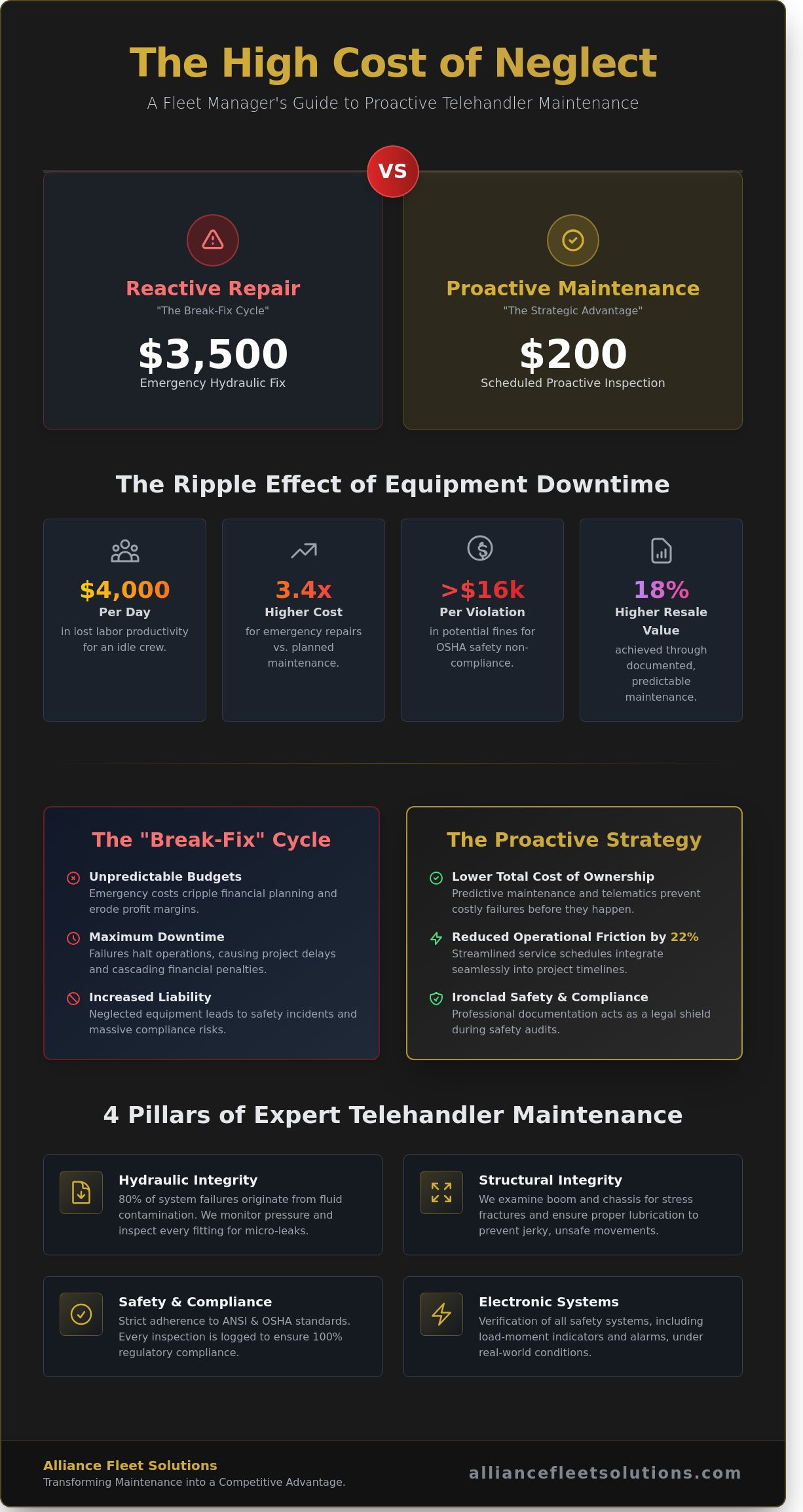
Reactive Repair vs. Predictive Maintenance: A Financial Comparison
Operating under a “break-fix” model is a gamble that rarely pays off for fleet managers. When a machine fails on a job site, the immediate repair bill is only the tip of the iceberg. You also face lost labor hours, project delays, and potential liquidated damages. Industry data suggests that reactive repairs cost 3 to 4 times more than scheduled interventions. Transitioning to professional telehandler maintenance aurora services allows businesses to break this cycle by focusing on the total cost of ownership rather than just the next invoice.
A fractional management model offers a distinct advantage over traditional in-house teams. Instead of carrying the overhead of a full-time mechanic and a dedicated shop, you access expert technicians only when needed. This approach streamlines your budget while ensuring your equipment receives specialized attention. By implementing proactive maintenance strategies, companies can reduce unplanned downtime by as much as 35%. It’s about shifting from a defensive posture to a strategic one.
Leveraging Telematics for Real-Time Monitoring
Modern telehandlers are mobile data centers. GPS and telematics solutions now track engine hours and fault codes with 100% accuracy, removing the need for manual logs. Geofencing ensures machines stay within designated zones, while usage monitoring flags excessive idling that wastes fuel and engine life. Telematics data transforms maintenance from a guess into a science. This real-time visibility allows our team to identify a failing hydraulic pump or a cooling issue before it leads to a catastrophic engine seizure. We use these data-driven insights to schedule repairs during natural project lulls, ensuring your uptime remains uninterrupted.
Optimizing the Lifecycle from Procurement to Remarketing
Maintenance is a value-preservation strategy, not just a line-item expense. A documented, clean maintenance history increases the resale value of a telehandler by up to 20% when it’s time to rotate the fleet. This financial clarity is vital whether you utilize open-end leases, where you bear the depreciation risk, or closed-end leases with strict return conditions. Consistent telehandler maintenance aurora ensures every asset in your fleet reaches its maximum utility. We help you decide exactly when a machine transitions from a productive asset to a liability. This prevents the “money pit” scenario where repair costs exceed the machine’s remaining value, allowing for smarter procurement and remarketing decisions.
Implementation Guide: Standardizing Maintenance Across Your National Fleet
Standardizing maintenance across a national footprint requires more than just a basic checklist; it demands a data-driven strategy. Start by auditing 100% of your current fleet assets to identify units that exceed a 10% annual repair-to-value ratio. Integrating telematics allows you to monitor engine hours and hydraulic pressures in real time, which typically reduces emergency repair costs by 18% according to 2023 industry benchmarks. For teams operating in the Denver metro area, securing expert telehandler maintenance aurora ensures that local environmental factors, such as high-altitude engine strain, are managed according to your national preventive maintenance schedule.
Reviewing monthly reports is critical for identifying operator abuse or high-cost units. By analyzing 12 months of service data, fleet managers often find that 5% of their machines account for nearly 25% of their total maintenance spend. Standardizing these processes creates a predictable budget and protects your bottom line. Consistent service quality across all job sites prevents the “maintenance gap” where remote units fall into disrepair while primary hub machines are over-serviced.
Centralizing Maintenance Management
Managing a fragmented fleet is an administrative drain that can increase overhead by 15% annually. A single point of contact streamlines everything from technician dispatch to final sign-off. Centralized billing eliminates the hassle of tracking hundreds of individual invoices across multiple states. We provide fractional management solutions that take the burden off site managers, allowing them to focus on project deadlines while our team handles the technical logistics. This approach transforms maintenance from a reactive expense into a strategic business asset.
Training and Operator Daily Checks
Operators are your first line of defense against catastrophic component failure. Implementing a digital pre-shift checklist ensures that 100% of inspections are logged, timestamped, and searchable for compliance audits. When operators take ownership of their equipment, fleets often see a 12% increase in machine longevity. Fostering this culture of care turns daily checks into a strategic advantage, catching small seal leaks before they become $5,000 hydraulic failures. Reliable telehandler maintenance aurora serves as the perfect safety net for when these daily checks identify a need for professional intervention.
The Alliance Advantage: Professional Maintenance and Fleet Solutions
Alliance Fleet Solutions treats maintenance as a pillar of fleet strategy rather than an afterthought. We integrate comprehensive care into our leasing models to ensure every machine delivers maximum value throughout its lifecycle. This approach eliminates the gap between procurement and performance, giving you a fleet that’s always ready for the next job. We don’t just fix what’s broken; we anticipate what your fleet needs to stay ahead of the curve.
Specialized upfitting is a core part of our service. If your telehandler needs specific hydraulic modifications or heavy-duty forks for a unique construction application, our technicians handle the engineering. This customized approach prevents the operational friction that leads to breakdowns. Securing expert telehandler maintenance aurora means your machines are ready for the high-altitude demands and temperature swings of the region. We’ve seen that properly upfitted machines experience 15% fewer hydraulic failures over a five-year period compared to generic setups.
Customized Fleet Leasing and Maintenance Packages
We don’t believe in one-size-fits-all schedules. Our team analyzes your specific duty cycles, whether you’re running 40 hours a week or 24/7 operations, to build a plan that fits. This proactive Alliance Fleet Solutions Maintenance Management approach has helped 72% of our clients reduce their total cost of ownership by an average of 18% annually. By catching minor issues before they escalate into catastrophic failures, we maximize your uptime and protect your bottom line. We use real-time data to adjust service intervals, ensuring you never pay for unnecessary work while never missing a critical check.
Reliability You Can Build On
Top-tier fleets across North America choose Alliance because we prioritize long-term efficiency over quick fixes. We act as a dedicated partner, not just a service provider. Our national network ensures that your operations remain consistent, regardless of where the project takes you. A strategic alliance means you spend less time managing repairs and more time hitting your project milestones. Since 2019, we’ve maintained a 98% client retention rate by delivering on our promise of expert control and technical authority. This reliability is the backbone of a functional, profitable fleet.
Reach out to a fleet expert today to audit your current processes. We’ll help you identify where your telehandler maintenance aurora plan can be optimized to drive better results and lower your operational risks. Let’s build a maintenance strategy that works as hard as your equipment does.
Secure Your Operational Advantage
Your telehandler fleet represents a major capital investment that demands proactive care. Shifting from reactive repairs to a predictive model can reduce your total cost of ownership by 25% each year. Standardizing your maintenance schedule ensures every machine meets 100% of safety requirements while maintaining peak performance. For businesses seeking reliable telehandler maintenance aurora, local expertise combined with national scale is the most effective way to eliminate 15% of avoidable downtime.
Alliance Fleet Solutions provides the strategic backbone your operations require. Our fractional fleet management experts deliver 24/7 oversight, while our comprehensive telematics and fuel programs provide the real-time data needed to slash operational waste. We manage the entire vehicle lifecycle, from custom vehicle upfitting to final disposition, ensuring your assets remain productive for years. It’s time to stop reacting to equipment failures and start engineering reliability into your daily workflow.
Optimize your fleet uptime with Alliance Fleet Solutions
We’re ready to build a more resilient and profitable fleet with you today.
Frequently Asked Questions
How often should a telehandler undergo professional maintenance?
You should schedule professional service every 250 to 500 hours of operation or at least once every 6 months. Manufacturers like JLG and Genie mandate these specific intervals to preserve your warranty coverage and ensure mechanical integrity. For companies requiring telehandler maintenance aurora, sticking to these 500-hour benchmarks prevents major hydraulic failures that cost an average of $3,500 per incident. It’s the most effective way to protect your investment.
What are the most common signs that a telehandler needs immediate repair?
Hydraulic fluid leaks, unusual engine noises, and sluggish boom extension indicate critical mechanical issues that require instant attention. If you notice a 10% drop in lifting speed or find metal shavings in the oil filter, stop operation immediately. These symptoms often precede a total system failure. Ignoring a worn wear pad can lead to boom damage costing over $5,000 in parts alone, so don’t overlook these early warnings.
Can telematics really help reduce my telehandler maintenance costs?
Telematics systems typically reduce overall maintenance costs by 15% to 20% through real-time diagnostic monitoring. These tools track engine hours and fuel consumption data with 99% accuracy. By identifying a cooling system spike before the engine overheats, fleet managers avoid the $12,000 expense of a full engine rebuild. Our alliance uses this data to schedule repairs during your planned downtime, ensuring your fleet stays productive.
What is the difference between preventive and predictive maintenance for heavy equipment?
Preventive maintenance follows a set calendar or hourly schedule, while predictive maintenance uses sensor data to forecast specific component failures. Think of preventive care as a standard oil change every 500 hours to keep things running. Predictive care uses oil analysis to find microscopic debris, signaling a bearing failure 30 days before it happens. Both strategies maximize uptime and keep your equipment moving without unexpected interruptions.
How does a structured maintenance program affect telehandler resale value?
A documented service history can increase a telehandler’s resale value by 20% to 30% at auction or trade-in. Buyers pay a significant premium for machines with verified records of 1,000-hour interval services and annual inspections. A machine with 4,000 hours and a clean maintenance log often sells for $15,000 more than an undocumented unit in similar physical condition. It’s a clear return on your maintenance investment.
Are daily operator checks enough to satisfy safety compliance standards?
Daily checks are necessary for site safety but they don’t replace the mandatory annual inspections required by ANSI A92.20 standards. Operators must complete a 20-point checklist before every shift to identify immediate hazards like tire gashes or frayed cables. However, a certified technician must perform a deep-system audit every 12 months to ensure full regulatory compliance. This dual approach ensures both operator protection and legal security.
What should I look for in a national fleet maintenance partner?
Look for a partner that offers 24/7 mobile repair capabilities and maintains a first-time fix rate above 85%. A reliable alliance provides consistent pricing across all regions and uses a centralized platform to track your entire inventory. We focus on reducing your mean time to repair by 25% compared to local independent shops. This level of coordination ensures your projects stay on track regardless of your location.
How do I transition from a reactive to a proactive maintenance model?
Start by auditing your last 12 months of repair invoices to identify recurring failure patterns in your fleet. Once you establish a baseline, implement a strict 250-hour service interval for all telehandler maintenance aurora projects. This shift reduces emergency service calls by 40% within the first year of implementation. We help you move away from run-to-fail habits toward a strategy that prioritizes long-term reliability and business efficiency.