
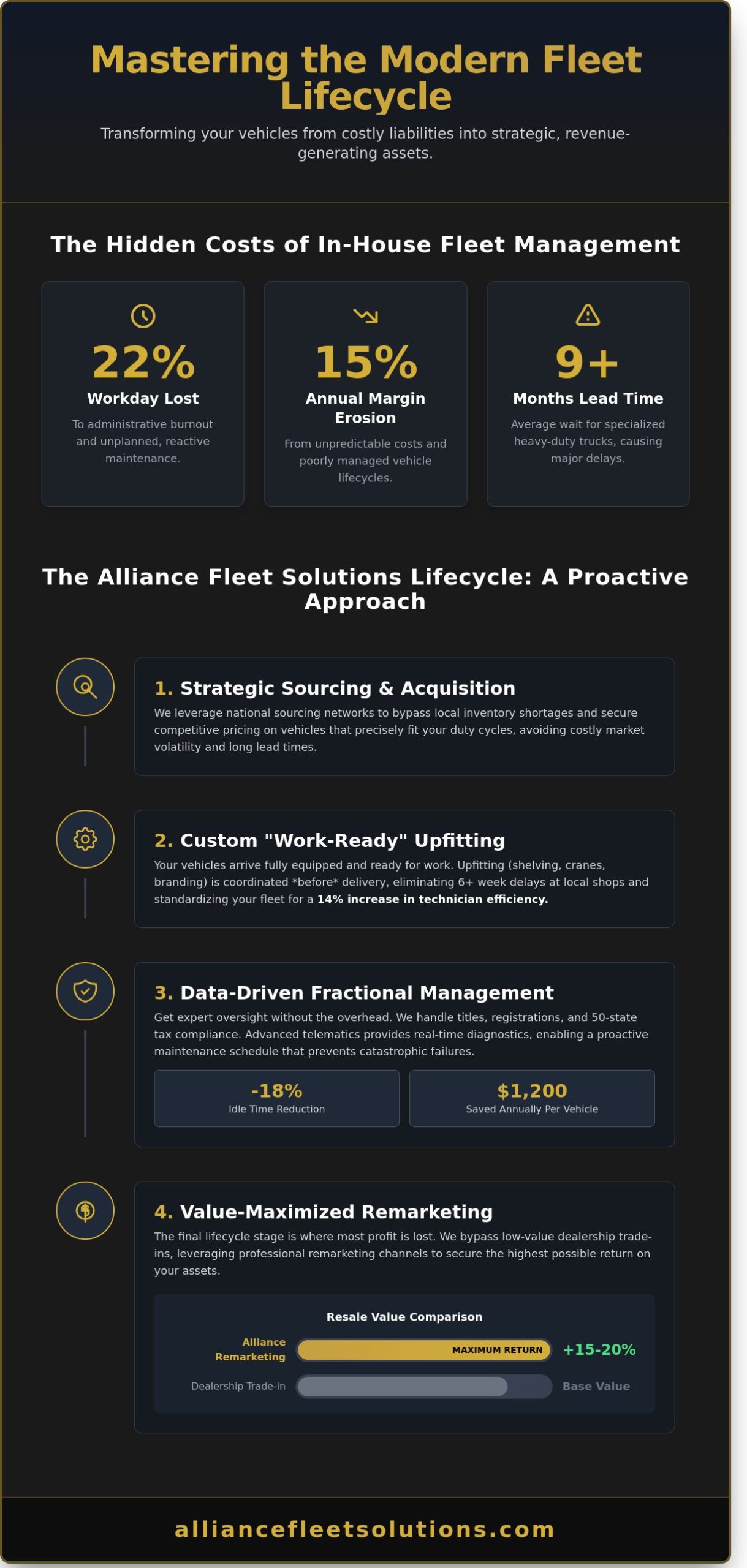
What if the most expensive part of your operation isn’t the fuel in the tanks, but the 22% of your workday lost to administrative burnout and unplanned maintenance? For most logistics leaders, the reality of managing fleet management services in-house means battling a constant cycle of equipment failure and title backlogs. You already know that every hour a specialized work truck sits in a bay is an hour it isn’t generating revenue. It’s a high-stakes game where unpredictable costs can erode your margins by up to 15% annually when lifecycles aren’t managed with precision.
At Alliance Fleet Solutions, we believe your vehicles should be strategic assets rather than liabilities. Efficiency isn’t a luxury; it’s a requirement. This guide provides the blueprint to master every stage of the vehicle lifecycle, ensuring you reduce your total cost of ownership through custom upfitting and fractional management. We’ll show you how to achieve predictable monthly expenses and secure higher resale values through professional remarketing. We’ll explore the exact steps to transition from reactive repairs to a proactive, work-ready fleet that drives your business growth through 2026.
Key Takeaways
- Learn how to optimize the full vehicle lifecycle by integrating strategic sourcing and custom upfitting before your assets even hit the road.
- Discover how fractional management offers your business high-level expertise and oversight without the traditional overhead of a full-time fleet department.
- Identify the specific leasing and fuel management structures that maximize cash flow and leverage professional fleet management services to lower your total cost of ownership.
- Understand the critical shift from simply owning vehicles to managing mobility assets through a strategic partnership that prioritizes long-term operational growth.
What Are Fleet Management Services and Why Are They Critical in 2026?
Fleet management services represent a comprehensive B2B strategy that handles every stage of a vehicle’s lifecycle, from procurement and financing to maintenance and final disposal. By 2026, the industry has fundamentally shifted away from the traditional mindset of simply owning cars. Successful commercial operations now view their vehicles as mobility assets that must be optimized for maximum utility. This evolution is vital because logistics firms currently face a 15% increase in fuel price volatility compared to 2024. To understand the foundational scope of these operations, many professionals ask What is Fleet Management? and how it integrates into a broader corporate strategy. At Alliance Fleet Solutions, we don’t just provide a service; we act as a strategic extension of your internal team. This alliance helps you navigate a market where vehicle lead times for specialized heavy-duty trucks still average nine months.
The Core Pillars of Modern Fleet Operations
Managing a national fleet requires high-level administrative efficiency to keep operations fluid. Our team handles titles, registrations, and complex tax compliance across 50 states to ensure your drivers remain legal and on the road. Professional oversight also serves as a critical tool for risk mitigation. By monitoring safety protocols and driver records, we help firms reduce their liability and improve overall safety scores. Cost control remains the final, most impactful pillar. We shift your operations from reactive, emergency repairs to a proactive preventive maintenance schedule. This transition typically saves fleet owners $1,200 per vehicle annually by avoiding catastrophic failures and unscheduled downtime.
While managing a fleet across 50 states presents significant administrative hurdles, expanding operations internationally introduces an entirely new layer of complexity. Businesses looking to grow into new markets, such as those between the United States and Israel, must navigate intricate cross-border legal frameworks for investment and commerce. For those exploring such opportunities, you can discover Israel Cross Border Law Firm to understand the legal side of international business expansion.
Beyond GPS: The Evolution of Telematics and Data
In 2026, basic GPS tracking is no longer sufficient for competitive logistics. Modern fleet management services utilize advanced telematics to provide real-time diagnostic data directly from the engine control module. This technology identifies minor mechanical faults before they cause a total engine breakdown on the highway. We use this granular data to optimize route efficiency and slash idle time by an average of 18% across the fleet. Telematics is the integration of telecommunications and informatics to monitor vehicle health and driver behavior. These insights allow us to maximize your uptime and ensure every asset delivers a high return on investment. By framing repairs as strategic fleet management services, we transform your maintenance shop from a cost center into a business asset.
The Full Vehicle Lifecycle: From Strategic Acquisition to Remarketing
Managing a fleet requires more than just purchasing vehicles; it demands a calculated approach to every stage of an asset’s life. Industry leaders often look to The Full Vehicle Lifecycle as the blueprint for operational success. By leveraging national sourcing networks, companies can bypass local inventory shortages and secure competitive pricing on specific makes and models. This strategic start ensures that the foundation of your fleet is built on assets that fit your specific duty cycles and budget requirements. By integrating these fleet management services into your core operations, you streamline the path from procurement to profit.
Acquisition and Custom Upfitting
A vehicle is only an asset when it’s on the road. Waiting 6 weeks for a local shop to install shelving, cranes, or branding is a costly delay that many businesses can’t afford. Professional fleet management services solve this by coordinating “work-ready” delivery. This means upfitting happens before the vehicle ever reaches your lot. Standardizing these configurations across your entire fleet improves technician efficiency by approximately 14% because every tool is exactly where they expect it to be. In the 2024 market, where lead times fluctuate constantly, proactive planning is the only way to maintain fleet continuity.
Maximizing Value Through Vehicle Remarketing
The final stage of the lifecycle is often where the most profit is lost. Trading a vehicle in at a dealership is convenient, but it rarely yields the highest return. Utilizing professional remarketing channels can increase resale value by 15% to 20% compared to traditional trade-ins. This success depends on two factors: timing and documentation. Vehicles with a complete history of preventive maintenance command much higher prices in secondary markets. Knowing exactly when to pull a unit from service; usually before major component failures begin at the 150,000-mile mark; is essential for capturing peak ROI. We help you identify that sweet spot to ensure you aren’t pouring repair dollars into a depreciating asset.
Active management bridges the gap between acquisition and disposal. Every hour of downtime can cost a logistics firm upwards of $850 in lost productivity. Our alliance focuses on maximizing uptime through consistent oversight, ensuring every unit remains a safe, reliable, and profitable part of your operation.
The Case for Fractional Fleet Management: Expert Oversight Without the Overhead
A common myth persists that only Fortune 500 corporations require professional fleet oversight. In reality, 72% of mid-sized businesses struggle with rising operational costs because they lack a dedicated strategist. Fractional fleet management changes this dynamic. It gives you access to C-suite level expertise on a project or part-time basis. This model allows a company with 20 trucks to utilize the same high-level fleet management services as a national carrier. You gain the competitive edge of a veteran director without the $92,000 average annual salary plus benefits of a full-time hire.
Bridging the Expertise Gap
Operations managers often find themselves buried under a mountain of logistics. They’re stretched too thin to scrutinize every line item on a repair order. A fractional partner steps in to provide specialized knowledge in fuel procurement and maintenance negotiations. They act as your advocate. This partnership reduces administrative burnout by offloading complex compliance paperwork. When experts manage your Integrated Fleet Solutions, they often identify 14% in annual savings by eliminating redundant services. You focus on growth while we handle the technical heavy lifting.
Scalability for Growing Fleets
Scaling a fleet from 10 to 50 vehicles presents unique hurdles that can stall your momentum. A fractional model scales alongside you. It provides the flexibility to pivot your strategy based on 2024 market trends and fuel price fluctuations. You don’t need a permanent executive during a slow quarter. You do need expert analysis when it’s time to refresh your assets. Fractional fleet management provides the strategic backbone of a functional fleet without the fixed cost of a full-time hire.
- Access specialized vendor networks for better parts pricing.
- Implement data-driven preventive maintenance schedules to maximize uptime.
- Streamline lifecycle management to improve vehicle resale value by 10% or more.
Professional oversight isn’t just about fixing what’s broken. It’s about proactive optimization. By leveraging fleet management services through a fractional model, you ensure your equipment stays on the road longer. This approach turns your fleet from a chaotic expense into a streamlined business asset. It’s the most efficient way to maintain expert control as you expand your footprint in the logistics sector.
Maximizing ROI Through Strategic Leasing and Maintenance Programs
Maximizing the return on investment for your vehicle assets requires more than just keeping them on the road. It demands a calculated approach to acquisition and upkeep. Professional fleet management services transform your fleet from a recurring expense into a streamlined strategic asset by aligning financial structures with operational reality.
Open-End vs. Closed-End Leasing for Commercial Fleets
Open-end leases offer the ultimate flexibility for high-mileage commercial users. These equity-based structures don’t impose mileage restrictions, which is vital for trucks averaging over 25,000 miles annually. The lessee assumes the residual risk but also keeps any profit if the vehicle sells for more than its book value. Conversely, closed-end leases provide absolute budget predictability. You pay a fixed monthly rate for a set term, such as 36 or 48 months, and simply walk away at the end. This is ideal for businesses that prioritize stable cash flow over asset ownership.
Fuel and Maintenance Management
Operating costs quickly spiral when businesses rely on fragmented payment systems. Centralized billing consolidates hundreds of individual fuel and repair receipts into one monthly statement, saving administrative teams roughly 12 hours of manual data entry per month. Fuel cards are essential tools here. They prevent up to 15% of unauthorized spending by restricting purchases to specific fuel types or locations. Beyond fraud prevention, these programs provide granular data that identifies inefficient vehicles or poor driving habits.
- Negotiated Labor Rates: Fleet partners leverage national volume to secure labor rates 20% to 30% lower than standard retail pricing.
- Real-Time Auditing: Every repair order is reviewed by ASE-certified technicians to ensure you only pay for necessary work.
- Driver Compliance: Automated alerts notify managers when fuel spend exceeds pre-set limits or when a driver fills up outside of authorized routes.
Strategic maintenance management eliminates the “surprise” repair bills that derail quarterly budgets. By adhering to a strict preventive maintenance schedule, companies reduce their Total Cost of Ownership (TCO) by approximately 15% annually. Catching a worn belt during a routine inspection costs $150; waiting for it to snap on the highway can cost $1,500 in towing and emergency repairs. We focus on these proactive fixes to ensure your capital remains focused on growth rather than crisis management.
For professionals looking to master the complex financial calculations behind TCO and ROI, advanced training from institutions like Financial Modelling University can provide the necessary skills to optimize fleet-related capital expenditures.
Ready to lower your operating costs and increase vehicle uptime? Optimize your fleet ROI with our expert management solutions today.
Building Your Alliance: How Integrated Fleet Solutions Drive Long-Term Growth
Success in the logistics sector requires more than just owning vehicles; it demands a strategic partnership. Alliance Fleet Solutions handles the technical mechanics so you can focus on core business growth. Our integrated fleet management services cover every stage of the vehicle lifecycle. This includes everything from the initial acquisition of heavy-duty assets to the final remarketing stages. We create a seamless operational flow that eliminates the friction often found in fragmented vendor relationships.
We built our model on a no-nonsense approach. This philosophy respects the fast-paced nature of service industries where every minute of downtime costs money. By centralizing your maintenance and logistics data, we provide a clear view of your operational health. You won’t find fluff or complex jargon here, just reliable results that keep your wheels turning and your drivers safe.
The Alliance Advantage
Our commitment to uptime is absolute. We treat your vehicles as the essential backbone of your revenue, not just pieces of equipment. In a 2023 performance review, our partner fleets achieved a 98% uptime rate through our rigorous preventive maintenance protocols. We move beyond transactional vendor interactions to offer a supportive partnership. You get national reach combined with a focused, family-owned commitment to reliability. This ensures your calls are answered by experts who understand your specific regional challenges rather than automated systems.
Next Steps for Your Fleet
A proactive fleet assessment is the first step toward reclaiming your budget. This audit identifies immediate cost-saving opportunities, often uncovering a 15% reduction in Total Cost of Ownership (TCO) within the first year of implementation. Moving from in-house chaos to professional management is a structured process we can complete in under 30 days. We help you transition smoothly so your team can stop firefighting and start growing. Contact Alliance Fleet Solutions today to optimize your fleet operations.
Future-Proof Your Fleet for 2026 and Beyond
Success in the coming year depends on moving beyond reactive repairs and embracing a total vehicle lifecycle strategy. By integrating expert oversight, you can reduce administrative overhead and focus on scaling your core operations. Our team brings over 30 years of combined industry expertise to every partnership, ensuring your assets are managed with technical precision from acquisition through to final remarketing. We provide national coverage for both maintenance and acquisition, so your drivers stay on the road regardless of their location.
Choosing the right fleet management services transforms your vehicles from a cost center into a powerful engine for growth. We deliver customized upfitting solutions that arrive work-ready on day one, eliminating the typical delays found in standard procurement cycles. This proactive approach minimizes downtime and protects your long-term ROI. You don’t have to navigate the complexities of logistics alone when you have a dedicated partner focused on your uptime.
Ready to streamline your operations? Request a Free Fleet Assessment from Alliance Fleet Solutions today. Let’s work together to keep your business moving forward with confidence.
Frequently Asked Questions
What is the difference between fleet management and vehicle leasing?
Vehicle leasing focuses on the financial acquisition of assets, while fleet management services encompass the daily oversight of those assets to maximize uptime. Leasing gets you the truck; management ensures that truck stays on the road through preventive maintenance and fuel monitoring. A 2023 industry study shows that companies combining both see a 15% reduction in total cost of ownership compared to managing assets independently.
How many vehicles do I need to qualify for professional fleet management services?
You can qualify for professional services with as few as 5 vehicles. While larger corporations often dominate the conversation, small businesses with 5 to 25 units benefit the most from outsourcing logistics to experts. Alliance Fleet Solutions partners with growing companies to ensure their small fleets operate with 98% uptime efficiency. Scaling early prevents the 20% administrative bloat typically seen in unmanaged growing fleets.
Can fleet management services help reduce my company’s fuel expenses?
Yes, fleet management services typically reduce fuel expenses by 12% through idle time monitoring and route optimization. By analyzing telematics data, we identify excessive idling which can waste up to 1 gallon of fuel per hour. Implementing fuel card programs and driver behavior coaching ensures your team avoids aggressive driving. These combined strategies often save a 50-vehicle fleet over $25,000 annually at current diesel prices.
What is included in professional vehicle upfitting?
Professional upfitting includes the installation of industry-specific equipment such as shelving, ladder racks, and safety lighting. We transform a standard chassis into a specialized tool tailored to your specific trade. For example, a 2024 plumbing van upfit might include 12 custom bins and a heavy-duty partition to protect the driver. This process ensures your vehicles meet 100% of safety regulations while maximizing the storage capacity of every square inch.
How does fractional fleet management save my business money?
Fractional management saves you money by providing expert oversight without the $90,000 annual salary of a full-time fleet manager. You gain access to a dedicated professional who handles maintenance scheduling and vendor relations for a fraction of the cost. This model allows businesses to recapture 15 hours of weekly productivity for their owners. It eliminates the overhead of a permanent position while ensuring your fleet meets all DOT compliance standards.
What happens at the end of a commercial fleet lease?
You typically choose between returning the vehicle, extending the lease, or purchasing the asset at a predetermined residual value. In an open-end TRAC lease, you’re responsible for the difference between the actual sale price and the book value. If the vehicle sells for $2,000 more than expected, you receive that credit. If it sells for less, you pay the difference. We manage this disposal process to ensure you maximize your return on investment.
Is telematics really necessary for a small business fleet?
Telematics is essential for small fleets because it provides the visibility needed to compete with larger organizations. Data from 2024 shows that small businesses using GPS tracking reduce unauthorized mileage by 12% and improve response times by 20%. It’s not just about tracking; it’s about having a digital record for insurance claims and maintenance alerts. This technology ensures you don’t miss critical oil changes or safety recalls that lead to costly downtime.
How do fleet management services improve driver safety and compliance?
Management services improve safety by automating DOT inspections and monitoring driver behavior in real-time. We use dash cams and sensors to track incidents like hard braking or speeding, which can reduce accidents by 30% within the first year. Consistent preventive maintenance ensures every vehicle is mechanically sound and compliant with Federal Motor Carrier Safety Administration standards. This proactive approach protects your brand reputation and reduces the risk of expensive legal liabilities.